
As filed with the Securities and Exchange Commission on September 1, 2026
Securities Act File No. 333-
UNITED STATES
SECURITIES AND EXCHANGE COMMISSION
Washington, D.C. 20549
FORM N-2
| REGISTRATION STATEMENT | ☒ | |
| UNDER | ||
| THE SECURITIES ACT OF 1933 | ||
| Pre-Effective Amendment No. | ☐ | |
| Post-Effective Amendment No. | ☐ | |
| REGISTRATION STATEMENT | ☐ | |
| UNDER | ||
| THE INVESTMENT COMPANY ACT OF 1940 | ||
| Amendment No. | ☐ |
Ellington Credit Company
(Exact name of registrant as specified in its charter)
53 Forest Avenue, Suite 301
Old Greenwich, CT 06870
(203) 698-1200
(Address and telephone number, including area code, of principal executive offices)
Daniel Margolis
Ellington Credit Company
53 Forest Avenue, Suite 301
Old Greenwich, CT 06870
(Name and address of agent for service)
WITH COPIES TO:
Richard Horowitz
Matthew Barsamian
Anna Tomczyk
Dechert LLP
1095 6th Avenue
New York, NY 10036
(212) 698-3525
Approximate Date of Commencement of Proposed Public Offering: As soon as practicable after the effective date of this Registration Statement.
| ☐ | Check box if the only securities being registered on this Form are being offered pursuant to dividend or interest reinvestment plans. |
| ☒ | Check box if any securities being registered on this Form will be offered on a delayed or continuous basis in reliance on Rule 415 under the Securities Act of 1933 (“Securities Act”), other than securities offered in connection with a dividend reinvestment plan. |
| ☒ | Check box if this Form is a registration statement pursuant to General Instruction A.2 or a post-effective amendment thereto. |
| ☐ | Check box if this Form is a registration statement pursuant to General Instruction B or a post-effective amendment thereto that will become effective upon filing with the Commission pursuant to Rule 462(c) under the Securities Act. |
| ☐ | Check box if this Form is a post-effective amendment to a registration statement filed pursuant to General Instruction B to register additional securities or additional classes of securities pursuant to Rule 413(b) under the Securities Act. |
It is proposed that this filing will become effective (check appropriate box):
| ☐ | when declared effective pursuant to Section 8(c) of the Securities Act. |
If appropriate, check the following box:
| ☐ | This [post-effective] amendment designates a new effective date for a previously filed [post-effective amendment] [registration statement]. |
| ☐ | This Form is filed to register additional securities for an offering pursuant to Rule 462(b) under the Securities Act, and the Securities Act registration statement number of the earlier effective registration statement for the same offering is:. |
| ☐ | This Form is a post-effective amendment filed pursuant to Rule 462(c) under the Securities Act, and the Securities Act registration statement number of the earlier effective registration statement for the same offering is: . |
| ☐ | This Form is a post-effective amendment filed pursuant to Rule 462(d) under the Securities Act, and the Securities Act registration statement number of the earlier effective registration statement for the same offering is: . |
Check each box that appropriately characterizes the Registrant:
| ☒ | Registered Closed-End Fund (closed-end company that is registered under the Investment Company Act of 1940 (“Investment Company Act”)). |
| ☐ | Business Development Company (closed-end company that intends or has elected to be regulated as a business development company under the Investment Company Act). |
| ☐ | Interval Fund (Registered Closed-End Fund or a Business Development Company that makes periodic repurchase offers under Rule 23c-3 under the Investment Company Act). |
| ☒ | A.2 Qualified (qualified to register securities pursuant to General Instruction A.2 of this Form). |
| ☐ | Well-Known Seasoned Issuer (as defined by Rule 405 under the Securities Act). |
| ☐ | Emerging Growth Company (as defined by Rule 12b-2 under the Securities Exchange Act of 1934 (“Exchange Act”)). |
| ☐ | If an Emerging Growth Company, indicate by check mark if the registrant has elected not to use the extended transition period for complying with any new or revised financial accounting standards provided pursuant to Section 7(a)(2)(B) of Securities Act. |
| ☐ | New Registrant (registered or regulated under the Investment Company Act for less than 12 calendar months preceding this filing). |
THE REGISTRANT HEREBY AMENDS THIS REGISTRATION STATEMENT ON SUCH DATE OR DATES AS MAY BE NECESSARY TO DELAY ITS EFFECTIVE DATE UNTIL THE REGISTRANT SHALL FILE A FURTHER AMENDMENT WHICH SPECIFICALLY STATES THAT THIS REGISTRATION STATEMENT SHALL THEREAFTER BECOME EFFECTIVE IN ACCORDANCE WITH SECTION 8(A) OF THE SECURITIES ACT OF 1933, AS AMENDED, OR UNTIL THE REGISTRATION STATEMENT SHALL BECOME EFFECTIVE ON SUCH DATE AS THE SECURITIES AND EXCHANGE COMMISSION, ACTING PURSUANT TO SAID SECTION 8(A), MAY DETERMINE.
| The information in this preliminary prospectus is not complete and may be changed. The securities may not be sold until the registration statement filed with the Securities and Exchange Commission is effective. This preliminary prospectus is not an offer to sell nor does it seek an offer to buy these securities in any jurisdiction where not permitted. |
SUBJECT TO COMPLETION, DATED SEPTEMBER 1, 2026
Preliminary Prospectus
$500,000,000

Ellington Credit Company
Common Shares
Preferred Shares
Subscription Rights
Debt Securities
Ellington Credit Company (the “Fund”) is a non-diversified, closed-end management investment company that has registered as an investment company under the Investment Company Act of 1940, as amended (the “1940 Act”). The Fund’s primary investment objectives are to generate attractive current cash flow and risk-adjusted total returns for its shareholders. The Fund seeks to achieve these objectives by investing primarily in mezzanine debt and equity tranches of corporate collateralized loan obligations (“CLOs”), which are securitizations that are collateralized by portfolios of corporate credit assets. See “Prospectus Summary—Principal Investment Strategies—Collateralized Loan Obligation (CLO) Overview.”
The investment adviser to the Fund is Ellington Credit Company Management LLC (the “Adviser”). The Adviser is registered as an investment adviser with the U.S. Securities and Exchange Commission (the “SEC”) under the Investment Advisers Act of 1940, as amended (the “Advisers Act”). The Adviser is a wholly owned subsidiary of Ellington Management Group, L.L.C. (“EMG” and, together with the Adviser, “Ellington”).
The Fund may offer, from time to time, in one or more offerings or series, together or separately, up to $500,000,000 of its common shares, preferred shares, subscription rights to purchase its common shares or debt securities, which the Fund refers to, collectively, as its “securities.” The preferred shares, subscription rights and debt securities offered hereby may be convertible or exchangeable into common shares of the Fund. The securities may be offered at prices and on terms to be described in one or more supplements to this prospectus.
The Fund may sell its securities through underwriters or dealers, “at-the-market” to or through a market maker into an existing trading market or otherwise directly to one or more purchasers or through agents or through a combination of methods of sale. The identities of such underwriters, dealers, market makers or agents, as the case may be, will be described in one or more supplements to this prospectus. In the event the Fund offers common shares, the offering price per common share, exclusive of any underwriting commissions or discounts, will not be less than the net asset value per share at the time the Fund makes the offering except (i) in connection with a rights offering to the Fund’s existing shareholders, (ii) with the consent of a majority of the Fund’s shareholders, (iii) upon the conversion of a convertible security in accordance with its terms, or (iv) under such circumstances as the SEC may permit. See “Plan of Distribution” in this prospectus. The Fund may not sell any of the securities pursuant to this registration statement through agents, underwriters or dealers without delivery of this prospectus and a prospectus supplement describing the method and terms of the offering of such securities.
The Fund’s common shares are listed and traded on the New York Stock Exchange (“NYSE”) under the ticker symbol “EARN.” The midpoint of the range of the Fund’s estimated net asset value per share at July 31, 2026 was $4.23. As of July 31, 2026, the last reported sales price of the Fund’s common shares on the NYSE was $4.32, representing a 2.1% premium to the midpoint of the range of the Fund’s estimated net asset value per share as of July 31, 2026.
Investors should consider their investment goals, time horizon and risk tolerance before investing in the Fund’s securities. An investment in the Fund’s securities is not appropriate for all investors and is not intended to be a complete investment program. In addition, investing in the Fund’s securities may be considered speculative and involves a high degree of risk, including the risk of a substantial loss of investment. Before purchasing any securities, you should read the discussion of the principal risks of investing in the Fund’s securities, which are summarized in “Risk Factors” beginning on page 19 of this prospectus.
This prospectus contains important information you should know before investing in the Fund’s securities. Please read this prospectus and retain it for future reference. The Fund files annual and semi-annual shareholder reports, proxy statements and other information with the Securities and Exchange Commission, or the “SEC.” To obtain this information free of charge or make other inquiries pertaining to the Fund, please call (203) 698-1200. You may also obtain a copy of any information regarding the Fund filed with the SEC from the SEC’s website (www.sec.gov).
Neither the SEC nor any state securities commission has approved or disapproved of these securities or determined if this prospectus is truthful or complete. Any representation to the contrary is a criminal offense.
The date of this prospectus is , 2026
TABLE OF CONTENTS
******
ABOUT THIS PROSPECTUS
This prospectus is part of a registration statement that the Fund has filed with the SEC, using the “shelf” registration process. Under the shelf registration statement, the Fund may offer, from time to time, in one or more offerings, together or separately, up to $500,000,000 of its common shares, preferred shares, debt securities and/or subscription rights to purchase its common shares, on terms to be determined at the time of the offering. See “Plan of Distribution” for more information.
This prospectus provides you with a general description of the securities that the Fund may offer. Each time the Fund uses this prospectus to offer securities, the Fund will provide a prospectus supplement that will contain specific information about the terms of that offering. The Fund may also authorize one or more free writing prospectuses to be provided to you that may contain material information relating to these offerings. In a prospectus supplement or free writing prospectus, the Fund may also add, update, or change any of the information contained in this prospectus or in the documents the Fund has incorporated by reference into this prospectus. This prospectus, together with the applicable prospectus supplement, any related free writing prospectus, and the documents incorporated by reference into this prospectus and the applicable prospectus supplement, will include all material information relating to the applicable offering. Before buying any of the securities being offered, please carefully read this prospectus, any accompanying prospectus supplement, any related free writing prospectus and the documents incorporated by reference in this prospectus and any accompanying prospectus supplement.
This prospectus may contain estimates and information concerning the industry, including market size and growth rates of the markets in which the Fund participates, that are based on industry publications and other third-party reports. These estimates and information involve many assumptions and limitations, and you are cautioned not to give undue weight to them. Neither the Fund nor the underwriters have independently verified the accuracy or completeness of the data contained in these industry publications and reports. The industry in which the Fund operates is subject to a high degree of uncertainty and risk due to a variety of factors, including those described or referenced in the section titled “Risk Factors,” that could cause results to differ materially from those expressed in these publications and reports.
From time to time, the Fund may disclose information about the Fund on its website at www.ellingtoncredit.com. Information contained on the Fund’s website is not incorporated by reference into this prospectus, and you should not consider that information to be part of this prospectus.
This prospectus includes summaries of certain provisions contained in some of the underlying documents described in this prospectus, but reference is made to the actual documents for complete information. All of the summaries are qualified in their entirety by the actual documents. Copies of some of the documents referred to herein have been filed or incorporated by reference, or will be filed or incorporated by reference, as exhibits to the registration statement of which this prospectus is a part, and you may obtain copies of those documents as described in the section titled “Additional Information” on page 12 of this prospectus.
Unless otherwise noted, numerical information relating to the Fund is approximate as of June 30, 2026.
i
SPECIAL NOTE REGARDING FORWARD-LOOKING STATEMENTS
All statements contained in or incorporated by reference into this prospectus and any accompanying prospectus supplement, other than statements of historical facts, may constitute “forward-looking statements.” These statements may relate to, among other things, future events or the Fund’s future operating results, actual and potential conflicts of interest with the Adviser, the Administrator and their affiliates, the adequacy of the Fund’s financing sources and working capital, and other factors. In some cases, you can identify forward-looking statements by terminology such as “estimate,” “may,” “might,” “believe,” “will,” “provided,” “anticipate,” “future,” “could,” “growth,” “plan,” “project,” “intend,” “expect,” “should,” “would,” “if,” “seek,” “possible,” “potential,” “likely” or the negative or other variations of such terms or comparable terminology. These forward-looking statements involve known and unknown risks, uncertainties and other factors that may cause the Fund’s actual results, levels of activity, performance or achievements to be materially different from any future results, levels of activity, performance or achievements expressed or implied by these forward-looking statements. These factors include:
| ● | changes in the economy and the capital markets; |
| ● | risks associated with the negotiation and consummation of pending and future transactions; |
| ● | changes in the Fund’s investment objectives and strategy; |
| ● | availability, terms of, and deployment of capital; |
| ● | changes in interest rates, exchange rates, regulations or the general economy; |
| ● | changes in governmental regulations, tax rates and similar matters; |
| ● | the Fund’s ability to exit investments in a timely manner; |
| ● | the Fund’s ability to comply with the 1940 Act; |
| ● | the Fund’s ability to maintain its qualification as a RIC; |
| ● | the use of the proceeds from this offering; |
| ● | the ability of the Fund to sell securities in the amounts and on the terms contemplated by the relevant prospectus supplement or supplements, or at all; and |
| ● | those factors described in the “Risk Factors” section of this prospectus and any accompanying prospectus supplement and in similar sections in the documents incorporated by reference herein and in any accompanying prospectus supplement. |
The Fund cautions readers not to place undue reliance on any such forward-looking statements, which speak only as of the date made. Actual results could differ materially from those anticipated in the Fund’s forward-looking statements and future results could differ materially from historical performance. The Fund has based forward-looking statements on information available to the Fund on the date of this prospectus. The Fund undertakes no obligation to publicly update or revise any forward-looking statements, whether as a result of new information, future events or otherwise, after the date of this prospectus or any accompanying prospectus supplement, except as otherwise required by applicable law. The forward-looking statements contained in or incorporated by reference into this prospectus and any accompanying prospectus supplement are excluded from the safe harbor protection provided by the Private Securities Litigation Reform Act of 1995 and Section 27A of the Securities Act.
ii
This prospectus summary highlights certain information contained elsewhere in this prospectus. This is only a summary, is not complete and may not contain all the information that is important to a decision to invest in the Fund’s securities. You should read carefully the more detailed information set forth under “Risk Factors” and the other information included in this prospectus. Except where the context suggests otherwise:
| ● | The “Fund” refers to Ellington Credit Company, a Delaware statutory trust, registered under the Investment Company Act of 1940, as amended (the “1940 Act”), as a non-diversified, closed-end management investment company. |
| ● | The “Adviser” refers to Ellington Credit Company Management LLC, an SEC-registered investment adviser. |
| ● | The “Administrator” refers to Ellington Credit Company Administration LLC. |
Ellington Credit Company
Ellington Credit Company (the “Fund”) is a non-diversified, closed-end management investment company that has registered as a closed-end management investment company under the Investment Company Act of 1940, as amended (the “1940 Act”). The Fund is advised by Ellington Credit Company Management LLC (the “Adviser”), pursuant to an advisory agreement dated as of April 1, 2025 (the “Investment Advisory Agreement”). The Investment Advisory Agreement was first approved by the Fund’s Board of Trustees (the “Board”) and then subsequently approved by shareholders at a special meeting of the Fund’s shareholders held on January 17, 2025 (the “Special Meeting”).
Prior to April 1, 2025 (the “Conversion Date”), the Fund was not registered under the 1940 Act and was domiciled in Maryland. Specifically: (i) from its inception until January 1, 2024, the Fund operated as a real estate investment trust specializing in residential mortgage-backed securities (“RMBS”), and (ii) from January 1, 2024 until the Conversion Date, the Fund operated as a taxable C-Corporation while gradually shifting its investment focus away from RMBS and towards corporate collateralized loan obligations (“CLOs”). In connection with this shift in investment focus, the Fund rebranded as Ellington Credit Company (from Ellington Residential Mortgage REIT).
On the Conversion Date, the Investment Advisory Agreement was executed and became effective, and the Fund became a Delaware statutory trust and registered closed-end investment company under the 1940 Act (such actions, collectively, the “Conversion”). The Fund intends to elect to be treated, and intends to qualify annually, as a regulated investment company (a “RIC”) under the Internal Revenue Code of 1986, as amended (the “Code”) under Subchapter M of the Code. To facilitate this qualification, the Fund requested and received Internal Revenue Service (“IRS”) approval to change its tax year to end on the day prior to the Conversion Date (March 31). As a RIC, the Fund expects generally not to be subject to corporate income tax. See “U.S. Federal Income Tax Matters” for more information.
The Fund’s primary investment objectives are to generate attractive current cash flow and risk-adjusted total returns for its shareholders. The Fund seeks to achieve these objectives by investing primarily in mezzanine debt and equity tranches of CLOs, which are securitizations that are collateralized primarily by corporate credit assets. These corporate credit assets are predominantly non-investment grade, first lien, senior secured corporate bank loans, although many CLOs may allocate a portion of their portfolios (typically below ten percent) to other corporate credit assets, such as second lien or unsecured loans and/or secured or unsecured corporate bonds. While a CLO’s collateral pool technically serves as collateral for all debt tranches issued by the CLO, the more junior tranches (including the mezzanine debt tranches) only have a subordinated claim on such collateral. Meanwhile, the equity tranche’s claim on such collateral is unsecured and subordinated to all other tranches of the CLO; in each period, the equity tranche is generally only entitled to the residual cash flows (if any) from the collateral after the debt tranches have received their required interest and principal payments for such period.
Each CLO is structured as multiple tranches which offer investors varying degrees of credit risk, maturity and yield characteristics. CLO tranches are typically categorized as either senior debt, mezzanine debt, or subordinated/equity according to their relative seniority, payment priority and degree of risk. If the collateral underlying a given CLO defaults or otherwise underperforms, scheduled payments to senior tranches of such CLO securitization take precedence over those of more junior tranches, such as mezzanine debt and equity tranches, which are the focus of the Fund’s investment strategy. The CLO securities, including the mezzanine debt and equity tranches, in which the Fund typically invests are unrated or rated below investment grade and are hence considered speculative with respect to timely payment of interest and repayment of principal. While the majority of the CLO tranches in which the Fund invests are U.S. dollar-denominated, the Fund also invests in CLO tranches denominated in other currencies, typically Euros. When investing in a CLO tranche in a foreign currency, the Fund’s primary objective is generating attractive risk-adjusted returns in that currency, as opposed to profiting from currency movements. Accordingly, the Fund typically attempts to hedge its foreign currency risk associated with these investments.
1
The Fund may also invest in other related securities and instruments that the Adviser believes are consistent with its investment objectives, including senior debt tranches of CLOs; loan accumulation facilities (“LAFs” or “warehouses”); corporate loans (including, but not limited to, loans that ultimately may serve as collateral for CLOs); and securities issued by other securitization vehicles, such as collateralized bond obligations (“CBOs”). LAFs are entities that acquire corporate loans and other similar corporate credit-related assets in anticipation of ultimately collateralizing a CLO transaction. See “Principal Investment Strategies—Other Investments.”
The CLO equity securities in which the Fund invests have capital structures that are highly leveraged, with debt-to-equity ratios typically ranging from eight to sixteen times, which magnifies the Fund’s risk of loss on such investments. The LAFs in which the Fund intends to invest are also highly leveraged, with debt-to-equity ratios typically ranging from three to six times prior to a CLO’s pricing, which also magnifies the Fund’s risk of loss on such investments.
The Fund may also engage in “Derivative Transactions,” as described herein, from time to time to hedge against interest rate, credit, credit spread widening, currency and/or other risks, or for other risk management or investment purposes, including to accommodate additional investments.
For a further discussion of the Fund’s principal investment strategies, see “Investment Objective, Opportunities and Principal Strategies.” There can be no assurance that the Fund will achieve its investment objective. These investment objectives and strategies may be changed by the Board without prior approval of shareholders. See “Regulation as a Closed-End Management Investment Company.”
“Names Rule” Policy
In accordance with the requirements of the 1940 Act, the Fund has adopted a policy to invest at least 80% of its assets in the particular type of investments suggested by its name. Accordingly, under normal circumstances, the Fund invests at least 80% of the aggregate of its net assets and borrowings for investment purposes in credit and credit-related instruments. For purposes of this policy, the Fund considers credit and credit-related instruments to include, without limitation: (i) equity and debt tranches of CLOs, LAFs and securities issued by other securitization vehicles, such as CBOs; (ii) secured and unsecured floating-rate and fixed rate loans; (iii) investments in corporate debt obligations, including bonds, notes, debentures, commercial paper and other obligations of corporations to pay interest and repay principal; (iv) debt instruments issued by governments, their agencies, instrumentalities, and central banks; (v) commercial paper and short-term notes; (vi) convertible debt securities; (vii) certificates of deposit, bankers’ acceptances and time deposits; (viii) certain preferred equity investments, especially those with dividend rates that either are fixed or float based on market interest rates; and (ix) other credit-related instruments. Corporate debt and equity assets may be acquired in conjunction with the liquidations of CLOs (whether CLOs in which the Fund already holds investments, or other CLOs), as well as on an outright basis, although they are not currently a core focus of the Fund’s investment strategy.
The Fund’s investments in other investment companies, and other instruments designed to obtain indirect exposure to credit and credit-related instruments will also be counted towards its 80% investment policy to the extent such instruments have similar economic characteristics to the investments included within that policy. Derivatives instruments used by the Fund will be counted toward the Fund’s 80% investment policy discussed above to the extent the derivatives instruments provide investment exposure to investments included within that policy or to one or more of the market risk factors associated with investments included in that policy. The 80% policy with respect to investments in credit and credit-related instruments is not fundamental and may be changed by the Board without prior approval of shareholders. Shareholders will be provided with sixty (60) days’ notice in the manner prescribed by the SEC before making any change to this policy.
The Adviser – Ellington Credit Company Management LLC
Ellington Credit Company Management LLC (the “Adviser”) serves as the Fund’s investment adviser. The Adviser is registered as an investment adviser with the SEC under the Advisers Act. Under its advisory agreement with the Adviser (the “Investment Advisory Agreement”), the Fund has agreed to pay the Adviser a quarterly base management fee based on its Net Asset Value, as well as a performance fee based on its investment performance. See “The Investment Advisory Agreement” for more information.
The Adviser is an affiliate of Ellington Management Group, L.L.C. (“EMG” and, together with the Adviser, “Ellington”), which is a global investment firm that was founded in 1994 and, as of June 30, 2026, has more than 170 employees, including more than 60 investment professionals, and has approximately $23.0 billion in assets under management.
The Fund expects to benefit from the ability of the Adviser’s team to identify attractive opportunities, conduct diligence on and value prospective investments, negotiate terms where appropriate, and manage and monitor the Fund’s portfolio. The Adviser’s investment team members have broad investment backgrounds, with prior experience at investment banks, unregistered investment funds and other financial services companies, and have collectively developed a broad network of contacts to provide the Fund with its principal source of investment opportunities.
2
The Adviser is led by Michael Vranos, Chief Executive Officer, who serves as a Portfolio Manager of the Fund; Laurence Penn, Executive Vice President, who serves as Chief Executive Officer of the Fund; Gregory Borenstein, who also serves as a Portfolio Manager of the Fund; and Mark Tecotzky, Executive Vice President, who serves as Executive Vice President of the Fund. Messrs. Vranos, Penn, Borenstein and Tecotzky are assisted by Christopher Smernoff, who serves as Chief Financial Officer of the Fund; and JR Herlihy, who serves as Chief Operating Officer of the Fund.
An affiliate of the Adviser and EMG, Ellington Credit Company Administration LLC (the “Administrator”), performs, or arranges for the performance of, its required administrative services. The Fund reimburses the Administrator for its allocable portion of overhead and other expenses incurred by the Administrator in performing its obligations under an administration agreement by and among the Fund and the Administrator (the “Administration Agreement”), including rent, the fees and expenses associated with performing administrative functions, and its allocable portion of the compensation of its Chief Financial Officer, Chief Operating Officer and any administrative support staff, including accounting personnel. The Fund also reimburses the Adviser for the costs associated with the functions performed by its Chief Compliance Officer that the Adviser pays on the Fund’s behalf pursuant to the terms of an agreement between the Fund and Vigilant, LLC (“Vigilant”). These arrangements could create conflicts of interest that the Fund’s Board must monitor.
For a description of the fees and expenses that the Fund pays to the Adviser and the Administrator, see “The Adviser and the Administrator—Investment Advisory Agreement—Management Fee and Performance Fee” and “The Adviser and the Administrator—The Administrator and the Administration Agreement.”
Principal Investment Strategies
Collateralized Loan Obligation (CLO) Overview
The Fund’s investment portfolio consists primarily of investments in mezzanine debt and equity tranches of corporate collateralized loan obligations (“CLOs”), which are securitizations that are collateralized primarily by corporate credit assets. These corporate credit assets are predominantly non-investment grade, first lien, senior secured corporate bank loans, although many CLOs may allocate a portion of their portfolios (typically below ten percent) to other corporate credit assets, such as second lien or unsecured loans and/or secured or unsecured corporate bonds.
CLOs are generally required to hold a portfolio of assets that is highly diversified by underlying borrower and industry and that is subject to a variety of asset concentration limitations. By focusing its investments primarily in CLOs, the Fund believes that it correspondingly diversifies its industry-related exposures and avoids undue exposure to specific economic themes, such as the possible disruptions and imbalances arising from advances in, and the growing significance of, artificial intelligence.
While a CLO’s collateral pool technically serves as collateral for all debt tranches issued by the CLO, the more junior tranches (including the mezzanine debt tranches) only have a subordinated claim on such collateral. Meanwhile, the equity tranche’s claim on such collateral is unsecured and subordinated to all other tranches of the CLO; in each period, the equity tranche is generally only entitled to the residual cash flows (if any) from the collateral after the debt tranches have received their required interest and principal payments for such period. The CLO equity securities in which the Fund invests have capital structures that are highly leveraged, with debt-to-equity ratios typically ranging from eight to sixteen times, which magnifies the Fund’s risk of loss on such investments.
Each CLO is structured as multiple tranches which offer investors varying degrees of credit risk, maturity, and yield characteristics. CLO tranches are typically categorized as either senior debt, mezzanine debt, or subordinated/equity according to their relative seniority, payment priority and degree of risk. If the collateral underlying a given CLO defaults or otherwise underperforms, scheduled payments to senior tranches of such CLO securitization take precedence over those of more junior tranches, such as mezzanine debt and equity tranches, which are the focus of the Fund’s investment strategy. The CLO securities, including the mezzanine debt and equity tranches, in which the Fund typically invests are unrated or rated below investment grade and are hence considered speculative with respect to timely payment of interest and repayment of principal. While the majority of the CLO tranches in which the Fund invests are U.S. dollar-denominated, the Fund also invests in CLO tranches denominated in other currencies, typically Euros. When investing in a CLO tranche in a foreign currency, the Fund’s primary objective is generating attractive risk-adjusted returns in that currency, as opposed to profiting from currency movements. Accordingly, the Fund typically attempts to hedge its foreign currency risk associated with these investments.
Most CLOs are non-static, revolving structures that generally allow for reinvestment of capital by an external manager (the “CLO Collateral Manager”) over a pre-specified period (the “Reinvestment Period”), typically up to five years from issuance. The terms and covenants governing a typical CLO are, with certain exceptions, based primarily on the cash flow generated by, and the par value (as opposed to the market price or fair value) of, the collateral.
3
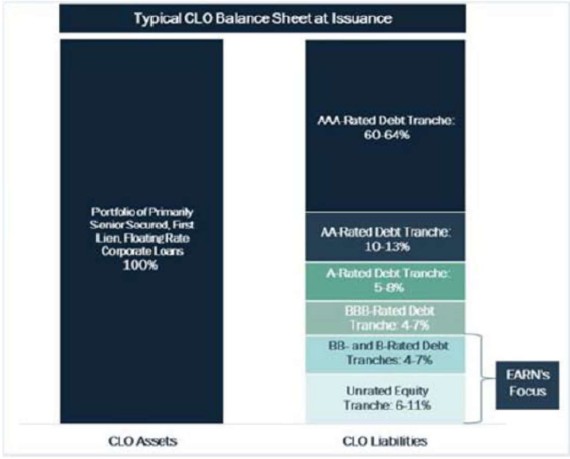
A CLO finances its initial purchase of a portfolio of assets via the issuance of CLO debt and equity tranches, with the debt tranches typically carrying floating-rate coupons. CLO debt tranches typically carry ratings at issuance ranging from “AAA” (or its equivalent) at the most senior level to “BB-” or “B-” (or its equivalent), which are below investment grade, at the junior level, typically by Moody’s Investors Service, Inc. (“Moody’s”), S&P Global Ratings (“S&P”) and/or Fitch Ratings, Inc. (“Fitch”). The coupon on CLO debt tranches is typically lowest at the AAA-level and generally increases at each level down the ratings scale. CLO equity tranches are unrated, and at issuance typically represent approximately 6% to 11% of a CLO’s capital structure. The diagram below is for illustrative purposes only and is intended to depict the general structure of a typical CLO. Some CLOs also include a B-rated debt tranche (in which the Fund may invest), and the structure of CLOs in which the Fund invests may otherwise vary from this example. The left column represents the CLO’s assets, which support the liabilities and equity in the right column. The right column shows the various classes of debt and equity issued by the CLO in order of seniority as to relative rights to receive payments from the assets. The ranges appearing directly below the rating of each class represent the percentages that such classes typically comprise, at issuance, of the overall “capital structure” (i.e., total debt and equity issued by the CLO).
CLOs typically have two priority-of-payment schedules (commonly called “waterfalls”), which are detailed in a CLO’s indenture and govern how cash generated from a CLO’s underlying collateral is distributed to the CLO’s debt and equity tranches.
First, the “interest waterfall” applies to interest payments received on a CLO’s underlying collateral. Subject to compliance with certain tests as set forth in the interest waterfall, the CLO’s equity tranche is entitled to receive any excess interest available after the required regular interest payments to CLO debt investors are made and certain CLO fees and expenses (such as administration and collateral management fees) are paid. To the extent that any of these compliance tests (such as overcollateralization and/or interest coverage tests) are breached, cash flows could be diverted away from CLO mezzanine debt and equity tranches in favor of the more senior CLO debt tranches until and unless such breaches are cured.
Second, the “principal waterfall” applies to cash flow received from the return of principal on the underlying collateral, primarily through loan repayments and proceeds from loan sales. During the CLO’s Reinvestment Period, this principal cash flow is typically used to purchase new assets, whereas after the Reinvestment Period, it is typically used to pay down CLO debt tranches sequentially based on relative seniority.
A CLO’s indenture typically requires that the CLO Collateral Manager only purchase assets for such CLO with maturity dates (which for a senior secured loan are typically five to eight years from the loan issuance date) that are shorter than the maturity date of the CLO’s liabilities (which are typically 12 to 13 years from the CLO issuance date). Subject to the covenants set forth in the CLO indenture, a CLO Collateral Manager is able to trade an underlying CLO’s assets and reinvest proceeds from the sales or repayments of CLO assets. As a result, CLO investors can face significant reinvestment risk with respect to a CLO’s underlying portfolio. Furthermore, in addition to the risk that underlying CLO assets may prepay, debt investors in most CLO transactions are subject to additional prepayment risk in that the holders of a majority of the equity tranche can direct a call or refinancing of a CLO, which could cause the CLO’s outstanding CLO debt securities to be repaid at a sub-optimal time.
4
Other Investments
As part of its investment strategy, the Fund may also invest in other related securities and instruments that the Adviser believes are consistent with its investment objectives, including senior debt tranches of CLOs; loan accumulation facilities (“LAFs” or “warehouses”); corporate loans (including, but not limited to, loans that ultimately may serve as collateral for CLOs); and securities issued by other securitization vehicles, such as collateralized bond obligations (“CBOs”). LAFs are vehicles that acquire corporate loans and other similar corporate credit-related assets in anticipation of ultimately collateralizing a CLO transaction.
LAFs receive debt financing from the “LAF provider”, which is generally the investment bank expected to ultimately serve as the arranger on the ultimate CLO transaction. The equity capital provided by the LAF investors, combined with the debt financing provided by the LAF provider, is used by the LAF to acquire corporate loans and other similar corporate credit-related assets that are expected to collateralize the ultimate CLO transaction. This period of accumulating assets, known as the “warehouse period,” terminates when the ultimate CLO transaction closes, whereupon the vehicle repays the debt financing using the proceeds from the sale of the CLO debt and equity securities.
The debt financing provided to LAFs typically carry maturities ranging from one to two years (subject to potential extension). Notwithstanding these longer maturities, the Fund’s investments in LAFs are generally expected to last from one to three months, as the Fund would typically invest in the LAF after the debt tranches of the related CLO have been priced (with such investments typically being referred to as “price-to-close” LAF investments). Typically, the Fund commits a specified amount of equity capital to the LAF, and the LAF draws down this equity capital over time as it acquires assets, with leverage in the LAF generally maintained between four and six times. During this commitment period, the debt financing provided by the LAF provider typically bears interest at a floating rate with a specified margin over a benchmark rate such as the Secured Overnight Financing Rate (“SOFR”). The LAF investors primarily earn the difference between the interest earned on the accumulated assets and the interest paid to the LAF provider.
While LAF investors (including the Fund) generally expect to invest in the equity tranche of the ultimate CLO transaction (assuming it is launched), they are not contractually required to do so. In cases where the CLO is not ultimately launched, the LAF is generally unwound and the accumulated assets liquidated. In such cases, LAF investors would receive the excess, if any, of the proceeds from the sale of the LAF’s assets over the unpaid principal balance of the debt financing, in addition to any interest differential described above.
FINANCING AND HEDGING STRATEGY
Leverage by the Fund. Subject to prevailing market conditions, the Fund may add financial leverage if, immediately after such borrowing, it would have asset coverage (as defined in the 1940 Act) of 300% or more (for leverage obtained through debt or other “senior securities”) or 200% or more (for leverage obtained through preferred shares). As one example, if the Fund has $100 in “Net Asset Value” (as defined below), it may utilize leverage through obtaining debt or other “senior securities” subject to a 300% asset coverage requirement, which will typically result in a debt limit of $50 (e.g., $150 in total assets compared to $50 in debt or other “senior securities”). As another example, if the Fund has $100 in “Net Asset Value” (as defined below) and no debt, it may issue $100 in preferred shares subject to a 200% asset coverage requirement, which will typically result in a $100 limit on preferred shares (e.g., $200 in total assets compared to $100 in preferred shares). “Net Asset Value” means the total assets of the Fund minus the Fund’s total liabilities. The Fund also may add financial leverage through borrowings entered into under reverse repurchase agreements subject to the requirements discussed under “Derivatives Transactions” below. The Fund may use leverage opportunistically and may choose to increase or decrease its leverage, or use different types or combinations of leveraging instruments, at any time based on the Fund’s assessment of market conditions and the investment environment. Certain instruments that create leverage are considered to be senior securities under the 1940 Act.
In the event the Fund fails to meet its applicable asset coverage ratio requirements, the Fund may not be able to incur additional debt and/or issue preferred shares, and could be required by law or otherwise to sell a portion of its investments to repay some debt or redeem preferred shares (if any) when it is disadvantageous to do so, which could have a material adverse effect on its operations, and the Fund may not be able to make certain distributions or pay dividends of an amount necessary to continue to qualify for treatment as a RIC for U.S. federal income tax purposes.
The Fund expects that it will, or may need to, raise additional capital in the future to fund its continued growth or otherwise, and the Fund may do so by entering into a credit facility, issuing preferred shares or debt securities or through other leveraging instruments. Subject to the limitations under the 1940 Act, the Fund may incur additional leverage opportunistically and may choose to increase or decrease its leverage. In addition, the Fund may borrow for temporary, emergency or other purposes as permitted under the 1940 Act, which indebtedness would be in addition to the asset coverage requirements described above. By leveraging its investment portfolio, the Fund may create an opportunity for increased net income and capital appreciation. However, the use of leverage also involves significant risks and expenses, which will be borne entirely by its shareholders, and its leverage strategy may not be successful. For example, the more leverage is employed, the more likely a substantial negative change will occur in the Fund’s net asset value per share. Accordingly, any event that adversely affects the value of an investment would be magnified to the extent leverage is utilized.
5
Derivative Transactions. The Fund engages in “Derivative Transactions,” as described below, primarily to hedge against credit, credit spread widening, currency, interest rate, and/or other risks, or for other risk management or investment purposes, including to accommodate additional investments. Such Derivatives Transactions may include: (i) purchasing credit protection, via credit default swaps, on broad-based indices tracking high-yield credit (such as the Markit CDX North America High Yield Index), as well as tranches on such credit default swaps, (ii) purchases of payer swaptions (puts) on such credit default swaps, and (iii) purchases of put options on exchange-traded funds (ETFs) that track broad-based high yield corporate bond or leveraged loan indices.
However, the Fund may also use Derivative Transactions for investment purposes to the extent consistent with its investment objectives if the Adviser deems it appropriate to do so. The Fund may purchase and sell a variety of derivative instruments, including exchange-listed and over-the-counter (“OTC”) options, futures, options on futures, swaps and similar instruments, various interest rate-related products, such as fixed-to-floating interest rate swaps, caps, floors or collars, and credit transactions and credit default swaps. The Fund also may purchase and sell derivative instruments that combine features of these instruments. Collectively, the Fund refers to these financial management techniques as “Derivative Transactions.” The use of Derivative Transactions, if any, will generally be deemed to create leverage for the Fund and involves significant risks. No assurance can be given that the strategy and use of derivatives will be successful, and the Fund’s investment performance could diminish compared with what it would have been if Derivative Transactions were not used.
As required by Rule 18f-4 under the 1940 Act (the “Derivatives Rule”), funds that engage in derivatives transactions, other than “limited derivatives users” (as defined under the Derivatives Rule), generally must adopt and implement a written derivatives risk management program (the “Derivatives Risk Management Program”), that is reasonably designed to manage the Fund’s derivatives risks, while taking into account the Fund’s derivatives and other investments. The Derivatives Rule mandates that the fund adopt and/or implement: (i) value-at-risk limitations (“VaR”); (ii) a written derivatives risk management program; (iii) Board oversight responsibilities; and (iv) reporting and recordkeeping requirements. The Fund has adopted and implemented a Derivatives Risk Management Program. However, the Fund may elect in the future, without notice to shareholders, to operate as a “limited derivatives user,” in which case it would no longer be required to maintain its Derivatives Risk Management Program.
The Derivatives Rule also provides special treatment for reverse repurchase agreements, similar financing transactions and unfunded commitment agreements. Specifically, a fund may elect whether to treat reverse repurchase agreements and similar financing transactions as “derivatives transactions” subject to the requirements of the Derivatives Rule or as senior securities equivalent to bank borrowings for purposes of Section 18 of the 1940 Act. Repurchase agreements are not subject to the Derivatives Rule but are still subject to other provisions of the 1940 Act. In addition, when-issued or forward settling securities transactions that physically settle within 35 days are deemed not to involve a “senior security” for the purposes of the asset coverage tests described above. The Fund has currently elected to treat reverse repurchase agreements and similar financing transactions as “derivatives transactions,” subject to the requirements of the 1940 Act under the Derivatives Rule, but alternatively may elect to treat such transactions as borrowings subject to the asset coverage requirements discussed above. Further, the Fund is permitted under the Derivatives Rule to enter into an unfunded commitment agreement, and such unfunded commitment agreement will not be subject to the asset coverage requirements under the 1940 Act, if the Fund reasonably believes, at the time the Fund enters into such agreement, that the Fund will have sufficient cash and cash equivalents to meet its obligations with respect to all such agreements as they come due. However, the Fund may elect in the future, without notice to shareholders, to no longer treat these types of liabilities as derivative transactions.
Hedging with Short Sales. As part of its hedging program, the Fund may engage in short sales or take short positions, such as short sales of (or short positions in) ETFs that track leveraged loan indices, such as the Morningstar LSTA US Leveraged Loan 100 Index. Short selling typically involves selling securities that are not owned and borrowing the same securities for delivery to the purchaser, with an obligation to repurchase the borrowed securities at a later date. Short selling allows an investor to profit from declines in market prices to the extent such declines exceed the transaction costs and the costs of borrowing the securities. A short sale may create the risk of an unlimited loss, in that the price of the underlying security might theoretically increase without limit, thus increasing the cost of repurchasing the securities.
In executing its hedging strategy, the Fund may not be able to borrow the securities that it seeks to sell short, or repurchase the securities that it has sold short. Market conditions, including lower liquidity and regulatory restrictions during periods of financial stress, could limit the Fund’s ability to enter or maintain short positions effectively. Further, repurchasing securities to close out a short position can itself cause the price of the securities to rise further, thereby exacerbating the Fund’s loss.
Temporary Defensive Position. The Fund may take a temporary defensive position and substantially increase its credit hedges and/or invest all or a substantial portion of its total assets in cash or cash equivalents, government securities or short-term fixed income securities during periods in which the Fund believes that adverse market, economic, political or other conditions make it advisable to maintain a temporary defensive position. As the CLOs and other assets in which the Fund invests are generally illiquid in nature, the Fund may not be able to dispose of such investments and take a defensive position. To the extent that the Fund invests defensively, the Fund likely will not achieve its investment objectives.
6
OPERATING AND REGULATORY STRUCTURE
The Fund is a non-diversified closed-end management investment company that has registered as an investment company under the 1940 Act. As a registered closed-end management investment company, the Fund is required to meet certain regulatory tests. See “Regulation as a Closed-End Management Investment Company.” In addition, the Fund intends to elect to be treated, and intends to qualify annually, as a RIC under Subchapter M of the Code.
Pursuant to the Investment Advisory Agreement by and between the Fund and the Adviser, and in consideration of the advisory services provided by the Adviser to the Fund, the Adviser is entitled to a fee consisting of two components—a base management fee (the “Base Management Fee”) and a performance fee (the “Performance Fee”).
The Base Management Fee is calculated and payable quarterly in arrears at the annual rate of 1.50% of the Fund’s “Net Asset Value” as of the end of such fiscal quarter. The Base Management Fee is prorated for partial quarterly periods based on the number of days in such partial period compared to a 90-day quarter and is calculated and payable quarterly in arrears.
The Performance Fee is calculated and payable quarterly in arrears based upon the Fund’s “Pre-Performance Fee Net Investment Income” with respect to each fiscal quarter, and is subject to a hurdle rate, expressed as a rate of return on the Fund’s common equity equal to 2.00% per quarter (i.e., 8.00% per annum), and is subject to a “catch-up” feature.
Specifically:
| ● | If the Fund’s Pre-Performance Fee Net Investment Income for a fiscal quarter does not exceed the Hurdle Amount (as defined below) for such quarter, then no Performance Fee is payable to the Adviser with respect to such quarter; |
| ● | If the Fund’s Pre-Performance Fee Net Investment Income for a fiscal quarter exceeds the Hurdle Amount for such quarter but is less than or equal to 121.21% of the Hurdle Amount, then 100% of the portion of the Fund’s Pre-Performance Fee Net Investment Income that exceeds the Hurdle Amount (the “Catch-Up”) is payable to the Adviser as the Performance Fee with respect to such quarter; |
| ○ | Therefore, once the Fund’s Pre-Performance Fee Net Investment Income for such quarter exactly reaches 121.21% of the Hurdle Amount, the Adviser will have accrued a Performance Fee with respect to such quarter that is exactly equal to 17.5% of the Pre-Performance Fee Net Investment Income (because 21.21% of the Hurdle Amount (which is the Pre-Performance Fee Net Investment Income captured by the Adviser during the Catch-Up phase) is equal to 17.5% of 121.21% of the Hurdle Amount (which is the entire Pre-Performance Fee Net Investment Income at the end of the Catch-Up phase)); and |
| ● | If the Fund’s Pre-Performance Fee Net Investment Income for a fiscal quarter exceeds 121.21% of the Hurdle Amount for such quarter, then 17.5% of the Fund’s Pre-Performance Fee Net Investment Income is payable to the Adviser as the Performance Fee with respect to such quarter. |
With respect to the Performance Fee, there will be no accumulation of the Hurdle Amount from quarter to quarter, no claw back of amounts previously paid if the Pre-Performance Fee Net Investment Income in any subsequent quarter is below the Hurdle Amount for such subsequent quarter, and no delay or adjustment of payment if the Pre-Performance Fee Net Investment Income in any prior quarter was below the Hurdle Amount for such prior quarter.
For these purposes, the following definitions are applicable:
“Hurdle Amount” for any fiscal quarter means the result obtained by multiplying the Net Asset Value of Common Equity at the end of the immediately preceding fiscal quarter by the Hurdle Rate. The Hurdle Amount will be appropriately adjusted for any common share issuances or repurchases during the fiscal quarter.
“Hurdle Rate” means 2.00% per quarter, or 8.00% per annum. The Hurdle Rate will be appropriately prorated for partial quarterly periods based on the number of days in such partial period compared to a 90-day quarter.
“Net Asset Value” means the figure that is equal to the total assets of the Fund minus its total liabilities.
“Net Asset Value of Common Equity” means the portion of Net Asset Value attributable to common equity.
7
“Pre-Performance Fee Net Investment Income” for any fiscal quarter means interest income (including accretions of discounts, amortization of premiums, and payment-in-kind income), dividend income, and any other income (including any fee income) earned or accrued by the Fund during such fiscal quarter, minus the Fund’s operating expenses for such quarter (which, for this purpose, will not include any litigation-related expenses, any extraordinary expenses, or Performance Fee). Pre-Performance Fee Net Investment Income does not include any realized capital gains, realized capital losses or unrealized capital appreciation or depreciation. For purposes of computing Pre-Performance Fee Net Investment Income, the calculation methodology will look through total return swaps as if the Fund owned the referenced assets directly. As a result, Pre-Performance Fee Net Investment Income includes net interest (whether positive or negative) associated with a total return swap, which is the difference between (a) the interest income and transaction fees related to the reference assets and (b) all interest and other expenses paid by the Fund to the total return swap counterparty. In the case of an interest rate swap, Pre-Performance Fee Net Investment Income includes the net payments and net accruals of periodic payments.
The “catch-up” provision is intended to provide the Adviser with a performance fee of 17.5% on all of the Fund’s Pre-Performance Fee Net Investment Income when the Fund’s Pre-Performance Fee Net Investment Income reaches 2.424% of Net Asset Value of Common Equity in a quarter. See “The Investment Advisory Agreement—Management Fees.”
The Adviser is obligated to pay expenses associated with providing the investment services stated in the Investment Advisory Agreement, including compensation of and office space for its officers and employees connected with research, trading and investment management of the Fund.
CONFLICTS OF INTEREST
Affiliations of the Adviser and the Administrator
The Fund’s executive officers, Portfolio Managers and certain trustees, and the Adviser, the Administrator and their affiliates’ officers and employees, have several conflicts of interest as a result of affiliations they have and other activities in which they engage. The Adviser and the Administrator are indirectly owned by Ellington Management Group, L.L.C. (“EMG”), a registered investment adviser that provides advisory services to several clients unrelated to the Fund. The Fund’s executive officers, Portfolio Managers and certain trustees, and members of the Adviser’s and the Administrator’s respective management teams, are also employees, officers and/or principals of EMG. Under the Services Agreement, EMG provides such services, including personnel, support and resources, to the Adviser and the Administrator as the Adviser and the Administrator, respectively, may determine to be reasonably necessary to perform their respective obligations under the Advisory Agreement and the Administration Agreement. The fact that the same individuals affiliated with the Fund are also affiliated with the Adviser, the Administrator and EMG may result in conflicts of interest that may not be foreseen or resolved in a manner that is always or exclusively in the Fund’s best interest.
The Fund’s executive officers and trustees, as well as other current and potential future affiliated persons, officers and employees of the Adviser, the Administrator, EMG and certain of their affiliates, may serve as officers, directors or principals of, or manage the accounts for, other entities with investment strategies that substantially or partially overlap with the strategy that the Fund pursues. Accordingly, they may have obligations to investors in those entities, the fulfillment of which obligations may not be in the best interests of the Fund or its shareholders. The Adviser has entered into, and may in the future enter into, additional business arrangements with certain of the Fund’s shareholders, including granting beneficial ownership in limited liability company interests in the Adviser. In such cases, such shareholders may have an incentive to vote shares held by them in a manner that takes such arrangements into account. As a result of these relationships and separate business activities, the Adviser has conflicts of interest in allocating management time, services and functions among the Fund, other advisory clients and other business activities.
Other Accounts
The Adviser is responsible for the investment decisions made on the Fund’s behalf. There are no restrictions on the ability of the Adviser and certain of its affiliates to manage accounts for multiple clients, including accounts for affiliates of the Adviser or their directors, officers or employees, following the same, similar, or different investment objectives, philosophies, and strategies as those used by the Adviser for its account. In those situations, the Adviser and its affiliates may have conflicts of interest in allocating investment opportunities between the Fund and any other account managed by such person. See “—Allocations of Opportunities” below. Such conflicts of interest would be expected to be heightened where the Adviser manages an account for an affiliate or its directors, officers, or employees. In addition, certain of these accounts may provide for higher management fees or have higher performance fees than the Fund, and/or may allow for higher expense reimbursements, all of which may contribute to a conflict of interest and create an incentive for the Adviser to favor such other accounts. Further, accounts managed by the Adviser or certain of its affiliates may hold certain investments in CLOs, such as mezzanine debt and equity tranches, which conflict with the positions held by other accounts in such CLOs, such as those held by the Fund. In these cases, when exercising the rights of each account with respect to such investments, the Adviser and/or its affiliate will have a conflict of interest, as actions on behalf of one account may have an adverse effect on another account managed by the Adviser or such affiliate, including the Fund.
8
Further, the professional staff of the Adviser and Administrator will devote as much time to the Fund as such professionals deem appropriate to perform their duties in accordance with the Investment Advisory Agreement and Administration Agreement, respectively. However, such persons may be committed to providing investment advisory and other services for other clients and engage in other business ventures in which the Fund has no interests. In addition, payments under the Administration Agreement are equal to an amount based upon the Fund’s allocable portion of certain of the Administrator’s expenses. See “The Adviser and the Administrator—The Administrator and the Administration Agreement” herein. As a result of these separate business activities, the Adviser and Administrator may have conflicts of interest in allocating management and administrative time, services, and functions among the Fund and its affiliates and other business ventures or clients.
Allocation of Investment Opportunities
As a fiduciary, Ellington has a duty to act in the best interests of its clients and to allocate investment opportunities in a fair and equitable manner over time. Ellington has adopted policies and procedures designed to govern the allocation of investment opportunities among multiple client accounts in a manner that it believes is consistent with its fiduciary duties, taking into account various factors. These factors may include, but are not limited to, regulatory, tax, or legal considerations applicable to an account, the investment guidelines and restrictions of a particular client, the risk and return profile of the investment, available capital, liquidity needs, and other relevant circumstances.
Investment opportunities may be allocated using various methodologies, including rotational, percentage-based, or other allocation approaches, provided that such methodologies are consistent with Ellington’s internal conflict of interest and allocation policies and the requirements of applicable law, including the Advisers Act, the 1940 Act and other applicable laws, rules, and regulations. Automated allocation tools may be utilized as part of its portfolio management system to assist in trade allocation, and may be subject to review and oversight by Ellington’s risk management and compliance teams.
In certain cases, priority may be given to accounts in a ramp-up or start-up phase, including the Fund, as such accounts seek to establish their investment portfolios. While this prioritization is permitted within Ellington’s policies, the policies allow for a protocol of allocating assets so that, on an overall basis, each account is treated equitably. As part of these policies, the Fund may be excluded from specified allocations of assets for tax, regulatory, risk management, or similar reasons.
In addition, an account managed by the Adviser, such as the Fund, is expected to be considered for the allocation of investment opportunities alongside other accounts managed by Ellington. However, there is no assurance that a particular opportunity will be allocated to any particular account in a certain manner or that any such account, including the Fund, will be able to participate in all investment opportunities that are suitable for it.
Valuation
The market for the Fund’s targeted investments is more limited than the market for other credit-related investments. As a result, the Fund’s investments are generally measured at fair value. The values of such investments are determined by the Adviser in good faith, subject to the Board’s oversight and in accordance with the 1940 Act and the Fund’s valuation policies, based on relevant information compiled by the Adviser and third-party pricing services (when available), as follows:
| ● | For investments that are readily valued, such as exchange-traded securities, valuations are generally based on market prices provided by recognized pricing sources. |
| ● | For investments that do not have readily available market quotations, including CLO securities and other structured products, the Adviser may value these investments using third-party pricing services, if available. The Adviser’s Valuation Committee oversees the valuation process and reviews third-party prices when received. In cases where third-party pricing is unavailable, deemed unreliable or otherwise not received, The Adviser may determine fair value in good faith using internal models, market data, and/or input from portfolio management. |
Due to the limited market liquidity of certain investments, valuations may involve subjective judgment and could differ materially from values that would be realized in an actual transaction. There is no guarantee that the Fund will be able to sell an investment at the fair value of such investment as determined by the Fund. See “Determination of Net Asset Value” for more information.
The Interested Trustees are associated with the Adviser and have an interest in the Adviser’s economic success. The participation of the Adviser’s investment professionals in the valuation process, and the interest of the Interested Trustees in the Adviser and Ellington, could result in a conflict of interest because, for example, the management fees paid to the Adviser are based in part on the Fund’s Net Asset Value.
9
Co-Investment Relief and Related Party Transactions
In the ordinary course of business, and to the extent permitted by the 1940 Act and other applicable law, the Fund may enter into transactions with persons affiliated with it by reason of common control of the Adviser, the Administrator, or their affiliates, including EMG. To ensure compliance with applicable regulations, the Fund has adopted policies and procedures requiring its executive officers to review transactions for potential affiliations among the Fund, the Adviser, the Administrator, and their respective affiliates, employees, officers, and directors. The Fund will not enter into such transactions unless satisfied that doing so is consistent with the 1940 Act, applicable SEC rules, interpretations or guidance, or the terms of any exemptive relief granted to it. Because of these affiliations, the Fund may be required to forgo certain investment opportunities, including investments in CLOs managed by Adviser affiliates.
The Nominating and Corporate Governance Committee (the “Governance Committee”) of the Fund reviews and approves in advance any related-party transactions, except for certain transactions pre-approved under guidelines or rules established by the Governance Committee or the Board. The Governance Committee may prohibit any transaction it determines to be inconsistent with the interests of the Fund and its shareholders.
In certain instances, the Fund may co-invest concurrently with other accounts managed by the Adviser, Ellington or certain of the Adviser’s affiliates, subject to compliance with applicable regulations, regulatory guidance, and the Adviser’s allocation procedures. The Fund, the Adviser and certain of their affiliates have received an exemptive order from the SEC that permits the Fund and other investment funds managed by Ellington to coinvest with each other and with other affiliated entities (the “Co-Investment Exemptive Order”). As required by the Co-Investment Exemptive Order, the Fund has adopted, and the Board has approved, policies and procedures reasonably designed to ensure compliance with its terms, and the Adviser and the Fund’s Chief Compliance Officer provide regular reports to the Board regarding the Fund’s co-investment activity. Co-investments made under order are subject to certain conditions and requirements, which could limit the Fund’s ability to participate in specific transactions. As a result, there may be significant overlap among the Fund’s investments and those of affiliated Ellington entities that could avail themselves of the exemptive relief and that have investment objectives similar to ours. The Fund may also co-invest with funds managed by Ellington or its affiliates, subject to applicable regulations, regulatory guidance, and the Adviser’s allocation policy. A copy of the Co-Investment Exemptive Order, including all of the conditions and the related order, is available on the SEC’s website at www.sec.gov.
Material Non-Public Information
In the course of their advisory and other activities, the Adviser and Ellington may acquire confidential or material non-public information or become subject to trading restrictions in certain securities. As a result, the Adviser may be unable to use or disclose such information, even when it could be useful to investment decisions. These restrictions may limit the Adviser’s ability to initiate or exit transactions on behalf of the Fund, which could prevent the Fund from acquiring or disposing of certain investments.
Other Conflicts of Interest
In the ordinary course of its business, Ellington may face other conflicts of interest in managing multiple client accounts. These conflicts may arise due to differing investment advice, competing interests in the same issuer or securitization, joint participation in transactions, investment in other client accounts, service provider relationships, and the receipt of administrative, servicing, or other fees. For example, client accounts may be provided with differing investment recommendations, take opposing positions in the same security, or invest in different levels of an issuer’s capital structure, which may create competing economic interests. In certain cases, Ellington or its affiliates may manage securitizations or structured vehicles in which client accounts invest, act as a servicer or administrator for client transactions, or determine whether services should be provided by third-party vendors or in-house resources. These situations may present conflicts where Ellington has incentives to maximize fees, allocate investments among accounts, or select service providers based on existing relationships. Additionally, conflicts may arise when client accounts provide guarantees, indemnities, or financing through joint vehicles, or when Ellington determines whether to invest in affiliated entities.
Both EMG and the Adviser have adopted policies and procedures to identify, manage, and mitigate potential conflicts of interest in a manner consistent with their fiduciary duties. However, there is no guarantee that all conflicts can be eliminated or that actions taken on behalf of another client account will not adversely affect the Fund.
10
Code of Ethics and Compliance Procedures
To address potential conflicts of interest, the Fund has adopted a code of ethics under Rule 17j-l under the 1940 Act. Separately, the Adviser has adopted EMG’s Code of Ethics (the “Adviser Code of Ethics”) which applies to the Adviser’s officers and employees. The Adviser Code of Ethics requires personnel to (i) act in the best interests of the Adviser and its client accounts (including the Fund), (ii) conduct themselves in good faith and in an ethical manner, (iii) avoid conflicts of interest with client accounts to the extent reasonably possible, and (iv) identify and manage conflicts of interest as they arise. Personnel subject to each code of ethics may invest in securities for their personal accounts, including investments that may be purchased or held by the Fund, provided that such transactions comply with the applicable pre-clearance, reporting, and trading restrictions. The Fund’s trustees and officers, and the officers and employees of the Adviser, must also comply with applicable U.S. federal securities laws and promptly report any actual or suspected violations to supervisory personnel.
The Adviser believes it has established a working environment, firm-wide compliance culture, and compliance procedures and systems reasonably designed to manage potential conflicts of interest. The Adviser has adopted policies and procedures governing, among other things, the execution of portfolio transactions, personal trading by employees, and other potential conflicts of interest. These policies are designed to ensure that all client accounts are treated equitably over time.
In addition, each code of ethics referenced above is incorporated by reference as an exhibit to the registration statement that this prospectus is a part of and is available on the EDGAR Database on the SEC’ s website at www.sec.gov. Copies may also be obtained for a duplicating fee by emailing publicinfo@sec.gov.
11
ADDITIONAL INFORMATION
The Fund will file with or submit to the SEC periodic and current reports, proxy statements and other information meeting the informational requirements of the Exchange Act. The Fund maintains a website at http://www.ellingtoncredit.com and makes all of its periodic and current reports, proxy statements and other publicly filed information available, free of charge, on or through the Fund’s website. The Fund makes its website content available for informational purposes only. The Fund’s website should not be relied upon for investment purposes, nor is it incorporated by reference into this Prospectus. The SEC maintains a website that contains reports, proxy and information statements and other information the Fund files with the SEC at www.sec.gov. Copies of these reports, proxy and information statements and other information may also be obtained for a duplicating fee by emailing publicinfo@sec.gov.
CORPORATE INFORMATION
The Fund’s principal executive offices are located at 53 Forest Avenue, Suite 301, Old Greenwich, Connecticut 06870. The Fund maintains a website at www.ellingtoncredit.com (which is not intended to be an active hyperlink). Information contained on the Fund’s website is not incorporated by reference into this prospectus, and you should not consider that information to be part of this prospectus.
12
OFFERINGS
The Fund may offer, from time to time, in one or more offerings or series, together or separately, up to $500,000,000 of its common shares, preferred shares, subscription rights to purchase its common shares or debt securities, which the Fund refers to, collectively, as its “securities.” Securities other than common shares may be convertible or exchangeable into common shares of Fund. The securities may be offered at prices and on terms to be described in one or more supplements to this prospectus.
The Fund may sell its securities through underwriters or dealers, “at-the-market” to or through a market maker into an existing trading market or otherwise directly to one or more purchasers or through agents or through a combination of methods of sale. The identities of such underwriters, dealers, market makers or agents, as the case may be, will be described in one or more supplements to this prospectus. In the event the Fund offers common shares, the offering price per common share, exclusive of any underwriting commissions or discounts, will not be less than the net asset value per share at the time the Fund makes the offering except (i) in connection with a rights offering to the Fund’s existing shareholders, (ii) with the consent of a majority of the Fund’s shareholders, (iii) upon the conversion of a convertible security in accordance with its terms, or (iv) under such circumstances as the SEC may permit. See “Plan of Distribution” in this prospectus. The Fund may not sell any of the securities pursuant to this registration statement through agents, underwriters or dealers without delivery of this prospectus and a prospectus supplement describing the method and terms of the offering of such securities.
Set forth below is additional information regarding offerings of the Fund’s securities:
| Use of Proceeds | Unless otherwise specified in the applicable prospectus supplement, the Fund expects to use any net proceeds from the sale of its securities pursuant to this prospectus for general corporate purposes, including to acquire investments in accordance with its investment objectives and strategies described in this prospectus. The Fund currently anticipates that it will generally take not more than one month to deploy the net proceeds from the completion of any sale of securities, although this timeline may vary depending on market conditions and the availability of appropriate investment opportunities. Pending such deployment, the Fund may invest the net proceeds in temporary investments, which are expected to earn substantially lower returns than the Fund’s principal investment strategy. Each supplement to this prospectus relating to an offering will more fully identify the use of proceeds from such offering. See “Use of Proceeds.” |
| Listing | The Fund’s common shares are listed and traded on the NYSE under the ticker symbol “EARN”. The Fund’s 2031 Notes are listed and traded on the NYSE under the ticker symbol “ELLA.” |
| Leverage | Subject to prevailing market conditions, the Fund may incur financial leverage if, immediately after such incurrence, it would have asset coverage (as defined in the 1940 Act) of at least 300% for leverage obtained through debt or other “senior securities”, or at least 200% for leverage obtained through preferred shares.
As an example, if the Fund has $100 in “Net Asset Value” (as defined below), it may utilize leverage through debt or other “senior securities” subject to a 300% asset coverage requirement, which will typically result in a maximum debt of $50 (e.g., $150 in total assets against $50 in debt or other “senior securities”). As a further example, if the Fund has $100 in “Net Asset Value” (as defined below) and no debt, it may issue up to $100 in preferred shares subject to a 200% asset coverage requirement (e.g., $200 in total assets against $100 in preferred shares). “Net Asset Value” means the total assets of the Fund minus the Fund’s total liabilities.
The Fund may also incur financial leverage through reverse repurchase agreements, subject to the requirements discussed under “Derivatives Transactions” herein. The Fund may use leverage opportunistically and may choose to increase or decrease its leverage, or use different types or combinations of leveraging instruments, at any time based on its assessment of market conditions and the investment environment. Certain instruments that create leverage may be considered senior securities under the 1940 Act. See “Prospectus Summary—Financing and Hedging Strategy.”
|
| U.S. Federal Income Taxes | The Fund intends to elect to be treated, and intends to qualify annually thereafter, as a RIC for U.S. federal income tax purposes, beginning with its tax year ended March 31, 2026.
As a RIC, the Fund generally will not be required to pay U.S. federal income taxes on ordinary income or capital gains that it distributes to holders of its common shares. To qualify and maintain its status as a RIC, the Fund must meet specific source-of-income and asset diversification requirements and distribute, in each taxable year, at least 90% of the sum of its investment company taxable income and net tax-exempt interest, if any, to holders of its common shares. If, in any taxable year, the Fund fails to qualify as a RIC, it would be taxed as an ordinary corporation, and could be required to recognize unrealized gains, pay substantial taxes, and make substantial distributions before re-qualifying as a RIC. Prospective investors are urged to consult their own tax advisors regarding the tax implications of acquiring, holding and disposing of common shares in light of their particular circumstances. See “U.S. Federal Income Tax Matters.”
|
| Risk Factors | Investing in the Fund’s securities involves significant risks. Please carefully consider the information set forth under “Risk Factors” in this prospectus before investing. |
| Available Information | The Fund is required to file periodic reports, proxy statements and other information with the SEC. Such information is available on the SEC’s website at www.sec.gov and free of charge on the Fund’s website, at www.ellingtoncredit.com, or by contacting the Fund at: Ellington Credit Company, 53 Forest Avenue, Suite 301, Old Greenwich, CT 06870, Attention: Secretary, or by telephone at (203) 698-1200. |
13
The value of the Fund’s assets, as well as the market price of its securities, will fluctuate. The Fund’s investments should be considered risky, and investors may lose all or part of their investment in the Fund. Investors should consider their financial situation and needs, other investments, investment goals, investment experience, time horizons, liquidity needs and risk tolerance before investing in the Fund’s securities. An investment in the Fund’s securities may be speculative in that it involves a high degree of risk and should not be considered a complete investment program. The Fund is designed primarily as a long-term investment vehicle, and its securities are not an appropriate investment for a short-term trading strategy. There can be no assurance that returns, if any, on the Fund’s investments will be commensurate with the risk of investment in the Fund, nor can the Fund provide any assurance that enough appropriate investments that meet its investment criteria will be available.
The following is a summary of certain principal risks of an investment in the Fund. See “Risk Factors” for a more complete discussion of the risks of investing in the Fund’s securities, including certain risks not summarized below.
| ● | The Fund invests in corporate CLOs, which exposes it to certain risks associated with corporate loans. |
| ● | The Fund’s CLO investments are subject to risks related to the financial leverage employed by the underlying corporate borrowers. |
| ● | The CLOs in which the Fund invests may be subject to risks associated with syndicated loans. |
| ● | The Fund’s CLO investments are exposed to the misalignment of the interests of CLO collateral managers with the interests of CLO investors, such as the Fund. |
| ● | The Fund’s investments in the primary corporate CLO market involve certain additional risks. |
| ● | The Fund and its investments are subject to prepayment and reinvestment risk. |
| ● | The Fund’s portfolio of corporate CLO investments may lack diversification, which may subject the Fund to a risk of significant loss if one or more of these corporate CLOs experience a high level of defaults on collateral. |
| ● | Failure by a CLO to satisfy certain tests, including as a result of loan defaults and/or negative loan ratings migration, may place pressure on the performance of the Fund’s investments in such CLO. |
| ● | CLO investments involve complex documentation and complex accounting considerations. |
| ● | The Fund is dependent on the collateral managers of the corporate CLOs in which the Fund invests, and those corporate CLOs are generally not registered under the 1940 Act. |
| ● | The Fund’s CLO investments often have limited liquidity. |
| ● | The Fund and its corporate CLO investments are subject to risks associated with non-U.S. investing, including in some cases foreign currency risk. |
| ● | The CLOs in which the Fund invests could become subject to U.S. federal income tax or withholding requirements. |
| ● | The Adviser has significant latitude in determining the types of assets the Fund acquires, and there is no specific prohibition in the Fund’s investment strategy, investment guidelines and/or the RIC qualification requirements against investing in investments that are not CLOs. |
| ● | The Fund is subject to risks associated with loan accumulation facilities. |
| ● | The Fund may invest in corporate loans directly, which not only carry risks similar to those to which the Fund is indirectly exposed through its CLO investments, but also carry incremental risks. |
| ● | There are risks associated with the implementation of the Conversion. |
| ● | Certain actions by the Federal Reserve and other central banks could materially adversely affect the Fund’s business, financial condition and results of operations, and its ability to make distributions to its shareholders. |
14
| ● | Interest rate mismatches between the Fund’s assets and its liabilities, and the assets and liabilities of the CLOs in which the Fund invests, may reduce the Fund’s income during periods of changing interest rates, and volatility in interest rates could adversely affect the value of the Fund’s assets. |
| ● | The Fund’s investments are concentrated in subordinated and lower-rated securities that generally have greater risks of loss than senior and higher-rated securities and are subject to amplified market risks. |
| ● | To the extent that due diligence is conducted on potential assets, such due diligence may not reveal all the risks associated with such assets and may not reveal other weaknesses in such assets, which could lead to losses. |
| ● | The lack of liquidity in the Fund’s assets may materially adversely affect its business, financial condition and results of operations, and its ability to make distributions to its shareholders. |
| ● | The Fund’s access to financing sources may not be available on favorable terms, may be limited or completely shut off, and its lenders and derivative counterparties may require the Fund to post additional collateral. |
| ● | The Fund uses financial leverage in executing its business strategy, which may adversely affect the return on its assets and may reduce cash available for distribution to its shareholders, as well as increase losses when economic conditions are unfavorable. |
| ● | The Fund may hedge against changes in corporate credit risks, credit spread widening risks, interest rates, and other risks, which could materially adversely affect the Fund’s business, financial condition and results of operations and its ability to make distributions to its shareholders. |
| ● | There are risks and conflicts of interest associated with the Performance Fee the Fund is obligated to pay the Adviser. |
| ● | The Fund is dependent on the Adviser and certain key personnel of Ellington that are provided to the Fund through the Adviser and may not find a suitable replacement if the Adviser terminates the Investment Advisory Agreement or such key personnel are no longer available to the Fund. |
| ● | There are risks and conflicts of interests associated with the Base Management Fee the Fund is obligated to pay the Adviser. |
| ● | The Board has approved a very broad investment strategy and will generally not review or approve the decisions made by the Adviser to acquire, dispose of, or otherwise manage an asset. |
| ● | The Fund competes with Ellington’s other accounts for access to Ellington and for opportunities to acquire assets. |
| ● | There are other conflicts of interest in the Fund’s relationships with the Adviser and Ellington, which could result in decisions that are not in the best interests of the Fund’s shareholders. |
| ● | Common shares of closed-end management investment companies have historically traded at discounts to their net asset values per share for sustained periods of time, and there can be no assurance that the market price of the Fund’s common shares will not decline below the Fund’s net asset value per share. |
| ● | The Fund’s shareholders may not receive distributions, or distributions may decline over time. |
| ● | An increase in interest rates may adversely affect the market price of the Fund’s common shares and the Fund’s ability to make distributions to its shareholders. |
| ● | The Fund’s declaration of trust contains provisions that make the removal of its trustees difficult, which could impede shareholders’ ability to effect changes to the Fund’s management. |
| ● | The Fund has a limited operating history as a closed-end investment company. |
| ● | Investment in the Fund has various U.S. federal, state, and local income tax risks. |
| ● | The Fund may be subject to certain corporate-level taxes, and will be subject to corporate-level U.S. federal income tax if it is unable to maintain its RIC status under Subchapter M of the Code, which could substantially reduce the cash available for distribution to its shareholders. |
| ● | The Fund’s failure to procure adequate funding and capital would adversely affect the Fund’s results and may, in turn, negatively affect its ability to make distributions to its shareholders. |
Investors should carefully review the full “Risk Factors” section of this prospectus for a more detailed discussion of these and other risks associated with an investment in the Fund. There is no guarantee that the Fund will achieve its investment objectives, and investors may lose all or a significant portion of their investment.
15
Summary of Certain Aspects of the Delaware Control Share Statute
Because the Fund is organized as a Delaware statutory trust, unless it expressly “opts-out,” it is subject to the Delaware Control Share Statute included in the Delaware Statutory Trust Act (the “Control Share Statute”). The Control Share Statute provides for a series of voting power thresholds above which shares are considered “control beneficial interests” (referred to here as “control shares”). Voting power is defined by the Control Share Statute as the power to directly or indirectly exercise or direct the exercise of the voting power of fund shares in the election of trustees. Once a threshold is reached, an acquirer has no voting rights under the Delaware Statutory Trust Act or the governing documents of the fund with respect to shares acquired in excess of that threshold (i.e., the “control shares”) unless approved by shareholders of the fund or exempted by the board. Approval by the shareholders requires the affirmative vote of two-thirds of all votes entitled to be cast on the matter, excluding shares held by the acquirer and its associates as well as shares held by certain insiders of the fund. Further approval by a fund’s shareholders would be required with respect to additional acquisitions of control shares above the next applicable threshold level. The board is permitted, but not obligated to, exempt specific acquisitions or classes of acquisitions of control shares, either in advance or retroactively. The Control Share Statute became automatically applicable to listed closed-end funds organized as Delaware statutory trusts, such as the Fund, upon its effective date of August 1, 2022. The Control Share Statute does not retroactively apply to acquisitions of shares that occurred prior to August 1, 2022. However, such shares will be aggregated with any shares acquired after August 1, 2022 for purposes of determining whether a voting power threshold is exceeded, resulting in the newly acquired shares constituting control shares.
The Control Share Statute, if applicable, may protect the long-term interests of Fund shareholders by limiting the ability of certain investors to use their ownership to attempt to disrupt the Fund’s long-term strategy, such as by forcing a liquidity event. However, the Control Share Statute may also serve to entrench the Board and make it less responsive to shareholder requests. The totality of positive or negative effects is difficult to predict as the Control Share Statute has been in effect for a relatively short period of time. See “Description of its Securities—Certain Aspects of the Delaware Control Share Statute.”
Notwithstanding the foregoing, through the inclusion of Section 10.10 in the Declaration of Trust, the Fund has categorically exempted all acquisitions of its shares from the application of the Control Share Statute and therefore effectively “opted-out” of the Control Share Statute.
16
Information about the Fund’s fees and expenses may be found in the “Summary of Fees and Expenses” section of the Fund’s most recent Annual Report on Form N-CSR, for the fiscal year ended March 31, 2026, filed with the SEC on May 29, 2026, which is incorporated by reference herein.
17
Information about the Fund’s financial highlights is incorporated by reference herein from the Fund’s annual report on Form N-CSR for the fiscal year ended March 31, 2026, filed with the SEC on May 29, 2026.
18
Investing in the Fund’s securities involves a significant number of risks. In addition to the other information contained in this prospectus, any accompanying prospectus supplement, any related free writing prospectus, and any subsequent filings the Fund has made with the SEC that are incorporated by reference into this prospectus or any prospectus supplement, you should consider carefully the following information before making an investment in the Fund’s securities. If any of the following risks actually materialize, the Fund’s business, financial condition and results of operations could be materially adversely affected. In such case, the Net Asset Value and/or market price of the Fund’s common shares and other securities could decline substantially, in which case investors could lose all or part of their investment in the Fund. Investors should also be aware that during times of increased uncertainty, volatility and distress in economies, financial markets, and labor and health conditions, the risks to which the Fund is subject may also increase significantly compared to normal conditions. Finally, the risks set out below are not the only risks the Fund faces. Additional risks and uncertainties not presently known to it, or not presently deemed material by it, may also impair its operations and performance, as well as the Net Asset Value and/or the market price of the Fund’s common shares.
19
Principal Risks of the Fund
The Fund invests in corporate CLOs, which exposes it to certain risks associated with corporate loans.
Investments in corporate CLO securities involve certain risks. Corporate CLOs are securitizations that are typically backed by a pool of corporate loans or similar corporate credit-related assets that serve as collateral. The assets underlying the Fund’s CLO investments generally consist of lower-rated first-lien corporate loans, although certain CLO structures may also allow for limited exposure to other asset classes including unsecured loans, second-lien loans, or corporate bonds. To the extent that the assets underlying the Fund’s CLO investments are rated for creditworthiness by any nationally recognized statistical ratings organizations, they generally carry lower credit ratings, and certain assets may not be rated by any nationally recognized statistical ratings organization. As a result, the assets underlying the Fund’s CLO investments are considered to bear significant credit risks. Corporate issuers of lower-rated debt securities may be highly leveraged and may not have access to more traditional methods of financing. During economic downturns or sustained periods of rising interest rates, issuers of lower-rated debt securities may be likely to experience financial stress, especially if such issuers are highly leveraged, and in such periods the market for lower-rated debt securities could be severely disrupted, adversely affecting the value of such securities.
The risk of loss for lower-rated debt securities is also magnified to the extent that such securities are unsecured or subordinated to more senior creditors. Lower-rated debt securities generally have limited liquidity and limited secondary market support. These risks are further exacerbated in the case of second-lien loans, as they are subordinated to first-lien loans and have weaker recovery prospects in the event of borrower distress or default. Further, ratings downgrades on the Fund’s CLO debt investments may result in its investments being viewed as riskier than they were previously thought to be. This perception of increased riskiness resulting from a downgrade can result in adverse impacts to the market value and liquidity of the Fund’s CLO debt investments, as well as reduce the availability or increase the cost of financing for the Fund’s CLO debt investments.
The CLOs in which the Fund invests, may acquire loans to smaller companies (“middle-market loans”), which may carry more inherent risks than loans to larger, publicly traded entities. Compared to larger companies, these middle-market companies tend to have more limited access to capital, weaker financial positions, narrower product lines, and tend to be more vulnerable to competitors’ actions and market conditions, as well as to general economic downturns. As a result, the securities issued by CLOs that hold significant investments in middle-market loans are generally considered riskier than securities issued by CLOs that primarily invest in broadly syndicated loans.
The corporate loans that underlie the Fund’s CLO investments may become nonperforming or impaired for a variety of reasons. Nonperforming or impaired loans may require substantial workout negotiations or restructurings that may result in significant delays in repayment, a significant reduction in the interest rate, and/or a significant write-down of the principal of the loan. A wide range of factors could adversely affect the ability of an underlying corporate borrower to make interest or other payments on its loan. The corporate issuers of the loans or securities underlying the Fund’s CLO investments may be highly leveraged and may be subject to an increased risk of default depending on certain micro- or macro-economic conditions, such as economic recessions, heightened interest rates and/or inflation, tariffs, and other conditions. The risk of economic recession and declining creditworthiness of corporate borrowers would be amplified by rising corporate default rates, tightening credit conditions, and potential credit downgrades in leveraged loan markets. Accordingly, the subordinated and lower-rated (or unrated) CLO securities in which the Fund invests may experience significant price and performance volatility relative to more senior or higher-rated CLO securities, and they are subject to greater risk of loss than more senior or higher-rated CLO securities which, if realized, could materially adversely affect the Fund’s business, financial condition and results of operations, and its ability to make distributions to its shareholders.
Such defaults and losses, especially those in excess of the market’s or the Fund’s expectations, would have a negative impact on the value of the Fund’s CLO investments, and reduce the cash flows that the Fund receives from its CLO investments, which could materially adversely affect its business, financial condition and results of operations, and its ability to make distributions to its shareholders.
In addition, if a CLO in which the Fund invests experiences an event of default as a result of the CLO’s failure to make a payment when due, the erosion of the CLO’s underlying collateral, or other reasons, the CLO would be subject to the possibility of liquidation. In such cases, the risks are heightened that the collateral underlying the CLO may not be able to be readily liquidated, or that when liquidated, the resulting proceeds would be insufficient to redeem in full the CLO mezzanine debt and equity tranches that are the focus of the Fund’s investment strategy. CLO equity tranches often suffer a loss of all of their value in these circumstances, which could materially adversely affect the Fund’s business, financial condition and results of operations, and its ability to make distributions to its shareholders. Furthermore, following an event of default by a CLO, the holders of CLO mezzanine debt and equity tranches typically have limited rights regarding decisions made with respect to the underlying collateral, with the result that such decisions might favor the more senior tranches of the CLO.
In the event of a bankruptcy or insolvency of an issuer of a loan or of an underlying asset held by a CLO in which the Fund invests, a court or other governmental entity may determine that the related claims held by such CLO are not valid or are subject to significant modification. In addition, any payments previously received by such CLO could be subject to avoidance as a “preference” if made within a certain period of time (which may be as long as one year under U.S. Federal bankruptcy law or even longer under state laws) before insolvency.
20
Further, “covenant-lite” loans may comprise a significant portion of the underlying collateral of the CLOs in which the Fund invests. Generally, covenant-lite loans provide the obligor with more freedom to take actions that could negatively impact their lenders because the obligor’s covenants are incurrence-based and not maintenance-based, which means that they are only tested and can only be breached following an affirmative action of the borrower, rather than by a deterioration in the borrower’s financial condition. At times, covenant-lite loans have represented a significant majority of the syndicated corporate loan market. To the extent that the corporate CLO securities in which the Fund invests hold covenant-lite loans, the Fund may have a greater risk of loss on such investments as compared to investments in CLOs holding loans with more robust covenants.
The CLOs in which the Fund invests may also acquire interests in corporate loans indirectly, by way of participations. In a participation, the underlying debt obligation remains with the institution that has sold the participation, which typically results in a contractual relationship only with such selling institution, and not with the corporate obligor directly. As a result, the holder of a participation assumes the credit risk of both the obligor and the selling institution and may only have limited rights to influence any decisions made by the selling institution in connection with the underlying debt obligation.
The Fund’s CLO investments are subject to risks related to the financial leverage employed by the underlying corporate borrowers.
The corporate borrowers of the underlying assets in a CLO are typically highly leveraged, and there may be few or no restrictions on the amount of indebtedness such borrowers can incur. Substantial indebtedness adds additional risk with respect to a borrower and could (i) limit its ability to borrow money or otherwise access funds for its working capital, capital expenditures, debt service requirements, strategic initiatives or other purposes; (ii) require it to dedicate a substantial portion of its cash flow from operations to the repayment of its indebtedness, thereby reducing funds available to it for other purposes; (iii) make it more highly leveraged than some of its competitors, which may place it at a competitive disadvantage; and/or (iv) subject it to restrictive financial and operating covenants, which may preclude it from executing on favorable business activities or from financing future operations or other capital needs. In some cases, proceeds of indebtedness incurred by a borrower could be paid as a dividend to its equity holders rather than retained by the borrowers for its working capital or to pursue favorable opportunities. Highly leveraged companies are often more sensitive to declines in revenues, increases in expenses, and adverse business, political, or financial developments or economic factors such as a significant rise in interest rates, a severe downturn in the economy, or deterioration in the condition of such companies or their industries. A leveraged company’s income and net assets will tend to increase or decrease at a greater rate than if borrowed money were not used.
If an underlying borrower is unable to generate sufficient cash flow to meet principal and/or interest payments on its indebtedness, it may be forced to take other actions to satisfy its obligations under its indebtedness. These alternative actions may include reducing or delaying capital expenditures, selling assets, seeking additional capital, or restructuring or refinancing indebtedness. Any of these actions could significantly reduce the value of the related underlying asset held by the CLO, and thus the CLO security held by the Fund. Furthermore, if the borrower is unable to meet its scheduled debt service obligations even after taking these actions, the borrower may be forced into liquidation, dissolution or insolvency, and the value of the related underlying asset held by the CLO, and thus the CLO security held by the Fund, could decline significantly or even be rendered worthless. Reductions in the value of the Fund’s CLO investments may negatively impact the Fund’s financial condition and cash flows, and could impair the Fund’s ability to make distributions to its shareholders.
21
The CLOs in which the Fund invests may be subject to risks associated with syndicated loans.
Under the documentation for syndicated loans, a financial institution or other entity typically is designated as the administrative agent and/or collateral agent. This agent is granted a lien on any collateral on behalf of the other lenders and distributes payments on the indebtedness as they are received. The agent is the party responsible for administering and enforcing the loan and generally may take actions only in accordance with the instructions of a majority or two-thirds in commitments and/or principal amount of the associated indebtedness. In most cases for the Fund’s syndicated loan investments, the Fund does not expect to hold a sufficient amount of the indebtedness to be able to compel any actions by the agent. Consequently, the Fund would only be able to direct such actions if instructions from it were made in conjunction with other holders of associated indebtedness that together with the Fund compose the requisite percentage of the related indebtedness then entitled to take action. Conversely, if holders of the required amount of the associated indebtedness other than the Fund desire to take certain actions, such actions may be taken even if the Fund did not support such actions. Furthermore, if a syndicated loan is subordinated to one or more senior loans made to the applicable obligor, the Fund’s ability to exercise such rights may be subordinated to the exercise of such rights by the senior lenders. Whenever the Fund is unable to direct such actions, the parties taking such actions may not have interests that are aligned with the Fund, and the actions taken may not be in the Fund’s best interests. Furthermore, in recent years, “priming” transactions in the distressed debt sector have become more common. These “priming” arrangements are transactions where a group of debtholders can move collateral away from existing lenders so that it can serve as the primary source of secured assets for new money and/or restructuring existing debt. If the Fund were to hold distressed debt, either directly or indirectly through its CLO investments, that became “primed” by another group of lenders, it could lose all or a significant part of such investment, which could negatively impact the Fund’s financial condition and its ability to make distributions to its shareholders.
If an investment is a syndicated revolving loan or delayed drawdown loan, other lenders may fail to satisfy their full contractual funding commitments for such loan, which could create a breach of contract, result in a lawsuit by the obligor against the lenders and adversely affect the value of the Fund’s investment.
There is a risk that a loan agent may become bankrupt or insolvent. If the loan agent becomes bankrupt or insolvent, holders of the related loan may be delayed and possibly impaired in their ability to access the collateral linked to the related indebtedness. They may also be limited in their ability to direct the agent to take actions against the related obligor. In addition, the Fund may be unable to remove the agent in circumstances in which removal would be in the Fund’s best interests. Moreover, agented loans typically allow for the agent to resign with certain advance notice, and the Fund may not find a replacement agent on a timely basis, or at all, in order to protect its investment.
The Fund’s investments in corporate CLOs involve certain structural risks.
Most CLOs are issued in multiple tranches, offering investors various maturity and credit risk characteristics, often categorized as senior, mezzanine and subordinated/equity according to their relative seniority and degree of risk. If the relevant collateral defaults or otherwise underperforms, payments to the more senior tranches of such securitizations take precedence over those of more junior tranches, such as mezzanine debt and equity tranches, which are the focus of the Fund’s corporate CLO investment strategy. CLOs present risks similar to those of other types of credit investments, including credit, interest rate and prepayment risks. See “—The Fund invests in corporate CLOs, which exposes it to risks associated with corporate loans.”
Even though the Fund expects that most of its CLO mezzanine debt investments will have floating rate coupons, these and other of the Fund’s CLO investments are still exposed to interest rate risk. There can be significant mismatches between the timing and frequency of coupon resets on the floating rate CLO debt tranches and the underlying floating rate assets, and furthermore some of the underlying assets may bear fixed coupon rates. When interest rates are low but increasing, variations between interest rate floors on the CLO debt tranches and the underlying corporate loans can reduce the amount of excess interest available for payment to the CLO debt and equity tranches. This reduction in excess interest could adversely impact the Fund’s CLO equity cashflows and valuations, which could materially adversely affect the Fund’s business, financial condition and results of operations, and its ability to make distributions to its shareholders.
CLOs have at times experienced negative credit events in their constituent loans, credit rating downgrades of constituent loans and issued debt tranches, and failures of certain deal metrics. The failure by a CLO in which the Fund invests to satisfy certain tests, including with respect to adequate collateralization and/or interest coverage, would generally lead to a reduction in the payments made to holders of its mezzanine debt and equity tranches.
The Fund’s CLO investments are exposed to the misalignment of the interests of CLO collateral managers with the interests of CLO investors, such as the Fund.
As discussed under “—The Fund is subject to the risk of legislative and regulatory changes impacting its business or the markets in which the Fund invests,” CLO collateral managers are not securitizers subject to the U.S. Risk Retention Rules. This may reduce a CLO collateral manager’s incentives to prioritize the interests of CLO investors, including the Fund, increase the risk of default as a result of less stringent credit or underwriting standards with respect to the underlying portfolios, and limit investor confidence in the CLOs.
22
The Fund’s investments in the primary corporate CLO market involve certain additional risks.
Between the pricing date and the closing date of a corporate CLO, the collateral manager generally purchases additional assets for the CLO. During this period, the price and availability of these assets may be adversely affected by a number of market factors, including price volatility and availability of investments suitable for the CLO, which could hamper the ability of the collateral manager to acquire a portfolio of assets that will satisfy specified concentration limitations and allow the CLO to reach the target initial principal amount of collateral prior to the effective date. An inability or delay in reaching the target initial principal amount of collateral may adversely affect the timing and amount of payments received by the holders of CLO mezzanine debt securities and equity securities and could result in early redemptions which could cause significant principal losses on the CLO mezzanine debt and equity securities, which could materially adversely affect the Fund’s business, financial condition and results of operations, and its ability to make distributions to its shareholders.
The Fund and its investments are subject to prepayment and reinvestment risk.
As part of the ordinary management of its portfolio, a CLO will typically generate cash flow from asset repayments and sales that is reinvested into substitute assets, subject to compliance with its investment tests and certain other conditions. If the CLO collateral manager causes the CLO to purchase substitute assets at a lower yield than those initially acquired, the excess interest-related cash flow available for distribution to the CLO equity tranches would decline. In addition, prepayment rates of the assets underlying a CLO are driven by a number of factors, including changing interest rates and other factors that are beyond the Fund’s control. Furthermore, in most CLO transactions, CLO debt investors are subject to the risk that the holders of a majority of the equity tranche can direct a call or refinancing of a CLO, causing such CLO’s outstanding CLO debt securities to be repaid at par earlier than expected. Such early repayment of CLO debt investments could affect the Fund’s ability to earn anticipated returns, and could impact the Fund’s cash flows available to make distributions to its shareholders. This and other factors can cause considerable uncertainty in the average lives of the CLO tranches in which the Fund invests.
The Fund’s portfolio of corporate CLO investments may lack diversification, which may subject the Fund to a risk of significant loss if one or more of these corporate CLOs experience a high level of defaults on collateral.
The Fund operates as a non-diversified investment company under the 1940 Act. Therefore, other than the limitations imposed by the 1940 Act, the Fund does not have any limitations on the ability to invest in any one CLO, and its investments may be concentrated in relatively few CLOs, CLOs that have similar risk profiles (including by being concentrated in a limited number of industries), CLOs where there is an overlap of underlying corporate issuers, or CLOs that are managed by the same collateral manager. The overlap of underlying corporate issuers is often more prevalent across CLOs of the same year of origination, as well as across CLOs managed by the same asset manager or collateral manager.
To the extent that the Fund’s CLO investments are more concentrated, the Fund is susceptible to a greater risk of loss if one or more of the CLOs in which the Fund is invested performs poorly, or in the event a CLO collateral manager were to fail, experience the loss of key employees or sell its business. To the extent the Fund invests in CLOs that have a high level of overlap of underlying corporate obligors, there is a greater likelihood of experiencing multiple defaults in the Fund’s CLO portfolio. In general, to the extent that the Fund’s CLO portfolio is less diversified, the Fund may have a greater likelihood of experiencing large overall losses, which could materially adversely affect the Fund’s business, financial condition and results of operations, and its ability to make distributions to its shareholders.
Failure by a CLO to satisfy certain tests, including as a result of loan defaults and/or negative loan ratings migration, may place pressure on the performance of the Fund’s investments in such CLO.
The failure by a CLO in which the Fund invests to satisfy certain tests, including with respect to adequate collateralization and/or interest coverage, would generally lead to a reduction in the payments made to holders of the Fund’s mezzanine debt and equity tranches. In a typical corporate CLO, nonperforming assets, or performing assets rated “CCC+” or lower (or their equivalent) in excess of applicable limits, typically do not receive full par credit for purposes of calculation of the CLO’s overcollateralization tests. As a result, if an asset were to default, or an asset’s credit rating were to decrease to a lower credit rating level, also known as “negative rating migration,” it could cause a CLO to move out of compliance with some or all of its overcollateralization tests. CLOs are also generally subject to interest coverage tests, under each of which the interest income generated by the underlying assets is compared to the interest owed to a given CLO tranche and all tranches more senior to it. To the extent that any overcollateralization tests or interest coverage tests are breached, cash flows could be diverted away from the CLO mezzanine debt and equity tranches in favor of the more senior CLO debt tranches until and unless such breaches are cured, which could materially adversely affect the Fund’s business, financial condition and results of operations, and its ability to make distributions to its shareholders.
23
CLO investments involve complex documentation and complex accounting considerations.
CLOs are often governed by a complex series of legal documents and contracts. As a result, the risk of dispute over the interpretation or enforceability of the documentation may be higher relative to other types of investments. Further, the complex structure of a particular CLO may not be fully understood at the time of investment and may produce disputes with the issuer or unexpected investment results, which could materially adversely affect the Fund’s business, financial condition and results of operations, and its ability to make distributions to its shareholders.
The accounting calculations related to the Fund’s CLO investments are complex in numerous ways. For instance, under GAAP, the Fund calculates its net investment income—which is used to determine the performance fee payable to the Adviser—based on effective yield calculations. These calculations involve significant judgment in projecting expected cash flows. If an investment underperforms expectations, the Fund may accrue more interest income than it ultimately realizes on such investment and pay the Adviser a higher performance fee than it otherwise would have if different projections had been used.
The risks associated with the accounting complexities include inaccurate financial reporting, such as incorrect accruals, reserves and estimates, or the misapplication of accounting standards. These issues could lead to the miscalculation of fees, potentially in favor of the Adviser, and could necessitate a financial restatement. Financial restatements are often costly and time-consuming, and they may lead to regulatory scrutiny, legal proceedings, or shareholder litigation. In addition, a restatement could result in a loss of investor confidence, which would negatively impact the Fund’s reputation in the marketplace and impair its ability to raise capital on favorable terms in the future. A financial restatement could also trigger a significant decline in the price of the Fund’s common shares, eroding shareholder value and potentially exacerbating financial and reputational damage. These events could materially adversely affect the Fund’s business, financial condition and results of operations, as well as its ability to make distributions to its shareholders.
The Fund is dependent on the collateral managers of the corporate CLOs in which the Fund invests, and those corporate CLOs are generally not registered under the 1940 Act.
The Fund invests in CLO securities issued by CLOs that are managed by collateral managers unaffiliated with the Fund, and the Fund is dependent on the skill and expertise of such managers. While the actions of the CLO collateral managers may significantly affect the return on the Fund’s investments, the Fund typically does not have any direct contractual relationship with these collateral managers.
While the Fund also relies on these collateral managers to act in the best interests of the CLOs in which the Fund invests, there can be no assurance that such collateral managers will do so. Moreover, such collateral managers are subject to fiduciary duties owed to other classes of notes besides those in which the Fund invests, and they may have other incentives to manage the CLO portfolios in a manner that disadvantages the particular classes of notes in which the Fund is invested. Furthermore, since the CLO issuer often provides an indemnity to its collateral manager, the CLO tranches the Fund holds may ultimately bear the burden of any legal claims brought against the collateral manager.
In addition, the CLOs in which the Fund invests are generally not registered as investment companies under the 1940 Act. As investors in these CLOs, the Fund is not afforded the protections that shareholders in an investment company registered under the 1940 Act would have.
The Fund may only have limited information regarding the underlying assets held by the CLOs in which it invests, and collateral managers may not identify or report issues relating to the underlying assets on a timely basis (or at all) to enable the Fund to take appropriate measures to manage the Fund’s risks. Furthermore, much of the information furnished to the Fund as an investor in a corporate CLO is neither audited nor reviewed, nor is an opinion expressed, by an independent public accountant. Finally, the Fund is not required to disclose to its shareholders any trustee reports or any other information received concerning any of its CLO investments. Thus, the Fund’s shareholders will have limited information on the assets held by, and the performance of, the CLOs in which the Fund invests.
Collateral managers are subject to removal or replacement by other holders of CLO securities without the Fund’s consent and may also voluntarily resign as collateral manager or assign their role as collateral manager to another entity. The removal, replacement, resignation, or assignment of any particular CLO collateral manager’s role could adversely affect the returns on the CLO securities in which the Fund invests, which could materially adversely affect the Fund’s business, financial condition and results of operations, and its ability to make distributions to its shareholders.
The Fund’s CLO investments often have limited liquidity.
The Fund expects to focus its CLO investment activity in mezzanine debt and equity tranches, which have less liquidity than many other securities, including as a result of lower or no trading volume, transfer restrictions, and their bespoke nature. This illiquidity results in price volatility and can make it more difficult to value or sell these securities if the need arises, which could require the Fund to realize a greater loss if the Fund is ever required to liquidate such assets, which could materially adversely affect its business, financial condition and results of operations, and its ability to make distributions to its shareholders.
24
The CLOs in which the Fund invests incur significant operating expenses.
The CLOs in which the Fund invests incur significant operating fees and expenses, including but not limited to collateral management fees, administrative expenses, and other operating expenses, which are all indirectly borne by CLO investors. CLO collateral management base fees, which typically range from 0.30% to 0.50% of a CLO’s total assets, are charged on the CLO’s total assets and are usually paid from residual cash flows after interest payments to senior debt tranches. Additional CLO operating expenses, estimated at 0.30% to 0.70%, may also apply, although these are not routinely reported in a standardized manner. Furthermore, CLO collateral managers may also earn incentive fees tied to equity cash flows once the equity tranche achieves a cash-on-cash return of capital and a specified “hurdle” rate. All of these fees and expenses are borne first by the CLO equity tranche due to its subordinated position. Given that the CLO equity tranche represents only a fraction of the value of the entire CLO, these fees and expenses are greatly magnified when expressed as a percentage of the value of the CLO equity tranche. Both types of CLO tranches in which the Fund invests (equity tranches and mezzanine debt tranches) may bear these expenses, with the equity tranche—being the most subordinated—usually shouldering these costs. To the extent that the CLO equity tranche has suffered or will suffer a total principal loss, mezzanine debt tranches will then effectively bear these fees and expenses.
In addition to the collateral management fees, administrative expenses, and other operating expenses incurred by the CLOs in which the Fund invests (and therefore indirectly incurred by the Fund), the Fund will also directly incur the Base Management Fee and the Performance Fee payable to the Adviser, as well as all the other operating expenses of the Fund. Therefore, each shareholder bears his or her share of the Base Management Fee and the Performance Fee of the Adviser, the Fund’s other operating expenses as well as indirectly bearing the ratable share of the collateral management fees, administrative expenses, and other operating expenses of a CLO.
The Fund and its corporate CLO investments are subject to risks associated with non-U.S. investing, including in some cases foreign currency risk.
While the Fund invests primarily in CLOs that hold underlying U.S. assets, the Fund may also invest in corporate CLOs that hold non-U.S. assets, and the Fund expects that many of the CLO issuers in which the Fund invests will be domiciled outside the United States. Investing directly or indirectly in non-U.S. issuers may expose the Fund to additional risks, including political and social instability, expropriation, imposition of foreign taxes, less developed bankruptcy laws, difficulty in enforcing contractual obligations, lack of uniform accounting and auditing standards, currency fluctuations and greater price volatility. Further, the Fund, and the CLOs in which the Fund invests, may have difficulty enforcing creditor’s rights in foreign jurisdictions.
A portion of the Fund’s CLO investments (and the income and gains received by the Fund in respect of such investments) may be denominated in currencies other than the U.S. dollar, including the Euro. Accordingly, changes in foreign currency exchange rates may materially adversely affect the value of these investments, which could, in turn, impair the Fund’s ability to make distributions to its shareholders.
The CLOs in which the Fund invests could become subject to U.S. federal income tax or withholding requirements.
The CLO issuers in which the Fund invests will generally operate pursuant to investment guidelines intended to ensure that the CLO is not treated for U.S. federal income tax purposes as engaged in a U.S. trade or business. If a CLO issuer fails to comply with the investment guidelines, or if the IRS otherwise successfully asserts that the CLO should be treated as engaged in a U.S. trade or business, such CLO could be subject to U.S. federal income tax, which could reduce the amount available to distribute to mezzanine debt and equity holders in such CLO, including the Fund, and thereby adversely affect the Fund’s ability to make distributions to its shareholders.
The Code imposes a withholding tax of 30% on certain U.S. source periodic payments, including interest and dividends, to certain non-U.S. entities, including certain non-U.S. financial institutions and investment funds, unless such non-U.S. entity complies with certain reporting requirements regarding its U.S. account holders and its U.S. owners. Most CLOs in which the Fund invests will be treated as non-U.S. financial entities for this purpose and therefore will be required to comply with these reporting requirements to avoid the 30% withholding. If a CLO in which the Fund invests fails to properly comply with these reporting requirements, certain payments received by such CLO may be subject to the 30% withholding tax, which could reduce the amount available to distribute to equity and mezzanine debt holders in such CLO, including the Fund, and thereby materially adversely affect the Fund’s business, financial condition and results of operations, and its ability to make distributions to its shareholders.
25
The Adviser has significant latitude in determining the types of assets the Fund acquires, and there is no specific prohibition in the Fund’s investment strategy, investment guidelines and/or the RIC qualification requirements against investing in investments that are not CLOs.
To maintain the Fund’s qualification as a RIC and compliance with the 1940 Act, the Fund is subject to various requirements and tests that impose limits on its investment strategy. However, other than as described in this prospectus, neither the broad investment guidelines in its Investment Advisory Agreement, the RIC qualification requirements, nor the 1940 Act impose any specific limits on, or prohibitions against, investing its capital in investments that are not CLOs. Under the terms of the Investment Advisory Agreement, the Adviser has significant latitude within its broad investment guidelines in determining the types of assets it may acquire. The Board generally does not review individual acquisitions, dispositions, or many other management decisions.
The Fund is subject to risks associated with loan accumulation facilities.
The Fund may invest in CLO warehouse facilities, otherwise known LAFs or Warehouses, by contributing equity capital to a LAF. LAFs are vehicles that acquire corporate loans and other similar corporate credit-related assets in anticipation of ultimately collateralizing a CLO transaction. LAF investors (including the Fund) generally expect to invest in the equity tranche of the ultimate CLO transaction (assuming it is launched).
Investments in LAFs have risks similar to those applicable to investments in CLO equity securities. The use of leverage, typically ranging from three to six times prior to a CLO’s pricing, also magnifies the Fund’s risk of loss on such investments. See “The Fund uses financial leverage in executing its business strategy, which may adversely affect the return on its assets and may reduce cash available for distribution to its shareholders, as well as increase losses when economic conditions are unfavorable.”
Further, if the assets accumulated by a LAF are ultimately not purchased by the planned CLO, or if the planned CLO is not issued, the LAF may be unwound and the accumulated assets liquidated. In such cases, LAF investors, such as the Fund, may be responsible for either holding or disposing of the assets, exposing them to credit risk and/or market risk, particularly if loan prices have declined. This scenario may become more likely in times of economic distress or when the loans comprising the warehouse collateral, even if still performing, have declined materially in market value. In such instances, the Fund may suffer a loss upon the disposition of the assets and may not recover its full investment in the LAF.
There can be no assurance that the Fund will invest in the ultimate CLO transaction (if any), and any decision not to do so may result in the Fund realizing losses from its LAF investment and/or forgoing a potentially attractive investment opportunity. The occurrence of any of the foregoing or similar events could materially adversely affect the Fund’s business, financial condition and results of operations, and its ability to make distributions to its shareholders.
The Fund may invest in corporate loans directly, which not only carry risks similar to those to which the Fund is indirectly exposed through its CLO investments, but also carry incremental risks.
In addition to gaining exposure to corporate loans through investments in CLO securities, the Fund may also invest in corporate loans directly. In some cases, these loan investments may result from asset sales or in-kind distributions from CLOs in which the Fund has invested, but in other cases the Fund may acquire such loans directly in the open market. To the extent the Fund invests in corporate loans directly, it will be exposed to all of the risks associated with corporate loans that CLOs are exposed to, as described herein. See “—The Fund invests in corporate CLOs, which exposes it to certain risks associated with corporate loans.”; “—The Fund’s CLO investments are subject to risks related to the financial leverage employed by the underlying corporate borrowers.” and “—The CLOs in which the Fund invests may be subject to risks associated with syndicated loans.”
Direct investments in corporate loans carry additional risks beyond those associated with investments in CLO tranches. Individual corporate loans are directly exposed to idiosyncratic corporate borrower-specific risks, and, as a result, their valuations may be directly and adversely impacted in the event of isolated underperformance or borrower-specific distress. Further, corporate loans do not benefit from CLO structural features such as credit enhancement, cash flow diversion tests, and excess spread, which are designed to mitigate the impact of credit losses at the tranche level. As a result, a direct investment in a corporate loan will generally incur principal losses and realized impairments in the event of a corporate default by that loan’s issuer.
26
Risks Related to the Fund’s Business
There are risks associated with the implementation of the Conversion.
The implementation of the Conversion required the Fund to make several changes to its day-to-day functions, including a number of complex operational, accounting, regulatory, and market-related changes. Each of these changes include significant risks, each of which could materially adversely affect the Fund’s business, financial condition and results of operations, and its ability to make distributions to its shareholders. These risks include, but are not limited to:
| ● | Regulatory and Compliance Risks Related to Bank Custody Rules – Following the Conversion, the Fund is subject to new regulatory requirements, including bank custody rules that were not previously applicable. Compliance with these rules necessitated changes in the Fund’s operational processes, including its custodial arrangements and its master trade agreements with its counterparties, potentially leading to additional costs, operational burdens, or constraints on its available executing counterparties for certain transactions. |
| ● | Tax and Structural Uncertainties – The Conversion may result in unanticipated tax liabilities, including potential recognition of taxable gains or other inefficiencies that could impact the Fund. Additionally, changes in tax laws, IRS interpretations, or regulatory guidance could further affect the Fund’s tax treatment and require further adjustments to its structure. See also “—The Fund may be subject to certain corporate-level taxes, and will be subject to corporate-level U.S. federal income tax if it is unable to maintain its RIC status under Subchapter M of the Code, which could substantially reduce the cash available for distribution to its shareholders.” |
| ● | Accounting, Operational and Systems Transition – Following the Conversion, the Fund prospectively applied investment company accounting and, accordingly, it has modified its internal systems, reporting processes, and third-party service provider arrangements as a result of the Conversion. Any delays, errors, or other challenges related to the transition to investment company accounting could result in operational disruptions, compliance issues, or increased administrative costs. |
| ● | Legal and Regulatory – Upon the Conversion, the Fund became subject to the 1940 Act, implicating a new regulatory reporting regime, including a new schedule, and new reporting forms, and additional compliance obligations, including the implementation of the Derivatives Risk Management Program. Adapting to this new regime may require enhancements to internal compliance protocols, additional personnel, and increased oversight, all of which could increase costs and regulatory risks and there may be delays, errors, or other challenges in adapting to the rules, regulations and requirements of the 1940 Act. |
The Fund’s ability to achieve its objectives is contingent on the Fund’s ability to manage and maintain all of these, and other changes, to its business. Any failure to do so could materially adversely affect the Fund’s business, financial condition and results of operations, and its ability to make distributions to its shareholders as well as its ability to comply with the requirements of the 1940 Act. Any failure on the part of the Fund to comply with the requirements of the 1940 Act could expose it to SEC enforcement actions, litigation, reputational damage, and limitations on future capital raising, which could materially adversely affect the Fund’s regulatory standing, tax status, business, financial condition and results of operations, and its ability to make distributions to its shareholders.
Certain actions by the Federal Reserve and other central banks could materially adversely affect the Fund’s business, financial condition and results of operations, and its ability to make distributions to its shareholders.
Actions by the Federal Reserve (and similar actions by other central banks), including tightening or easing of monetary policy, increases or decreases in short-term interest rates, balance sheet liquidations or runoff, or other actions, or the perception that the Federal Reserve or other central banks are failing to take actions deemed necessary or advisable by the market, could cause elevated market volatility and adversely impact the value and performance of the Fund’s assets and the ability of the Fund to borrow money or otherwise access capital to fund its operations. See also “—Interest rate mismatches between the Fund’s assets and its liabilities, and the assets and liabilities of the CLOs in which the Fund invests, may reduce the Fund’s income during periods of changing interest rates, and volatility in interest rates could adversely affect the value of the Fund’s assets” for the impact of changing interest rates on the Fund’s business.
Interest rate mismatches between the Fund’s assets and its liabilities, and the assets and liabilities of the CLOs in which the Fund invests, may reduce the Fund’s income during periods of changing interest rates, and volatility in interest rates could adversely affect the value of the Fund’s assets.
Although most of the assets underlying the Fund’s CLO investments carry floating rate coupons, some may have fixed rate coupons or have a fixed rate component, which is most apparent when a given CLO is backed by corporate bonds, rather than loans, since bonds generally are issued with a fixed coupon. The fixed coupons on assets of this nature present some risk of cashflow mismatch between the Fund’s liabilities and its assets, since the Fund’s primary short term liabilities are expected to be reverse repurchase agreements. Reverse repurchase agreement borrowings typically bear a floating rate, and so are typically sensitive to changes in short term interest rates, since maturing reverse repurchase agreements will typically be replaced by new reverse repurchase agreements bearing interest rates based on short term interest rates at the time of the replacement transaction. If the income from the Fund’s assets is insufficient to support the interest payments on its liabilities due to a rise in short term interest rates, the Fund may be forced to reduce its positions, potentially during an inopportune time in the market, which could force it to realize losses or be unable to hold its desired amount of assets.
The Fund may also issue fixed rate debt, which could introduce a similar mismatch between interest owed on liabilities and interest income earned on its assets. As noted above, the Fund will primarily invest in CLOs that bear a floating rate coupon. In a falling interest rate environment, the Fund’s assets can be expected to pay a lower coupon rate, but any fixed-rate debt issued by the Fund will continue to require fixed payments, which could exceed the interest income available from its floating rate assets. This, too, could result in the Fund being forced to sell certain positions in order to meet interest and/or principal payments on its fixed liabilities.
27
The Fund may initiate and maintain derivative and similar positions in order to address both forms of interest rate mismatch, though the Fund is not required to do so. There can be no certainty that such positions, if they are initiated, will be effective at eliminating the Fund’s exposure to interest rate mismatches. Furthermore, derivative and similar positions come with their own risks, including liquidity risk, which may impact the Fund’s ability to close or adjust such positions efficiently. See “—Hedging instruments and other derivatives, including some credit default swaps, may not, in many cases, be traded on exchanges, or may not be guaranteed or regulated by any U.S. or foreign governmental authority and involve risks and costs that could result in material losses.”
While increases in interest rates will typically increase the interest income on the Fund’s CLO debt investments, which are generally floating rate in nature, they could also place pressure on the ability of the corporate borrowers underlying the Fund’s CLO investments to cover their interest expenses or to refinance their debt, potentially resulting in higher credit losses on the Fund’s CLO investments. When interest rates are low but increasing, variations between interest rate floors on the CLO debt tranches and the underlying corporate loans can reduce the amount of excess interest available for payment to the CLO debt and equity tranches. Finally, assets held directly or indirectly by the Fund that pay a fixed rate coupon typically decline in value when interest rates increase, and if interest rates were to increase significantly, not only would the market value of these assets be expected to decline, but these assets could lengthen in duration because borrowers would be less likely to prepay their fixed rate corporate borrowings, both of which would be expected to have an adverse impact on the Fund’s financial results.
Interest rates can change quickly and are highly sensitive to many factors, including governmental monetary and tax policies, domestic and international economic and political considerations, and other factors beyond the Fund’s control. Moreover, concerns over the United States’ debt ceiling and budget-deficit increase the possibility of downgrades by rating agencies to the U.S. government’s credit rating, which could cause interest rates and borrowing costs to rise. Interest rate movements are highly uncertain and notoriously difficult to predict. For example, from February 28, 2022 to October 31, 2023, the lower bound of the Federal Reserve’s Federal Funds Target Rate rose from 0.00% to 5.25%, while the yield on the ten-year U.S. Treasury rose from 1.83% to 4.93%. While the Fund may opportunistically hedge its exposure to changes in interest rates, such hedging may be limited by the tax rules governing RICs, and the Fund can provide no assurance that its hedges will be successful or that the Fund will be able to enter into or maintain such hedges. As a result, interest rate fluctuations can cause significant losses, reductions in income, and can limit the cash available to make distributions to its shareholders.
Difficult conditions in the corporate sector as well as general market concerns may adversely affect the value of the assets in which the Fund invests.
The Fund’s business is materially affected by conditions in the corporate sector, the financial markets, and the economy, including inflation, interest rates, energy costs, unemployment, geopolitical issues, concerns over the creditworthiness of governments worldwide and the stability of the global banking system. Any deterioration of financial markets or the economy or investor perception of the risks associated with financial markets or the economy could materially adversely affect the Fund’s business, financial condition and results of operations, and its ability to make distributions to its shareholders.
The Fund’s investments are concentrated in subordinated and lower-rated securities that generally have greater risks of loss than senior and higher-rated securities and are subject to amplified market risks.
The Fund’s portfolio is concentrated in CLO mezzanine debt and equity tranches. These tranches are subordinated in cash flow priority to other more “senior” securities of the same CLO securitization and therefore absorb losses from CLO asset defaults before senior tranches are at risk. The CLO equity tranche typically represents less than 15% of the overall principal balance of a CLO, but it absorbs 100% of the CLO’s credit losses until its principal balance has been written off, after which the mezzanine debt absorbs all losses. As a result, the CLO equity and mezzanine securities that the Fund targets are deemed by rating agencies to have substantial vulnerability to default in payment of interest and/or principal. Such securities are therefore considered to be highly speculative investments. When a CLO underlying corporate borrower defaults, the Fund generally has the right to receive payments only from the CLOs and has no direct rights against the underlying borrowers or the entity that sponsored the CLO transaction. In addition, the Fund may have the option in certain CLOs to contribute additional amounts to the CLO issuer for purposes of acquiring additional assets or curing coverage tests, thereby increasing the Fund’s overall exposure and capital at risk to such CLO. The value and performance of CLO securities are subject to the same types of political and economic factors and risks that affect corporate issuers and capital markets generally, but, for all of the foregoing reasons, these risks are amplified in the case of CLO mezzanine debt and equity tranches.
To the extent that due diligence is conducted on potential assets, such due diligence may not reveal all the risks associated with such assets and may not reveal other weaknesses in such assets, which could lead to losses.
Before making an investment, the Adviser may decide to conduct (either directly or using third parties) certain due diligence on a potential investment. There can be no assurance that the Adviser will conduct any specific level of due diligence, or that, among other things, the Adviser’s due diligence processes will uncover all relevant facts or that any purchase will be successful, which could result in losses on these assets, which could materially adversely affect the Fund’s business, financial condition and results of operations, and its ability to make distributions to its shareholders.
28
The Fund relies on analytical models and other data to analyze potential asset acquisition and disposition opportunities and to manage its portfolio. Such models and other data may be incorrect, misleading or incomplete, which could cause the Fund to purchase assets that do not meet the Fund’s expectations or to make asset management decisions that are not in line with its strategy.
The Fund relies on the Adviser and the Adviser relies on the analytical models used by Ellington (both proprietary and third-party models) and information and data supplied by third parties. These models and data may be used to value assets or potential asset acquisitions and dispositions and also in connection with the Fund’s asset management activities. If Ellington’s models (including the data utilized by the models) and/or third party models or data prove to be incorrect, misleading, or incomplete, any decisions made in reliance thereon could expose the Fund to potential risks. The Adviser’s reliance on the models and data used by Ellington may induce it to purchase certain assets at prices that are too high, to sell certain other assets at prices that are too low, or to miss favorable opportunities altogether. Similarly, any hedging activities that are based on faulty models and data may prove to be unsuccessful.
Some of the risks of relying on analytical models and third-party data include the following:
| ● | collateral cash flows and/or liability structures may be incorrectly modeled in all or only certain scenarios, or may be modeled based on simplifying assumptions that lead to errors; |
| ● | information about assets or the underlying collateral may be incorrect, incomplete, or misleading; |
| ● | asset, collateral, or CLO historical performance (such as historical prepayments, defaults, cash flows, etc.) may be incorrectly reported, or subject to interpretation (e.g., different CLO issuers may report delinquency and default statistics based on different definitions of what constitutes a delinquent or defaulted loan); and |
| ● | asset, collateral, or CLO information may be outdated, in which case the models may contain incorrect assumptions as to what has occurred since the date information was last updated. |
Some models, such as prepayment models or default models, may be predictive in nature. The use of predictive models has inherent risks. For example, such models may incorrectly forecast future behavior, leading to potential losses. In addition, the predictive models used by the Adviser may differ substantially from those models used by other market participants, with the result that valuations based on these predictive models may be substantially higher or lower for certain assets than actual market prices. Furthermore, because predictive models are usually constructed based on historical data supplied by third parties, the success of relying on such models may depend heavily on the accuracy and reliability of the supplied historical data, and, in the case of predicting performance in scenarios with little or no historical precedent (such as extreme broad-based widening in corporate credit yield spreads or deep economic recessions or depressions), such models must employ greater degrees of extrapolation and are therefore more speculative and of more limited reliability.
All valuation models rely on correct market data inputs. If incorrect market data is entered into even a well-founded valuation model, the resulting valuations will be incorrect. However, even if market data is input correctly, “model prices” will often differ substantially from market prices, especially for securities with complex characteristics or whose values are particularly sensitive to various factors. If the Fund’s market data inputs are incorrect or its model prices differ substantially from market prices, its business, financial condition and results of operations, and its ability to make distributions to its shareholders could be materially adversely affected.
The Fund’s investment portfolio is recorded at market value and/or fair value, with its Board overseeing its Valuation Designee in its determination of fair value and, as a result, there will be uncertainty as to the value of its portfolio investments.
Under the 1940 Act, the Fund is required to carry its portfolio investments at market value, if such value is readily available, or fair value, if there is no readily available market value, as determined by the Adviser in good faith, as the Fund’s valuation designee pursuant to Rule 2a-5 under the 1940 Act, in accordance with its written valuation policy and subject to the oversight of the Board. Typically, there will not be a widely visible public market for the type of investments the Fund targets. As a result, the Fund will value these securities at fair value based on relevant information compiled by the Adviser and third-party pricing services (when available), and with oversight conducted by the Board. The values of the Fund’s investments are often not readily determinable.
The determination of market value or fair value and, consequently, the amount of unrealized gains and losses in the Fund’s portfolio, are to a certain degree subjective and dependent on a valuation process conducted by the Adviser and overseen by the Board. Because such valuations are inherently uncertain, may fluctuate over short periods of time, especially during periods of elevated market volatility, and may be based on estimates, the Adviser’s determinations of fair value may differ from the values that would have been used if a ready market for these assets existed or from the prices at which trades occur. Furthermore, the Fund may not obtain third-party valuations for all of its assets. Changes in the fair value of the Fund’s assets directly impact its net income through recording unrealized appreciation or depreciation of its investments and derivative instruments, and so the determination of fair value has a material impact on its net income.
29
While in many cases the Adviser’s determination of the fair value of its assets is based on valuations provided by third-party dealers and pricing services, the Adviser can and does value assets based upon its judgment, and such valuations may differ from those provided by third-party dealers and pricing services. Valuations of certain assets are often difficult to obtain or are unreliable, and many or all of the Fund’s CLO investments may trade infrequently and are illiquid. In general, dealers and pricing services heavily disclaim their valuations. Additionally, dealers and pricing services may claim to furnish valuations only as an accommodation and without special compensation, and they may disclaim any and all liability for any direct, incidental, or consequential damages arising out of any inaccuracy or incompleteness in valuations, including any act of negligence or breach of any warranty. Depending on the complexity and illiquidity of an asset, valuations of the same asset can vary substantially from one dealer or pricing service to another. Higher valuations of the Fund’s assets have the effect of increasing the amount of management fees the Fund pays to the Adviser. Therefore, conflicts of interest exist because the Adviser is involved in the determination of the fair value of the Fund’s assets.
Market-based inputs are generally the preferred source of values for purposes of measuring the fair value of the Fund’s assets under U.S. GAAP. However, the markets for the Fund’s investments have experienced, and could in the future experience, extreme volatility, reduced transaction volume and liquidity, and disruption as a result of certain events which has made, and could in the future make, it more difficult for the Fund’s Adviser, and for third-party dealers and pricing services that the Fund uses, to rely on market-based inputs in connection with the valuation of its assets under U.S. GAAP. Furthermore, in determining the fair value of the Fund’s assets, the Adviser uses proprietary models that require the use of a significant amount of judgment and the application of various assumptions including, but not limited to, assumptions concerning future prepayment rates, interest rates, default rates and loss severities. These assumptions might be especially difficult to project accurately during periods of economic disruption. The fair value of certain of the Fund’s investments may fluctuate over short periods of time, and the Adviser’s determinations of fair value may differ materially from the values that would have been used if a ready market for these investments existed. The fair value of the Fund’s investments has a material impact on its earnings through the recording of unrealized appreciation or depreciation of investments and may cause its Net Asset Value on a given date to materially understate or overstate the value that the Fund may ultimately realize on one or more of its investments. Investors purchasing the Fund’s securities based on an overstated Net Asset Value may pay a higher price than the value of its investments might warrant. Conversely, investors selling shares during a period in which the Net Asset Value understates the value of the Fund’s investments may receive a lower price for their shares than the value of its investments might warrant.
The Fund’s business, financial condition and results of operations, and its ability to make distributions to its shareholders could be materially adversely affected if the Adviser’s fair value determinations of these assets were materially different from the values that would exist if a ready market existed for these assets.
The lack of liquidity in the Fund’s assets may materially adversely affect its business, financial condition and results of operations, and its ability to make distributions to its shareholders.
Certain of the assets and other instruments the Fund acquires are not publicly traded. As such, these assets may be subject to legal and other restrictions on resale, transfer, pledge or other disposition, or will otherwise be less liquid than publicly-traded securities. Other assets that the Fund acquires, while publicly traded, have limited liquidity on account of their complexity, turbulent market conditions, or other factors. Illiquid assets typically experience greater price volatility, because a ready market does not exist, and they can be more difficult to value or sell if the need arises. In addition, if the Fund is required to liquidate all or a portion of its portfolio quickly, the Fund may realize significantly less than the value at which the Fund has previously recorded its assets. The Fund may also face other restrictions on its ability to liquidate any assets for which the Fund or the Adviser has or could be attributed with material non-public information. Furthermore, assets that are illiquid are more difficult to finance, and to the extent that the Fund finances assets that are or become illiquid, the Fund may lose that financing or have it reduced. If the Fund is unable to sell its assets at favorable prices or at all, it could materially adversely affect its business, financial condition and results of operations, and its ability to make distributions to its shareholders.
The Fund is highly dependent on Ellington’s information systems and those of third-party service providers, and system failures could significantly disrupt the Fund’s business, which could materially adversely affect its business, financial condition and results of operations, and its ability to make distributions to its shareholders.
The Fund’s business is highly dependent on Ellington’s communications and information systems and those of third-party service providers. Any failure or interruption of Ellington’s or certain third-party service providers’ systems or cyber-attacks or security breaches of their networks or systems could cause delays or other problems in the Fund’s securities trading activities, could allow unauthorized access for purposes of misappropriating assets, stealing proprietary and confidential information, corrupting data or causing operational disruption, or could prevent the Fund from receiving distributions to which the Fund is entitled, any of which could materially adversely affect its business, financial condition and results of operations, and its ability to make distributions to its shareholders.
30
Computer malware, ransomware, viruses, and computer hacking and phishing attacks have become more prevalent in the financial services industry and may occur on Ellington’s or certain third party service providers’ systems in the future. The Fund relies heavily on Ellington’s financial, accounting and other data processing systems. Financial services institutions have reported breaches of their systems, some of which have been significant, and Ellington has experienced a data breach, which was not material to its or the Fund’s operations. Even with all reasonable security efforts, not every breach can be prevented or even detected. It is possible that Ellington or certain third-party service providers have experienced an undetected breach, and it is likely that other financial institutions have experienced more breaches than have been detected and reported. There is no assurance that the Fund, Ellington, or certain of the third parties that facilitate the Fund’s and Ellington’s business activities, have not or will not experience a breach. It is difficult to determine what, if any, negative impact may directly result from any specific interruption or cyber-attacks or security breaches of Ellington’s networks or systems (or the networks or systems of certain third parties that facilitate the Fund’s and Ellington’s business activities) or any failure to maintain performance, reliability and security of Ellington’s or certain third-party service providers’ technical infrastructure, but such computer malware, ransomware, viruses, and computer hacking and phishing attacks could materially adversely affect the Fund’s business, financial condition and results of operations, and its ability to make distributions to its shareholders.
Additionally, operational failures or cyber incidents relating to the Fund’s or Ellington’s third-party service providers (or their service providers) may negatively impact the Fund’s business in the future. If a material operational failure or material breach of the information technology systems of its third-party service providers occurs, the Fund could be required to expend significant amounts of money, be delayed in receiving funds (or not receive them at all) or have to expend significant time and resources to respond to these threats or breaches, each of which could materially adversely impact the Fund’s business, financial condition and results of operations, and its ability to make distributions to its shareholders.
New technologies also continue to develop, including tools that harness generative artificial intelligence and other machine learning techniques (collectively, “AI”). AI is developing at a rapid pace and becoming more accessible. As a result, the use of such new technologies by the Fund, Ellington, and/or the Fund’s third-party service providers can present additional known and unknown risks, including, among others, the risk that confidential information may be stolen, misappropriated or disclosed and the risk that the Fund, Ellington, and/or its third-party service providers may rely on incorrect, unclear or biased outputs generated by such technologies, any of which could have an adverse impact on the Fund and its business. See “—Artificial intelligence and other machine learning techniques could increase competitive, operational, legal and regulatory risks to the Fund’s business in ways that the Fund cannot predict.”
Risks Related to the Fund’s Financing, Hedging, and Derivatives Activities
The Fund’s access to financing sources may not be available on favorable terms, may be limited or completely shut off, and its lenders and derivative counterparties may require the Fund to post additional collateral.
The Fund’s ability to fund its operations, meet financial obligations, and finance targeted asset acquisitions may be impacted by an inability to secure and maintain its financing through reverse repurchase agreements or other types of borrowings the Fund may enter into from time to time in the future with its counterparties. Because reverse repurchase agreements are generally short-term transactions, lenders may respond to adverse market conditions by refusing to renew or replace, or making it more difficult for the Fund to renew or replace, the Fund’s maturing short-term borrowings, including imposing more onerous conditions or offering economically worse terms when renewing (i.e. “rolling”) such repurchase agreements.
The Fund’s lenders are primarily large global financial institutions, with exposures both to global financial markets and to more localized conditions. In addition to borrowing from large banks, the Fund may also borrow from smaller non-bank financial institutions. Whether because of a global or local financial crisis or other circumstances, such as if one or more of the Fund’s lenders experiences severe financial difficulties, they or other lenders could become unwilling or unable to provide the Fund with financing, could increase the haircut required for such financing, or could increase the costs of that financing.
31
Moreover, the Fund is currently party to short-term borrowings (in the form of reverse repurchase agreements) and there can be no assurance that the Fund will be able to roll these borrowings as they mature on a continuous basis and it may be more difficult for the Fund to obtain debt financing on favorable terms, or at all. If the Fund is not able to renew the Fund’s existing reverse repurchase agreements or other types of borrowings the Fund may enter into from time to time or arrange for new financing on terms acceptable to the Fund, or if the Fund defaults on its financial covenants, is otherwise unable to access funds under its financing arrangements, or is required to post more collateral or face larger haircuts, the Fund may have to dispose of assets at significantly depressed prices and at inopportune times, which could cause significant losses, and may also force the Fund to curtail its asset acquisition activities. Similarly, if the Fund were to move a financing from one counterparty to another that required a higher haircut, the Fund would have to repay more cash to the original counterparty than the Fund would be able to borrow from the new counterparty. To the extent that the Fund might be compelled to liquidate certain assets to repay debts, its compliance with the RIC asset tests, income tests, and distribution and other requirements could be negatively affected, which could jeopardize its qualification as a RIC. See “—The Fund may be subject to certain corporate-level taxes, and will be subject to corporate-level U.S. federal income tax if it is unable to maintain its RIC status under Subchapter M of the Code, which could substantially reduce the cash available for distribution to its shareholders.” Any such forced liquidations could also materially adversely affect the Fund’s business, financial condition and results of operations, and its ability to make distributions to its shareholders.
In addition, if there is a contraction in the overall availability of financing for the Fund’s assets, including if the regulatory capital requirements imposed on its lenders change or its shareholders’ equity decreases to levels that make the Fund a less attractive financing counterparty, its lenders may significantly increase the cost of the financing that they provide to the Fund, increase the amounts of collateral they require as a condition to providing the Fund with financing, or even cease providing it with financing. The Fund’s lenders also have revised, and may continue to revise, their eligibility requirements for the types of assets that they are willing to finance or the terms of such financing arrangements, including increased haircuts and requiring additional cash collateral, based on, among other factors, the regulatory environment and their management of actual and perceived risk, particularly with respect to assignee liability.
Moreover, the amount of financing that the Fund receives under its financing agreements will be directly related to its lenders’ valuation of the financed assets subject to such agreements. Typically, the master repurchase agreements that govern the Fund’s borrowings under reverse repurchase agreements grant the lender the right to reevaluate the value of the financed assets subject to such reverse repurchase agreements at any time. If a lender determines that the net decrease in the value of the portfolio of financed assets is greater in magnitude than any applicable threshold, it will generally initiate a margin call. In such cases, a lender’s valuations of the financed assets may be different than the values that the Fund ascribes to these assets and may be influenced by recent asset sales at distressed levels by forced sellers. A valid margin call requires the Fund to transfer cash or additional qualifying collateral to a lender or to repay a portion of the outstanding borrowings. If the Fund were to dispute the validity of a margin call from a lender under one of its reverse repurchase agreements and refuse to deliver margin collateral as a result, a lender could still send the Fund a notice of default. In this situation, such lender will have possession of the financed assets, and might still decide to exercise its contractual remedies, despite the margin dispute. In the event of the Fund’s default, its lenders or derivative counterparties can accelerate its indebtedness, terminate its derivative contracts (potentially on unfavorable terms requiring additional payments, including additional fees and costs), increase its borrowing rates, liquidate its collateral, and terminate its ability to borrow. In certain cases, a default on one reverse repurchase agreement or derivative agreement (whether caused by a failure to satisfy margin calls or another event of default) can trigger “cross defaults” on other such agreements. Similarly, if the market value of the Fund’s derivative contracts with a derivative counterparty declines in value, the Fund generally will be subject to a margin call by the derivative counterparty.
Significant margin calls and/or increased reverse repurchase agreement haircuts could have a material adverse effect on the Fund’s results of operations, financial condition, business, liquidity, and ability to make distributions to its shareholders, and could cause the value of its common shares to decline. During March and April of 2020, the Fund observed that many of its financing agreement counterparties assigned lower valuations to certain of its assets, resulting in the Fund having to pay cash to satisfy margin calls, which were higher than historical levels. In addition, during March and April of 2020 the Fund also experienced an increase in haircuts on reverse repurchase agreements that the Fund rolled. A sufficiently deep and/or rapid increase in margin calls or haircuts would have an adverse impact on the Fund’s liquidity. The Fund may have to sell assets at disadvantageous times or prices to meet such obligations.
Consequently, depending on market conditions at the relevant time, the Fund may have to rely on additional equity issuances to meet its capital and financing needs, which it may not be able to issue, or which may be dilutive to its shareholders, or the Fund may have to rely on less efficient forms of debt financing that consume a larger portion of its cash flow from operations, thereby reducing funds available for its operations, future business opportunities, cash distributions to its shareholders, and other purposes. There can be no assurance that the Fund will have access to such equity or debt capital on favorable terms (including, without limitation, cost and term) at the desired times, or at all, which may cause the Fund to curtail its asset acquisition activities and/or dispose of assets, which could materially adversely affect its business, financial condition and results of operations, and its ability to make distributions to its shareholders, or in the worst case, cause its insolvency.
32
The Fund uses financial leverage in executing its business strategy, which may adversely affect the return on its assets and may reduce cash available for distribution to its shareholders, as well as increase losses when economic conditions are unfavorable.
The Fund uses borrowed money to fund many of its investment activities and to enhance its financial returns. These borrowings include short-term reverse repurchase agreements to finance certain of its CLO assets, and may also include credit facilities, including term loans and revolving credit facilities, derivative transactions, issuance of preferred shares and issuance of debt securities, each in significant amounts and on terms that the Adviser and the Board deem appropriate, subject to applicable limitations under the 1940 Act. Such financings may be used for the acquisition and maintenance of its investments, to pay fees and expenses, and for other purposes. Such leverage may be secured or unsecured. Any such leverage is in addition to leverage embedded or inherent in the CLO structures or derivative instruments in which the Fund may invest. The CLO equity securities in which the Fund invests have capital structures that are highly leveraged, with debt-to-equity ratios typically ranging from eight to sixteen times, and the LAFs in which the Fund intends to invest are also highly leveraged, with debt-to-equity ratios typically ranging from three to six times prior to a CLO’s pricing. Accordingly, the CLO equity tranches and LAFs in which the Fund invests will expose the Fund indirectly to substantial leverage, which magnifies the risk of significant or total loss on such investments.
Through the use of leverage, the Fund may acquire positions with market exposure significantly greater than the amount of equity capital committed to the transaction. Leverage can enhance the Fund’s potential returns but can also exacerbate losses. Even if an asset increases in value, if the asset fails to earn a return that equals or exceeds its cost of borrowing, the leverage will diminish the Fund’s returns. Leverage also increases the risk of the Fund’s being forced to swiftly liquidate its assets. See “—The Fund’s access to financing sources may not be available on favorable terms, may be limited or completely shut off, and its lenders and derivative counterparties may require the Fund to post additional collateral.”
Since financial leverage increases the amount of the Fund’s assets without a corresponding increase in the Fund’s common equity, any event that adversely affects the Fund’s assets would have an amplified effect on the Fund’s common shares to the extent that leverage is utilized. For instance, any decrease in the yield of the Fund’s assets would cause the Fund’s net interest income to decline more sharply than it would have had the Fund not borrowed. Such a decline could also negatively affect the Fund’s ability to make distributions and other payments to its securityholders. Similarly, the more leverage that the Fund employs, the more likely a substantial change will occur in the Fund’s Net Asset Value. The Fund’s expected use of leverage is generally considered to be a speculative investment technique. Its ability to service any debt that the Fund incurs will depend largely on its financial performance and will be subject to prevailing economic conditions and competitive pressures. In a market that moves adversely to the Fund’s assets, the use of leverage would be expected to result in a loss that would be greater than if the Fund’s assets were not leveraged.
The Fund currently operates, and intends to continue to operate, as a fully compliant derivatives fund under the Derivatives Rule, including treating reverse repurchase agreement borrowings as derivatives transactions and implementing a Derivatives Risk Management Program. By electing to operate under the full derivatives framework rather than qualifying as a “limited derivatives user,” under the Derivatives Rule, the Fund is permitted to take on a significantly higher level of leverage through the use of derivatives and reverse repurchase agreement transactions than would be allowed for a limited derivatives user. This increased leverage may amplify both potential gains and losses, subjecting the Fund to greater volatility and market risk. While the Fund’s Derivatives Risk Management Program includes oversight and certain limits, leveraging the fund to a higher degree increases the potential for significant losses during periods of market stress or when asset prices move against its investments. Furthermore, any breach of its leverage or risk limits could result in forced portfolio adjustments, liquidity constraints, or regulatory scrutiny. See “Summary—Financing and Hedging Strategy—Derivative Transactions” and “—The Fund is subject to the risk of legislative and regulatory changes impacting its business or the markets in which the Fund invests.”
Additionally, if the Fund’s asset coverage declines below 300% (or 200%, as applicable), the Fund would not be able to declare distributions, incur additional debt or issue additional preferred shares, and could be required by law to sell a portion of its investments to repay some debt or redeem shares of preferred shares when it is disadvantageous to do so. As such, the Fund might not be able to make certain distributions or pay dividends of an amount necessary to continue to qualify for taxation as a RIC. The amount of leverage that the Fund employs will depend on the Adviser’s and its Board’s assessment of market and other factors at the time of any proposed borrowing. There can be no assurance that the Fund will be able to obtain credit at all or on terms acceptable to the Fund.
In addition, any debt facility into which the Fund may enter could impose financial and operating covenants that restrict its business activities, including limitations that could hinder its ability to finance additional loans and investments or to make the distributions required to maintain its qualification as a RIC.
The following table is furnished in response to the requirements of the SEC and illustrates the effect of leverage on returns from an investment in the Fund’s common shares assuming various annual returns, net of expenses. The calculations in the table below are hypothetical and actual returns may be higher or lower than those appearing in the table below.
| Assumed Return on the Fund’s Portfolio (Net of Expenses) | (10.00)% | (5.00)% | 0.00% | 5.00% | 10.00% | |
| Corresponding return to common shareholder(1) | (29.40)% | (18.29)% | (7.17)% | 3.94% | 15.05% |
| (1) | Assumes that the Fund incurs leverage in an amount equal to 55.00% of its total assets (as determined immediately after the leverage is incurred) and a projected annual rate of interest on the borrowings of 5.87%. |
33
Based on the Fund’s assumed leverage described above, its investment portfolio would have been required to experience an annual return of at least 3.23% to cover interest payments on its assumed indebtedness.
Regulations governing the Fund’s operation as a registered closed-end management investment company, including the asset coverage ratio requirements under the 1940 Act, affect the Fund’s ability to issue debt or preferred equity. The raising of debt capital may expose the Fund to risks, including the typical risks associated with leverage.
The Fund may in the future issue debt securities or preferred shares and/or borrow money from banks or other financial institutions, which the Fund refers to collectively as “senior securities,” up to the maximum amount permitted by the 1940 Act. Under the provisions of the 1940 Act, the Fund is permitted, as a registered closed-end management investment company, to issue senior securities representing indebtedness so long as its asset coverage ratio with respect thereto, defined under the 1940 Act as the ratio of the Fund’s gross assets (less all liabilities and indebtedness not represented by senior securities) to its outstanding senior securities representing indebtedness, is at least 300% immediately after each issuance of such senior securities. In addition, the Fund may also issue preferred shares in the future, so long as its asset coverage ratio with respect thereto, defined under the 1940 Act as the ratio of its gross assets (less all liabilities and indebtedness not represented by senior securities) to its outstanding senior securities representing indebtedness, plus the aggregate involuntary liquidation preference of its outstanding preferred shares, is at least 200% after each issuance of such preferred shares. If the value of its assets declines, the Fund may be unable to satisfy this test. If that happens, the Fund may be required to sell a portion of its investments and, depending on the nature of the Fund’s leverage, repay a portion of its indebtedness or redeem outstanding preferred shares or debt, in each case at a time when doing so may be disadvantageous. Also, any amounts that the Fund uses to service its indebtedness or preferred dividends would not be available for distributions to its common shareholders. Furthermore, as a result of issuing senior securities, the Fund would also be exposed to typical risks associated with leverage, including an increased risk of loss. If the Fund issues preferred shares, the preferred shares would rank “senior” to common shares in its capital structure, preferred shareholders would have separate voting rights on certain matters and might have other rights, preferences, or privileges more favorable than those of its common shareholders, and the issuance of preferred shares could have the effect of delaying, deferring or preventing a transaction or a change of control that might otherwise provide a premium price to holders of the Fund’s common shares or otherwise be in the Fund’s common shareholders’ best interest.
The Fund is not generally able to issue and sell its common shares at a price below its net asset value per share, other than in connection with a rights offering to its existing shareholders. The Fund may, however, sell its common shares at a price below the then-current net asset value per share if its Board determines that such sale is in the Fund’s and its shareholders’ best interests, and the Fund’s shareholders approve such sale. In any such case, the price at which the Fund’s securities are to be issued and sold may not be less than a price that, in the determination of its Board, closely approximates the market value of such securities (less any distributing commission or discount). If the Fund raises additional funds by issuing more common shares, then the percentage ownership of its shareholders at that time will decrease, and existing shareholders may experience dilution.
The Fund’s rights under reverse repurchase agreements are subject to the effects of the bankruptcy laws in the event of the bankruptcy or insolvency of the Fund or its lenders.
In the event of the Fund’s insolvency or bankruptcy, certain reverse repurchase agreements may qualify for special treatment under the U.S. Bankruptcy Code, the effect of which, among other things, would be to allow the lender to avoid the automatic stay provisions of the U.S. Bankruptcy Code and to foreclose on and/or liquidate the collateral pledged under such agreements without delay. In the event of the insolvency or bankruptcy of a lender during the term of a reverse repurchase agreement, the lender may be permitted, under applicable insolvency laws, to repudiate the contract, and the Fund’s claim against the lender for damages may be treated simply as an unsecured claim. In addition, if the lender is a broker or dealer subject to the Securities Investor Protection Act of 1970, or an insured depository institution subject to the Federal Deposit Insurance Act, the Fund’s ability to exercise its rights to recover its securities under a reverse repurchase agreement or to be compensated for any damages resulting from the lenders’ insolvency may be further limited by those statutes. These claims would be subject to significant delay and costs to the Fund and, if and when received, may be substantially less than the damages the Fund actually incurs.
The Fund may hedge against changes in corporate credit risks, credit spread widening risks, interest rates, and other risks, which could materially adversely affect the Fund’s business, financial condition and results of operations and its ability to make distributions to its shareholders.
Subject to maintaining its qualification as a RIC, the Fund may pursue various hedging strategies to seek to reduce its exposure to adverse changes in corporate credit spreads and corporate credit default rates (collectively, “corporate credit risks”) and interest rates. The Fund’s hedging activity is expected to vary in scope based on the level and volatility of corporate credit spreads and interest rates, the relative cost of protection against credit defaults, the types of CLO investments held, and other changing market conditions. Hedging may fail to protect or could adversely affect the Fund because, among other things:
| ● | hedging of corporate credit risks and interest rates can be expensive, particularly during periods of higher and volatile credit spreads and interest rates; |
34
| ● | available corporate credit risk and interest rate hedges may not correspond directly, or be correlated in the manner desired with, the credit risk and interest rate risk for which protection is sought; |
| ● | many hedges are structured as over-the-counter contracts with counterparties whose creditworthiness is not guaranteed, raising the possibility that the hedging counterparty may default on their obligations; |
| ● | to the extent that the creditworthiness of a hedging counterparty deteriorates, it may be difficult or impossible to terminate or assign any hedging transactions with such counterparty to another counterparty; |
| ● | the value of derivatives used for hedging may be adjusted from time to time in accordance with accounting rules to reflect changes in market value and/or fair value. Downward adjustments (“mark-to-market losses”) would reduce the Fund’s earnings and its shareholders’ equity; |
| ● | the Fund may fail to correctly assess the degree of correlation between the performance of the instruments used in the hedging strategy and the performance of the assets in the portfolio being hedged; |
| ● | the Adviser may fail to recalculate, re-adjust, and execute hedges in an efficient and timely manner; and |
| ● | the hedging transactions may actually result in poorer overall performance for the Fund than if it had not engaged in the hedging transactions. |
For these and other reasons, the Fund’s hedging activity could materially adversely affect its business, financial condition and results of operations, its ability to make distributions to its shareholders, and its ability to maintain its qualification as a RIC.
Hedging instruments and other derivatives, including some credit default swaps, may not, in many cases, be traded on exchanges, or may not be guaranteed or regulated by any U.S. or foreign governmental authority and involve risks and costs that could result in material losses.
Hedging instruments and other derivatives, including certain types of credit default swaps, involve risk because they may not, in many cases, be traded on exchanges or cleared on a central counterparty clearinghouse (“CCP”). Consequently, for these instruments there may be less stringent requirements with respect to record keeping and compliance with applicable statutory and regulatory requirements and, depending on the identity of the counterparty, applicable international requirements. The Adviser is not restricted from dealing with any particular counterparty or from concentrating any or all of its transactions with one counterparty. Furthermore, the Adviser has only a limited internal credit function to evaluate the creditworthiness of its counterparties, mainly relying on its experience with such counterparties and/or their general reputation as participants in these markets. Under the terms of many of the Fund’s derivatives transaction contracts, the business failure of a derivatives transaction counterparty with whom the Fund enters into a derivatives transaction will most likely result in a default under the governing agreement. In such an event, the Fund may lose any unrealized gain associated with the terminated derivative and, if the derivative was used for hedging purposes, the underlying asset or liability may become unhedged. Default by a party with whom the Fund enters into a derivatives transaction may result in losses and may force the Fund to re-initiate similar derivatives transactions with other counterparties at the then-prevailing market levels. Generally, the Fund will seek to reserve the right to terminate its derivatives transactions upon a counterparty’s insolvency, but absent an actual insolvency, the Fund may not be able to terminate a derivatives transaction without the consent of the derivatives transaction counterparty, and the Fund may not be able to assign or otherwise dispose of a derivatives transaction to another counterparty without the consent of both the original derivatives counterparty and the potential assignee. If the Fund terminates a derivatives transaction, the Fund may not be able to enter into a replacement contract in order to cover its risk. There can be no assurance that a liquid secondary market will exist for derivatives transactions purchased or sold, and therefore the Fund may be required to maintain any derivatives transaction until exercise or expiration, which could materially adversely affect its business, financial condition and results of operations, and its ability to make distributions to its shareholders. In this regard, the Fund may be required to hold additional cash or sell other investments in order to obtain cash to close out derivatives to meet the liquidity demands that derivatives can create to make payments of margin, collateral or settlement payments to counterparties. See “—The Fund’s access to financing sources may not be available on favorable terms, may be limited or completely shut off, and its lenders and derivative counterparties may require the Fund to post additional collateral.”
In addition, some portion of the Fund’s derivatives transactions may be cleared through a CCP, which the Fund accesses through a futures commission merchant (“FCM”). The Fund’s futures positions also are cleared with a CCP through an FCM. If an FCM that holds the Fund’s futures or cleared derivatives account were to become insolvent, the CCP will make an effort to move the Fund’s futures and cleared derivatives positions to an alternate FCM, though it is possible that no alternate FCM could be found to accept the Fund’s positions, which could result in a total cancellation of its positions in the account; in such a case, if the Fund wished to reinstate such positions, the Fund would have to re-initiate such positions with an alternate FCM. In addition, in the case of both futures and cleared derivatives, there could be knock-on effects of the Fund’s FCM’s insolvency, such as the failure of co-customers of the FCM or other FCMs of the same CCP. In such cases, there could be a shortfall in the funds available to the CCP due to such additional insolvencies and/or exhaustion of the CCP’s guaranty fund that could lead to total loss of the Fund’s positions in the FCM account. Finally, the Fund faces a risk of loss (including total cancellation) of positions in the account in the event of fraud by its FCM or other FCMs of the CCP, where ordinary course remedies would not apply.
35
Using derivatives also subjects the Fund to operational and legal risks. Operational risk generally refers to risk related to potential operational issues, including documentation issues, settlement issues, systems failures, inadequate controls, and human error. Legal risk generally refers to insufficient documentation, insufficient capacity or authority of counterparty, or legality or enforceability of a contract.
The U.S. Commodity Futures Trading Commission (the “CFTC”) and certain commodity exchanges have established limits referred to as speculative position limits or position limits on the maximum net long or net short position which any person or group of persons may hold or control in particular futures and options. Limits on trading in options contracts also have been established by the various options exchanges. It is possible that trading decisions may have to be modified and that positions held may have to be liquidated in order to avoid exceeding such limits. Such modification or liquidation, if required, could materially adversely affect the Fund’s business, financial condition and results of operations and its ability to make distributions to its shareholders.
The Fund engages in short selling transactions, which may subject it to additional risks.
Certain of the Fund’s hedging transactions, and occasionally its investment transactions, may be short sales or short positions. Short selling may involve selling securities that are not owned and typically borrowing the same securities for delivery to the purchaser, with an obligation to repurchase the borrowed securities at a later date. Short selling allows an investor to profit from declines in market prices to the extent such declines exceed the transaction costs and the costs of borrowing the securities. A short sale may create the risk of an unlimited loss, in that the price of the underlying security might theoretically increase without limit, thus increasing the cost of repurchasing the securities. There can be no assurance that securities sold short will be available for repurchase or borrowing. Market conditions, including lower liquidity in certain asset classes and derivatives, and increased short sale restrictions imposed by regulators during periods of financial stress, could limit the Fund’s ability to execute or maintain short positions effectively.
Repurchasing securities to close out a short position can itself cause the price of the securities to rise further, thereby exacerbating the loss, which could materially adversely affect the Fund’s business, financial condition and results of operations, and its ability to make distributions to its shareholders.
The Fund’s investments that are denominated in foreign currencies, domiciled outside the U.S., or that involve non-U.S. assets are subject to risks associated with non-U.S. investing, including in some cases foreign currency risk, which could materially adversely affect the Fund’s business, financial condition and results of operations, and its ability to make distributions to its shareholders.
While the majority of the CLO tranches in which the Fund invests are U.S. dollar-denominated, the Fund also invests in CLO tranches denominated in other currencies, typically Euros. The Fund’s investments that are denominated in foreign currencies, including the Euro, subject the Fund to foreign currency risk arising from fluctuations in exchange rates between such foreign currencies and the U.S. dollar. While the Fund currently attempts to hedge the vast majority of its foreign currency exposure, it may not always choose to hedge such exposure, or it may not be able to hedge such exposure. To the extent that the Fund is exposed to foreign currency risk, changes in exchange rates of such foreign currencies to the U.S. dollar could materially adversely affect the Fund’s business, financial condition and results of operations, and its ability to make distributions to its shareholders.
Further, the Fund also invests in CLOs that hold non-U.S. assets, and the Fund expect that many of the CLO issuers in which it invests will be domiciled outside the United States. Investing directly or indirectly in non-U.S. issuers may expose the Fund to additional risks, including political and social instability, expropriation, imposition of foreign taxes, less developed bankruptcy laws, difficulty in enforcing contractual obligations, lack of uniform accounting and auditing standards, currency fluctuations and greater price volatility. Further, the Fund, and the CLOs in which the Fund invests, may have difficulty enforcing creditor’s rights in foreign jurisdictions.
36
Other Business Risks
The Fund may change certain operating policies, investment criteria and strategy, hedging strategy, and asset allocation, operational, and management policies without notice or shareholder consent, which could materially adversely affect its business, financial condition and results of operations, and its ability to make distributions to its shareholders.
Other than a modification or waiver that would be deemed to be fundamental, the Board will have the authority to modify or waive its current operating policies, investment criteria and strategy, hedging strategy, and asset allocation, operational, and management policies at any time without notice to or consent from its shareholders. As a result, the types or mix of assets, liabilities, or hedging transactions in the Fund’s portfolio may be different from, and possibly riskier than, the types or mix of assets, liabilities, and hedging transactions that the Fund has historically held, or that are otherwise described in this report. A change in the Fund’s strategy may increase its exposure to corporate credit asset values, credit spreads, interest rates, and other factors. Changes in the Fund’s investment strategy may also affect its ability to qualify as a RIC or cause the Fund to determine that it is not in the best interests of the Fund and its shareholders for it to continue to qualify as a RIC. The Fund’s Board determines its investment guidelines and its operational policies, and may amend or revise the Fund’s policies, including those with respect to its acquisitions, growth, operations, indebtedness, capitalization, and distributions and/or dividends or approve transactions that deviate from these policies without a vote of, or notice to, its shareholders. The Fund cannot predict the effect of any changes to its current operating policies, its investment criteria and strategy, hedging strategy, and asset allocation, operational, and management policies and any such changes could materially adversely affect its business, financial condition and results of operations, and its ability to make distributions to its shareholders.
The Fund operates in a highly competitive market.
The Fund’s profitability depends, in large part, on its ability to acquire targeted assets at favorable prices. The Fund competes with a number of entities when acquiring its targeted assets, including other closed-end funds, BDCs, hedge funds, specialty finance companies, banks, insurance companies, mutual funds, institutional investors, investment banking firms, financial institutions, governmental bodies, and other entities. Many of the Fund’s competitors are substantially larger and have considerably more favorable access to capital and other resources than the Fund does. Furthermore, new companies with significant amounts of capital have been formed or have raised additional capital, and may continue to be formed and raise additional capital in the future, and these companies may have objectives that overlap with the Fund’s, which may create competition for assets the Fund wishes to acquire. Some competitors may have a lower cost of funds and access to funding sources that are not available to the Fund. In addition, some of the Fund’s competitors may have higher risk tolerances or different risk assessments, which could allow them to consider a wider variety of assets to acquire or pay higher prices than the Fund can. The Fund also may have different operating constraints from those of its competitors including, among others, (i) tax-, legal-, or accounting-driven constraints such as those arising from its qualification as a RIC, including asset diversification and distribution requirements, (ii) restraints imposed on the Fund by the 1940 Act as a registered closed-end fund and (iii) restraints and additional costs arising from the Fund’s status as a public company. Furthermore, competition for assets in the Fund’s targeted asset classes may lead to the price of such assets increasing, which may further limit its ability to generate desired returns. The competitive pressures the Fund faces could materially adversely affect its business, financial condition and results of operations, and its ability to make distributions to its shareholders.
An increase in interest rates may cause a decrease in the issuance volumes of certain of the Fund’s targeted assets, which could adversely affect its ability to acquire targeted assets that satisfy its investment objectives and to generate income and make distributions.
Rising interest rates generally reduce the demand to issue corporate loans due to the higher cost of borrowing. A reduction in the volume of corporate loans originated may affect the volume of targeted assets available to the Fund, which could adversely affect the Fund’s ability to acquire assets that satisfy its investment objectives. If rising interest rates cause the Fund to be unable to acquire a sufficient volume of the Fund’s targeted assets with a yield that is above its borrowing cost, the Fund’s ability to satisfy its investment objectives and to generate income and make distributions to its shareholders may be materially and adversely affected.
The Fund’s ability to make distributions will depend on its operating results, its financial condition and other factors, and the Fund may not be able to make distributions at a fixed rate or at all under certain circumstances. The same factors will influence the Fund’s ability to make distributions to its shareholders.
The Fund intends to make distributions to its shareholders in amounts such that the Fund distributes all or substantially all of each year’s taxable income (subject to certain adjustments). This distribution policy will enable the Fund to avoid being subject to U.S. federal income tax on its RIC taxable income that the Fund distributes to its shareholders. However, the Fund’s ability to make distributions will depend on its earnings, its financial condition and such other factors as its Board may deem relevant from time to time. The Fund will declare and make distributions only to the extent approved by its Board. In addition, these same factors will influence the Fund’s ability to make distributions to its shareholders.
37
Risks Related to the Fund’s Relationship with the Adviser and Ellington
There are risks and conflicts of interest associated with the Performance Fee the Fund is obligated to pay the Adviser.
In addition to its Base Management Fee, the Adviser is entitled to receive the Performance Fee based, in large part, upon its achievement of targeted levels of Pre-Performance Fee Net Investment Income. The Performance Fee payable to the Adviser is based on the Fund’s Pre-Performance Fee Net Investment Income, without considering any realized or unrealized gains or losses on its investments. As a result, (i) for quarters in which a Performance Fee is payable, such Performance Fee will exceed 17.5% of the Fund’s GAAP net income if the Fund generated net realized and unrealized losses on its investments during such quarter, (ii) the Adviser could earn a Performance Fee for fiscal quarters during which the Fund generates a GAAP net loss, and (iii) the Adviser might be incentivized to manage the Fund’s portfolio using higher risk assets, using assets with deferred interest features, or using more financial leverage through indebtedness, to generate more income than would be the case if there were no Performance Fee, both of which could result in higher investment losses, especially during economic downturns.
The Performance Fee is calculated quarterly, treating each quarter in isolation. As a result, the Hurdle Amount does not accumulate from quarter to quarter, and decreases in the Fund’s Net Asset Value of Common Equity, such as those due to unrealized losses, will reduce the Hurdle Amount, potentially making it easier for the Adviser to earn a Performance Fee. The Fund will not have the ability to claw back, delay, or adjust the payment of any Performance Fee based on financial results in prior or subsequent quarters. In addition, over a series of quarters, if the Fund’s Pre-Performance Fee Net Investment Income is positive in some quarters but negative in others, it is likely, when viewing the series of quarters as a whole, for the aggregate Performance Fee payable to the Adviser to exceed 17.5% of its aggregate Pre-Performance Fee Net Investment Income.
There is also a conflict of interest related to management’s involvement in many accounting determinations (including but not limited to valuations, which affect the calculation of the Hurdle Amount, and calculations of interest income) that can affect the Fund’s Performance Fee.
Finally, because the Hurdle Rate does not float with overall interest rates, an increase in interest rates will likely make it easier for Pre-Performance Fee Net Investment Income to exceed the Hurdle Amount. The Performance Fee Catch-Up feature (which provides that if the Fund’s Pre-Performance Fee Net Investment Income for a quarter exceeds the Hurdle Amount for such quarter but is less than or equal to 121.21% of the Hurdle Amount, then 100% of the portion of the Fund’s Pre-Performance Fee Net Investment Income that exceeds the Hurdle Amount is payable to the Adviser with respect to such quarter) may also cause the Fund’s Adviser to capture a disproportionate share of any increase in the Fund’s investment income resulting from higher interest rates.
The Fund is dependent on the Adviser and certain key personnel of Ellington that are provided to the Fund through the Adviser and may not find a suitable replacement if the Adviser terminates the Investment Advisory Agreement or such key personnel are no longer available to the Fund.
The Fund does not have any employees of its own. The Fund’s officers are employees of Ellington or one or more of its affiliates. The Fund has no separate facilities and are completely reliant on the Adviser, which has significant discretion as to the implementation of its operating policies and execution of its business strategies and risk management practices. The Fund also depends on the Adviser’s access to the professionals of Ellington as well as information and deal flow generated by Ellington. The employees of Ellington identify, evaluate, negotiate, structure, close, and monitor the Fund’s portfolio. The departure of any of the senior officers of the Adviser, or of a significant number of investment professionals of Ellington or the inability of such personnel to perform their duties due to acts of God, pandemics such as the COVID-19 pandemic, war or other geopolitical conflict, terrorism, elevated inflation, high energy costs, social unrest, or civil disturbances, could have a material adverse effect on the Fund’s ability to achieve its objectives. The Fund can offer no assurance that the Adviser will remain investment adviser or that the Fund will continue to have access to the Adviser’s senior management. The Fund is subject to the risk that the Adviser will terminate the Investment Advisory Agreement or that the Fund may deem it necessary to terminate the Investment Advisory Agreement or prevent certain individuals from performing services for the Fund and that no suitable replacement will be found to manage the Fund.
There are risks and conflicts of interests associated with the Base Management Fee the Fund is obligated to pay the Adviser.
The Fund pays the Adviser a Base Management Fee based on the Fund’s Net Asset Value, regardless of the performance of the Fund’s portfolio. The Adviser’s entitlement to such non-performance-based compensation might reduce its incentive to devote the time and effort of its professionals to seeking profitable opportunities for the Fund’s portfolio, which could result in worse performance for the Fund’s portfolio and could materially adversely affect the Fund’s business, financial condition and results of operations, and its ability to make distributions to its shareholders. Furthermore, the participation of the Adviser (including the Adviser’s investment professionals) in the Fund’s valuation process, and the financial interest of the Fund’s Interested Trustees in the Adviser, creates a conflict of interest as the Base Management Fee payable to the Adviser is based, in part, on the Fund’s Net Asset Value.
38
The Board has approved a very broad investment strategy and will generally not review or approve the decisions made by the Adviser to acquire, dispose of, or otherwise manage an asset.
The Adviser is authorized to follow a very broad strategy in pursuing the Fund’s investment objectives. While the Fund’s Board periodically reviews the Fund’s investment strategy and the Adviser’s portfolio and asset-management decisions, it generally does not review the Fund’s proposed acquisitions, dispositions, and other management decisions. In addition, in conducting periodic reviews, the Board relies primarily on information provided to them by the Adviser. Furthermore, the Adviser may arrange for the Fund to use complex strategies or to enter into complex transactions that may be difficult or impossible to unwind by the time they may be reviewed by the Board. The Adviser has great latitude in determining the types of assets it may decide are proper for the Fund to acquire, and in connection with other decisions with respect to the management of those assets. Poor decisions could materially adversely affect the Fund’s business, financial condition and results of operations, and its ability to make distributions to its shareholders.
The Fund competes with Ellington’s other accounts for access to Ellington and for opportunities to acquire assets.
Ellington has sponsored and/or currently manages accounts with a focus that overlaps with the Fund’s investment focus and expects to continue to do so in the future. Ellington is not restricted in any way from sponsoring or accepting capital from new accounts, even for investing in asset classes or strategies that are similar to, or overlapping with, the Fund’s asset classes or strategies. Therefore, the Fund competes for access to the benefits that its relationship with the Adviser and Ellington provides the Fund. For the same reasons, the personnel of Ellington and the Adviser may be unable to dedicate a substantial portion of their time to managing the Fund’s assets.
Further, to the extent that the Fund’s targeted assets are also targeted assets of other Ellington accounts, the Fund will compete with those accounts for opportunities to acquire assets. Ellington has no duty to allocate such opportunities in a manner that preferentially favors the Fund. Ellington makes available to the Fund all opportunities to acquire assets that it determines, in its reasonable and good faith judgment, based on the Fund’s objectives, policies and strategies, and other relevant factors, are appropriate for the Fund in accordance with Ellington’s written investment allocation policy, it being understood that the Fund might not participate in each such opportunity, but will equitably participate with Ellington’s other accounts in such opportunities on an overall basis.
Since many of the Fund’s targeted assets are typically available only in specified quantities and are also targeted assets for other Ellington accounts, Ellington often is not able to buy as much of any asset or group of assets as would be required to satisfy the needs of all of Ellington’s accounts. In these cases, Ellington’s investment allocation procedures and policies typically allocate such assets to multiple accounts in proportion to their needs and available capital. As part of these policies, accounts that are in a “start-up” or “ramp-up” phase may get allocations above their proportion of available capital, which could work to the Fund’s disadvantage, particularly because there are no limitations surrounding Ellington’s ability to create new accounts. In addition, the policies permit departure from proportional allocations under certain circumstances, for example when such allocation would result in an inefficiently small amount of the security or assets being purchased for an account, which may also result in the Fund not participating in certain allocations.
There are other conflicts of interest in the Fund’s relationships with the Adviser and Ellington, which could result in decisions that are not in the best interests of the Fund’s shareholders.
The Fund is subject to conflicts of interest arising out of its relationship with Ellington and the Adviser. Certain of the Fund’s executive officers and trustees are employees of Ellington or one or more of its affiliates. As a result, the Adviser and its officers may have conflicts between their duties to the Fund and their duties to, and interests in, Ellington or the Adviser. For example, Mr. Penn, the Fund’s President and Chief Executive Officer and one of the Fund’s trustees, also serves as the President and Chief Executive Officer of, and as a member of the Board of Directors of Ellington Financial Inc. (“EFC”), and Vice Chairman and Chief Operating Officer of Ellington. Mr. Vranos, one of the Fund’s trustees and one of the Fund’s Portfolio Managers, also serves as the Co-Chief Investment Officer of EFC, and Chairman of Ellington. Mr. Borenstein, one of the Fund’s Portfolio Managers also serves as a Managing Director and Head of Corporate Credit at Ellington. Mr. Tecotzky, the Fund’s Executive Vice President, also serves as the Co-Chief Investment Officer of EFC, and as Vice Chairman of Ellington. Mr. Smernoff, the Fund’s Chief Financial Officer, also serves as the Chief Accounting Officer of EFC. Mr. Herlihy, the Fund’s Chief Operating Officer, also serves as the Chief Financial Officer of EFC, and as a Managing Director of Ellington.
The Fund may acquire or sell assets in which Ellington or its affiliates have or may have an interest. Similarly, Ellington or its affiliates may acquire or sell assets in which the Fund has or may have an interest. Although such acquisitions or dispositions may present conflicts of interest, the Fund nonetheless may pursue and consummate such transactions. Additionally, the Fund may engage in transactions directly with Ellington or its affiliates, including the purchase and sale of all or a portion of a portfolio asset.
Acquisitions made for entities with similar objectives may be different from those made on the Fund’s s behalf. Ellington may have economic interests in, or other relationships with, others in whose obligations or securities the Fund may acquire. In particular, such persons may make and/or hold an investment in securities that the Fund acquires that may be pari passu, senior, or junior in ranking to its interest in the securities or in which partners, security holders, officers, directors, agents, or employees of such persons serve on boards of directors or otherwise have ongoing relationships. Each of such ownership and other relationships may result in securities laws restrictions on transactions in such securities and otherwise create conflicts of interest. In such instances, Ellington may, in its sole discretion, make recommendations and decisions regarding such securities for other entities that may be the same as or different from those made with respect to such securities and may take actions (or omit to take actions) in the context of these other economic interests or relationships the consequences of which may be adverse to the Fund’s interests.
39
In deciding whether to issue additional debt or equity securities, the Fund will rely in part on recommendations made by the Adviser. While such decisions are subject to the approval of the Board, two of the Fund’s trustees are Interested Trustees. Because the Adviser earns Base Management Fees that are based on the total amount of its equity capital, and because the Adviser earns Performance Fees that would be expected to increase should the Fund’s equity capital increase, the Adviser may have an incentive to recommend that the Fund issue additional equity securities. Future offerings of debt securities, which would rank senior to the Fund’s common shares upon liquidation, and future offerings of equity securities which would dilute the common share holdings of its existing shareholders and may be senior to its common shares for the purposes of dividend and liquidating distributions, may adversely affect the market price of the Fund’s common shares.
The officers of the Adviser and its affiliates devote as much time to the Fund as the Adviser deems appropriate; however, these officers may have conflicts in allocating their time and services among the Fund and Ellington and its affiliates’ accounts. During times where there are turbulent conditions or distress in the credit markets or other times when the Fund will need focused support and assistance from the Adviser and Ellington employees, other entities that Ellington advises or manages will likewise require greater focus and attention, placing the Adviser and Ellington’s resources in high demand. In such situations, the Fund may not receive the necessary support and assistance the Fund requires or would otherwise receive if Ellington or its affiliates did not act as a manager for other entities.
The Fund, directly or through Ellington, may obtain confidential information about the companies or securities in which the Fund has invested or may invest. If the Fund does possess confidential information about such companies or securities, there may be restrictions on its ability to dispose of, increase the amount of, or otherwise take action with respect to the securities of such companies. The Adviser’s and Ellington’s management of other accounts could create a conflict of interest to the extent the Adviser or Ellington is aware of material non-public information concerning potential investment decisions. For example, an Ellington affiliate’s membership in a loan syndicate or on a loan borrower’s creditors’ committee could potentially prevent the Adviser from entering into a transaction involving a CLO that holds the related loan. The Fund has implemented compliance procedures and practices designed to ensure that investment decisions are not improperly made while in possession of material non-public information. There can be no assurance, however, that these procedures and practices will be effective. In addition, this conflict and these procedures and practices may limit the freedom of the Adviser to make potentially profitable investments, which could have an adverse effect on the Fund’s operations. These limitations imposed by access to confidential information could materially adversely affect the Fund’s business, financial condition and results of operations, and its ability to make distributions to its shareholders.
The Adviser’s liability is limited under the Investment Advisory Agreement, and the Fund has agreed to indemnify the Adviser against certain liabilities, which may lead the Adviser to act in a riskier manner on the Fund’s behalf than it would when acting for its own account.
Under the Investment Advisory Agreement, the Adviser does not assume any responsibility to the Fund other than to render the services called for under the agreement, and it is not responsible for any action of the Fund’s Board in following or declining to follow the Adviser’s advice or recommendations. The Adviser maintains a contractual and fiduciary relationship with the Fund. Under the terms of the Investment Advisory Agreement, the Adviser, its officers, managers, members, agents, employees and other affiliates are not liable to the Fund for acts or omissions performed in accordance with and pursuant to the Investment Advisory Agreement, except those resulting from acts constituting willful misfeasance, bad faith, gross negligence or reckless disregard of the Adviser’s duties under the Investment Advisory Agreement. In addition, the Fund has agreed to indemnify the Adviser and each of its officers, managers, members, agents, employees and other affiliates from and against all damages, liabilities, costs and expenses (including reasonable legal fees and other amounts reasonably paid in settlement) incurred by such persons arising out of or based on performance by the Adviser of its obligations under the Investment Advisory Agreement, except where attributable to willful misfeasance, bad faith, gross negligence or reckless disregard of the Adviser’s duties under the Investment Advisory Agreement. These protections may lead the Adviser to act in a riskier manner when acting on the Fund’s behalf than it would when acting for its own account.
The Adviser’s failure to identify and acquire assets that meet the Fund’s asset criteria or perform its responsibilities under the Investment Advisory Agreement could materially adversely affect the Fund’s business, financial condition and results of operations, its ability to make distributions to its shareholders, and its ability to maintain its qualification as a RIC.
The Fund’s ability to achieve its objectives depends on the Adviser’s ability to identify and acquire assets that meet the Fund’s asset criteria. Accomplishing the Fund’s objectives is largely a function of the Adviser’s structuring of the Fund’s investment process, its access to financing on acceptable terms, and general market conditions. The Fund’s shareholders do not have input into the investment decisions. All of these factors increase the uncertainty, and thus the risk, of investing in the Fund’s securities. The senior management team of the Adviser has substantial responsibilities under the Investment Advisory Agreement. In order to implement certain strategies, the Adviser may need to hire, train, supervise, and manage new employees successfully. Any failure to manage the Fund’s future growth effectively could materially adversely affect its business, financial condition and results of operations, its ability to make distributions to its shareholders and its ability to maintain its qualification as a RIC.
If the Adviser ceases to be the Adviser or one or more of the Adviser’s key personnel ceases to provide services to the Fund, the Fund’s lenders and its derivative counterparties may cease doing business with the Fund.
If the Adviser ceases to be the Adviser, including upon the non-renewal of the Investment Advisory Agreement, or if one or more of the Adviser’s key personnel cease to provide services for the Fund, it could constitute an event of default or early termination event under many of the Fund’s reverse repurchase agreement financing and derivative hedging agreements, upon which the relevant counterparties would have the right to terminate their agreements with the Fund. If the Adviser ceases to be the Adviser for any reason, including upon the non-renewal of its Investment Advisory Agreement, and the Fund is unable to obtain or renew financing or enter into or maintain derivative transactions, it could materially adversely affect the Fund’s business, financial condition and results of operations, and its ability to make distributions to its shareholders.
40
The Fund does not own the Ellington brand or trademark but may use the brand and trademark as well as its logo pursuant to the terms of a license granted by Ellington.
Ellington has licensed the “Ellington” brand, trademark, and logo to the Fund for so long as the Adviser or another affiliate of Ellington continues to act as its investment adviser. The Fund does not own the brand, trademark, or logo that the Fund will use in its business and may be unable to protect this intellectual property against infringement from third parties. Ellington retains the right to continue using the “Ellington” brand and trademark. The Fund will further be unable to preclude Ellington from licensing or transferring the ownership of the “Ellington” brand and trademark to third parties, some of whom may compete against the Fund. Consequently, the Fund will be unable to prevent any damage to goodwill that may occur as a result of the activities of Ellington or others. Furthermore, in the event the Adviser or another affiliate of Ellington ceases to act as the Fund’s investment adviser, or in the event Ellington terminates the license, the Fund will be required to change its name and trademark. Any of these events could disrupt the Fund’s recognition in the marketplace, damage any goodwill the Fund may have generated, and otherwise harm its business. Finally, the license is a domestic license in the United States only and does not give the Fund any right to use the “Ellington” brand, trademark, and logo overseas even though the Fund expects to use the brand, trademark, and logo overseas. The Fund’s use of the “Ellington” brand, trademark and logo overseas will therefore be unlicensed and could expose the Fund to a claim of infringement.
Risks Related to the Fund’s Securities
Common shares of closed-end management investment companies have historically traded at discounts to net asset value per share for sustained periods of time, and there can be no assurance that the market price of the Fund’s common shares will not decline below the Fund’s net asset value per share.
Common shares of closed-end management investment companies have historically traded at discounts to their net asset value per share, and the Fund’s stock may similarly be so discounted. This characteristic of closed-end management investment companies is separate and distinct from the risk that the Fund’s net asset value per share may decline. The Fund cannot predict whether its common shares will trade above, at, or below their net asset value per share. The risk of loss associated with this characteristic of closed-end management investment companies may be greater for investors who expected to sell common shares shortly after purchasing them. In addition, if the Fund’s common shares trade below their net asset value per share, the Fund will not be able to sell additional common shares at market price except (i) in connection with a rights offering to the Fund’s existing shareholders, (ii) with the consent of a majority of the Fund’s shareholders, (iii) upon the conversion of a convertible security in accordance with its terms, or (iv) under such circumstances as the SEC may permit.
The Fund’s shareholders may not receive distributions, or distributions may decline over time.
The declaration, amount, nature, and payment of any future distributions on the Fund’s common shares is at the sole discretion of the Board. Under Delaware law, cash distributions on capital stock may only be paid if, after payment, the Fund will be able to pay its debts as they become due in the ordinary course of business; and the Fund’s assets will exceed its liabilities, plus, unless the Fund’s charter otherwise permits, the amount that would be needed, if the company were to be dissolved at the time of the distribution, to satisfy the preferential rights upon dissolution of shareholders whose preferential rights on dissolution are superior to those receiving the distribution. Further, even if the Fund is permitted to pay a distribution under Delaware law, the Fund may not have sufficient cash to make distributions to its shareholders. In addition, in order to preserve the Fund’s liquidity, its Board may not declare a distribution at all or declare all or any portion of a distribution to be payable in stock, may delay the record date or payment date for any previously declared, but unpaid, distribution, convert a previously declared, but unpaid, cash distribution on the Fund’s common shares to a distribution paid partially or completely in common shares, or revoke a declared but unpaid distribution.
The Fund’s ability to make distributions to its shareholders may be impaired if any of the risks described here, or any of the Fund’s other periodic or current reports filed with the SEC, were to occur. Furthermore, payment of distributions depends upon the Fund’s earnings, liquidity, financial condition, RIC distribution requirements, applicable financial covenants, and other factors that the Board may deem relevant from time to time. There can be no assurance that the Fund will generate sufficient cash flow from operations or that future borrowings or other capital will be available to the Fund in amounts sufficient to fund distributions, service indebtedness, or meet other liquidity needs. The Board will assess the distribution rate on an ongoing basis as market conditions and the Fund’s financial position evolve. The Board is under no obligation to declare any distribution, and there can be no assurance that the Fund will be able to pay a specified level of distributions or sustain distributions from one period to the next.
An increase in interest rates may have an adverse effect on the market price of the Fund’s common shares and its ability to make distributions to its shareholders.
One of the factors that investors may consider in deciding whether to buy or sell the Fund’s common shares is its distribution rate (or expected future distribution rate) as a percentage of its share price, relative to market interest rates. If market interest rates increase or remain at current levels, prospective investors may demand a higher distribution rate or seek alternative investments paying higher returns. There can be no assurance that the Fund will be able to increase its distribution rate in response to rising market interest rates.
41
Accordingly, interest rate fluctuations and capital market conditions can affect the market price of the Fund’s common shares independently of the effects such conditions may have on the Fund’s portfolio. For instance, if interest rates rise without a corresponding increase in the Fund’s distribution rate, the market price of the Fund’s common shares could decrease as potential investors require a higher distribution yield relative to prevailing rates on interest-bearing instruments such as bonds. In addition, to the extent the Fund has variable rate debt, such as under its reverse repurchase agreements, rising interest rates would result in increased interest expense, thereby adversely affecting the Fund’s cash flow and its ability to service its indebtedness and make distributions to shareholders.
Investing in the Fund’s securities involves a high degree of risk.
The assets the Fund acquires in accordance with its investment objectives may entail a higher amount of risk than other investment options. Such assets may be highly speculative and aggressive and may be subject to a variety of risks, including credit risk, prepayment risk, interest rate risk, and market risk. As a result, an investment in the Fund’s securities may not be suitable for investors with a lower risk tolerance.
If the Fund issues preferred shares, debt securities or convertible debt securities, its net asset value per share may become more volatile.
The Fund cannot assure shareholders that the issuance of preferred shares and/or debt securities would result in a higher yield or return. Such issuances would likely cause the Fund’s net asset value per share to become more volatile. If the dividend rate on any preferred shares, or the interest rate on any debt securities, were to approach the net rate of return on the Fund’s portfolio, the benefit of leverage to common shareholders would be reduced. If either were to exceed the net rate of return on the Fund’s portfolio, leverage would result in a lower rate of return to common shareholders than if the Fund had not issued such instruments. Any decline in the value of the Fund’s portfolio would be borne entirely by common shareholders. Accordingly, if the market value of the Fund’s portfolio were to decline, leverage would amplify the decrease in the Fund’s net asset value per share relative to an unleveraged fund.
There is also a risk that, in the event of a sharp decline in the value of its portfolio, the Fund could: (i) fail to maintain required asset coverage ratios under the applicable terms of its preferred shares, debt securities, or convertible debt or units, or under the 1940 Act; (ii) experience a downgrade of the ratings of any such instruments, if rated; or (iii) find that its current investment income is not sufficient to meet dividend or interest obligations thereon. If the Fund fails to maintain its required asset coverage ratios, it may not be permitted to declare distributions, which could cause it to fail to satisfy its distribution requirements and lose its RIC status, thereby becoming subject to corporate-level taxation. To counteract such an event, the Fund might need to liquidate investments to fund the redemption of some or all of its preferred shares, debt securities or convertible securities. The Fund’s common shares would bear all costs and expenses relating to the issuance and ongoing maintenance of such instruments. Holders of preferred shares, debt securities or convertible securities may have interests that differ from those of common shareholders and may, at times, have disproportionate influence over the Fund’s affairs.
Holders of any preferred shares that the Fund may issue would have the right to elect members of the Board and have class voting rights on certain matters.
The 1940 Act requires that holders of shares of preferred shares be entitled as a class to elect two trustees at all times and to elect a majority of the trustees if preferred dividends are in arrears by two years or more, until such arrearage is eliminated. Certain matters under the 1940 Act also require the separate vote of outstanding preferred shareholders, including changes in fundamental investment restrictions and conversion to open-end status; accordingly, preferred shareholders could veto any such changes. Restrictions on the declarations and payment of dividends or other distributions to the holders of the Fund’s common shares and preferred shares, both under the 1940 Act and under requirements imposed by rating agencies, might impair the Fund’s ability to maintain its RIC status.
A downgrade, suspension or withdrawal of any credit rating assigned to the Fund or to any preferred shares or debt securities it may issue could cause the liquidity or market value of such instruments to decline significantly.
Any credit rating assigned to the Fund represents an assessment of the Fund’s ability to pay its debts when due. Accordingly, real or anticipated changes in such credit ratings will generally affect the market value of any preferred shares or debt securities. Such credit ratings may not reflect the potential impact of risks relating to the structure or marketing of such instruments. Credit ratings are not a recommendation to buy, sell or hold any security, and may be revised or withdrawn at any time at the sole discretion of the issuing rating agency, and are dependent on the issuing rating agency maintaining its status as a nationally recognized statistical rating organization (“NRSRO”) as designated by the SEC; a loss of such designation could affect the regulatory recognition of, or market reliance on, any ratings so assigned. Neither the Fund nor any underwriter undertakes any obligations to obtain or maintain credit ratings or to advise holders of any changes thereto and there can be no assurance that any credit rating will be assigned, remain in effect for any given period of time, or not be downgraded or withdrawn if, in the rating agency’s judgment, circumstances so warrant, or that the rating agency will maintain its status as an NRSRO with the SEC. Prevailing market conditions and interest rates have fluctuated in the past and are likely to fluctuate in the future, which could adversely affect the value of any preferred shares or debt securities the Fund may issue.
42
Risks Related to the Fund’s Organization and Structure
The Fund has a limited operating history as a closed-end investment company.
The Fund was recently reorganized as an externally managed, non-diversified, closed-end management investment company with a limited prior operating history as such. As a result, the Fund’s current and historical financial information may not be suitable for evaluating an investment in the Fund as a closed-end management investment company. The Fund is subject to all of the business risks and uncertainties associated with any new business, including the risk that the Fund will not achieve its investment objectives and that the value of an investment in the Fund could decline substantially or become worthless. As the Fund finalizes the rotation of its investment portfolio out of agency mortgage-backed securities and into CLOs, the Fund could invest some of its capital in temporary investments, including, but not limited to, cash and cash equivalents, which the Fund expects will have returns substantially lower than the returns that the Fund anticipates earning from investments in CLO securities and related investments.
From January 1, 2024 through March 31, 2025, the Fund operated as a C-Corporation and focused on investments in both corporate collateralized loan obligations and agency mortgage-backed securities. Prior to January 1, 2024, the fund operated as a real estate investment trust focusing on residential mortgage-backed securities.
With only a limited prior history as a closed-end investment company, the Fund has only a limited prior history of complying with the requirements of the 1940 Act. The Fund’s failure to comply with the requirements of the 1940 Act could expose it to SEC enforcement actions, litigation, reputational damage, and limitations on future capital raising, which could materially adversely affect the Fund’s regulatory standing, tax status, business, financial condition and results of operations, and its ability to make distributions to its shareholders.
The Fund’s shareholders’ ability to control the Fund’s operations is severely limited.
The Board has approval rights with respect to the Fund’s major strategies, including strategies regarding investments, financing, growth, debt capitalization, compliance with the 1940 Act, RIC qualification and distributions. The Board may amend or revise these and other strategies without a vote of its shareholders, subject to such amendments or revisions not being fundamental.
Certain provisions of the Delaware Statutory Trust Act and the Fund’s Declaration of Trust and Bylaws could deter takeover attempts and have an adverse impact on the price of its common shares.
The Delaware Statutory Trust Act, the Fund’s declaration of trust and its bylaws contain provisions that may have the effect of discouraging a third party from making an acquisition proposal for the Fund. The Control Share Statute is a provision of the Delaware Statutory Trust Act that limits the voting rights of shares held in excess of certain specified thresholds. See “Description of the Fund’s Securities—Certain Aspects of the Delaware Control Share Statute.” In addition, certain provisions in the Declaration of Trust impose limits on the rights of shareholders with respect to bringing claims against or on behalf of the Fund. See “Description of the Fund’s Securities—Anti-Takeover Provisions in the Declaration of Trust.” Further, the Fund’s bylaws contain a provision requiring advance notice of shareholder nominees for trustee.
Notwithstanding the foregoing, through the inclusion of Section 10.10 in the Declaration of Trust, the Fund has categorically exempted all acquisitions of its shares from the application of the Control Share Statute and therefore effectively “opted-out” of the Control Share Statute.
The Fund’s authorized but unissued common and preferred shares may prevent a change in its control.
The Fund’s declaration of trust authorizes the Fund to issue an unlimited number of shares, including common shares and preferred shares. In addition, the Board, without shareholder approval, may classify or reclassify any unissued common shares or preferred shares, may set the preferences, rights and other terms of the classified or reclassified shares and, with respect to the establishment of the terms of such preferred shares, may amend the declaration of trust as they deem necessary or appropriate. As a result, among other things, the Board may establish a class or series of common shares or preferred shares that could delay or prevent a transaction or a change in control of the Fund that might involve a premium price for its common shares or otherwise be in the best interests of its shareholders.
The Fund’s rights and the rights of its shareholders to take action against its trustees and officers or against the Adviser or Ellington are limited, which could limit shareholders’ recourse in the event actions are taken that are not in shareholders’ best interests.
The Fund’s declaration of trust limits the liability of its present and former trustees and officers to the Fund and its shareholders or any other person or entity for money damages other than liability arising from (i) willful misfeasance, (ii) bad faith, (iii) gross negligence, or (iv) reckless disregard of the duties involved in the conduct of his or her position. The Fund’s declaration of trust limits the liability of the Fund’s present and former trustees and officers to the maximum extent permitted under applicable law.
43
The Fund’s declaration of trust requires the Fund to indemnify each of its present and former trustees and officers against any liabilities and expenses incurred in connection with actions taken by such trustee or officer in those capacities except with respect to any matter as to which he or she has not acted in good faith in the reasonable belief that his or her action was in the best interest of the Fund or, in the case of any criminal proceeding, as to which he or she had reasonable cause to believe that the conduct was unlawful and provided that no trustee or officer shall be indemnified against any liability to any person or entity or any expense of such trustee or officer arising by reason of (i) willful misfeasance, (ii) bad faith, (iii) gross negligence, or (iv) reckless disregard of the duties involved in the conduct of his or her position. Further, no indemnification shall be made unless there has been a determination (i) by a final decision on the merits by a court or other body of competent jurisdiction that such trustee or officer is entitled to indemnification or, (ii) in the absence of such a decision, by (1) a majority vote of a quorum of trustees who are neither “Interested Persons” (as defined in the 1940 Act) of the Trust nor parties to the proceeding, that such trustee or officer is entitled to indemnification, or (2) if such quorum is not obtainable or even if obtainable, if such majority so directs, independent legal counsel in a written opinion concludes that such trustee or officer should be entitled to indemnification. The Fund’s declaration of trust requires indemnification of the Fund’s present and former trustees and officers to the maximum extent permitted under applicable law. In addition, the Fund is obligated to pay or reimburse the expenses incurred by its present and former trustees and officers if certain conditions are satisfied.
As a result, the Fund and its shareholders may have more limited rights against its present and former trustees and officers than might otherwise exist absent the current provisions in its declaration of trust or that might exist with other companies, which could limit recourse available to shareholders in the event actions are taken that are not in shareholders’ best interest.
The Fund’s declaration of trust contains provisions that make removal of its trustees difficult, which could make it difficult for its shareholders to effect changes to its management.
The Fund’s declaration of trust provides that, subject to the rights of holders of any series of preferred shares, a trustee may be removed only for cause, and only by action taken by a majority of the remaining trustees. Vacancies generally may be filled only by a majority of the remaining trustees in office, even if less than a quorum, for the full term of the class of trustees in which the vacancy occurred. These requirements make it more difficult to change the Fund’s management by removing and replacing trustees and may prevent a change in its control that is in the best interests of its shareholders.
44
The Fund is subject to the risk of legislative and regulatory changes impacting its business or the markets in which the Fund invests.
Legal and regulatory changes. Legal and regulatory changes could occur and may adversely affect the Fund and its ability to pursue its investment strategies and/or increase the costs of implementing such strategies. New or revised laws or regulations that could adversely affect the Fund may be imposed by the CFTC, the SEC, the U.S. Federal Reserve and the other Central Banks, other banking regulators, other governmental regulatory authorities, or self-regulatory organizations that supervise the financial markets. In particular, these agencies are empowered to promulgate a variety of new rules pursuant to recently enacted financial reform legislation in the United States and the countries which they operate in. The Fund also may be adversely affected by changes in the enforcement or interpretation of existing statutes and rules by these governmental regulatory authorities or self-regulatory organizations. Such changes, or uncertainty regarding any such changes, could adversely affect the strategies and plans set forth in this prospectus and may result in the Fund’s investment focus shifting from the areas of expertise of the investment team to other types of investments in which the investment team may have less expertise or little or no experience. Thus, any such changes, if they occur, could have a material adverse effect on the Fund’s results of operations and the value of an investment in the Fund.
Relief from Registration as Commodity Pool Operator. With respect to the Fund’s operation, the Adviser has claimed an exclusion from the definition of the term “commodity pool operator” pursuant to CFTC Rule 4.5, which imposes certain commodity interest trading restrictions on the Fund. These trading restrictions permit the Fund to engage in commodity interest transactions that include: (i) “bona fide hedging” transactions, as that term is defined and interpreted by the CFTC and its staff, without regard to the percentage of the Fund’s assets committed to margin and option premiums; and (ii) non-bona fide hedging transactions, provided that the Fund does not enter into such non-bona fide hedging transactions if, immediately thereafter, (a) the sum of the amount of initial margin and premiums required to establish the Fund’s commodity interest positions would exceed 5% of its liquidation value, after taking into account unrealized profits and unrealized losses on any such transactions, or (b) the aggregate net notional value of the Fund’s commodity interest positions would exceed 100% of its liquidation value, after taking into account unrealized profits and unrealized losses on any such positions. In addition to meeting one of the foregoing trading limitations, interests in the Fund may not be marketed as or in a commodity pool or otherwise as a vehicle for trading in the futures, options or swaps markets.
In the event the Fund fails to qualify the Adviser for the exclusion, and the Adviser is required to register as a “commodity pool operator” in connection with serving as its investment adviser and becomes subject to additional disclosure, recordkeeping and reporting requirements, its expenses may increase. The Fund currently intends to operate in a manner that would permit the Adviser to continue to claim such exclusion.
Derivative Investments. The derivative investments in which the Fund may invest are subject to comprehensive statutes, regulations and margin requirements. In particular, certain provisions of the Dodd-Frank Wall Street Reform and Consumer Protection Act, or the “Dodd-Frank Act,” require certain standardized derivatives to be executed on a regulated market and cleared through a CCP, which may result in increased margin requirements and costs for the Fund. The Dodd-Frank Act also established minimum margin requirements on certain uncleared derivatives which may result in the Fund and its counterparties posting higher margin amounts for uncleared derivatives.
The “Derivatives Rule” (i.e., Rule 18f-4 under the 1940 Act) regulates and, in some cases limits, the use of derivatives, reverse repurchase agreements, and certain other transactions by funds registered under the 1940 Act. Unless the Fund qualifies as a “limited derivatives user,” as defined in the Derivatives Rule, which it does not currently intend to do, the Fund is required to establish a comprehensive Derivatives Risk Management Program, to comply with certain value-at-risk based leverage limits and reporting requirements, to appoint a derivatives risk manager and to provide additional disclosure both publicly and to the SEC regarding the Fund’s derivatives positions. Even if the Fund did qualify as a limited derivatives user, the Derivatives Rule would still require the Fund to have policies and procedures to manage its derivatives risk and limit its derivatives exposure. Under the Derivatives Rule, when the Fund trades reverse repurchase agreements or similar financing transactions, the Fund needs to aggregate the amount of indebtedness associated with the reverse repurchase agreements or similar financing transactions with the aggregate amount of any other senior securities representing indebtedness when calculating its asset coverage ratio or treat all such transactions as derivatives transactions. The Derivatives Rule also provides special treatment for reverse repurchase agreements and similar financing transactions. Specifically, a fund may elect whether to treat reverse repurchase agreements and similar financing transactions as “derivatives transactions” subject to the requirements of the Derivatives Rule or as senior securities equivalent to bank borrowings for purposes of Section 18 of the 1940 Act. The Fund has elected to treat reverse repurchase agreements and similar financing transactions as “derivatives transactions.” See “Summary—Financing and Hedging Strategy—Derivative Transactions.”
45
The SEC also has provided guidance in connection with the Derivatives Rule regarding the use of securities lending collateral that may limit the Fund’s securities lending activities. In addition, the Fund is permitted to invest in a security on a when-issued or forward-settling basis, or with a non-standard settlement cycle, and the transaction will be deemed not to involve a senior security, provided that (i) the Fund intends to physically settle the transaction and (ii) the transaction will settle within 35 days of its trade date (the “Delayed-Settlement Securities Provision”). The Fund may otherwise engage in such transactions that do not meet the conditions of the Delayed-Settlement Securities Provision so long as the Fund treats any such transaction as a “derivatives transaction” for purposes of compliance with the Derivatives Rule. Furthermore, under the Derivatives Rule, the Fund will be permitted to enter into an unfunded commitment agreement, and such unfunded commitment agreement will not be subject to the asset coverage requirements under the 1940 Act, if the Fund reasonably believes, at the time the Fund enters into such agreement, that the Fund will have sufficient cash and cash equivalents to meet its obligations with respect to all such agreements as they come due. These requirements may increase the cost of the Fund’s investments and cost of doing business.
European Credit Derivatives. Furthermore, the E.U. Regulation No 648/2012 on over the counter (“OTC”) derivatives, central counterparties and trade repositories (also known as the European Market Infrastructure Regulation (“EMIR”), which came into force on 16 August 2012, introduced uniform requirements in respect of OTC derivative transactions by requiring certain “eligible” OTC derivative transactions to be submitted for clearing to regulated central clearing counterparties and by mandating the reporting of certain details of derivative transactions to trade repositories. In addition, EMIR imposes requirements for appropriate procedures and arrangements to measure, monitor and mitigate operational and counterparty credit risk in respect of OTC derivatives contracts which are not subject to mandatory clearing. These requirements include the exchange of margin and, where initial margin is exchanged, its segregation by the parties, including by the Fund. While many of the obligations under EMIR have already come into force, the requirement to submit certain OTC derivative transactions to central clearing counterparties and the margin requirements for non-cleared OTC derivative transactions are subject to a staggered implementation timeline. It is not yet fully clear how the OTC derivatives market will adapt to the new regulatory regime. Accordingly, it is difficult to predict the full impact of EMIR on the Fund, which may include an increase in the overall costs of entering into and maintaining OTC derivative contracts. Prospective investors should be aware that the regulatory changes arising from EMIR and other similar regulations may in due course adversely affect the Fund’s ability to adhere to its hedging policy and achieve its objectives.
Volcker Rule. Section 619 of the Dodd-Frank Act, commonly referred to as the “Volcker Rule,” generally prohibits, subject to certain exemptions, covered banking entities from engaging in proprietary trading or sponsoring, or acquiring or retaining an ownership interest in, a hedge fund or private equity fund (“covered funds”), which has been broadly defined in a way which could include many CLOs. Although certain CLOs are exempt from “covered fund” status and amendments to the Volcker Rule have eased the ability of CLOs to meet those exemptions, any future changes to the Volcker Rule that further limit banking entities’ ability to invest in CLOs may adversely affect the market value or liquidity of any or all of the investments held by the Fund. It is uncertain how any future changes to the Volcker Rule could impact the Fund.
U.S. Risk Retention. In 2014, pursuant to the Dodd-Frank Act, U.S. federal regulators adopted joint final rules (the “U.S. Risk Retention Rules”) implementing certain credit risk retention requirements which generally require the “securitizer” of an asset-backed security to retain an exposure to certain credit risk in the securitization for a certain period of time. However, in 2018, a federal court of appeals interpreting the credit risk retention requirements in the Dodd-Frank Act held that open market CLO collateral managers are not securitizers subject to the U.S. Risk Retention Rules. Therefore, CLO collateral managers of open market CLOs are not required to hold retained interests in those CLOs, and they may dispose of any retained interest they may hold at any time. This could reduce the alignment of interests between managers and noteholders, including the Fund, potentially influencing management decisions in ways that are adverse to the Fund. See “—The Fund’s CLO investments are exposed to the misalignment of the interests of CLO collateral managers with the interests of CLO investors, such as the Fund.”
EU/UK Risk Retention. Regulators in the European Union (EU) and the United Kingdom (UK) have imposed significant securitization-related regulations (collectively, the “Securitization Regulations”).
Pursuant to the Securitization Regulations, sponsors of CLOs issued in the EU or UK (collectively, “European CLOs”) are required to retain a material net economic interest in such securitizations (“risk retention”), and such sponsors are also subject to various disclosure-related obligations. To the extent that the Securitization Regulations relating to CLO sponsors or managers (including risk retention requirements) are made less stringent or rescinded, the sponsors or managers of European CLOs may have reduced incentives to prioritize the interests of CLO investors, which may increase the risk of poor performance or default because of less careful construction or management of the underlying loan portfolios; this could also limit investor confidence in such CLOs. To the extent that the Securitization Regulations relating to sponsors or managers are made more stringent, sponsors could be dissuaded from sponsoring new European CLOs, which could limit the available supply of such CLOs. Pursuant to the Securitization Regulations, EU-based or UK-based investors purchasing certain securitizations (including CLOs) are required, prior to purchasing interests in such securitizations, to carry out due diligence assessments relating to the credit risks and other material risks of such interests (including verifying that such securitizations comply with risk retention), and such investors are also subject to various monitoring obligations related to the ongoing performance and risks of such interests. To the extent that the Securitization Regulations relating to EU-based or UK-based investors are made more stringent, such investors may be dissuaded from investing in (or maintaining their investments in) CLOs, which could adversely affect the price and liquidity of such CLOs.
46
European CLOs are generally structured in compliance with the Securitization Regulations so that prospective investors subject to the Securitization Regulations can invest in compliance with such requirements. To the extent the Fund invests in CLO securities that have not been structured to comply with the Securitization Regulations, the price and liquidity of such securities may be adversely affected.
The SEC staff could modify its position on certain non-traditional investments, including investments in CLO securities.
The staff of the SEC (and other regulators, including the European Securities and Markets Authority (“ESMA”)) from time to time has undertaken a broad review of the potential risks associated with different asset management activities, focusing on, among other things, liquidity risk and leverage risk. The staff of the Division of Investment Management of the SEC has, in correspondence with registered management investment companies, previously raised questions about the level of, and special risks associated with, investments in CLO securities. While it is not possible to predict what conclusions, if any, the staff may reach in these areas, or what recommendations, if any, the staff might make to the SEC, the imposition of limitations on investments by registered management investment companies in CLO securities by the SEC or ESMA, as applicable, could adversely impact the Fund’s ability to implement its investment strategy and/or its ability to raise capital through public offerings, or could cause the Fund to take certain actions that may result in an adverse impact on the Fund’s shareholders, its financial condition and/or its results of operations. The Fund is unable at this time to assess the likelihood or timing of any such regulatory development.
The Fund may experience fluctuations in its Net Asset Value and quarterly operating results.
The Fund could experience fluctuations in its Net Asset Value from month to month and in its quarterly operating results due to a number of factors, including the timing of distributions to its shareholders, fluctuations in the value of the CLO securities that the Fund holds, its ability or inability to make investments that meet its investment criteria, the interest and other income earned on its investments, the level of its expenses (including the interest or dividend rate payable on the debt securities or preferred shares the Fund issues), variations in and the timing of the recognition of realized and unrealized gains or losses, the degree to which the Fund encounters competition in its markets and general economic conditions. As a result of these factors, the Fund’s Net Asset Value and results for any period should not be relied upon as being indicative of its Net Asset Value and results in future periods.
U.S. Federal Income Tax Risks
Investment in the Fund has various U.S. federal, state, and local income tax risks.
The Fund strongly urges investors to consult their own tax advisors concerning the effects of U.S. federal, state, and local income tax law on an investment in the Fund’s common shares.
47
The Fund may be subject to certain corporate-level taxes, and will be subject to corporate-level U.S. federal income tax if it is unable to maintain its RIC status under Subchapter M of the Code, which could substantially reduce the cash available for distribution to its shareholders.
The U.S. federal income tax laws governing RICs are complex, and interpretations of the U.S. federal income tax laws governing qualification as a RIC are limited. Qualifying as a RIC requires the Fund to meet various tests regarding the nature of its assets, its income and the amount of its distributions on an ongoing basis. The Fund’s ability to satisfy the RIC asset and income tests depends upon the characterization and fair market values of its assets, many of which are not precisely determinable, and for which the Fund may not obtain independent appraisals. The Fund’s compliance with the RIC asset and income tests and the accuracy of its tax reporting to shareholders also depend upon its ability to successfully manage the calculation and composition of its taxable income and its assets on an ongoing basis. Even a technical or inadvertent mistake could jeopardize the Fund’s RIC status. Under certain circumstances, the Fund may be able to cure a failure to meet the RIC asset and income tests if such failure was due to reasonable cause and not willful neglect, but in order to do so the Fund may incur significant fund-level taxes, which would effectively reduce (and could eliminate) the Fund’s returns. Although the Fund intends to elect to be treated as a RIC under Subchapter M of the Code, no assurance can be given that it will be able to qualify for and maintain RIC status. If the Fund qualifies as a RIC under the Code, it generally will not be subject to corporate-level federal income taxes on its income and capital gains that are timely distributed (or deemed distributed) as dividends for U.S. federal income tax purposes to its shareholders. To qualify as a RIC under the Code and to be relieved of federal taxes on income and gains distributed as dividends for U.S. federal income tax purposes to its shareholders, the Fund must, among other things, meet certain source-of-income, asset diversification and distribution requirements. The distribution requirement for a RIC is satisfied if it distributes dividends each tax year for U.S. federal income tax purposes of an amount generally at least equal to 90% of the sum of its net ordinary income and net short-term capital gains in excess of net long-term capital losses, if any, to its shareholders. The Fund may, nonetheless, be subject to certain corporate-level taxes regardless of whether it continues to qualify as a RIC. Additionally, if the Fund fails to qualify or to maintain its qualification as a RIC in any calendar year, it would be required to pay U.S. federal income tax (and any applicable state and local taxes) on its taxable income at regular corporate rates, and dividends paid to its shareholders would not be deductible by the Fund in computing its taxable income (although such dividends received by certain non-corporate U.S. taxpayers generally would be subject to a preferential rate of taxation). Further, if the Fund fails to maintain its qualification as a RIC, it might need to borrow money or sell assets in order to pay any resulting tax. The Fund’s payment of income tax would decrease the amount of its income available for distribution to its shareholders and could adversely affect the value of its common shares. Furthermore, if the Fund fails to maintain its qualification as a RIC, it no longer would be required under U.S. federal tax laws to distribute substantially all of its taxable income to its shareholders.
The Fund’s investments may result in the Fund incurring tax or recognizing taxable income prior to receiving cash distributions related to such income.
The tax implications of the corporate CLOs in which the Fund invests are complex and, in some circumstances, unclear. In particular, the Fund may recognize taxable income on certain of its CLO investments without the concurrent receipt of cash.
The Fund expects that most of its investments in securities will be marked to market for tax purposes pursuant to its election under Section 475(f) of the Code (see “—The Fund has made a mark-to-market election under Section 475(f) of the Code.”), regardless of whether the investments are generating cash flow. This could cause the Fund to recognize taxable income on such investments without the concurrent receipt of cash. For any of the Fund’s investments that are not marked to market for tax purposes, such as certain CLO equity investments, the tax implications of such investments are often complex and, in some circumstances, unclear, which could also cause the Fund to recognize taxable income on such investments without the concurrent receipt of cash. If the Fund holds 10% or more (by vote or value) of the interests treated as equity for U.S. federal income tax purposes in a foreign corporation that is treated as a controlled foreign corporation (“CFC”) (including equity tranche investments and certain debt tranche investments in a CLO treated as a CFC), the Fund may be treated as receiving a deemed distribution (taxable as ordinary income) each tax year from such foreign corporation in an amount equal to its pro rata share of the corporation’s “subpart F income” for the tax year (including both ordinary earnings and capital gains). Treasury Regulations generally treat the Fund’s income inclusion with respect to a CFC as qualifying income for purposes of determining its ability to be subject to tax as a RIC if either (i) there is a current distribution out of the earnings and profits of the CFC that are attributable to such income inclusion or (ii) such inclusion is derived with respect to the Fund’s business of investing in stock, securities, or currencies. If the Fund fails to qualify or maintain its qualification for tax treatment as a RIC under Subchapter M of the Code for any reason, the Fund would be required to pay U.S. federal income tax on its taxable income at regular corporate rates, which could substantially reduce the Fund’s net assets, as well as the amount of income available for distributions, and the amount of such distributions, to the Fund’s shareholders and for payments to the holders of the Fund’s other equity securities or obligations. See “—The Fund may be subject to certain corporate-level taxes, and will be subject to corporate-level U.S. federal income tax if it is unable to maintain its RIC status under Subchapter M of the Code, which could substantially reduce the cash available for distribution to its shareholders.” Because the annual RIC distribution requirements are based on the RIC’s taxable income as opposed to the cash flow received by the RIC, if the Fund recognizes taxable income on its investments in excess of the cash either received from such investments or otherwise maintained on hand by the Fund, the Fund may have to sell some of its investments at times and/or at prices the Fund would not consider advantageous, raise additional debt or equity capital or forgo new investment opportunities to satisfy the RIC distribution requirements. If the Fund is not able to obtain cash from other sources, the Fund may fail to qualify for RIC tax treatment and thus become subject to corporate-level income tax.
48
The Fund has made a mark-to-market election under Section 475(f) of the Code.
The Fund has made an election under Section 475(f) of the Code to mark its securities to market. There are limited authorities under Section 475(f) of the Code as to what constitutes a trader for U.S. federal income tax purposes. Under other sections of the Code, the status of a trader in securities depends on all of the facts and circumstances, including the nature of the income derived from the taxpayer’s activities, the frequency, extent and regularity of the taxpayer’s securities transactions, and the taxpayer’s investment intent. There can be no assurance that the Fund will continue to qualify as a trader in securities eligible to make a mark-to-market election. The Fund has not received, nor is it seeking, an opinion from counsel or a ruling from the IRS regarding its qualification as a trader. If the qualification for, or the Fund’s application of, such election were successfully challenged by the IRS, in whole or in part, it could, depending on the circumstances, result in retroactive (or prospective) changes in the amount or timing of recognized gross income, and potentially jeopardize its RIC qualification. If the IRS were to successfully challenge the treatment or timing of recognition of income from its securities, the Fund could fail to maintain its qualification as a RIC. Finally, mark-to-market gains and losses could cause volatility in the amount of its taxable income. For instance, the mark-to-market election could generate losses in one taxable year that the Fund is unable to use to offset taxable income, followed by mark-to-market gains in a subsequent taxable year that force the Fund to make additional distributions to its shareholders. Hence, the mark-to-market gains and losses could cause the Fund to distribute more dividends to its shareholders in a particular period than would otherwise be desirable from a business perspective.
Complying with RIC requirements may cause the Fund to forgo or liquidate otherwise attractive investments.
To maintain its qualification as a RIC, the Fund must continually satisfy various tests regarding the sources of its income, the nature and diversification of its assets and the amounts it distributes to its shareholders. In order to meet these tests, the Fund may be required to forgo investments it might otherwise make. It may be required to make distributions to shareholders at disadvantageous times or when it does not have funds readily available for distribution and may be unable to pursue investments that would be otherwise advantageous to the Fund in order to satisfy the source of income or asset diversification requirements for qualifying as a RIC. Thus, compliance with the RIC requirements may hinder the Fund’s investment performance.
49
FATCA withholding may apply to payments to certain foreign entities.
Payments made under the Fund’s securities to a foreign financial institution (“FFI”), or non-financial foreign entity (“NFFE”) (including such an institution or entity acting as an intermediary), may be subject to a U.S. withholding tax of 30% under legislation generally known as “FATCA” (the Foreign Account Tax Compliance Act). This withholding tax may apply to certain payments of interest on the Fund’s debt securities or dividends on its shares unless the FFI or NFFE complies with certain information reporting, withholding, identification, certification and related requirements imposed by FATCA. Depending upon the status of a holder and the status of an intermediary through which any of the Fund’s debt securities or shares are held, the holder could be subject to this 30% withholding tax in respect of any interest paid on its debt securities or dividends on its shares. Investors should consult their own tax advisors regarding FATCA and how it may affect an investment in the Fund’s securities.
General Risk Factors
The Fund, Ellington, or its affiliates may be subject to adverse legislative, regulatory or public policy changes.
At any time, U.S. federal, state, local, or foreign laws or regulations that impact the Fund’s business, or the administrative interpretations of those laws or regulations, may be enacted or amended.
The Fund cannot predict when or if any new law, regulation, or administrative interpretation, or any amendment to or repeal of any existing law, regulation, or administrative interpretation, will be adopted or promulgated or will become effective. Additionally, the adoption or implementation of any new law, regulation, or administrative interpretation, or any revisions in or repeals of these laws, regulations, or administrative interpretations, could cause the Fund to change its portfolio, could constrain its strategy, or increase its costs. The Fund could be adversely affected by any change in or any promulgation of new law, regulation, or administrative interpretation.
In addition, political leaders in the U.S. and certain foreign countries have recently been elected on protectionist platforms, fueling doubts about the future of global free trade. The U.S. government has indicated its intent to alter its approach to international trade policy and in some cases to renegotiate certain existing trade agreements with foreign countries. In addition, the U.S. government has recently imposed tariffs on certain foreign goods and has indicated a willingness to impose tariffs on imports of other products. Some foreign governments have instituted retaliatory tariffs on certain U.S. goods and have indicated a willingness to impose additional tariffs on U.S. products. Global trade disruption, significant introductions of trade barriers and bilateral trade frictions, together with any future downturns in the global economy resulting therefrom, could adversely affect the Fund’s performance.
Changes in U.S. federal policy, including tax policies, and at regulatory agencies occur over time through policy and personnel changes following elections and otherwise, which lead to changes involving the level of oversight and focus on the financial services industry or the tax rates paid by corporate entities. The Fund cannot predict the ultimate impact of the foregoing on it, its business and investments, or the industries in which it invests generally, and any prolonged uncertainty could also have an adverse impact on the Fund and its investment objectives. Future changes may adversely affect the Fund’s operating environment, including through increasing competition, and therefore its business, operating costs, financial condition and results of operations. Further, an extended federal government shutdown resulting from failing to pass budget appropriations, adopt continuing funding resolutions, or raise the debt ceiling, and other budgetary decisions limiting or delaying government spending, may negatively impact U.S. or global economic conditions, including corporate and consumer spending, and liquidity of capital markets.
The Fund’s failure to procure adequate funding and capital would adversely affect the Fund’s results and may, in turn, negatively affect the value of its common shares and its ability to make distributions to its shareholders.
The Fund depends upon the availability of adequate funding and capital for its operations. To maintain its status as a RIC, the Fund is required to distribute to its shareholders at least 90% of its RIC taxable income annually, which generally includes ordinary income (e.g. dividends and interest) and net short-term capital gains. As a result, the Fund is not able to retain much or any of its earnings for new investments. There can be no assurance that any, or sufficient, funding or capital will be available to the Fund in the future on terms that are acceptable to the Fund. The Fund’s access to external capital will depend upon a number of factors, including the market price of its common shares, the market’s perception of its financial condition and potential future earnings, and general market conditions. In the event that the Fund cannot obtain sufficient funding and capital on acceptable terms, there may be a negative impact on the value of its common shares and the Fund’s ability to make distributions to its shareholders.
The Fund, Ellington, or its affiliates may be subject to regulatory inquiries and proceedings, or other legal proceedings.
At any time, industry-wide or company-specific regulatory or tax inquiries or proceedings can be initiated, and the Fund cannot predict when or if any such regulatory inquiries or proceedings will be initiated that involve the Fund or Ellington or its affiliates, including the Adviser. The Fund believes that the heightened scrutiny of the financial services industry increases the risk of inquiries and requests from regulatory or enforcement agencies. For example, as discussed under the caption “Investment Objective, Opportunities and Principal Strategies—Legal Proceedings”, over the years, Ellington and its affiliates have received, and the Fund expects in the future that the Fund and they may receive, inquiries and requests for documents and information from various federal, state, and foreign regulators.
50
The Fund can give no assurances that, whether the result of regulatory inquiries or otherwise, neither the Fund nor Ellington nor its affiliates will become subject to investigations, enforcement actions, fines, penalties or the assertion of private litigation claims. If any such events were to occur, the Fund, or the Adviser’s ability to perform its obligations to the Fund under the Investment Advisory Agreement between the Fund and the Adviser, or Ellington’s ability to perform its obligations to the Adviser under the services agreement between Ellington and the Adviser, could be materially adversely impacted, which could materially adversely affect the Fund’s business, financial condition and results of operations, and its ability to make distributions to its shareholders.
The market for the Fund’s common shares may be limited, and the price and trading volume of its common shares may be volatile.
While the Fund’s common shares are listed on the NYSE, such listing does not ensure that the market price reflects the Fund’s actual financial performance, nor does it ensure the liquidity of the Fund’s common shares or a holder’s ability to sell them at any particular price. Market prices for the Fund’s common shares may be volatile and subject to wide fluctuations, including as a result of changes in trading volume. There can be no assurance that the market price of the Fund’s common shares will not fluctuate or decline significantly in the future. Factors that could negatively affect the market price of the Fund’s common shares, or result in fluctuations in the price or trading volume, of its common shares include, without limitation:
| ● | actual or anticipated variations in the Fund’s distributions or operating results; |
| ● | changes in the Fund’s earnings estimates, the failure to meet the earnings or operating expectations of analysts and investors, or the publication of research reports about the Fund or the CLO industry; |
| ● | increases in market interest rates that lead investors to demand a higher rate of return on the Fund’s common shares; |
| ● | share repurchases or issuances of common shares by the Fund; |
| ● | the passage of legislation, changes in applicable law, court rulings, enforcement actions or other regulatory developments that adversely affect the Fund or its industry; |
| ● | changes in government policies or the timing of their implementation; |
| ● | changes in market valuations of similar funds; |
| ● | adverse market reactions to any additional indebtedness the Fund incurs; |
| ● | additions or departures of key personnel; |
| ● | shareholder actions; |
| ● | speculation in the press or the investment community; |
| ● | adverse changes in global, national, regional and local economic or market conditions, including those arising from pandemics, elevated unemployment, inflation, interest rate volatility, volatile and/or elevated credit spreads, concerns regarding recessions, geopolitical conflicts, social unrest, or civil disturbances, or concerns regarding leveraged loan defaults or credit losses; |
| ● | the Fund’s inclusion in, or exclusion from, various stock indices; |
| ● | the Fund’s absolute operating performance, and relative to that of comparable companies; and |
| ● | changes in accounting standards or principles. |
Stock markets in general have experienced volatility that has often been unrelated to the operating performance of a particular company. These broad market fluctuations may also adversely affect the market price of the Fund’s common shares.
Future offerings of debt securities, which would rank senior to the Fund’s common shares upon its bankruptcy liquidation, and future offerings of equity securities which could dilute the common share holdings of the Fund’s existing shareholders and may be senior to the Fund’s common shares for the purposes of dividend and liquidating distributions, may adversely affect the market price of the Fund’s common shares.
In the future, the Fund may seek to increase its capital by offering debt securities or additional equity securities. Upon a bankruptcy or liquidation, holders of the Fund’s debt securities and preferred shares, if any, and other lenders, would receive distributions of the Fund’s available assets prior to common shareholders. The Fund’s preferred shares, if issued, could have a preference on liquidating distributions or a preference on dividend payments or both that could limit the Fund’s ability to make distributions to the holders of its common shares. Because the Fund’s decision to offer securities will depend on market conditions and other factors beyond its control, the Fund cannot predict the amount, timing or nature of any future offerings. Common shareholders therefore bear the risk that any future securities offerings reduce the market price of the Fund’s common shares or dilute their holdings.
51
Future sales of the Fund’s common shares or other securities convertible into common shares could cause the market value of the common shares to decline and could result in dilution.
Sales of substantial amounts of the Fund’s common shares or of other securities convertible into common shares could cause the market price of the Fund’s common shares to decrease significantly. The Fund cannot predict the effect, if any, of future sales of such securities, or their availability for future sale, on the market price of the Fund’s common shares. Such sales, or the perception that they could occur, may adversely affect the market price of the Fund’s common shares.
Shareholders who do not participate in the dividend reinvestment plan will experience dilution in their ownership percentage.
All cash distributions payable to shareholders who participated in the Fund’s dividend reinvestment plan are automatically reinvested in common shares. As a result, shareholders who do not participate will experience dilution in their ownership percentage of the Fund’s common shares over time.
The Fund is subject to risks related to corporate social responsibility.
The Fund’s business faces public scrutiny related to environmental, social and governance (“ESG”) activities. The Fund may risk damage to its reputation if the Fund or affiliates of the Adviser are viewed as failing to act responsibly in a number of areas, such as diversity and inclusion, environmental stewardship, support for local communities, corporate governance and transparency and considering ESG factors in the Fund’s investment processes. Some investors have become more focused on ESG factors, including climate risks, in determining whether to invest in companies. However, regional and investor specific sentiment often differ in what constitutes a material positive or negative ESG corporate practice. The Fund’s corporate social responsibility practices will not uniformly fit investors’ definitions, particularly across geographies and investor types, of best practices for ESG considerations. Adverse incidents with respect to ESG activities could impact the cost of the Fund’s operations and relationships with investors, all of which could adversely affect its business and results of operations.
There is a growing regulatory interest across jurisdictions in improving transparency regarding the definition, measurement and disclosure of ESG factors to enable investors to validate and better understand sustainability claims, including an increased regulatory focused on the accuracy of those claims. As a result, the Fund is subject to evolving rules and regulations promulgated by various governmental and self-regulatory organizations, including the SEC, the NYSE and the Financial Accounting Standards Board. These rules continue to expand in scope and complexity, with new requirements potentially increasing compliance challenges and uncertainty. If the Fund is perceived as, or accused of, “greenwashing” or overstating the extent of its sustainability-related practices, such allegations could damage the Fund’s reputation, result in litigation or regulatory actions, and negatively impact its ability to raise capital.
At the same time, so-called “anti-ESG” sentiment has also gained momentum across the U.S., with several states having enacted or proposed “anti-ESG” policies, legislation, or issued related legal opinions. For example, certain states now require that relevant state entities or managers/administrators of state investments make investments based solely on pecuniary factors without consideration of ESG factors or have enacted “boycott bills.” If investors subject to such legislation viewed the Fund, its policies, or its practices, as being in contradiction of such “anti-ESG” policies, legislation or legal opinions, such investors may not invest in the Fund, which could negatively affect its financial performance.
If the Fund fails or is perceived to fail to comply with or meet applicable rules, regulations and stakeholder expectations, it could negatively impact the Fund’s reputation and its business results. Further, the Fund’s business could become subject to additional regulations, penalties and/or risks of regulatory scrutiny and enforcement in the future. Moreover, the requirements of various regulations the Fund may become subject to may not be consistent with each other. There can be no assurance that the Fund’s current ESG practices will meet future regulatory requirements, reporting frameworks or best practices, increasing the risk of related enforcement. Compliance with new requirements may lead to increased management burdens and costs.
52
Climate change has the potential to impact the Fund’s investments.
Currently, it is not possible to predict how legislation or new regulations that may be adopted to address greenhouse gas emissions will impact the assets underlying the Fund’s investments. However, any such future laws and regulations imposing reporting obligations, limitations on greenhouse gas emissions, or additional taxation of energy use could negatively affect the businesses of the underlying borrowers on the CLOs in which the Fund invests, including, for example by requiring an underlying borrower to make significant expenditures to attain and maintain compliance. Any new legislative or regulatory initiatives related to climate change could adversely affect the assets underlying the Fund’s investments and, therefore, the Fund’s business.
The physical impact of climate change could also have a material adverse effect on the assets underlying the Fund’s investments. Physical effects of climate change such as increases in temperature, sea levels, the severity of weather events and the frequency of natural disasters, such as hurricanes, tropical storms, tornadoes, wildfires, droughts, floods and earthquakes, among other effects, could reduce the value of the assets underlying the Fund’s investments and, therefore, the Fund’s investments.
Periods of heightened inflation could adversely impact the Fund’s financial results.
High inflation, whether caused by low unemployment, high corporate demand, supply-chain issues, geopolitical conflicts, quantitative easing, imposition of tariffs by the federal government, or a combination of these or other factors, may undermine the performance of the Fund’s investments by reducing the value of such investments and/or the income received from such investments. Inflation and rapid fluctuations in inflation rates have had in the past, and may in the future have, significant effects on interest rates and negative effects on economies and financial markets.
Inflation and rapid fluctuations in inflation rates have in the past had, and may in the future have, negative effects on economies and financial markets, particularly in emerging economies and particularly for some of the corporate sectors in which the Fund’s underlying obligors operate. For example, if a corporate borrower under an asset held by one of the Fund’s CLO investments is unable to increase its revenue in times of higher inflation, its profitability may be adversely affected. As inflation rises, an underlying obligor may earn more revenue but may incur higher expenses, as wages and prices of inputs increase during periods of inflation. Thus, heightened inflationary pressures could increase the risk of default by the underlying borrowers in CLOs. In addition, during any periods of rising inflation, interest rates would be expected to rise, which could create a mismatch between the Fund’s assets and liabilities. See “—Interest rate mismatches between the Fund’s assets and its liabilities, and between the assets and liabilities of the CLOs in which the Fund invests, the Fund’s CLO investments and their underlying corporate credit assets may reduce the Fund’s income during periods of changing interest rates, and volatility in interest rates could adversely affect the value of the Fund’s assets.” Conversely, as inflation declines, the Fund and any CLO in which the Fund invests and any underlying corporate borrower of its CLO investments may not be able to reduce expenses commensurate with any resulting reduction in revenue.
In addition, actions that the Federal Reserve has taken, and could continue to take in response to changes in inflation, could have an adverse impact on the economy broadly and/or on the Fund’s financial results specifically. See “Certain actions by the Federal Reserve and other central banks could materially adversely affect the Fund’s business, financial condition and results of operations, and its ability to make distributions to its shareholders.”
Artificial intelligence and other machine learning techniques could increase competitive, operational, legal and regulatory risks to the Fund’s business in ways that the Fund cannot predict.
The use of AI by the Fund and others, and the overall adoption of AI throughout society, may exacerbate or create new and unpredictable competitive, operational, legal and regulatory risks to the Fund’s business. There is substantial uncertainty about the extent to which AI will result in dramatic changes throughout the world, and the Fund may not be able to anticipate, prevent, mitigate or remediate all of the potential risks, challenges or impacts of such changes. These changes could potentially disrupt, among other things, the Fund’s business model, investment strategies and operational processes. Some of the Fund’s competitors may be more successful than it in the development and implementation of new technologies, including services and platforms based on AI, to improve their operations. If the Fund is unable to adequately advance its capabilities in these areas, or do so at a slower pace than others in its industry, the Fund may be at a competitive disadvantage.
If the data the Fund, or third parties whose services the Fund relies on, use in connection with the possible development or deployment of AI is incomplete, inadequate or biased in some way, the performance of the Fund’s business could suffer. In addition, recent technological advances in AI both present opportunities and pose risks to the Fund. Data in technology that uses AI may contain a degree of inaccuracy and error, which could result in flawed algorithms in various models used in the Fund’s business. The volume and reliance on data and algorithms also make AI more susceptible to cybersecurity threats, including data poisoning and the compromise of underlying models, training data or other intellectual property. The personnel provided to the Fund by the Adviser, and/or its third-party service providers could, without being known to the Fund, improperly utilize AI and machine learning-technology while carrying out their responsibilities. This could reduce the effectiveness of AI technologies and adversely impact the Fund and its operations to the extent that it relies on the AI’s work product.
53
There is also a risk that AI may be misused or misappropriated by the Fund’s third party service providers. For example, a user may input confidential information, including material non-public information, into AI applications, resulting in the information becoming a part of a dataset that is accessible by third-party technology applications and users, including the Fund’s competitors. Further, the Fund may not be able to control how third-party AI that it chooses to use is developed or maintained, or how data the Fund inputs is used or disclosed. The misuse or misappropriation of the Fund’s data could have an adverse impact on its reputation and could subject it to legal and regulatory investigations or actions or create competitive risk.
In addition, the use of AI by the Fund or others may require compliance with legal or regulatory frameworks that are not fully developed or tested, and the Fund may face litigation and regulatory actions related to its use of AI. There has been increased scrutiny, including from global regulators, regarding the use of “big data,” diligence of data sets and oversight of data vendors. The Fund’s ability to use data to gain insights into and manage its business may be limited in the future by regulatory scrutiny and legal developments.
54
Unless otherwise specified in the applicable prospectus supplement, the Fund expects to use any net proceeds from the sale of its securities pursuant to this prospectus for general corporate purposes, including to acquire investments in accordance with its investment objectives and strategies described in this prospectus.
The Fund currently anticipates that it will generally take not more than one month to deploy the net proceeds from the completion of any sale of securities, although this timeline may vary depending on the availability of appropriate investment opportunities consistent with its investment objectives and strategies. The Fund’s investment decisions will depend on prevailing market conditions and the opportunities identified by the Adviser and may be adjusted in response to changes in interest rates or the economic and credit environment. The Fund cannot assure investors that it will achieve its targeted investment pace, which may adversely affect its returns. Until the Fund identifies appropriate investments or other uses for such proceeds, the Fund may repay short-term borrowings under reverse repurchase agreements, which the Fund uses to finance many of its investments, or may invest in temporary investments, such as cash, cash equivalents, and high-quality debt instruments; the Fund expects returns on such instruments to be substantially lower than those anticipated from its principal investment strategy. Accordingly, before the Fund has fully deployed the proceeds hereunder in accordance with its investment objectives and strategies, such proceeds are likely to earn only modest income, which may not cover the Fund’s expenses during such period.
While the Fund intends to use any net proceeds from a sale of its securities as described above, it will have significant flexibility in deploying such proceeds and may use them to acquire assets with which investors may not agree, or that differ from those in which the Fund has historically invested, or for purposes outside the scope described herein.
As of August 28, 2026, the Fund’s asset coverage (as defined in the 1940 Act) with respect to senior securities that are debt was approximately 696%.
55
The Fund is a non-diversified, closed-end management investment company that has registered as an investment company under the 1940 Act. The Fund’s adviser is Ellington Credit Company Management LLC (the “Adviser”), which serves as the adviser pursuant to the Investment Advisory Agreement. The Investment Advisory Agreement was first approved by the Fund’s Board and then subsequently approved by shareholders at the Special Meeting.
Prior to the Conversion Date, the Fund was not registered under the 1940 Act and was domiciled in Maryland. Specifically: (i) from its inception until January 1, 2024, the Fund operated as a real estate investment trust specializing in RMBS, and (ii) from January 1, 2024 until the Conversion Date, the Fund operated as a taxable C-Corporation while gradually shifting its investment focus away from RMBS and towards corporate CLOs. In connection with this shift in investment focus, the Fund rebranded as Ellington Credit Company (from Ellington Residential Mortgage REIT).
On the Conversion Date, the Investment Advisory Agreement was executed and became effective, and the Fund became a Delaware statutory trust and registered closed-end investment company under the 1940 Act (such actions, collectively, the “Conversion”). The Fund intends to elect to be treated, and intends to qualify annually, as a RIC under the Code. To facilitate this qualification, the Fund requested and received IRS approval to change its tax year to end on the day prior to the Conversion Date (March 31). As a RIC, the Fund expects generally not to be subject to corporate income tax. See “U.S. Federal Income Tax Matters” for more information.
The Fund’s primary investment objectives are to generate attractive current cash flow and risk-adjusted total returns for its shareholders. The Fund seeks to achieve its investment objective by investing primarily in the mezzanine debt and equity tranches of CLOs, which are securitizations that are collateralized primarily by corporate credit assets. These corporate credit assets are predominantly non-investment grade, first lien, senior secured corporate bank loans, although many CLOs may allocate a portion of their portfolios (typically below ten percent) to other corporate credit assets, such as second lien or unsecured loans and secured or unsecured corporate bonds.
While a CLO’s collateral pool technically serves as collateral for all debt tranches issued by the CLO, the more junior tranches (including the mezzanine debt tranches) only have a subordinated claim on such collateral. Meanwhile, the equity tranche’s claim on such collateral is unsecured and subordinated to all other tranches of the CLO; in each period, the equity tranche is generally only entitled to the residual cash flows (if any) from the collateral after the debt tranches have received their required interest and principal payments for such period.
For a further discussion of the Fund’s principal investment strategies, see “Investment Objective, Opportunities and Principal Strategies.” There can be no assurance that the Fund will achieve its investment objective.
The Fund’s investment adviser is Ellington Credit Company Management LLC. See “The Adviser.” Responsibility for monitoring and overseeing the Fund’s investment program, management and operation is vested in the individuals who serve on the Board. The principal office of the Fund is located at 53 Forest Avenue, Suite 301, Old Greenwich, CT 06870 and its telephone number is (203) 698-1200.
56
INVESTMENT OBJECTIVE, OPPORTUNITIES AND PRINCIPAL STRATEGIES
Investment Objective
The Fund’s primary investment objectives are to generate attractive current cash flow and risk-adjusted total returns for its shareholders.
Investment Opportunities and Strategies
“Names Rule” Policy
In accordance with the requirements of the 1940 Act, the Fund has adopted a policy to invest at least 80% of its assets in the particular type of investments suggested by its name. Accordingly, under normal circumstances, the Fund invests at least 80% of the aggregate of its net assets and borrowings for investment purposes in credit and credit-related instruments. For purposes of this policy, the Fund considers credit and credit-related instruments to include, without limitation: (i) equity and debt tranches of CLOs, LAFs and securities issued by other securitization vehicles, such as CBOs; (ii) secured and unsecured floating-rate and fixed rate loans; (iii) investments in corporate debt obligations, including bonds, notes, debentures, commercial paper and other obligations of corporations to pay interest and repay principal; (iv) debt instruments issued by governments, their agencies, instrumentalities, and central banks; (v) commercial paper and short-term notes; (vi) convertible debt securities; (vii) certificates of deposit, bankers’ acceptances and time deposits; (viii) certain preferred equity investments, especially those with dividend rates that are either fixed or float based on market interest rates; and (ix) other credit-related instruments. Corporate debt and equity assets may be acquired in conjunction with the liquidations of CLOs (whether CLOs in which the Fund already holds investments, or other CLOs), as well as on an outright basis, although they are not currently a core focus of the Fund’s investment strategy.
The Fund’s investments in other investment companies, and other instruments designed to obtain indirect exposure to credit and credit-related instruments will also be counted towards its 80% investment policy to the extent that such instruments have similar economic characteristics to the investments included within that policy. Derivatives instruments used by the Fund will be counted toward the Fund’s 80% investment policy to the extent the derivatives instruments provide investment exposure to investments included within that policy or to one or more of the market risk factors associated with investments included in that policy. The 80% policy with respect to investments in credit and credit-related instruments is not fundamental and may be changed by the Board without prior approval of shareholders. Shareholders will be provided with sixty (60) days’ notice in the manner prescribed by the SEC before making any change to this policy.
Additional Information on the Structure of CLOs
The terms and covenants governing a typical CLO are, with certain exceptions, based primarily on the cash flow generated by, and the par value (as opposed to the market price or fair value) of, the collateral.
CLOs typically have two priority-of-payment schedules (commonly called “waterfalls”), which are detailed in a CLO’s indenture and govern how cash generated from a CLO’s underlying collateral is distributed to the CLO’s debt and equity investors.
First, the “interest waterfall” applies to interest payments received on a CLO’s underlying collateral. Subject to compliance with certain tests as set forth in the interest waterfall, the CLO’s equity tranche is entitled to receive any excess interest available after the required regular interest payments to CLO debt investors are made and certain CLO fees and expenses (such as administration and collateral management fees) are paid. To the extent that any of these compliance tests (such as overcollateralization and/or interest coverage tests) are breached, cash flows could be diverted away from CLO mezzanine debt and equity tranches in favor of the more senior CLO debt tranches until and unless such breaches are cured.
Second, the “principal waterfall” applies to cash flow received from the return of principal on the underlying collateral, primarily through loan repayments and proceeds from loan sales. During the CLO’s Reinvestment Period, this principal cash flow is typically used to purchase new assets, whereas after the Reinvestment Period, it is typically used to pay down CLO debt tranches sequentially based on relative seniority.
A CLO’s indenture typically requires that the CLO Collateral Manager only purchase assets for such CLO with maturity dates (which for a senior secured loan are typically five to eight years from the loan issuance date) that are shorter than the maturity date of the CLO’s liabilities (which are typically 12 to 13 years from the CLO issuance date). Subject to the covenants set forth in the indenture, a CLO Collateral Manager is able to trade an underlying CLO’s assets and reinvest proceeds from the sales or repayments of CLO assets. As a result, CLO investors can face significant reinvestment risk with respect to a CLO’s underlying portfolio. Furthermore, in addition to the risk that underlying CLO assets may prepay, debt investors in most CLO transactions are subject to additional prepayment risk in that the holders of a majority of the equity tranche can direct a call or refinancing of a CLO, which could cause the CLO’s outstanding CLO debt securities to be repaid at a sub-optimal time.
57
Overview of Senior Secured Corporate Loans
Senior secured corporate loans hold or, in some instances, share the seniormost position in a corporate borrower’s capital structure. Broadly syndicated senior secured corporate loans, which serve as the vast majority of the collateral backing CLOs, are typically originated and structured by banks on behalf of corporate borrowers. These loans are issued to raise proceeds for a variety of corporate purposes, including leveraged buyout transactions (LBOs), mergers and acquisitions (M&A), stock repurchases, recapitalizations, refinancings, capital expenditures, and internal growth. Broadly syndicated senior secured corporate loans are typically acquired by investors through both primary bank syndications and in the secondary market. These loans are owned by a broad group of investors, including CLOs, loan and high-yield bond registered funds, loan separate accounts, banks, insurance companies, and hedge funds. Senior secured corporate loans are typically floating-rate instruments that make regular interest payments based on a spread over a given index. In most cases, a senior secured corporate loan will be secured by specific collateral of the issuer.
A senior secured corporate loan is generally negotiated between a borrower and several lenders represented by one or more lenders acting as agent for all the lenders. The agent is responsible for negotiating the loan credit agreement that establishes the terms and conditions of the senior secured loan, including the rights of the borrower and the lenders. Senior secured corporate loans can have covenants, which may include mandatory prepayments out of excess cash flows (“cash flow sweeps”), restrictions on dividend payments, the maintenance of minimum financial ratios, limits on indebtedness, and financial tests. A breach of these covenants generally constitutes an event of default which, if not waived by the lenders, may give lenders the right to accelerate principal and interest payments on a given loan. Other senior secured corporate loans may be issued with less restrictive covenants. These loans are often characterized as “covenant-lite”. In a typical “covenant-lite” loan, the covenants that require the borrower to maintain certain financial ratios on an ongoing basis are eliminated altogether, and the lenders can only rely on covenants that restrict a company from “incurring” or actively engaging certain action. As an example, a covenant that only restricts a company from incurring new debt cannot be violated simply by a deteriorating financial condition; the company would need to take affirmative action to breach such a covenant.
Access to Ellington’s Expertise
In conducting its investment activities, the Fund believes that it will benefit from the scale and resources of Ellington and its affiliates. The Fund is served by Ellington’s longstanding experience providing portfolio management, risk management, research, fund operations, compliance, and accounting services to its clients.
Portfolio Composition
The Fund’s portfolio consists of the following types of investments:
Collateralized Loan Obligations
The Fund’s investment portfolio consists primarily of investments in the mezzanine debt and equity tranches of CLOs, which are securitizations that are collateralized primarily by underlying corporate credit assets. These corporate credit assets are predominantly non-investment grade, first lien, senior secured corporate bank loans, although many CLOs may allocate a portion of their portfolios (typically below ten percent) to other corporate credit assets, such as second lien or unsecured loans and/or secured or unsecured corporate bonds.
CLOs are generally required to hold a portfolio of assets that is highly diversified by underlying borrower and industry and that is subject to a variety of asset concentration limitations. By focusing its investments primarily in CLOs, the Fund believes that it correspondingly diversifies its industry-related exposures and avoids undue exposure to specific economic themes, such as the possible disruptions and imbalances arising from advances in, and the growing significance of, artificial intelligence.
While a CLO’s collateral pool technically serves as collateral for all debt tranches issued by the CLO, the more junior tranches (including the mezzanine debt tranches) only have a subordinated claim on such collateral. Meanwhile, the equity tranche’s claim on such collateral is unsecured and subordinated to all other tranches of the CLO; in each period, the equity tranche is generally only entitled to the residual cash flows (if any) from the collateral after the debt tranches have received their required interest and principal payments for such period. The CLO equity securities in which the Fund invests have capital structures that are highly leveraged, with debt-to-equity ratios typically ranging from eight to sixteen times, which magnifies the Fund’s risk of loss on such investments.
58
Each CLO is structured as multiple tranches which offer investors varying degrees of credit risk, maturity and yield characteristics. CLO tranches are typically categorized as either senior debt, mezzanine debt, or subordinated/equity according to their relative seniority, payment priority and degree of risk. If the collateral underlying a given CLO defaults or otherwise underperforms, scheduled payments to senior tranches of such CLO securitization take precedence over those of more junior tranches, such as mezzanine debt and equity tranches, which are the focus of the Fund’s investment strategy. The CLO securities, including the mezzanine debt and equity tranches, in which the Fund typically invests, are unrated or rated below investment grade and are hence considered speculative with respect to timely payment of interest and repayment of principal. While the majority of the CLO tranches in which the Fund invests are U.S. dollar-denominated, the Fund also invests in CLO tranches denominated in other currencies, typically Euros. When investing in a CLO tranche in a foreign currency, the Fund’s primary objective is generating attractive risk-adjusted returns in that currency, as opposed to profiting from currency movements. Accordingly, the Fund typically attempts to hedge its foreign currency risk associated with these investments.
Most CLOs are non-static, revolving structures that generally allow for reinvestment of capital by an external manager (the “CLO Collateral Manager”) over a pre-specified period (the “Reinvestment Period”), typically up to five years from issuance. The terms and covenants governing a typical CLO are, with certain exceptions, based primarily on the cash flow generated by, and the par value (as opposed to the market price or fair value) of, the collateral.
A CLO finances its initial purchase of a portfolio of assets via the issuance of CLO debt and equity tranches, with the debt tranches typically carrying floating-rate coupons. CLO debt tranches typically carry ratings at issuance ranging from “AAA” (or its equivalent) at the most senior level to “BB-” or “B-” (or its equivalent), which are below investment grade, at the junior level by Moody’s Investors Service, Inc. (“Moody’s”), S&P Global Ratings (“S&P”) and/or Fitch Ratings, Inc. (“Fitch”). The coupon on CLO debt tranches is typically lowest at the AAA-level and generally increases at each level down the ratings scale. CLO equity tranches are unrated, and at issuance typically represent approximately 6% to 11% of a CLO’s capital structure. The diagram below is for illustrative purposes only and is intended to depict the general structure of a typical CLO. Some CLOs also include a B-rated debt tranche (in which the Fund may invest), and the structure of CLOs in which the Fund invests may otherwise vary from this example. The left column represents the CLO’s assets, which support the liabilities and equity in the right column. The right column shows the various classes of debt and equity issued by the CLO in order of seniority as to relative rights to receive payments from the assets. The ranges appearing directly below the rating of each class represent the percentages that such classes typically comprise, at issuance, of the overall “capital structure” (i.e., total debt and equity issued by the CLO).
Figure 1: Typical CLO “Balance Sheet” (Assets vs. Liabilities)
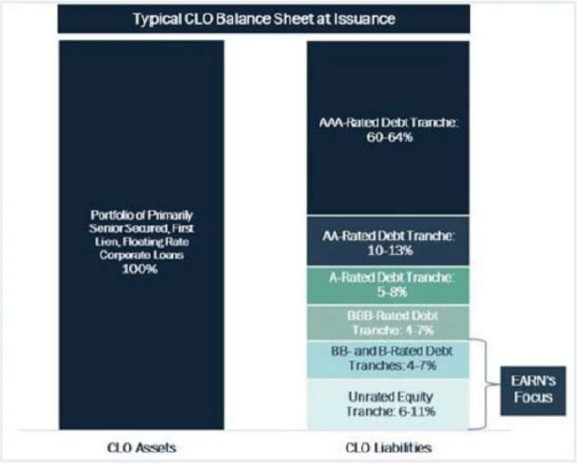
CLOs typically have two priority-of-payment schedules (commonly called “waterfalls”), which are detailed in a CLO’s indenture and govern how cash generated from a CLO’s underlying collateral is distributed to the CLO’s debt and equity tranches.
59
First, the “interest waterfall” applies to interest payments received on a CLO’s underlying collateral. Subject to compliance with certain tests as set forth in the interest waterfall, the CLO’s equity tranche is entitled to receive any excess interest available after the required regular interest payments to CLO debt investors are made and certain CLO fees and expenses (such as administration and collateral management fees) are paid. To the extent that any of these compliance tests (such as overcollateralization and/or interest coverage tests) are breached, cash flows could be diverted away from CLO mezzanine debt and equity tranches in favor of the more senior CLO debt tranches until and unless such breaches are cured.
Second, the “principal waterfall” applies to cash flow received from the return of principal on the underlying collateral, primarily through loan repayments and proceeds from loan sales. During the CLO’s Reinvestment Period, this principal cash flow is typically used to purchase new assets, whereas after the Reinvestment Period, it is typically used to pay down CLO debt tranches sequentially based on relative seniority.
A CLO’s indenture typically requires that the CLO Collateral Manager only purchase assets for such CLO with maturity dates (which for a senior secured loan are typically five to eight years from the loan issuance date) that are shorter than the maturity date of the CLO’s liabilities (which are typically 12 to 13 years from the CLO issuance date). Subject to the covenants set forth in the indenture, a CLO Collateral Manager is able to trade an underlying CLO’s assets and reinvest proceeds from the sales or repayments of CLO assets. As a result, CLO investors can face significant reinvestment risk with respect to a CLO’s underlying portfolio. Furthermore, in addition to the risk that underlying CLO assets may prepay, debt investors in most CLO transactions are subject to additional prepayment risk in that the holders of a majority of the equity tranche can direct a call or refinancing of a CLO, which could cause the CLO’s outstanding CLO debt securities to be repaid at a sub-optimal time.
Other Investments
As part of its investment strategy, the Fund may also invest in other related securities and instruments that the Adviser believes are consistent with its investment objectives, including senior debt tranches of CLOs; loan accumulation facilities (“LAFs” or “warehouses”); corporate loans (including, but not limited to, loans that ultimately may serve as collateral for CLOs); and securities issued by other securitization vehicles, such as collateralized bond obligations (“CBOs”).
Loan Accumulation Facilities. LAFs are vehicles that acquire corporate loans and other similar corporate credit-related assets in anticipation of ultimately collateralizing a CLO transaction. LAFs receive debt financing from the “LAF provider”, which is generally the investment bank expected to ultimately serve as the arranger on the ultimate CLO transaction. The equity capital provided by the LAF investors, combined with the debt financing provided by the LAF provider, is used by the LAF to acquire corporate loans and other similar corporate credit-related assets that are expected to collateralize the ultimate CLO transaction. This period of accumulating assets, known as the “warehouse period,” terminates when the ultimate CLO transaction closes, whereupon the vehicle repays the debt financing using the proceeds from the sale of the CLO debt and equity securities.
The debt financing provided to LAFs typically carry maturities ranging from one to two years (subject to potential extension). Notwithstanding these longer maturities, the Fund’s investments in LAFs are generally expected to last from one to three months, as the Fund would typically invest in the LAF after the debt tranches of the related CLO have been priced (with such investments typically being referred to as “price-to-close” LAF investments). Typically, the Fund commits a specified amount of equity capital to the LAF, and the LAF draws down this equity capital over time as it acquires assets, with leverage in the LAF generally maintained between four and six times. During this commitment period, the debt financing provided by the LAF provider typically bears interest at a floating rate with a specified margin over a benchmark rate such as the Secured Overnight Financing Rate (“SOFR”). The LAF investors primarily earn the difference between the interest earned on the accumulated assets and the interest paid to the LAF provider.
While LAF investors (including the Fund) generally expect to invest in the equity tranche of the ultimate CLO transaction (assuming it is launched), they are not contractually required to do so. In cases where the CLO is not ultimately launched, the LAF is generally unwound and the accumulated assets liquidated. In such cases, LAF investors would receive the excess, if any, of the proceeds from the sale of the LAF’s assets over the unpaid principal balance of the debt financing, in addition to any interest differential described above.
Collateralized Bond Obligations. A collateralized bond obligation (“CBO”) is a form of securitization that is similar to a CLO but is primarily backed by high yield corporate bonds (as opposed to almost entirely senior secured corporate loans). As with CLOs, CBOs typically issue various tranches carrying different degrees of credit risk and payment priority. Higher-rated tranches have greater degrees of insulation from collateral deterioration and lower coupons, whereas lower-rated tranches, with greater credit risk and lower payment priority, have higher coupons. CBOs enjoy structural advantages similar to those of CLOs, including collateral coverage/overcollateralization tests, interest coverage tests, and collateral quality tests. CBOs also have similar priority-of-payment structures to CLOs. In contrast to CLOs, CBO debt tranches typically carry fixed rate coupons, as their underlying assets are typically fixed rate in nature. CBOs are typically less levered than traditional CLOs as a result of their differentiated collateral, for which debt investors demand higher credit enhancement.
60
Derivatives Transactions. The Fund may engage in Derivative Transactions from time to time. To the extent the Fund engages in Derivative Transactions, the Fund expects to do so to hedge against interest rate, credit, credit spread widening, currency and/or other risks, or for other risk management or investment purposes, including to accommodate additional investments. The Fund may use Derivative Transactions for investment purposes to the extent consistent with its investment objectives if the Adviser deems it appropriate to do so. The Fund may purchase and sell a variety of derivative instruments, including exchange-listed and OTC options, futures, options on futures, swaps and similar instruments, various interest rate-related products, such as fixed-to-floating interest rate swaps, caps, floors or collars, and credit transactions and credit default swaps. The Fund also may purchase and sell derivative instruments that combine features of these instruments. The use of Derivative Transactions, if any, will generally be deemed to create leverage for the Fund and involves significant risks. No assurance can be given that the strategy and use of derivatives will be successful, and the Fund’s investment performance could diminish compared with what it would have been if Derivative Transactions were not used.
As required by the Derivatives Rule, funds that engage in derivatives transactions, other than “limited derivatives users” (as defined under the Derivatives Rule), generally must adopt and implement a Derivatives Risk Management Program that is reasonably designed to manage the Fund’s derivatives risks, while taking into account the Fund’s derivatives and other investments. The Derivatives Rule mandates that the fund adopt and/or implement: (i) VaR; (ii) a written derivatives risk management program; (iii) Board oversight responsibilities; and (iv) reporting and recordkeeping requirements. The Fund has adopted and implemented a Derivatives Risk Management Program. However, the Fund may elect in the future, without notice to shareholders, to operate as a “limited derivatives user,” in which case it would no longer be required to maintain its Derivatives Risk Management Program.
Investment Process
Ellington’s CLO investment process typically includes several components, such as (i) sourcing and trading, (ii) due diligence (which may include an assessment of collateral, documentation, CLO Collateral Manager, and/or structure), (iii) stress sensitivity and technical model analyses, and (iv) investment monitoring. There can be no assurance that any particular component will be used for every investment or that the investment process will achieve its intended results.
Sourcing and Trading
Ellington and its investment team have longstanding and deep experience investing and trading in the CLO market and in structured products more broadly, providing it with access to a wide range of market opportunities. The Fund’s investment team identifies investment and trading opportunities through a network of dealer, investor, and manager relationships that it has developed over time. Ellington intends to evaluate investment and trading opportunities across a range of CLO vehicles, managers, and vintages.
At the current time, the Fund only intends to invest in CLOs (or LAFs) that are managed by third parties, i.e., it does not expect to invest in CLOs (or LAFs) that are managed by the Adviser or its affiliates. However, the Fund’s intentions in this regard may change at any time, without notice to shareholders, provided that any such investment will be made in a manner consistent with the provisions of the 1940 Act.
Nevertheless, when negotiating an investment in a CLO (or LAF) that is in the process of being formed, even if such CLO (or LAF) will be managed by third parties, the Fund’s investment team may be able to negotiate certain structural terms of the CLO (or LAF) as a condition of its investment. In addition, in situations where the Fund’s participation in a LAF culminates in the issuance of a new CLO, the Fund will typically be offered the ability to purchase some of the newly issued CLO tranches, and in some of these cases the Fund’s investment team may be able to negotiate some of the terms of the CLO, including certain structural terms.
Due Diligence
The following are examples of the components of the investment team’s due diligence process on a CLO transaction. The investment team has broad authority as to which of these components are performed with respect to any given investment or proposed investment. As a result, there can be no assurance that the investment team will perform each of the below-listed components on any particular investment that the Fund makes.
| ● | Review of the CLO’s underlying loan portfolio |
| ○ | Review of portfolio-level metrics and characteristics, such as: |
| ■ | Market prices and coupon spreads |
| ■ | Credit ratings and weighted average lives |
| ■ | Liquidity (as measured by asset bid depth and facility size) |
| ■ | CLO-level exposures to specific industries and to lower-priced or lower-rated assets |
61
| ○ | Identification of specific underlying assets for further review, including: |
| ■ | In-depth analysis by Ellington’s internal credit analysts |
| ■ | Consultation with third-party collateral managers |
| ■ | Application of valuation adjustments based on internal and external insights |
| ● | Review of CLO deal documentation, including: |
| ○ | Priorities of payment (waterfalls) |
| ○ | Reinvestment flexibility |
| ○ | Cash flow tests and triggers |
| ○ | Asset concentration limits |
| ○ | Deal redemption language (e.g., call, refinance, and reset provisions) |
| ○ | Favorability of specific terms under varying market conditions |
| ○ | Structural features, such as: |
| ■ | Overcollateralization test cushion |
| ■ | Interest diversion test cushion |
| ■ | Equity NAV |
| ■ | Deal excess spread / net interest margin |
| ■ | Leverage levels |
| ○ | Other key provisions |
| ● | Assessment of historical CLO performance, including: |
| ○ | Collateral quality tests |
| ○ | Coverage ratio compliance |
| ● | Analysis of results of model analyses and stress sensitivities (see “Stress Sensitivity and Technical Model Analyses” below, for additional detail) |
| ● | Evaluation of CLO Collateral Manager, including: |
| ○ | Overall performance and market reputation |
| ○ | Secondary market liquidity of the CLO’s tranches |
| ○ | Historical equity distributions and internal rates of return (IRRs) |
| ○ | Quality of underlying portfolios |
| ○ | Effectiveness in building or maintaining portfolio par over time |
| ● | Comparison of the investment’s value proposition relative to other available opportunities |
| ● | Engagement and ongoing assessment, including: |
| ○ | Conducting update calls and meetings with CLO Collateral Managers |
| ○ | Reviewing CLO Collateral Managers’ trading strategies, market outlooks, and positioning |
| ○ | Integrating historical performance data and qualitative insights into the overall investment evaluation |
| ○ | See also “Investment Monitoring” below |
62
Stress Sensitivity and Technical Model Analyses
In addition to reviewing a given CLO’s collateral, documentation, CLO Collateral Manager, and structure, the investment team may conduct sensitivity analyses to evaluate how a CLO tranche could perform under different credit stress scenarios. These analyses may consider several factors, including loan prices, spreads, maturities, default rates, prepayment rates, and recovery rates to estimate potential cashflows and performance across different market conditions. Scenarios may include historical macroeconomic shocks as well as hypothetical market environments. Individual assets within a CLO may be analyzed and various factors may be considered across each scenario, including how deal tests, cashflows, and triggers are projected to evolve over time, as well as projected credit spreads, yields, tranche weighted average lives (WALs) and credit spread durations. This analysis typically includes the assessment of the potential return profiles across different scenarios.
In addition to cashflow analyses, the investment team may utilize technical models to assess a CLO tranche relative to other corporate credit investments, including other CLO tranches. This relative value analysis may take into account various factors, including fundamental credit considerations and mark-to-market risk information.
Investment Monitoring
To help inform decisions regarding whether to retain or divest the Fund’s investments, the investment team employs a monitoring process, as follows:
Portfolio-level reports are generated regularly by the investment team and the Risk Oversight Group related to the Fund’s investments. These reports incorporate a combination of third-party data and analytical tools to assess various factors related to the Fund’s CLO holdings.
Given that CLOs are typically actively managed vehicles prior to the end of their Reinvestment Periods, the CLO investment team may attempt to engage in discussions with CLO Collateral Managers to monitor developments in the deal portfolios. If available, the investment team may also review monthly and quarterly reports from CLO trustees, which contain information on CLO portfolio composition and structural changes.
The investment team uses a variety of additional resources to monitor the underlying collateral exposures of the Fund’s investments. The investment team seeks to limit specific, key concentrations in the loans underlying the Fund’s portfolio, such as concentrations in loan issuers, loan sectors/industries, loan maturities, collateral types, and perceived trading liquidity. The investment team also seeks to limit exposure to any one CLO collateral manager, as well to any one CLO tranche. The foregoing concentration limits are typically tested at trade time, monitored periodically through a series of reports generated by the Adviser, and, to the extent possible and applicable, discussed during meetings between the Fund’s investment team and such CLO collateral managers.
The Fund, in connection with managing its derivatives risks under the Derivatives Risk Management Program, conducts daily testing of interest rate risks on its portfolio. For example, the Fund conducts periodic tests that: (i) measure the impact of parallel upward and downward shifts in the interest rate yield curve, on both the Fund’s derivatives portfolio specifically and the Fund’s net asset value overall, and (ii) project changes in the Fund’s net liquidity as a result of variation margin increases due to changes in interest rates. Given that the Fund’s assets will primarily consist of floating rate instruments, the Fund intends to engage in Derivatives Transactions that it believes will mitigate the interest rate mismatch triggered by the issuance of fixed rate Notes pursuant to this offering. See “Risks Related to the Fund’s Financing, Hedging, and Derivatives Activities” for more detail on the risks associated with the Fund’s derivatives transactions and hedging program.
The Fund may choose to exit investments for a variety of reasons, which could include changes in market value of the CLO, changes in market conditions, changes in collateral quality or coverage tests, collateral manager performance, changes in the Fund’s view of the market, the Fund’s liquidity needs, to maintain compliance with 1940 Act or RIC-related tests, trading opportunities, or to rotate into what it perceives to be more attractive investment opportunities.
Staffing
The Fund does not currently have any employees. The Adviser manages the Fund’s day-to-day investment operations.
The Fund will reimburse the Administrator for its allocable portion of overhead and other expenses incurred by it in performing its obligations under the Administration Agreement, including rent, the fees and expenses associated with performing administrative functions, and the compensation of its Chief Financial Officer, Chief Operating Officer, and any administrative support staff, including accounting personnel. See “The Adviser and the Administrator—The Administration Agreement.” The Fund will also pay indirectly the costs associated with the functions performed by its Chief Compliance Officer under the terms of an agreement between the Fund and Vigilant.
63
Legal Proceedings
As of the date of this prospectus, neither the Fund, the Adviser, nor the Administrator were subject to any pending legal proceedings that they considered material.
THE ADVISER AND THE ADMINISTRATOR
Its Board is responsible for the overall management and supervision of its business and affairs, including the appointment of the adviser, administrators, and third-party service providers.
The Investment Advisory Agreement
Pursuant to the Investment Advisory Agreement, its Board has appointed Ellington Credit Company Management LLC, a Delaware limited lability company (the “Adviser”), as the Fund’s investment adviser. The Adviser is registered as an investment adviser with the SEC under the Advisers Act. The Adviser is an affiliate of Ellington Management Group, L.L.C. (“EMG” and, together with the Adviser, “Ellington”), a global investment firm and an SEC-registered investment adviser. EMG was founded in 1994, and as of June 30, 2026, has more than 170 employees, including more than 60 investment professionals, and has approximately $23.0 billion in assets under management.
Subject to the overall supervision of its Board, the Adviser manages the day-to-day operations of, and provides investment advisory and management services to, the Fund. Under the terms of its Investment Advisory Agreement, the Adviser:
| ● | Determines the composition of the portfolio of the Fund, the nature and timing of the changes therein and the manner of implementing such changes; |
| ● | Identifies, evaluates and negotiates the structure of the investments made by the Fund; |
| ● | Closes, monitors and services the Fund’s investments; |
| ● | Determines the securities and other assets that the Fund will purchase, retain, or sell; and |
| ● | Provides the Fund with such other investment advisory, research and related services as the Fund may, from time to time, reasonably require for the investment of its funds. |
The Adviser’s services under the Investment Advisory Agreement are not exclusive, and both it and its members, officers and employees are free to furnish similar services to other entities so long as its services to the Fund are not impaired. See “Conflicts of Interest.”
Management Fees
Pursuant to the Investment Advisory Agreement, the Fund has agreed to pay the Adviser fees for investment advisory and management services, which consist of two components — a base management fee and a performance fee.
Base Management Fee
The “Base Management Fee” that the Fund pays to the Adviser with respect to each fiscal quarter is equal to the product of 0.375% (i.e., 1.50% per annum) and the Fund’s “Net Asset Value,” which is equal to the total assets of the Fund minus its total liabilities, as of the end of such fiscal quarter. The Base Management Fee is prorated for partial quarterly periods based on the number of days in such partial period compared to a 90-day quarter and is calculated and payable quarterly in arrears.
Performance Fee
The Fund pays to the Adviser a “Performance Fee,” calculated and payable quarterly in arrears based upon the Fund’s “Pre-Performance Fee Net Investment Income” with respect to each fiscal quarter, and is subject to a hurdle rate, expressed as a rate of return on the Fund’s common equity, equal to 2.00% per quarter (i.e., 8.00% per annum), and is subject to a “catch-up” feature.
Specifically:
| ● | If the Fund’s Pre-Performance Fee Net Investment Income for a fiscal quarter does not exceed the Hurdle Amount (as defined below) for such quarter, then no Performance Fee is payable to the Adviser with respect to such quarter; |
| ● | If the Fund’s Pre-Performance Fee Net Investment Income for a fiscal quarter exceeds the Hurdle Amount for such quarter but is less than or equal to 121.21% of the Hurdle Amount, then 100% of the portion of the Fund’s Pre-Performance Fee Net Investment Income that exceeds the Hurdle Amount (the “Catch-Up”) is payable to the Adviser as the Performance Fee with respect to such quarter; |
64
| ○ | Therefore, once the Fund’s Pre-Performance Fee Net Investment Income for such quarter exactly reaches 121.21% of the Hurdle Amount, the Adviser will have accrued a Performance Fee with respect to such quarter that is exactly equal to 17.5% of the Pre-Performance Fee Net Investment Income (because 21.21% of the Hurdle Amount (which is the Pre-Performance Fee Net Investment Income captured by the Adviser during the Catch-Up phase) is equal to 17.5% of 121.21% of the Hurdle Amount (which is the entire Pre-Performance Fee Net Investment Income at the end of the Catch-Up phase)); and |
| ● | If the Fund’s Pre-Performance Fee Net Investment Income for a fiscal quarter exceeds 121.21% of the Hurdle Amount for such quarter, then 17.5% of the Fund’s Pre-Performance Fee Net Investment Income is payable to the Adviser as the Performance Fee with respect to such quarter. |
With respect to the Performance Fee, there will be no accumulation of the Hurdle Amount from quarter to quarter, no claw back of amounts previously paid if the Pre-Performance Fee Net Investment Income in any subsequent quarter is below the Hurdle Amount for such subsequent quarter, and no delay or adjustment of payment if the Pre-Performance Fee Net Investment Income in any prior quarter was below the Hurdle Amount for such prior quarter.
For these purposes, the following definitions are applicable:
“Hurdle Amount” for any fiscal quarter means the result obtained by multiplying the Net Asset Value of Common Equity at the end of the immediately preceding fiscal quarter by the Hurdle Rate. The Hurdle Amount will be appropriately adjusted for any common share issuances or repurchases during the fiscal quarter.
“Hurdle Rate” means 2.00% per quarter, or 8.00% per annum. The Hurdle Rate will be appropriately prorated for partial quarterly periods based on the number of days in such partial period compared to a 90-day quarter.
“Net Asset Value” means the figure that is equal to the total assets of the Fund minus its total liabilities.
“Net Asset Value of Common Equity” means the portion of Net Asset Value attributable to common equity.
“Pre-Performance Fee Net Investment Income” for any fiscal quarter means interest income (including accretions of discounts, amortization of premiums, and payment-in-kind income), dividend income, and any other income (including any fee income) earned or accrued by the Fund during such fiscal quarter, minus the Fund’s operating expenses for such quarter (which, for this purpose, will not include any litigation-related expenses, any extraordinary expenses, or Performance Fee). Pre-Performance Fee Net Investment Income does not include any realized capital gains, realized capital losses or unrealized capital appreciation or depreciation. For purposes of computing Pre-Performance Fee Net Investment Income, the calculation methodology will look through total return swaps as if the Fund owned the referenced assets directly. As a result, Pre-Performance Fee Net Investment Income includes net interest (whether positive or negative) associated with a total return swap, which is the difference between (a) the interest income and transaction fees related to the reference assets and (b) all interest and other expenses paid by the Fund to the total return swap counterparty. In the case of an interest rate swap, Pre-Performance Fee Net Investment Income includes the net payments and net accruals of periodic payments.
The “catch-up” provision is intended to provide the Adviser with a performance fee of 17.5% on all of the Fund’s Pre-Performance Fee Net Investment Income when the Fund’s Pre-Performance Fee Net Investment Income reaches 2.424% of Net Asset Value of Common Equity in a quarter.
The Adviser is obligated to pay expenses associated with providing the investment services stated in the Investment Advisory Agreement, including compensation of and office space for its officers and employees connected with research, trading and investment management of the Fund.
The Performance Fee is based on the Fund’s Pre-Performance Fee Net Investment Income, without considering any realized or unrealized gains or losses on its investments. As a result, (i) for quarters in which a Performance Fee is payable, such Performance Fee will exceed 17.5% of the Fund’s GAAP net income if the Fund generated net realized and unrealized losses on its investments during such quarter, (ii) the Adviser could earn a Performance Fee for fiscal quarters during which the Fund generates a GAAP net loss, and (iii) given the Performance Fee, the Adviser might be incentivized to manage its portfolio using higher risk assets, using assets with deferred interest features, or using more financial leverage through indebtedness (subject to the applicable 1940 Act restrictions), to generate more income, both of which could result in higher investment losses, especially during economic downturns.
65
The Performance Fee is calculated quarterly, treating each quarter in isolation. As a result, the Hurdle Amount does not accumulate from quarter to quarter, and decreases in the Fund’s Net Asset Value of Common Equity, such as those due to unrealized losses, will reduce the Hurdle Amount, potentially making it easier for the Adviser to earn a Performance Fee. The Fund will not have the ability to claw back, delay, or adjust the payment of any Performance Fee based on financial results in prior or subsequent quarters. In addition, over a series of quarters, if the Fund’s Pre-Performance Fee Net Investment Income is positive in some quarters but negative in others, it is likely, when viewing the series of quarters as a whole, for the aggregate Performance Fee payable to the Adviser to exceed 17.5% of the Fund’s aggregate Pre-Performance Fee Net Investment Income. There is also a conflict of interest related to management’s involvement in many accounting determinations (including but not limited to valuations and calculations of interest income) that can affect the Fund’s Performance Fee.
The following is a graphical representation of the calculation of the Performance Fee:
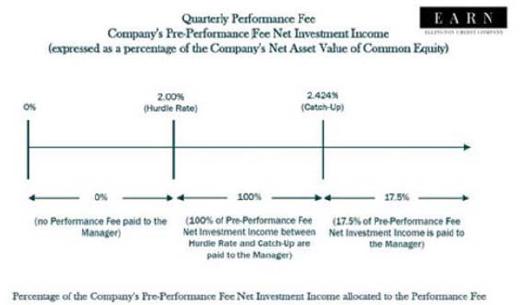
These calculations will be appropriately prorated for any period of less than three months.
Examples of the Quarterly Performance Fee:
Alternative 1: No Performance Fee is Earned
Assumptions
Investment income (including interest, dividends, fees, etc.) = 1.80%
Hurdle rate(1) = 2.00%
Management fee(2) = 0.375%
Other operating expenses (legal, accounting, custodian, transfer agent, etc.) = 0.20%
Pre-performance fee net investment income
(investment income–(management fee + other expenses)) = 1.225%
Because the pre-performance fee net investment income of 1.225% does not exceed the hurdle rate of 2.00%, no performance fee is earned
Alternative 2: Performance Fee Earned – Catch-Up Not Exceeded
Assumptions
Investment income (including interest, dividends, fees, etc.) = 2.70%
Hurdle rate(1) = 2.00%
Management fee(2) = 0.375%
Other operating expenses (legal, accounting, custodian, transfer agent, etc.) = 0.20%
66
Pre-performance fee net investment income
(investment income–(management fee + other expenses)) = 2.125%
Performance fee = 100% × pre-performance fee net investment income in excess of the hurdle rate of 2.00% but is less than 2.424% (i.e., the “catch-up”(3))
= 100% × (2.125%–2.00%)
= 0.125% performance fee earned
Alternative 3: Performance Fee Earned – Catch-Up Exceeded
Assumptions
Investment income (including interest, dividends, fees, etc.) = 3.50%
Hurdle rate(1) = 2.00%
Management fee(2) = 0.375%
Other operating expenses (legal, accounting, custodian, transfer agent, etc.) = 0.20%
Pre-performance fee net investment income
(investment income–(management fee + other expenses)) = 2.925%
Performance fee = 17.5% × pre-performance fee net investment income, subject to “catch-up”(3)
Performance fee = 100% × “catch-up” + (17.5% × (pre-performance fee net investment income–2.424%))
Catch-up = 2.424%–2.00%
= 0.424%
Performance fee = (100% × 0.424%) + (17.5% × (2.925%–2.424%))
= 0.424% + (17.5% × 0.501%)
= 0.424% + 0.088%
= 0.512% performance fee earned
| (1) | Represents 8% annualized Hurdle Rate. |
| (2) | Represents 1.50% annualized Base Management Fee. |
| (3) | The “catch-up” provision is intended to provide the Adviser with a performance fee of 17.5% on all of the Fund’s Pre-Performance Fee Net Investment Income when the Fund’s Pre-Performance Fee Net Investment Income reaches 2.424% of Net Asset Value of Common Equity in a quarter. |
Board Approval of the Investment Advisory Agreement
On August 13, 2024, the Board, including a majority of the trustees who are not “interested persons” as defined in the 1940 Act (the “Independent Trustees” and, those trustees who are “interested persons,” the “Interested Trustees”), approved the Investment Advisory Agreement, subject to shareholder approval, which was obtained at the Special Meeting. At the Special Meeting, the Fund’s shareholders voted in favor of the Investment Advisory Agreement and related matters enabling the Fund to complete the Conversion. The Investment Advisory Agreement was executed on the Conversion Date. The Board weighed a number of factors in reaching its decision to approve the Investment Advisory Agreement, including (1) the nature, extent, and quality of services to be provided by the Adviser; (2) the fees payable and expenses reimbursable to the Adviser under the terms of the Investment Advisory Agreement; (3) the Adviser’s projected profitability in advising the Fund and the estimated cost of services to be provided; (4) the extent to which economies of scale would be realized as the Fund grows; and (5) any ancillary or “fall-out” benefits received by the Adviser or its affiliates as a result of its relationship with the Fund. In approving the Investment Advisory Agreement, the Board also considered the investment history and experience of the Adviser and EMG. A discussion regarding the basis for the Board’s approval of the Investment Advisory Agreement is available in the Fund’s definitive proxy statement on Schedule 14A for the Special Meeting, filed with the SEC on December 19, 2024, which is incorporated herein by reference.
67
Fund Expenses
All investment professionals of the Adviser (and/or its affiliates) and their respective staffs, when and to the extent engaged in providing investment advisory and investment management services as set forth in the Investment Advisory Agreement, and the compensation and routine overhead expenses of such personnel allocable to such services, shall be provided and paid for by the Adviser and not by the Fund.
Expenses borne directly by the Fund include:
| ● | expenses relating to organizing, merging, liquidating or dissolving the Fund and offerings (including without limitation out-of-pocket expenses, but not overhead or employee costs of the Adviser); |
| ● | calculating the Fund’s Net Asset Value (including the cost and expenses of any independent valuation firms); |
| ● | direct costs and expenses of administration, including for legal, accounting and auditing services (including expenses of legal counsel to the trustees who are not interested persons (as defined in the 1940 Act) of the Fund or the Adviser), printing, mailing, long distance telephone, copying, secretarial and other staff, independent auditors and outside legal costs; |
| ● | taxes (including without limitation securities and commodities issuance and transfer taxes) and governmental fees (including without limitation fees payable by the Fund to Federal, State or other governmental agencies and associated filing costs); |
| ● | dues, fees, charges and expenses incurred in connection with membership in investment company organizations (including without limitation membership dues of the Investment Company Institute) or trade associations; |
| ● | costs associated with circulating shareholder reports, proxy materials, prospectuses, stock certificates, making distributions and/or other notices to shareholders, including printing costs and any other proxy voting expenses; |
| ● | charges or distributions required to be paid to the Fund’s custodians and sub-custodians, administrators and sub-administrators, registrars, depositories, transfer agents, dividend disbursing agents and dividend reinvestment plan agents (including settlement and clearing costs and other expenses under the custody, administration and other agreements); |
| ● | fees and expenses associated with marketing and distribution efforts; |
| ● | fees and expenses paid to agents and intermediaries for sub-transfer agency, sub-accounting and other shareholder services on behalf of shareholders of the Fund held through omnibus and networked, record shareholder accounts; |
| ● | payment for portfolio pricing services to a pricing agent, if any; |
| ● | registration and filing fees of the SEC and various states and other jurisdictions (including filing fees and legal fees and disbursements of counsel); |
| ● | fees and expenses of registering or qualifying securities of the Fund federally or in the various states; |
| ● | postage, freight and other charges in connection with the shipment of the Fund’s portfolio securities; |
| ● | fees and expenses of trustees who are not interested persons (as defined in the 1940 Act) of the Fund or the Adviser and of any other trustees or members of any advisory board or committee who are not employees of the Adviser or any corporate affiliate of the Adviser; |
| ● | salaries of shareholder relations personnel and/or fees and expenses associated with marketing, branding, advertising and shareholder relations efforts; |
| ● | costs of shareholders meetings; |
| ● | all insurance costs incurred with respect to insurance policies obtained in connection with the operation of the Fund’s business, including but not limited to insurance covering activities of the Adviser and its employees relating to the performance of the Adviser’s duties and obligations under this Agreement, trustees and officers (D&O liability insurance), errors and omissions insurance (E&O insurance), employee practices liability, cybersecurity, and fidelity insurance and fidelity bonds (e.g. for ERISA and otherwise), each as applicable; |
| ● | any and all fees, costs and expenses incurred in creating, implementing or maintaining third-party or proprietary software tools, programs, hardware or other technology for the benefit of the Fund (including, without limitation, any and all fees, costs and expenses of any investment, books and records, portfolio compliance and reporting systems, general ledger or portfolio accounting systems and similar systems and services, including, without limitation, consultant, software licensing, data management and recovery services fees and expenses); |
68
| ● | travel-related and other expenses for trustee, executive and administrative staff in connection with activities for the benefit of the Fund; |
| ● | interest and other costs payable on any debt incurred to finance the Fund’s investments; |
| ● | any interest or brokerage costs (including without limitation brokers’ commissions or transactions costs chargeable to the Fund in connection with portfolio securities transactions to which the Fund is a party); |
| ● | the Fund’s proportionate share of expenses related to co-investments; |
| ● | all expenses incident to the payment of any dividend, distribution (including any dividend or distribution program), withdrawal or redemption, whether in shares or in cash; |
| ● | litigation and other extraordinary or non-recurring expenses (including without limitation legal claims and liabilities and litigation costs and any indemnification related thereto) (subject, however, to indemnification provisions of this Agreement); |
| ● | the compensation of the Fund’s chief compliance officer and the salary of any compliance personnel of the Adviser and its affiliates who provide compliance-related services to the Fund, provided such salary expenses are properly allocated between the Fund and other affiliates, as applicable, and any costs associated with the monitoring, testing and revision of the Fund’s compliance policies and procedures required by Rule 38a-1 under the 1940 Act, including costs, expenses or fees payable to third-parties; |
| ● | the cost of any valuation services retained by the Fund or the Adviser with respect to the Fund’s investments or potential investments (including engagement of such valuation service provider by the Adviser or its affiliates) and all other charges and costs of the Fund’s operations; |
| ● | fees and expenses incurred by the Adviser or the Fund in monitoring financial and legal affairs for the Fund and in monitoring the Fund’s investments and performing due diligence on its prospective investments or otherwise relating to, or associated with, evaluating, making, maintaining and disposing of investments; and |
| ● | all other expenses incurred by the Fund or the Administrator in connection with administering the Fund’s business, such as the allocable portion of overhead and other expenses incurred by Ellington Credit Company Administration LLC in performing its obligations under the Administration Agreement, including, without limitation, rent, office supplies, the fees and expenses associated with performing compliance functions, and the Fund’s allocable portion of the costs of compensation and related expenses of the Fund’s Chief Financial Officer, Chief Operating Officer and their respective support staff. |
Except as otherwise described in this prospectus, the Adviser will be reimbursed by the Fund, as applicable, for any of the above expenses that it pays on behalf of the Fund. The Fund will also reimburse the Adviser or its affiliates for any expenses of the Fund as may be reasonably incurred as specifically provided for in the Investment Advisory Agreement (including, for the avoidance of doubt, any of the above expenses incurred by the Adviser or its affiliates on the Fund’s behalf) or as specifically agreed to by the Board. The Adviser shall keep and supply to the Fund reasonable records of all such expenses.
Duration and Termination
The initial term of the Investment Advisory Agreement is two years from its execution. Unless earlier terminated as described below, the Investment Advisory Agreement will remain in effect for successive one-year periods, provided that such continuance is approved by the Board or by the affirmative vote of the holders of a majority of its outstanding voting securities, including, in either case, approval by a majority of the Independent Trustees. The Investment Advisory Agreement will automatically terminate in the event of its assignment. The Investment Advisory Agreement may also be terminated by either party without penalty upon not more than 60 days’ written notice to the other party.
Limitation on Liability and Indemnification
The Investment Advisory Agreement provides that, absent willful misfeasance, bad faith or gross negligence in the performance of its duties or by reason of the reckless disregard of its duties and obligations, the Adviser and its officers, managers, partners, agents, employees, controlling persons, members and any other person or entity affiliated with it are entitled to indemnification from the Fund for any damages, liabilities, costs and expenses (including reasonable attorneys’ fees and amounts reasonably paid in settlement) arising from the rendering of the Adviser’s services under the Investment Advisory Agreement or otherwise as an investment adviser of the Fund.
69
Organization of the Adviser
The Adviser is a Delaware limited liability company that is registered as an investment adviser under the Advisers Act. EMG is a Delaware limited liability company, and is an affiliate of the Adviser. Under the Services Agreement, EMG provides such services, including personnel, support and resources, to the Adviser as the Adviser may determine to be reasonably necessary to perform its obligations under the Advisory Agreement. The principal address of the Adviser, the Administrator and of EMG is 53 Forest Avenue, Suite 301, Old Greenwich, Connecticut 06870.
The Administration Agreement
Ellington Credit Company Administration LLC, a Delaware limited lability company, serves as the Fund’s administrator (the “Administrator”). Pursuant to the Administration Agreement, the Administrator furnishes the Fund with office facilities, equipment and clerical, bookkeeping and record keeping services at such facilities. Under the Administration Agreement, the Administrator also performs, or oversees the performance of, its required administrative services, which include, among other things, being responsible for the financial records which the Fund is required to maintain and preparing reports to its shareholders. In addition, the Administrator assists the Fund in determining and publishing its Net Asset Value, oversees the preparation and filing of its tax returns and the printing and dissemination of reports to its shareholders, and generally oversees the payment of its expenses and the performance of administrative and professional services rendered to the Fund by others. Payments under the Administration Agreement are equal to an amount based upon its allocable portion of the Administrator’s costs and expenses incurred in performing its obligations and providing personnel (including wages, salaries, bonuses and related payroll expenses) under the Administration Agreement, including rent, office supplies, the fees and expenses associated with performing compliance functions, and the Fund’s allocable portion of the costs of compensation and related expenses of the Fund’s Chief Financial Officer, Chief Operating Officer, and their respective support staff. To the extent the Administrator outsources any of its functions, the Fund pays the fees on a direct basis, without profit to the Administrator. The Administration Agreement may be terminated by the Fund without penalty upon not less than 60 days’ written notice to the Administrator and by the Administrator upon not less than 90 days’ written notice to the Fund. The Administration Agreement will remain in effect if approved by the Board, including by a majority of the Independent Trustees.
The Board will consider the approval of the Administration Agreement on an annual basis, and the Administration Agreement may be amended by the Board and the Administrator, without shareholder approval. When considering the approval of the Administration Agreement, the Board considers, among other factors, (i) the reasonableness of the compensation paid by the Fund to the Administrator and any third-party service providers in light of the services provided, the quality of such services, any cost savings to the Fund as a result of the arrangements and any conflicts of interest, (ii) the methodology employed by the Administrator in determining how certain expenses are allocated to the Fund, (iii) the breadth, depth and quality of such administrative services provided, (iv) certain comparative information on expenses borne by other companies for somewhat similar services known to be available and (v) the possibility of obtaining such services from a third-party. The Administration Agreement was approved by the Board on March 19, 2025.
Limitation on Liability and Indemnification
The Administration Agreement provides that, absent willful misfeasance, bad faith or negligence in the performance of its duties or by reason of the reckless disregard of its duties and obligations, the Administrator and its officers, managers, partners, agents, employees, controlling persons, members and any other person or entity affiliated with it are entitled to indemnification from then Fund for any damages, liabilities, costs and expenses (including reasonable attorneys’ fees and amounts reasonably paid in settlement) arising from the rendering of the Administrator’s services under the Administration Agreement or otherwise as administrator for the Fund.
Sub-Administrator Services
U.S. Bank Fund Services LLC (“U.S. Bank”), which has its principal office at 618 E. Michigan Street, Milwaukee, WI 53202, serves as sub-administrator to the Fund. Pursuant to an agreement (the “Sub-Administration Agreement”), U.S. Bank furnishes the Fund with certain administration, accounting, and reporting services, being responsible for certain of the financial records that the Fund is required to maintain and preparing certain reports filed with the SEC. The Sub-Administration Agreement may be terminated by either party without penalty prior to the initial term or renewal date.
Organization of the Administrator
The Administrator is a Delaware limited liability company. EMG is a Delaware limited liability company and is an affiliate of the Administrator. Under the Services Agreement, EMG provides such services, including personnel, support and resources, to the Administrator as the Administrator may determine to be reasonably necessary to perform its obligations under the Administration Agreement. The principal address of the Adviser, the Administrator and of EMG is 53 Forest Avenue, Suite 301, Old Greenwich, Connecticut 06870.
70
Trustees
Pursuant to the Amended and Restated Declaration of Trust (“Declaration of Trust”) and Amended and Restated By-Laws (the “Bylaws”), the Fund’s business and affairs are managed under the direction of the Board, which has overall responsibility for monitoring and overseeing the Fund’s management and operations. The Board consists of six members, four of whom are considered not to be “interested persons” of the Fund, as defined in the 1940 Act (the “Independent Trustees”) and two of whom are considered to be “interested persons” (the “Interested Trustees”). All of the trustees are subject to removal or replacement in accordance with Delaware law and the Declaration of Trust. All of the trustees serving on the Board were elected by the shareholders of the Fund at the latest annual meeting of shareholders of the Fund.
The Board, which includes a majority of Independent Trustees, oversees and monitors the Fund’s management and operations. The Board reviews on an annual basis the Investment Advisory Agreement to determine, among other things, whether the fees payable under such agreement are reasonable in light of the services provided.
Board of Trustees and Officers
Information regarding the members of the Board is set forth below. The trustees have been divided into two groups, Interested Trustees and Independent Trustees. As set forth in the Fund’s declaration of trust, each Trustee’s term of office shall continue until his or her death, resignation or removal.
Independent Trustees
| Name
and Year of Birth |
Position(s) With the Fund |
Term
of Office and Length of Time Served |
Principal Occupation(s) During Past Five Years |
Number
of Portfolios in the Fund Complex to be Overseen |
Other
Directorships Held During Past Five Years | |||||
Robert
B. 1946 |
Chairman of the Board | Has served on the Board since May 2013 and has served as Chairman since January 2021. | Private Investor | 1 | Director, member of the audit committee, and chairman of the finance, investment and risk management committee of The Hartford Financial Services Group, Inc. (NYSE: HIG), from September 2008 until June 2023.
Director of GasLog Partners LP (NYSE: GLOP) from October 2014 until January 2021. | |||||
Ronald I. Simon, Ph.D. 1938 |
Trustee | Has served on the Board since May 2013. | Private Investor and Financial Consultant | 1 | Director of Ellington Financial Inc. since 2007. Chairman of the Board of Directors and Chairman of the Audit Committee since January 2021.
Director of the successor company of SoftNet, Inc., American Independence Corp. (“AIC”), from 2002 until August 2016, when AIC was acquired by Independence Holdings Company (“IHC”).
Director of IHC from August 2016 until February 2022. Member of the Audit Committee of IHC from November 2017 until February 2022. |
71
| Name,
and Year of Birth |
Position(s) With the Fund |
Term
of Office and Length of Time Served |
Principal Occupation(s) During Past Five Years |
Number
of Portfolios in the Fund Complex to be Overseen |
Other
Directorships Held During Past Five Years | |||||
David J. Miller 1959 |
Trustee | Has served on the Board since May 2013. | Private Investor | 1 | Director of StoneMor Inc. (NYSE: STON), the public predecessor to Everstory Inc., from July 2019 until November 2022 and Chairman of the Compensation, Nominations & Governance Committee and as a member of the Audit Committee from July 2019 until November 2022. Director of Everstory Inc. since November 2022, when StoneMor Inc. was taken private. Has served as Chairman of the Compensation, Nominations & Governance Committee and as a member of the Audit and Trust Investment Committees at Everstory Inc. since November 2022.
Director of J.G. Wentworth since January 2018. Chairman of the Board since January 2018.
Director of Prima Insurance since July 2018. Chairman of the Risk and Control Committee since July 2018.
Director of Figure Acquisition Corp. (NYSE: FACA) from February 2021 until December 2022 and Chair of the Audit Committee from February 2021 until December 2022.
Director of Lombard International Assurance from July 2015 until his resignation in December 2023. | |||||
Mary McBride 1955 |
Trustee | Has served on the Board since March 2021. | President of CoBank, ACB from 2013 until 2016
Private Investor |
1 | Director of Intrepid Potash Inc., a diversified minerals company, since May 2020.
Director of EnXchange, an energy management technology company, since November 2025.
Director of CatchMark Timber Trust, Inc., a real estate company that invests in timberlands, from February 2018 until September 2022. |
72
Interested Trustees
| Name,
and Year of Birth |
Position(s) With the Fund |
Term
of Office and Length of Time Served |
Principal Occupation(s) During Past Five Years |
Number
of Portfolios in the Fund Complex to be Overseen |
Other
Directorships Held During Past Five Years | |||||
Laurence E. Penn 1962
|
Chief Executive Officer, President & Trustee | Has served on the Board since the Fund’s inception in September 2012. | Chief Executive Officer and President of the Fund (since October 2012)
Vice Chairman of EMG (since 1995)
Executive Vice President of the Adviser and member of EMG’s Investment and Risk Management Committee (since 1995)
Chief Executive Officer and President of Ellington Financial Inc. (since August 2007) |
2 | Trustee of Ellington Income Opportunities Fund, a closed-end management investment company, since October 2018.
Director of Ellington Financial Inc. since 2007.
| |||||
Michael W. Vranos 1961
|
Trustee | Has served on the Board since the Fund’s inception in September 2012. | Co-Chief Investment Officer of the Fund from October 2012 until February 2025
Chief Executive Officer and President of the Adviser (since October 2012)
Co-Chief Investment Officer of Ellington Financial Inc. (since June 2009)
Founder and Chief Executive Officer of EMG (since December 1994) |
1 | N/A |
73
Officers
| Name
and Year of Birth |
Position
Held With the Fund |
Term of Office | Principal Occupation(s) During Past 5 Years | |||
Laurence Penn 1962 |
President, Chief Executive Officer | Indefinite Length – since October 2012 | Chief Executive Officer and President of the Fund (since October 2012); Vice Chairman of EMG (since 1995); Executive Vice President of the Adviser and member of EMG’s Investment and Risk Management Committee (since 1995); Chief Executive Officer and President of Ellington Financial Inc. (since August 2007) | |||
Michael Vranos 1961 |
Portfolio Manager | Indefinite Length – since October 2012 | Co-Chief Investment Officer of the Fund (October 2012-March 2024); Co-Chief Investment Officer of Ellington Financial Inc. (since June 2009); Founder and Chief Executive Officer of EMG (since December 1994) | |||
Mark Tecotzky 1962 |
Executive Vice President | Indefinite Length – since October 2012 | Co-Chief Investment Officer of the Fund (October 2012-March 2024); Vice Chairman—Head of Credit Strategies of EMG (since July 2023); Head portfolio manager for MBS/ABS credit at EMG (since July 2006); Co-Chief Investment Officer of Ellington Financial Inc. (since June 2009); | |||
Gregory Borenstein 1985 |
Portfolio Manager | Indefinite Length – since April 2024 | Managing Director, Head of Corporate Structured Credit at EMG (since July 2023); Head of Corporate Structured Credit (November 2021-October 2023); Portfolio Manager (November 2012-November 2021) | |||
Christopher Smernoff 1976 |
Chief Financial Officer | Indefinite Length – since April 2018 | Chief Financial Officer of the Fund (since April 2018); Chief Accounting Officer of Ellington Financial Inc. (since April 2018) | |||
JR Herlihy 1981 |
Chief Operating Officer, Treasurer | Indefinite Length – since April 2018 and May 2017 respectively | Chief Operating Officer of the Fund (since April 2018); Treasurer of the Fund (Since May 2017); Chief Financial Officer of Ellington Financial Inc. (since April 2018); Treasurer of Ellington Financial Inc. (Since May 2017) | |||
Daniel Margolis 1973 |
General Counsel | Indefinite Length – since October 2012 | General Counsel of the Fund (since April 2013); General Counsel of Ellington Financial Inc. (since August 2013) |
Biographical Information and Discussion of Experience and Qualifications
Trustees
The following is a summary of the experience, qualifications, attributes and skills of each trustee that support the conclusion, as of the date of this prospectus, that each trustee should serve as a trustee of the Fund.
74
Independent Trustees
Robert B. Allardice, III. Mr. Allardice has served as a member of the Fund’s Board since May 2013 and was appointed as Chairman of the Board in January 2021. Mr. Allardice is also a director, member of the audit committee, and chairman of the finance, investment and risk management committee of The Hartford Financial Services Group, Inc. (NYSE: HIG), where he has served since September 2008. Mr. Allardice served as a director of GasLog Partners LP (NYSE: GLOP) from October 2014 to January 2021. Mr. Allardice retired in 1999 from his position as regional chief executive officer of Deutsche Bank Americas Holding Corporation, North and South America, or “DBAHC.” Prior to joining Deutsche Bank, Mr. Allardice was a consultant to Smith Barney. Prior to consulting to Smith Barney, Mr. Allardice spent nearly 20 years in positions of increasing responsibility at Morgan Stanley & Co., Inc. He founded the company’s Merger Arbitrage Department and later became Chief Operating Officer of the Equity Department. Mr. Allardice has served as a board member of Bankers Trust Company, Carlyle Capital Corporation Ltd., DBAHC and Worldwide Excellerated Leasing Limited. Mr. Allardice earned a B.A., cum laude, from Yale University and an MBA from Harvard University, where he graduated as a George F. Baker Scholar.
Ronald I. Simon, Ph.D. Dr. Simon is a private investor and financial consultant to businesses. Dr. Simon has served as a member of the Board since May 2013, and is Chairman of the Governance Committee. Dr. Simon has also served as a member of the Board of Directors of EFC since 2007 and was appointed as Chairman of the Board of Directors and Chairman of the Audit Committee of EFC in January 2021. Dr. Simon was a Director of WFS Financial, Inc., a publicly-traded financial services company specializing in automobile finance, from March 2003 through February 2006, when WFS Financial was acquired by Wachovia Corp. From 1995 through 2002, Dr. Simon was a director of SoftNet Systems, Inc. (“SoftNet”), during 2001, he served as Acting Chairman, Chief Executive Officer, and Chief Financial Officer for SoftNet, Inc. From 2002 through August 2016 he was a director of its successor company, American Independence Corp. (“AIC”), a holding company engaged principally in the health insurance and reinsurance business. AIC was acquired by Independence Holdings Company (“IHC”), a holding company principally engaged in the disability, health insurance and pet insurance business, in August 2016, and he served as a director of IHC from August 2016 to February 2022, and as a member of the Audit Committee from November 2017 to February 2022. Dr. Simon earned a B.A. from Harvard University, an M.A. from Columbia University, and a Ph.D. from Columbia University Graduate School of Business.
David J. Miller. Mr. Miller is currently a private investor and has served as a member of the Board since May 2013. Mr. Miller previously served as a member of the board of Figure Acquisition Corp. (NYSE: FACA), and StoneMor Inc. (NYSE: STON). At FACA he served as the Chair of the Audit Committee from February 2021 until December 2022. At STON he served as the Chairman of the Compensation, Nominations & Governance Committee and as a member of the Audit Committee from July 2019 to November 2022. He continues to serve on the private company board of StoneMor Inc., as well as several other private company boards including Lombard International Assurance; J.G. Wentworth; and Prima Insurance. Mr. Miller previously served as the Chief Executive Officer of JGWPT Holdings, LLC, or its predecessor J.G. Wentworth, LLC from January 2009 until July 2014. Prior to joining J.G. Wentworth, LLC, in January 2009, Mr. Miller held various positions including: Executive Vice-President responsible for Ace Group’s International Accident and Health Insurance Business, President and Chief Executive Officer of Kemper Auto and Home Insurance, and Chief Operating Officer of Providian Direct Insurance. Mr. Miller began his insurance career with Progressive Insurance where he held various positions over his seven-year career there. Mr. Miller has a BSEE in electrical engineering from Duke University and an MBA in Finance from The Wharton School of the University of Pennsylvania. In November 2021 Mr. Miller was elected to serve a four-year term on the board of supervisors of Tredyffrin Township. He was previously a member of the New York Stock Exchange.
Mary McBride. Ms. McBride has served as a member of the Board since March 2021. Ms. McBride was President of CoBank, ACB (“CoBank”), a cooperative bank and member of the Farm Credit System serving vital industries across rural America, from 2013 to 2016. Ms. McBride joined CoBank in 1993 and served as Vice President, Loan Policy & Syndications; Senior Vice President and Manager, Corporate Finance Division; Senior Vice President and Manager, Operations Division; Executive Vice President, Communications and Energy Banking Group; and Chief Operating Officer before being appointed Chief Banking Officer in 2010. Ms. McBride has served as a Director of Intrepid Potash Inc., a diversified minerals company, since May 2020 and served as a Director of CatchMark Timber Trust, Inc., a real estate company that invests in timberlands, from February 2018 until September 2022. Before joining CoBank, Ms. McBride was Senior Vice President and Manager, Commercial Lending at First Interstate Bank of Denver, N.A., and prior to that served as Assistant Vice President, Energy & Utilities at First National Bank of Boston. Ms. McBride served on the Biomass Technical Advisory and Research Committee of the U.S. Departments of Energy and Agriculture from 2006 to 2012. She also previously served as Chair of Mile High United Way. Ms. McBride received a Bachelor of Arts in Political Science from Wellesley College, a Master of Science in European Studies from the London School of Economics and a Master of Science in Applied Economics and International Management and Finance from the Sloan School of Management at the Massachusetts Institute of Technology.
75
Interested Trustees
Laurence Penn. Mr. Penn is a Founding Partner, Vice Chairman and the Chief Operating Officer of Ellington, where he helps oversee many functions of the firm. In Ellington’s earlier years, Mr. Penn was the senior portfolio manager primarily responsible for investments in Agency RMBS. Mr. Penn currently serves on the Fund’s Disclosure Committee and its Pricing Committee; additionally, Mr. Penn also serves on the following committees at Ellington: Executive, Investment and Risk Management, Valuation, Compliance, Counterparty Review, Technology and Environmental, Social and Governance. Prior to joining Ellington in 1995 shortly after its inception, Mr. Penn was at Lehman Brothers, where he was a Managing Director and co-head of CMO origination and trading, and where he specialized in the trading of CMO derivatives. Prior to trading CMOs and CMO derivatives, Mr. Penn was in charge of Lehman Brothers’ structured transaction modeling group from 1987 to 1990, where he was responsible for the structuring, modeling and computer system design for MBS and ABS, and where he was the co-creator (with Jonathan Amsterdam) of “BondTalk”, the first high-level programming language specifically designed to model Collateralized Mortgage Obligations. Mr. Penn began his career at Lehman Brothers in 1984, after receiving a Master of Advanced Study in Mathematics from Cambridge University, where he studied as both a National Science Foundation Fellow and Winston Churchill Scholar. Mr. Penn graduated summa cum laude, Phi Beta Kappa with a B.A. in Mathematics from Harvard University. Mr. Penn was one of five winners nationwide in the 1980 Putnam collegiate mathematics problem-solving competition, and represented the United States in the 21st International Mathematics Olympiad held in London, England.
Michael Vranos. Mr. Vranos is the Founder and Chief Executive Officer of the Adviser. He oversees the Adviser’s investment activities, including those of the Fund. Mr. Vranos holds ultimate responsibility for portfolio construction, including strategy-level allocation and risk targets, and holds a prominent role in the implementation of credit and interest rate hedging strategies across the Adviser’s constituent funds. He interacts on a regular basis with members of senior management of the Adviser, including Mr. Borenstein, to discuss both high-level and trade-specific portfolio management and strategy. Mr. Vranos founded Ellington in December of 1994 to capitalize on distressed conditions in the MBS derivatives market. Mr. Vranos currently sits on the following committees at Ellington: Executive, Investment and Risk Management, Portfolio Management, Risk Review and European Asset Risk Subcommittee. Prior to founding Ellington in December 1994, Mr. Vranos was the Senior Managing Director of Kidder Peabody in charge of RMBS trading. With Mr. Vranos as head trader and senior manager, Kidder Peabody’s MBS department became a leader on Wall Street in CMO underwriting for each of the three years between 1991 and 1993. Mr. Vranos began his Wall Street career in 1983, after graduating magna cum laude and Phi Beta Kappa with a Bachelor of Arts in Mathematics from Harvard University. Mr. Vranos also devotes much of his time, energy, and resources to philanthropic causes, donating to worthy child advocacy, homeless relief, education, and medical research organizations across the country. A longtime director of Hedge Funds Care and recipient of the organization’s 2007 Lifetime Award for Caring, he supports the group’s mission to prevent child abuse and provide assistance for families in need. Mr. Vranos recently established a research fellowship to sponsor the ongoing work of the Harvard Stem Cell Institute.
Board Structure and Role of the Board in Risk Oversight
The 1940 Act requires that at least 40% of the trustees not be “interested persons” of the Fund, as that term is defined in the 1940 Act. Certain exemptive rules promulgated under the 1940 Act require that at least 50% of the trustees not be “interested persons” of the Fund, as that term is defined in the 1940 Act. Currently, four of the six trustees (66.67%) meet such definition (the “Independent Trustees”). The Independent Trustees exercise their informed business judgment to appoint an individual of their choosing to serve as Chairman of the Board, regardless of whether the trustee happens to be independent or a member of management. Robert B. Allardice III, an Independent Trustee, serves as the Chairman of the Board.
The Board expects to perform its risk oversight function primarily: (a) through its two standing committees, which report to the entire Board and consist solely of Independent Trustees; and (b) by monitoring the Fund’s Chief Compliance Officer in accordance with the Fund’s compliance policies and procedures.
The Board believes that this leadership structure is appropriate because it allows the Board to exercise informed judgment over matters under its purview, and it allocates areas of responsibility among committees or working groups of trustees and the full Board in a manner that enhances effective oversight. The Board also believes that having a majority of Independent Trustees is appropriate and in the best interest of its shareholders. Nevertheless, the Board also believes that having interested persons serve on the Board brings corporate and financial viewpoints that are, in the Board’s view, crucial elements in its decision-making process. The leadership structure of the Board may be changed at any time and in the discretion of the Board, including in response to changes in circumstances or its characteristics.
Committees of the Board
The Board has established two standing committees of the Board: the Audit Committee, and the Nominating and Corporate Governance Committee. The charter for each committee, more fully describing the responsibilities of each committee, can be found on the Fund’s website at www.ellingtoncredit.com under the “For Investors—Corporate Governance” section. Pursuant to their charters, each of these committees consists solely of Independent Trustees. The table below indicates its current committee membership and the number of times each committee met during the year ended March 31, 2026 (which is referred to below as “2026”).
76
The Fund requires each trustee to make a diligent effort to attend all Board and committee meetings. In 2026, there were eight meetings of the Board, and each of the current trustees attended at least 75% of the meetings of both the Board and committees on which he or she served.
The Fund has a policy that trustees attend its annual meetings of shareholders. Mr. Miller, Mr. Allardice, Dr. Simon, Mr. Vranos, Mr. Penn, and Ms. McBride attended the 2024 and 2025 Annual Meeting of Shareholders and the Special Meeting.
| Trustee Name | Audit Committee |
Nominating
and Corporate Governance Committee | ||
| Robert B. Allardice, III | Chair | Member | ||
| Mary McBride | Member | Member | ||
| David J. Miller | Member | Member | ||
| Ronald I. Simon, Ph.D. | Member | Chair | ||
| Number of Meetings in 2026 | 6 | 7 |
The committees make recommendations to the Board as appropriate and regularly report on their activities to the entire Board.
Audit Committee
The members of the Audit Committee are Mr. Miller, Mr. Allardice, Dr. Simon, and Ms. McBride, each of whom is independent for purposes of the 1940 Act. Mr. Allardice serves as chairman of the committee. Pursuant to its charter, the Audit Committee assists the Board in overseeing (1) the accounting and financial reporting processes of the Fund and its internal control over financial reporting and, as the Audit Committee deems appropriate, to inquire into the internal control over financial reporting of certain third-party service providers, (2) the quality and integrity of the financial statements; (3) the Fund’s compliance with legal and regulatory requirements; (4) the engagement of the Fund’s independent auditor, including the review and evaluation of its qualifications, independence and performance; and (5) the performance of the Fund’s independent auditors and internal audit function. The Audit Committee also (1) acts as a liaison between the Fund’s independent auditors and the Board and (2) assists the Board’s oversight of any internal audit function of the Fund.
Each member of the Audit Committee meets the independence requirements of the 1940 Act, NYSE and SEC rules and regulations, and each is financially literate. The Board has determined that each of Mr. Allardice, Ms. McBride, Mr. Miller and Dr. Simon is an “audit committee financial expert” as that term is defined by the SEC and that each satisfies the financial expertise requirements of the NYSE.
Nominating and Corporate Governance Committee
The members of the Nominating and Corporate Governance Committee (the “Governance Committee”) are Mr. Miller, Mr. Allardice, Dr. Simon, and Ms. McBride, each of whom is independent for purposes of the 1940 Act. Dr. Simon serves as chairman of the committee. Pursuant to its charter, the Governance Committee is responsible for identifying, recruiting, evaluating and recommending to the Board qualified candidates for election as trustees and recommending a slate of nominees for election as trustees at the Fund’s annual meetings of shareholders. It also reviews the background and qualifications of individuals being considered as trustee candidates pursuant to attributes and criteria established by the committee and the Board from time to time. It reviews and makes recommendations on matters involving general operation of the Board and its corporate governance, and annually recommends to the Board nominees for each committee of the Board. In addition, the committee annually facilitates the assessment of the Board’s performance as a whole and of the individual trustees, and reports thereon to the Board. The committee is responsible for reviewing and approving in advance any related party transactions, other than related party transactions which have been pre-approved pursuant to pre-approval guidelines to address specific categories of transactions, which the committee reviews, evaluates and updates, as appropriate, from time to time.
In selecting candidates to recommend to the Board as trustee nominees, the Governance Committee looks at a number of attributes and criteria, including experience, skills, expertise, diversity of experience, personal and professional integrity, character, business judgment, time availability in light of other commitments (including the number of public and private company boards of which a candidate serves on), dedication, conflicts of interest and such other relevant factors that the Governance Committee considers appropriate in the context of the needs of the Board. In assessing the needs of the Board, the Governance Committee and the Board review and consider from time to time the requisite skills and characteristics of individual trustees as well as the composition of the Board as a whole.
77
Trustee and Executive Officer Beneficial Ownership of Shares
Independent Trustees
The following table sets forth the dollar range of equity securities of the Fund that each Independent Trustee beneficially owned as of March 31, 2026 based on a net asset value per share of $4.09 as of that date. For purposes of this table, beneficial ownership is defined to mean a direct or indirect pecuniary interest.
| Name of Independent Trustee | Dollar
Range of Equity Securities in the Fund(1) |
Aggregate
Dollar Range of Equity Securities in All Registered Investment Companies Overseen by Trustee in Family of Investment Companies(1) | ||
| Robert B. Allardice, III | $100,001–$500,000 | $100,001–$500,000 | ||
| Mary McBride | $100,001–$500,000 | $100,001–$500,000 | ||
| David J. Miller | $100,001–$500,000 | $100,001–$500,000 | ||
| Ronald I. Simon, Ph.D. | $100,001–$500,000 | $100,001–$500,000 |
| (1) | Dollar ranges are as follows: None, $1–$10,000, $10,001–$50,000, $50,001–$100,000, $100,001–$500,000, $500,001–$1,000,000 or Over $1,000,000. |
Interested Trustees and Executive Officers
The following table sets forth the dollar range of equity securities of the Fund that each Interested Trustee and executive officer beneficially owned as March 31, 2026 based on a net asset value per share of $4.09 as of that date. For purposes of this table, beneficial ownership is defined to mean a direct or indirect pecuniary interest.
| Name of Interested Trustee or Officer | Dollar
Range of Equity Securities in the Fund(1) |
Aggregate
Dollar Range of Equity Securities in All Registered Investment Companies Overseen by Trustee in Family of Investment Companies(1) | ||
| Michael Vranos(2) | $500,001–$1,000,000 | $500,001–$1,000,000 | ||
| Laurence Penn(3) | $100,001–$500,000 | $100,001–$500,000 | ||
| Mark Tecotzky | $10,001–$50,000 | $10,001–$50,000 | ||
| Christopher Smernoff | $100,001–$500,000 | $100,001–$500,000 | ||
| JR Herlihy | $100,001–$500,000 | $100,001–$500,000 | ||
| Daniel Margolis | None | None | ||
| Greg Borenstein | $100,001–$500,000 | $100,001–$500,000 |
| (1) | Dollar ranges are as follows: None, $1–$10,000, $10,001–$50,000, $50,001–$100,000, $100,001–$500,000, $500,001–$1,000,000 or Over $1,000,000. |
| (2) | Mr. Vranos serves as a trustee and is also an executive officer by virtue of his role as Portfolio Manager. |
| (3) | Mr. Penn serves as a trustee and is also an executive officer by virtue of his role as Chief Executive Officer. |
Compensation of Trustees
For more information relating to compensation of the Fund’s trustees, see its most recent Definitive Proxy Statement on Schedule 14A for the fiscal year ended March 31, 2026, which is incorporated by reference herein.
For the year ended March 31, 2026, each Independent Trustee received a cash retainer of $85,000. In addition, for the year ended March 31, 2026, the Chairman of the Board and the Chairman of each of the Audit Committee, and Governance Committee of the Board also received an additional annual cash retainer of $25,000, $15,000, and $7,500, respectively.
Prior to the Conversion, each of the Independent Trustees was also eligible to receive equity awards; following the Conversion, in accordance with the restrictions in the 1940 Act, the Fund will not grant any restricted common share awards to any trustee, officer, or other employee of the Fund, and the 2023 Equity Incentive Plan was terminated prior to the Conversion Date.
The Fund reimburses its trustees for their travel expenses incurred in connection with their attendance at in person Board and committee meetings as well as shareholders meetings and certain trustee education events.
78
Compensation of Trustees in 2026(1)
The table below describes the compensation earned by the trustees during the fiscal year ended March 31, 2026. Any member of the Board who is also an employee of the Adviser, EMG, or their respective affiliates does not receive additional compensation for serving on the Board.
| Name | Fees
Earned or Paid in Cash |
Restricted Common Share Award(2) |
All
Other Compensation |
Total Compensation |
||||||||||||
| Robert B. Allardice, III | $ | 125,000 | $ | — | $ | — | $ | 125,000 | ||||||||
| David J. Miller | 85,000 | — | — | 85,000 | ||||||||||||
| Ronald I. Simon, Ph.D. | 92,500 | — | — | 92,500 | ||||||||||||
| Mary McBride | 85,000 | — | — | 85,000 | ||||||||||||
| Laurence E. Penn | — | — | — | — | ||||||||||||
| Michael W. Vranos | — | — | — | — | ||||||||||||
| (1) | Represents compensation expense incurred for the fiscal year from April 1, 2025 to March 31, 2026. In connection with the Conversion, the Fund changed its fiscal year to end on March 31, and, as a result, had a stub fiscal period from January 1, 2025 to March 31, 2025. During that period, the Independent Trustees earned a total compensation (consisting of the fees earned or paid in cash, and all other compensation): Robert B. Allardice III - $27,963, David J. Miller - $19,838, Ronald I. Simon, Ph.D. - $19,838, and Mary McBride - $17,963. None of the Independent Trustees were granted any outstanding stock awards or option awards during the stub fiscal period ended March 31, 2025. |
| (2) | In accordance with the restrictions in the 1940 Act, the Fund does not grant any restricted common share awards to any trustee, officer, or other employee of the Fund, and its previously active 2023 Equity Incentive Plan was terminated prior to the Conversion Date. |
79
Investment sourcing and investment decisions are jointly and primarily the responsibility of two portfolio managers, Michael Vranos and Gregory Borenstein. In addition, the Fund is also supported by an investment committee. See “Investment Objective, Opportunities and Principal Strategies—Investment Process.”
Below is biographical information relating to the portfolio managers:
Michael Vranos
Mr. Vranos is the Founder and Chief Executive Officer of the Adviser. He oversees the Adviser’s investment activities, including those of the Fund. Mr. Vranos holds ultimate responsibility for portfolio construction, including strategy-level allocation and risk targets, and holds a prominent role in the implementation of credit and interest rate hedging strategies across both the Fund and the other clients managed by Ellington. Mr. Vranos interacts on a regular basis with members of senior management of the Adviser, including Mr. Borenstein, to discuss both high-level and trade-specific portfolio management and strategy. Mr. Vranos founded Ellington in December of 1994 to capitalize on distressed conditions in the MBS derivatives market. Mr. Vranos currently sits on the following committees at Ellington: Executive, Investment and Risk Management, Portfolio Management, Risk Review and European Asset Risk Subcommittee. Prior to founding Ellington in December 1994, Mr. Vranos was the Senior Managing Director of Kidder Peabody in charge of RMBS trading. With Mr. Vranos as head trader and senior manager, Kidder Peabody’s MBS department became a leader on Wall Street in CMO underwriting for each of the three years between 1991 and 1993. Mr. Vranos began his Wall Street career in 1983, after graduating magna cum laude and Phi Beta Kappa with a Bachelor of Arts in Mathematics from Harvard University. Mr. Vranos also devotes much of his time, energy, and resources to philanthropic causes, donating to worthy child advocacy, homeless relief, education, and medical research organizations across the country. A longtime director of Hedge Funds Care and recipient of the organization’s 2007 Lifetime Award for Caring, he supports the group’s mission to prevent child abuse and provide assistance for families in need. Mr. Vranos recently established a research fellowship to sponsor the ongoing work of the Harvard Stem Cell Institute.
Gregory Borenstein
Gregory Borenstein is a Managing Director and the Head of Corporate Credit at Ellington, and is responsible for the firm’s CLO investment business. Mr. Borenstein joined Ellington in 2012 to establish and grow the firm’s CLO capabilities, which has led to CLOs representing an important component of the firm’s overall assets under management. In addition to CLOs, he is responsible for the management of index and bespoke tranches and is closely involved in the development of hedging strategies and broader portfolio management across the firm. Mr. Borenstein currently serves on the Portfolio Management and Risk Oversight Committees of Ellington. Prior to joining Ellington, Mr. Borenstein was a member of the Secondary CLO trading desk at Goldman Sachs, where he traded both US and European CLOs, along with Trust Preferred Securities (TruPS). He began his career on Goldman Sachs’ Proprietary Structured Credit Desk, which managed a multi-billion dollar portfolio, where Mr. Borenstein primarily focused on CLOs and credit derivatives. Mr. Borenstein holds degrees in Applied Mathematics and Economics from Johns Hopkins University.
Compensation of Portfolio Managers
None of the Adviser’s investment personnel receive any direct compensation from the Fund in connection with the management of its portfolio. Mr. Vranos, through his ownership interest in EMG, an affiliate of the Adviser, is entitled to a portion of any profits earned by the Adviser, which includes any fees payable to the Adviser under the terms of the Investment Advisory Agreement, less expenses incurred by the Adviser in performing its services under the Investment Advisory Agreement. Mr. Vranos does not receive any additional compensation from the Adviser in connection with the management of the portfolio. The compensation paid by the Adviser to certain other investment personnel includes: (i) annual base salary and (ii) performance-based bonus awards.
Securities Owned in the Fund by Portfolio Managers
The following table sets forth the dollar range of equity securities of the Fund that each portfolio manager beneficially owned as of March 31, 2026 based on a net asset value per share of $4.09 as of that date. For purposes of this table, beneficial ownership is defined to mean a direct or indirect pecuniary interest.
| Name of Portfolio Manager | Dollar
Range of Equity Securities in the Fund(1) | |
| Michael Vranos | $500,001 – $1,000,000 | |
| Gregory Borenstein | $100,001 – $500,000 |
| (1) | Dollar ranges are as follows: None, $1 – $10,000, $10,001 – $50,000, $50,001 – $100,000, $100,001 – $500,000, $500,001 – $1,000,000 and over $1,000,000. |
80
Indemnification
The Investment Advisory Agreement provides that, absent willful misfeasance, bad faith or gross negligence in the performance of its duties or by reason of the reckless disregard of its duties and obligations, the Adviser (and its officers, managers, partners, agents, employees, controlling persons, members and any other person or entity affiliated with any such person or entity or with the Adviser) are entitled to indemnification from the Fund for any damages, liabilities, costs and expenses (including reasonable attorneys’ fees and amounts reasonably paid in settlement) arising out of or otherwise based upon the performance of any of the Adviser’s duties or obligations under the Investment Advisory Agreement or otherwise as an investment adviser of the Fund.
Custodians, Distribution Paying Agent, Transfer Agent and Registrar
The Bank of New York Mellon Trust Company, National Association, which has its principal office at 240 Greenwich Street, New York, NY 10286, serves as custodian for the fund.
Equiniti Trust Company, LLC, (“Equiniti”) which has its principal office at 48 Wall Street, New York, NY 10005, serves as the Fund’s distribution paying agent, registrar and transfer agent (the “Transfer Agent”). Under the Transfer Agency Agreement, the Fund pays the Transfer Agent an annual fee in monthly installments.
DETERMINATION OF NET ASSET VALUE
The Fund’s Net Asset Value is determined as the value of the Fund’s total assets minus the Fund’s total liabilities. The Fund’s net asset value per share is determined by dividing the Fund’s Net Asset Value by the total number of common shares outstanding. The most significant estimate inherent in the preparation of the Fund’s financial statements is the valuation of investments and the related amounts of unrealized appreciation and depreciation of investments recorded. There is no single method for determining fair value in good faith. As a result, determining fair value requires that judgment be applied to the specific facts and circumstances of each investment while employing a consistently applied valuation process for the types of investments the Fund makes. Rule 2a-5 under the 1940 Act establishes requirements for determining fair value in good faith for purposes of the 1940 Act. Pursuant to Rule 2a-5, the Board has elected to designate the Adviser as the Fund’s “valuation designee” to perform fair value determinations in respect to the Fund’s assets and liabilities. The Fund’s Board oversees the valuation designee and the process that it uses to determine the fair value of its assets and liabilities. In this regard, the Board receives periodic and, as applicable, prompt reporting regarding certain material valuation matters, as required by Rule 2a-5 under the 1940 Act.
The Adviser, subject to the Board’s oversight, determines the fair value of the Fund’s assets and liabilities on at least a quarterly basis, in accordance with the terms of FASB Accounting Standards Codification Topic 820, Fair Value Measurement (“ASC 820”). The valuation procedures are set forth in more detail below.
ASC 820 defines fair value as “The price that would be received to sell an asset or paid to transfer a liability in an orderly transaction between market participants at the measurement date.” Fair value is a market-based measurement, not an entity-specific measurement. For some assets and liabilities, observable market transactions or market information might be available. For other assets and liabilities, observable market transactions and market information might not be available. However, the objective of a fair value measurement in both cases is the same: to estimate the price at which an orderly transaction to sell the asset or transfer the liability would take place between market participants at the measurement date under current market conditions (that is, an exit price at the measurement date from the perspective of a market participant that holds the asset or owes the liability).
ASC 820 establishes a hierarchal disclosure framework which ranks the observability of inputs used in measuring financial instruments at fair value. The observability of inputs is impacted by a number of factors, including the type of financial instrument, the characteristic specific to the financial instrument, and the state of the marketplace, including the existence and transparency of transactions between market participants. Financial instruments with readily available quoted prices, or for which fair value can be measured from quoted prices in active markets, will generally have a higher degree of market price observability and a lesser degree of judgment applied in determining fair value.
The Fund expects that it will hold a high proportion of investments where there is less price transparency (also known as “Level 3 investments”) relative to its total investments, which is directly related to the Fund’s investment philosophy and target portfolio of investments in CLO debt, CLO equity, and loan accumulation facilities. The Adviser generally values each financial instrument at the average of third-party valuations received and not rejected as described below. Third-party valuations are not binding; the Adviser may adjust the valuations it receives (e.g., downward adjustments for odd lots), and may challenge or reject a valuation when, based on its validation criteria, the Adviser determines that such valuation is unreasonable or erroneous. Furthermore, based on its validation criteria, the Adviser may determine that the average of the third-party valuations received for a given instrument does not result in what the Adviser believes to be the fair value of such instrument, and in such circumstances the Adviser may override this average with its own good faith valuation. The validation criteria may take into account output from the Adviser’s own models, recent trading activity in the same or similar instruments, and valuations received from third parties. Determinations of fair value may differ materially from the values that would have been used if an exchange-traded market for these securities existed.
81
Determinations in Connection with Offerings
The Fund is not generally able to issue and sell its common shares at a price below net asset value per share, other than in connection with a rights offering to its existing shareholders or in connection with the DRP. In connection with any offering of shares of its common shares, the Fund is required to make the determination that the Fund is not selling shares of its common shares at a price below the then current net asset value per share at the time at which the sale is made. Factors that may be considered in making such determination include, among others:
| ● | the net asset value per share disclosed in the most recent periodic report that the Fund filed with the SEC; |
| ● | management’s assessment of whether any material change in the net asset value per share has occurred (including through the realization of gains or losses on the sale of portfolio securities, or unrealized gains or losses on portfolio securities) during the period beginning on the date of the most recently disclosed net asset value per share and ending as of a time within 48 hours (excluding Sundays and holidays) of the sale of the common shares; and |
| ● | the magnitude of the difference between (i) a value that the Fund has determined reflects the current (as of a time within 48 hours, excluding Sundays and holidays) net asset value per share, which is based upon the net asset value per share disclosed in the most recent periodic report that the Fund filed with the SEC, as adjusted to reflect its management’s assessment of any material change in the net asset value per share since the date of the most recently disclosed net asset value per share, and (ii) the offering price of the shares of the common shares in the proposed offering. |
Moreover, to the extent that the Fund determines in good faith that that a pending issuance of shares of its common shares would be at a price below the then-current net asset value per share at the time at which the sale is made, the Fund will not proceed with such issuance.
Affiliations of the Adviser and the Administrator
The Fund’s executive officers, Portfolio Managers and certain trustees, and the Adviser, the Administrator and their affiliates officers and employees, have several conflicts of interest as a result of affiliations they have and other activities in which they engage. The Adviser and the Administrator are indirectly owned by Ellington Management Group, L.L.C. (“EMG”), a registered investment adviser that provides advisory services to several clients unrelated to the Fund. The Fund’s executive officers, Portfolio Managers and certain trustees, and members of the Adviser’s and the Administrator’s respective management teams, are also employees, officers and/or principals of EMG. Under the Services Agreement, EMG provides such services, including personnel, support and resources, to the Adviser and the Administrator as the Adviser and the Administrator, respectively, may determine to be reasonably necessary to perform their respective obligations under the Advisory Agreement and the Administration Agreement. The fact that the same individuals affiliated with the Fund are also affiliated with the Adviser, the Administrator and EMG may result in conflicts of interest that may not be foreseen or resolved in a manner that is always or exclusively in the Fund’s best interest.
The Fund’s executive officers and trustees, as well as other current and potential future affiliated persons, officers and employees of the Adviser, the Administrator, EMG and certain of their affiliates, may serve as officers, directors or principals of, or manage the accounts for, other entities with investment strategies that substantially or partially overlap with the strategy that the Fund pursues. Accordingly, they may have obligations to investors in those entities, the fulfillment of which obligations may not be in the best interests of the Fund or its shareholders. The Adviser has entered into, and may in the future enter into, additional business arrangements with certain of the Fund’s shareholders, including granting beneficial ownership in limited liability company interests in the Adviser. In such cases, such shareholders may have an incentive to vote shares held by them in a manner that takes such arrangements into account. As a result of these relationships and separate business activities, the Adviser has conflicts of interest in allocating management time, services and functions among the Fund, other advisory clients and other business activities.
82
Other Accounts
The Adviser is responsible for the investment decisions made on the Fund’s behalf. There are no restrictions on the ability of the Adviser and certain of its affiliates to manage accounts for multiple clients, including accounts for affiliates of the Adviser or their directors, officers or employees, following the same, similar, or different investment objectives, philosophies, and strategies as those used by the Adviser for its account. In those situations, the Adviser and its affiliates may have conflicts of interest in allocating investment opportunities between the Fund and any other account managed by such person. See “— Allocations of Opportunities” below. Such conflicts of interest would be expected to be heightened where the Adviser manages an account for an affiliate or its directors, officers, or employees. In addition, certain of these accounts may provide for higher management fees or have higher performance fees than the Fund, and/or may allow for higher expense reimbursements, all of which may contribute to a conflict of interest and create an incentive for the Adviser to favor such other accounts. Further, accounts managed by the Adviser or certain of its affiliates may hold certain investments in CLOs, such as mezzanine debt and equity tranches, which conflict with the positions held by other accounts in such CLOs, such as those held by the Fund. In these cases, when exercising the rights of each account with respect to such investments, the Adviser and/or its affiliate will have a conflict of interest, as actions on behalf of one account may have an adverse effect on another account managed by the Adviser or such affiliate, including the Fund.
Further, the professional staff of the Adviser and Administrator will devote as much time to the Fund as such professionals deem appropriate to perform their duties in accordance with the Investment Advisory Agreement and Administration Agreement, respectively. However, such persons may be committed to providing investment advisory and other services for other clients and engage in other business ventures in which the Fund has no interests. In addition, payments under the Administration Agreement are equal to an amount based upon the Fund’s allocable portion of certain of the Administrator’s expenses. See “The Adviser and the Administrator—The Administrator” and “—The Administration Agreement” herein. As a result of these separate business activities, the Adviser and Administrator may have conflicts of interest in allocating management and administrative time, services, and functions among the Fund and its affiliates and other business ventures or clients.
Allocation of Investment Opportunities
As a fiduciary, Ellington has a duty to act in the best interests of its clients and to allocate investment opportunities in a fair and equitable manner over time. Ellington has adopted policies and procedures designed to govern the allocation of investment opportunities among multiple client accounts in a manner that it believes is consistent with its fiduciary duties, taking into account various factors. These factors may include, but are not limited to, regulatory, tax, or legal considerations applicable to an account, the investment guidelines and restrictions of a particular client, the risk and return profile of the investment, available capital, liquidity needs, and other relevant circumstances.
Investment opportunities may be allocated using various methodologies, including rotational, percentage-based, or other allocation approaches, provided that such methodologies are consistent with Ellington’s internal conflict of interest and allocation policies and the requirements of applicable law, including the Advisers Act, the 1940 Act and other applicable laws, rules, and regulations. Automated allocation tools may be utilized as part of its portfolio management system to assist in trade allocations, and may be subject to review and oversight by Ellington’s risk management and compliance teams.
In certain cases, priority may be given to accounts in a ramp-up or start-up phase, including the Fund, as such accounts seek to establish their investment portfolios. While this prioritization is permitted within Ellington’s policies, the policies allow for a protocol of allocating assets so that, on an overall basis, each account is treated equitably. As part of these policies, the Fund may be excluded from specified allocations of assets for tax, regulatory, risk management, or similar reasons.
In addition, an account managed by the Adviser, such as the Fund, is expected to be considered for the allocation of investment opportunities alongside other accounts managed by Ellington. However, there is no assurance that a particular opportunity will be allocated to any particular account in a certain manner or that any such account, including the Fund, will be able to participate in all investment opportunities that are suitable for it.
Valuation
The market for the Fund’s targeted investments is more limited than the market for other credit-related investments. As a result, the Fund’s investments are generally measured at fair value. The values of such investments are determined by the Adviser in good faith, subject to the Board’s oversight and in accordance with the 1940 Act and the Fund’s valuation policies, based on relevant information compiled by the Adviser and third-party pricing services (when available), as follows:
| ● | For investments that are readily valued, such as exchange-traded securities, valuations are generally based on market prices provided by recognized pricing sources. |
83
| ● | For investments that do not have readily available market quotations, including CLO securities and other structured products, the Adviser may value these investments using third-party pricing services, if available. The Adviser’s Valuation Committee oversees the valuation process and reviews third-party prices when received. In cases where third-party pricing is unavailable, deemed unreliable or otherwise not received, the Adviser may determine the value of these investments using third-party, market data, and/or input from portfolio management. |
Due to the limited market liquidity of certain investments, valuations may involve subjective judgment and could differ materially from values that would be realized in an actual transaction. There is no guarantee that the Fund will be able to sell an investment at its fair value. See “Determination of Net Asset Value” for more information.
The Interested Trustees are associated with the Adviser and have an interest in the Adviser’s economic success. The participation of the Adviser’s investment professionals in the valuation process, and the interest of the Interested Trustees in the Adviser and Ellington, could result in a conflict of interest because, for example the management fees paid to the Adviser are based in part on the Fund’s Net Asset Value.
Co-Investment Relief and Related Party Transactions
In the ordinary course of business, and to the extent permitted by the 1940 Act and other applicable law, the Fund may enter into transactions with persons affiliated with it by reason of common control of the Adviser, the Administrator or their affiliates, including EMG. To ensure compliance with applicable regulations, the Fund has adopted certain policies and procedures requiring its executive officers to review transactions for potential affiliations among the Fund, the Adviser the Administrator, and their respective affiliates, employees, officers, and directors. The Fund will not enter into such transactions unless satisfied that doing so is consistent with the 1940 Act, applicable SEC rules, interpretations or guidance or the terms of any exemptive relief granted to it. Because of these affiliations, the Fund may be required to forgo certain investment opportunities, including investments in CLOs managed by Adviser affiliates.
The Governance Committee of the Fund reviews and approves in advance any related-party transactions, except for those pre-approved under guidelines established by the Governance Committee or the Board. The Governance Committee may prohibit any transaction it determines to be inconsistent with the interests of the Fund and its shareholders.
In certain instances, the Fund may co-invest concurrently with other accounts managed by the Adviser, Ellington or certain of the Adviser’s affiliates, subject to compliance with applicable regulations, regulatory guidance, and the Adviser’s allocation procedures. The Fund, the Adviser and certain of their affiliates have received the Co-Investment Exemptive Order from the SEC. As required by the Co-Investment Exemptive Order, the Fund has adopted, and the Board has approved, policies and procedures reasonably designed to ensure compliance with its terms, and the Adviser and the Fund’s Chief Compliance Officer provide regular reports to the Board regarding the Fund’s co-investment activities. Co-investments made under order are subject to certain conditions and requirements, which could limit the Fund’s ability to participate in specific transactions. As a result, there may be significant overlap among the Fund’s investments and those of affiliated Ellington entities that could avail themselves of the exemptive relief and that have investment objectives similar to ours. The Fund may also co-invest with funds managed by Ellington or its affiliates, subject to applicable regulations, regulatory guidance, and the Adviser’s allocation policy. A copy of the Co-Investment Exemptive Order, including all of the conditions and the related order, is available on the SEC’s website at www.sec.gov.
Material Non-Public Information
In the course of their advisory and other activities, the Adviser and Ellington may acquire confidential or material non-public information or become subject to trading restrictions in certain securities. As a result, the Adviser may be unable to use or disclose such information, even when it could inform investment decisions. These restrictions may limit the Adviser’s ability to initiate or exit transactions on behalf of the Fund, which could prevent the Fund from acquiring or disposing of certain investments.
Other Conflicts of Interest
In the ordinary course of its business, Ellington may face other conflicts of interest in managing multiple client accounts. These conflicts may arise due to differing investment advice, competing interests in the same issuer or securitization, joint participation in transactions, investment in other client accounts, service provider relationships, and the receipt of administrative, servicing, or other fees. For example, client accounts may be provided with differing investment recommendations, take opposing positions in the same security, or invest in different levels of an issuer’s capital structure, which may create competing economic interests. In certain cases, Ellington or its affiliates may manage securitizations or structured vehicles in which client accounts invest, act as a servicer or administrator for client transactions, or determine whether services should be provided by third-party vendors or in-house resources. These situations may present conflicts where Ellington has incentives to maximize fees, allocate investments among accounts, or select service providers based on existing relationships. Additionally, conflicts may arise when client accounts provide guarantees, indemnities, or financing through joint vehicles, or when Ellington determines whether to invest in affiliated entities.
84
Both EMG and the Adviser have adopted policies and procedures to identify, manage, and mitigate potential conflicts of interest in a manner consistent with their fiduciary duties. However, there is no guarantee that all conflicts can be eliminated or that actions taken on behalf of another client account will not adversely affect the Fund.
Code of Ethics and Compliance Procedures
To address potential conflicts of interest, the Fund has adopted a code of ethics under Rule 17j-l under the 1940 Act. Separately, the Adviser has adopted EMG’s Code of Ethics (the “Adviser Code of Ethics”) which applies to the Adviser’s officers and employees. The Adviser Code of Ethics requires personnel to (i) act in the best interests of the Adviser and its client accounts (including the Fund), (ii) conduct themselves in good faith and in an ethical manner, (iii) avoid conflicts of interest with client accounts to the extent reasonably possible, and (iv) identify and manage conflicts of interest as they arise. Personnel subject to each code of ethics may invest in securities for their personal accounts, including investments that may be purchased or held by the Fund, provided that such transactions comply with the applicable pre-clearance, reporting, and trading restrictions. The Fund’s trustees and officers, and the officers and employees of the Adviser, must also comply with applicable U.S. federal securities laws and promptly report any actual or suspected violations to supervisory personnel.
The Adviser believes it has established a working environment, firm-wide compliance culture, and compliance procedures and systems reasonably designed to manage potential conflicts of interest. The Adviser has adopted policies and procedures governing, among other things, the execution of portfolio transactions, personal trading by employees, and other potential conflicts of interest. These policies are designed to ensure that all client accounts are treated equitably over time.
In addition, each code of ethics referenced above is incorporated by reference as an exhibit to the registration statement of which this prospectus is a part and is available on the EDGAR Database on the SEC’s website at www.sec.gov. Copies may be obtained for a duplicating fee by emailing publicinfo@sec.gov.
85
The Fund’s common shares began trading on May 1, 2013 and are currently traded on the NYSE under the symbol “EARN.” The following table lists the high and low closing sale price for the Fund’s common shares, the high and low closing sale price as a percentage of net asset value per share, and distributions declared per common share for each quarter since January 1, 2023.
| Net asset | Closing Sales Price | Premium (Discount) of High Sales Price to net asset |
Premium (Discount) of Low Sales Price to net asset |
Distributions | ||||||||||||||||||||
| Period | value(1) | High | Low | value(2) | value(2) | Declared(3) | ||||||||||||||||||
| Fiscal year ending December 31, 2023(4) | ||||||||||||||||||||||||
| First quarter | $ | 8.31 | $ | 8.10 | $ | 6.96 | (2.5 | )% | (16.2 | )% | $ | 0.24 | ||||||||||||
| Second quarter | $ | 8.12 | $ | 7.37 | $ | 6.77 | (9.2 | )% | (16.6 | )% | $ | 0.24 | ||||||||||||
| Third quarter | $ | 7.02 | $ | 7.57 | $ | 6.20 | 7.8 | % | (11.7 | )% | $ | 0.24 | ||||||||||||
| Fourth quarter | $ | 7.32 | $ | 6.40 | $ | 5.15 | (12.6 | )% | (29.6 | )% | $ | 0.24 | ||||||||||||
| Fiscal year ending December 31, 2024(5) | ||||||||||||||||||||||||
| First quarter | $ | 7.21 | $ | 6.99 | $ | 5.55 | (3.1 | )% | (23.0 | )% | $ | 0.24 | ||||||||||||
| Second quarter | $ | 6.91 | $ | 7.22 | $ | 6.55 | 4.5 | % | (5.2 | )% | $ | 0.24 | ||||||||||||
| Third quarter | $ | 6.85 | $ | 7.15 | $ | 6.52 | 4.4 | % | (4.8 | )% | $ | 0.24 | ||||||||||||
| Fourth quarter | $ | 6.53 | $ | 7.03 | $ | 6.33 | 7.7 | % | (3.1 | )% | $ | 0.24 | ||||||||||||
| Fiscal year ending March 31, 2025(6) | ||||||||||||||||||||||||
| First quarter | $ | 6.08 | $ | 6.82 | $ | 5.41 | 12.2 | % | (11.0 | )% | $ | 0.24 | ||||||||||||
| Fiscal year ending March 31, 2026(7) | ||||||||||||||||||||||||
| First quarter | $ | 6.12 | $ | 5.78 | $ | 4.54 | (5.6 | )% | (25.8 | )% | $ | 0.24 | ||||||||||||
| Second quarter | $ | 5.99 | $ | 6.05 | $ | 5.45 | 1.0 | % | (9.0 | )% | $ | 0.24 | ||||||||||||
| Third quarter | $ | 5.19 | $ | 5.51 | $ | 5.02 | 6.2 | % | (3.3 | )% | $ | 0.24 | ||||||||||||
| Fourth quarter | $ | 4.09 | $ | 5.70 | $ | 4.34 | 39.4 | % | 6.1 | % | $ | 0.24 | ||||||||||||
| Fiscal year ending March 31, 2027(8) | ||||||||||||||||||||||||
| First quarter | $ | 4.18 | $ | 4.93 | $ | 4.36 | 17.9 | % | 4.3 | % | $ | 0.24 | ||||||||||||
| Second quarter (through August 28, 2026) | N/A(9) | $ | 4.48 | $ | 4.27 | N/A(9) | N/A(9) | $ | 0.16 | |||||||||||||||
| (1) | Net asset value per share is determined as of the final day of the quarter and is based on outstanding common shares at the end of each period. As such, it does not reflect the net asset value per share on each of the dates of the high and low sales prices. For all periods prior to April 1, 2025, “net asset value” represents book value per share, which is the available metric for such period that the Fund believes is most similar to net asset value per share. |
| (2) | Calculated as of the respective high or low closing sales price divided by the Net Asset Value on the final day of the applicable quarter. |
| (3) | Represents the cash distributions (including distributions, dividends reinvested and returns of capital, if any) per common share declared in the specified quarter. Tax characteristics of such distributions varied. |
| (4) | For the fiscal year ending December 31, 2023, as reported on the Fund’s 2023 1099-DIV, distributions made by the Fund consisted, in part, of a return of capital, as calculated on a per common share basis, of $0.5952 per common share. |
| (5) | For the fiscal year ending December 31, 2024, as reported on the Fund’s 2024 1099-DIV, distributions made by the Fund consisted, in part, of a return of capital, as calculated on a per common share basis, of $0.7290 per common share. |
| (6) | In connection with the Conversion, the Fund changed its fiscal year end from December 31 to March 31, resulting in a three-month shortened fiscal year from January 1, 2025 to March 31, 2025. For the fiscal year ended March 31, 2025, distributions of $0.24 per common share were declared, all of which consisted of a return of capital, as calculated on a per common share basis. |
| (7) | For the fiscal year ended March 31, 2026, distributions of $0.96 per common share were declared, all of which consisted of a return of capital, as calculated on a per common share basis. |
| (8) | For the fiscal year ending March 31, 2027, distributions of $0.40 per common share were declared as of the date of this registration statement, a portion of which may consist, in part, of a return of capital, as calculated on a per common share basis. |
| (9) | “Net asset value” is not available as of the date of the filing of this registration statement. |
Common shares of closed-end management investment companies may trade at a market price that is less than the Net Asset Value that is attributable to those common shares. The possibility that the Fund’s common shares will trade at a discount to Net Asset Value or at a premium that is unsustainable over the long term is separate and distinct from the risk that its Net Asset Value will decrease. It is not possible to predict whether the Fund’s common shares will trade at, above or below Net Asset Value in the future. The midpoint of the range of the Fund’s estimated net asset value per share at July 31, 2026 was $4.23. The closing sales price for common shares on the NYSE on July 31, 2026 was $4.32, which represented a 2.1% premium to the midpoint of the range of the Fund’s estimated net asset value per share. Common shares of closed-end management investment companies that are listed on an exchange frequently trade at a discount to their net asset value per share. If the Fund’s common shares trade at a discount to net asset value per share, it will likely increase the risk of loss for purchasers of its securities. There can be no assurance that the Fund’s common shares will not be trading at a discount to the Fund’s net asset value per share at any time.
86
DESCRIPTION OF THE FUND’S SECURITIES
This prospectus contains summaries of the Fund’s securities. These summaries are not meant to be a complete description of each security.
The following are its authorized and outstanding classes of securities as of June 30, 2026:
| Title of Class | Amount Authorized | Amount Held By Fund | Amount Outstanding | |||
| Common Shares of Beneficial Interest | Unlimited* | None | 38,171,182 | |||
| 8.50% Notes due 2031 | 2,300,000 | None | 2,160,000 |
| * | Under the Declaration of Trust, the Fund is authorized to issue an unlimited number of common shares and is not subject to a dollar limit on the size of the Fund. |
Anti-Takeover Provisions in the Declaration of Trust
The Declaration of Trust includes provisions that could have the effect of limiting the ability of any entities or persons to acquire control of the Fund or to change the composition of the Board. These provisions may have the effect of discouraging attempts to acquire control of the Fund, which attempts could have the effect of increasing the expenses of the Fund and interfering with the normal operation of the Fund.
Derivative Actions. In addition to the requirements set forth in Section 3816 of the Delaware Statutory Trust Act, Section 5.6 of the Declaration of Trust states that a shareholder or shareholders may bring a derivative action on behalf of the Fund only if all of the following conditions are met: (i) the shareholder or shareholders must make a pre-suit demand upon the Board to bring the subject action unless an effort to cause the Board to bring such an action is not likely to succeed, and a demand on the Board shall only be deemed not likely to succeed and therefore excused if a majority of the Board, or a majority of any committee established to consider the merits of such action, is composed of trustees who are not “independent trustees” (as such term is defined in the Delaware Statutory Trust Act); (ii) shareholders holding at least 10% of the outstanding common shares of the Fund join in the request for the Board to commence such action; and (iii) the Board must be afforded a reasonable amount of time to consider such shareholder request and to investigate the basis of such claim. The Board shall be entitled to retain counsel or other advisors in considering the merits of the request and shall require an undertaking by the shareholders making such request to reimburse the Fund for the expense of any such advisors in the event that the Board determines not to bring such action. Additionally, the Board may designate a committee of one trustee to consider a shareholder demand if necessary to create a committee with a majority of trustees who are “independent trustees” (as such term in defined in the Delaware Statutory Trust Act). However, these requirements do not apply to claims brought under the federal securities laws.
Exclusive Delaware Jurisdiction and Jury Waiver. Any claims, suits, actions or proceedings arising out of or relating in any way to the Fund, the Delaware Statutory Trust Act, the Declaration of Trust or the By-Laws shall be exclusively brought in the Court of Chancery of the State of Delaware or, if such court does not have subject matter jurisdiction thereof, any other court in the State of Delaware with subject matter jurisdiction, and irrevocably waives any and all right to trial by jury in any such claim, suit, action or proceeding. However, these requirements do not apply to claims asserted under the U.S. federal securities laws including, without limitation, the 1940 Act.
The Declaration of Trust does not contain any other specific inhibiting provisions that would operate only with respect to an extraordinary transaction such as a merger, reorganization, tender offer, sale or transfer of substantially all of the Fund’s asset, or liquidation. The foregoing is only a summary of certain aspects of the Declaration of Trust. Reference should be made to the Declaration of Trust on file with the SEC for the full text of these provisions.
87
Certain Aspects of the Delaware Control Share Statute
Because the Fund is organized as a Delaware statutory trust, unless it expressly “opts-out,” it is subject to the Delaware Control Share Statute included in the Control Share Statute. The Control Share Statute became automatically applicable to listed closed-end funds organized as Delaware statutory trusts, such as the Fund, upon its effective date of August 1, 2022. Notwithstanding the foregoing and the following, through the inclusion of Section 10.10 in the Declaration of Trust, the Fund has categorically exempted all acquisitions of its shares from the application of the Control Share Statute and therefore effectively “opted-out” of the Control Share Statute.
The Control Share Statute provides for a series of voting power thresholds above which shares are considered control shares. These voting power thresholds are as follows:
| ● | 10% or more, but less than 15% of all voting power; |
| ● | 15% or more, but less than 20% of all voting power; |
| ● | 20% or more, but less than 25% of all voting power; |
| ● | 25% or more, but less than 30% of all voting power; |
| ● | 30% or more, but less than a majority of all voting power; or |
| ● | a majority or more of all voting power. |
Voting power is defined by the Control Share Statute as the power to directly or indirectly exercise or direct the exercise of the voting power of fund shares in the election of trustees. Whether a voting power threshold is met is determined by aggregating the holdings of the acquirer as well as those of its “associates,” which is broadly defined by the Control Share Statute.
Once a threshold is reached, an acquirer has no voting rights under the Delaware Statutory Trust Act or the governing documents of a fund with respect to shares acquired in excess of that threshold (i.e., the “control shares”) unless approved by shareholders of the fund or exempted by the board. Approval by the shareholders requires the affirmative vote of two-thirds of all votes entitled to be cast on the matter, excluding shares held by the acquirer and its associates as well as shares held by certain insiders of the fund. The Control Share Statute provides procedures for an acquirer to request a shareholder meeting for the purpose of considering whether voting rights shall be accorded to control shares. Further approval by the fund’s shareholders would be required with respect to additional acquisitions of control shares above the next applicable threshold level. The board is permitted, but not obligated to, exempt specific acquisitions or classes of acquisitions of control shares, either in advance or retroactively.
The Control Share Statute does not retroactively apply to acquisitions of shares that occurred prior to August 1, 2022. However, such shares will be aggregated with any shares acquired after August 1, 2022 for purposes of determining whether a voting power threshold is exceeded, resulting in the newly acquired shares constituting control shares.
The Control Share Statute requires shareholders to disclose to the Fund any control share acquisition within 10 days of such acquisition and, upon request, to provide any information that the Board reasonably believes is necessary or desirable to determine whether a control share acquisition has occurred.
The Control Share Statute may protect the long-term interests of Fund shareholders by limiting the ability of certain investors to use their ownership to attempt to disrupt the Fund’s long-term strategy such as by forcing a liquidity event. However, the Control Share Statute may also serve to entrench the Board and make it less responsive to shareholder requests. The totality of positive or negative effects is difficult to predict as the Control Share Statute has been in effect for a relatively short period of time.
The foregoing is only a summary of certain aspects of the Control Share Statute. Shareholders should consult their own legal counsel to determine the application of the Control Share Statute with respect to their shares of the Fund and any subsequent acquisitions of shares.
88
DESCRIPTION OF THE FUND’S COMMON SHARES
The following description is based on relevant portions of the Delaware Statutory Trust Statute and its Declaration of Trust and Bylaws. This summary is not necessarily complete, and the Fund refers you to the Delaware Statutory Trust Statute, Declaration of Trust and Bylaws for a more detailed description of the provisions summarized below.
General
The Fund is an unincorporated statutory trust established under the laws of the State of Delaware upon the filing of a Certificate of Trust with the Secretary of State of Delaware on the Conversion Date. The Fund’s Declaration of Trust was amended and restated as the Fund re-domiciled from the State of Maryland to the State of Delaware in connection with the Conversion. The Declaration of Trust provides that the trustees of the Fund may authorize separate classes of common shares of beneficial interest. The trustees have authorized an unlimited number of common shares. The Fund holds annual meetings of its shareholders. As of June 30, 2026, 38,171,182 common shares of the Fund were outstanding, of which none were owned by the Fund.
The Declaration of Trust, which has been filed with the SEC, permits the Fund to issue an unlimited number of full and fractional common shares of beneficial interest, no par value, as well as the other securities described in this prospectus. Each common share of beneficial interest of the Fund represents an equal proportionate interest in the assets of the Fund with each other common share of beneficial interest in the Fund. Holders of common shares of beneficial interest will be entitled to the payment of distributions when, as and if declared by the Board. The Fund currently intends to make distributions to its shareholders of common shares of beneficial interest after payment of Fund operating expenses including interest on outstanding borrowings, if any, monthly and no less frequently than annually. Distributions declared on common shares will be automatically reinvested in additional common shares of the Fund unless a common shareholder elects to opt-out. See “Dividend Reinvestment Plan.” The 1940 Act may limit the making of distributions to the holders of common shares. Each whole and partial common share of beneficial interest shall be entitled to one vote as to matters on which it is entitled to vote pursuant to the terms of the Declaration of Trust on file with the SEC. Upon liquidation of the Fund, after paying or adequately providing for the payment of all liabilities of the Fund, and upon receipt of such releases, indemnities and refunding agreements as they deem necessary for their protection, the trustees may distribute the remaining assets of the Fund among its shareholders. The common shares of beneficial interest as well as the other securities described in this prospectus are not liable to further calls or to assessment by the Fund. There are no pre-emptive rights associated with the common shares of beneficial interest or other securities described in this prospectus. The Declaration of Trust provides that the Fund’s common shareholders are not liable for any liabilities of the Fund. Although common shareholders of an unincorporated statutory trust established under Delaware law, in certain limited circumstances, may be held personally liable for the obligations of the Fund as though they were general partners, the provisions of the Declaration of Trust described in the foregoing sentence make the likelihood of such personal liability remote.
The Fund generally will not issue share certificates. However, a share certificate may be issued at the Fund’s discretion for any or all of the full common shares credited to an investor’s account. Share certificates that have been issued to an investor may be returned at any time. The Transfer Agent will maintain an account for each shareholder upon which the registration of common shares is recorded, and transfers, permitted only in rare circumstances, such as death, will be reflected by bookkeeping entry, without physical delivery. The Transfer Agent will require that a shareholder provide requests in writing, accompanied by a valid signature guarantee form, when changing certain information in an account such as wiring instructions or telephone privileges.
89
DESCRIPTION OF THE FUND’S PREFERRED SHARES
In addition to common shares, the Fund’s Declaration of Trust authorizes the issuance of preferred shares. As of August 31, 2026, the Fund did not have any preferred shares outstanding. If the Fund offers preferred shares under this prospectus, it will provide an appropriate prospectus supplement. The Fund may issue preferred shares from time to time in one or more classes or series, without Shareholder approval. Prior to issuance of shares of each class or series, the Board is required by Delaware law and by the Fund’s Declaration of Trust to set, subject to the express terms of any of the Fund’s then-outstanding classes or series of shares, the preferences, conversion or other rights, voting powers, restrictions, limitations as to dividends or other distributions, qualifications and terms or conditions of redemption for each class or series. Any such issuance must adhere to the requirements of the 1940 Act, Delaware law and any other limitations imposed by law.
The 1940 Act limits the Fund’s flexibility as to certain rights and preferences of the preferred shares. In particular, every share issued by the Fund must be a voting share and have equal voting rights with every other outstanding class of voting shares, except to the extent that the shares satisfy the requirements for being treated as a senior security, which requires, among other things, that:
| ● | immediately after issuance and before any distribution is made with respect to shares, the Fund must meet a coverage ratio of total assets (less total liabilities other than indebtedness) to total indebtedness plus preferred shares, of at least 200%; and |
| ● | the holders of preferred shares must be entitled as a class to elect two trustees at all times and to elect a majority of the trustees if and for so long as dividends on the preferred shares are unpaid in an amount equal to two full years of dividends on the preferred shares. |
The features of the preferred shares may be further limited by the requirements applicable to RICs under the Code.
For any class or series of preferred shares that the Fund may issue, the Board will determine, and the applicable supplement to the Declaration of Trust and the prospectus supplement relating to such class or series will describe:
| ● | the designation and number of shares of such class or series; |
| ● | the rate and time at which, and the preferences and conditions under which, any dividends will be paid on shares of such class or series, as well as whether such dividends are participating or non-participating; |
| ● | any provisions relating to convertibility or exchangeability of the shares of such class or series, including adjustments to the conversion price of such class or series; |
| ● | the rights and preferences, if any, of holders of shares of such class or series upon the Fund’s liquidation, dissolution or winding up of its affairs; |
| ● | the voting powers, if any, of the holders of shares of such class or series; |
| ● | any provisions relating to the redemption of the shares of such class or series; |
| ● | any limitations on the Fund’s ability to pay dividends or make distributions on, or acquire or redeem, other securities while shares of such class or series are outstanding; |
| ● | any conditions or restrictions on the Fund’s ability to issue additional shares of such class or series or other securities; |
| ● | if applicable, a discussion of certain U.S. federal income tax considerations; and |
| ● | any other relative powers, preferences and participating, optional or special rights of shares of such class or series, and the qualifications, limitations or restrictions thereof. |
All preferred shares that the Fund may issue will be identical and of equal rank except as to the particular terms thereof that may be fixed by the Board, and all shares of each class or series of preferred shares will be identical and of equal rank except as to the dates from which dividends, if any, thereon will be cumulative.
90
DESCRIPTION OF THE FUND’S SUBSCRIPTION RIGHTS
General
The following is a general description of the terms of the subscription rights the Fund may issue from time to time. Particular terms of any subscription rights the Fund offers will be described in the prospectus supplement relating to such subscription rights.
The Fund may issue subscription rights to its Shareholders to purchase common shares. Subscription rights may be issued independently or together with any other offered security and may or may not be transferable by the person purchasing or receiving the subscription rights. The Fund will not offer transferable subscription rights to its Shareholders at a price equivalent to less than the then-current net asset value per common share, taking into account underwriting commissions, unless it first files a post-effective amendment that is declared effective by the SEC with respect to such issuance and the common shares to be purchased in connection with the rights represent no more than one-third of the Fund’s outstanding common shares at the time such rights are issued. In connection with any subscription rights offering to its Shareholders, the Fund may enter into a standby underwriting, backstop or other arrangement with one or more persons pursuant to which such persons would purchase any offered securities remaining unsubscribed for after such subscription rights offering. In connection with a subscription rights offering to its Shareholders, the Fund would distribute certificates evidencing the subscription rights and a prospectus supplement to its Shareholders on the record date that it sets for receiving subscription rights in such subscription rights offering. In accordance with the 1940 Act, any transferable subscription rights offering will entitle the Fund’s record date Shareholders at the time of such offering to one right for each common share held, entitling the rights holder to purchase one new common share for a minimum of every three rights held.
Any transferable rights offering for common shares will also comply with the following conditions:
| ● | the offering fully protects Shareholders’ preemptive rights and does not discriminate among Shareholders; |
| ● | management uses its best efforts to ensure an adequate trading market in the rights for use by Shareholders who do not exercise such rights; |
| ● | the ratio of the offering does not exceed one new share for each three rights held; and |
| ● | the Board makes a good faith determination that the offering would result in a net benefit to existing Shareholders. |
A prospectus supplement will describe the particular terms of any subscription rights the Fund may issue, including the following:
| ● | the period of time the offering would remain open (which shall be a minimum number of days such that all record holders would be eligible to participate in the offering but shall not be longer than 120 days); |
| ● | the title and aggregate number of such subscription rights; |
| ● | the exercise price for such subscription rights (or method of calculation thereof); |
| ● | the currency or currencies, including composite currencies, in which the price of such subscription rights may be payable; |
| ● | if applicable, the designation and terms of the securities with which the subscription rights are issued and the number of subscription rights issued with each such security or each principal amount of such security; |
| ● | the ratio of the offering (which, in the case of transferable rights, will require a minimum of three shares to be held of record before a person is entitled to purchase an additional share); |
91
| ● | the number of such subscription rights issued to each Shareholder; |
| ● | the extent to which such subscription rights are transferable and the market on which they may be traded if they are transferable; |
| ● | the date on which the right to exercise such subscription rights shall commence, and the date on which such right shall expire (subject to any extension); |
| ● | if applicable, the minimum or maximum number of subscription rights that may be exercised at one time; |
| ● | the extent to which such subscription rights include an over-subscription privilege with respect to unsubscribed securities and the terms of such over-subscription privilege; |
| ● | any termination right the Fund may have in connection with such subscription rights offering; |
| ● | the terms of any rights to redeem, or call, such subscription rights; |
| ● | information with respect to book-entry procedures, if any; |
| ● | the terms of the securities issuable upon exercise of the subscription rights; |
| ● | the material terms of any standby underwriting, backstop or other purchase arrangement that the Fund may enter into in connection with the subscription rights offering; |
| ● | if applicable, a discussion of certain U.S. federal income tax considerations applicable to the issuance or exercise of such subscription rights; and |
| ● | any other terms of such subscription rights, including exercise, settlement and other procedures and limitations relating to the transfer and exercise of such subscription rights. |
Exercise of Subscription Rights
Each subscription right will entitle the holder of the subscription right to purchase for cash or other consideration such amount of common shares at such subscription price as shall in each case be set forth in, or be determinable as set forth in, the prospectus supplement relating to the subscription rights offered thereby. Subscription rights may be exercised as set forth in the prospectus supplement beginning on the date specified therein and continuing until the close of business on the expiration date for such subscription rights set forth in the prospectus supplement. After the close of business on the expiration date, all unexercised subscription rights will become void.
Upon receipt of payment and the subscription rights certificate properly completed and duly executed at the corporate trust office of the subscription rights agent or any other office indicated in the prospectus supplement, the Fund will forward, as soon as practicable, the common shares purchasable upon such exercise. If less than all of the rights represented by such subscription rights certificate are exercised, a new subscription rights certificate will be issued for the remaining rights. Prior to exercising their subscription rights, holders of subscription rights will not have any of the rights of holders of the securities purchasable upon such exercise. To the extent permissible under applicable law, the Fund may determine to offer any unsubscribed offered securities directly to persons other than shareholders, to or through agents, underwriters or dealers or through a combination of such methods, as set forth in the applicable prospectus supplement.
Dilutive Effects
Any shareholder who chooses not to participate in a rights offering should expect to own a smaller interest in the Fund upon completion of such rights offering. Any rights offering will dilute the ownership interest and voting power of shareholders who do not fully exercise their subscription rights. Further, because the net proceeds per common share from any rights offering may be lower than the Fund’s then-current net asset value per common share, the rights offering may reduce the Fund’s net asset value per common share. The amount of dilution that a shareholder will experience could be substantial, particularly to the extent the Fund engages in multiple rights offerings within a limited time period. In addition, the market price of the Fund’s common shares could be adversely affected while a rights offering is ongoing as a result of the possibility that a significant number of additional common shares may be issued upon completion of such rights offering. All of the Fund’s shareholders will also indirectly bear the expenses associated with any rights offering the Fund may conduct, regardless of whether they elect to exercise any rights.
92
DESCRIPTION OF THE FUND’S DEBT SECURITIES
The Fund may issue additional debt securities in one or more series. The specific terms of each series of debt securities will be described in the particular prospectus supplement relating to that series. The prospectus supplement may or may not modify the general terms found in this prospectus and will be filed with the SEC. For a complete description of the terms of a particular series of debt securities, you should read both this prospectus and the prospectus supplement relating to that series. As of March 31, 2026, the Fund had $54,000,000 aggregate principal amount of its 8.50% Notes due 2031 (the “2031 Notes”) outstanding.
As required by federal law for all bonds and notes of companies that are publicly offered, the 2031 Notes and any future debt securities the Fund may issue, are governed by a document called an “indenture.” An indenture is a contract between the Fund and a financial institution acting as trustee on behalf of noteholders, and is subject to and governed by the Trust Indenture Act of 1939, as amended. The trustee has two main roles. First, the trustee can enforce noteholders’ rights against the Fund if it defaults. There are some limitations on the extent to which the trustee acts on noteholders’ behalf, described in the second paragraph under “— Events of Default — Remedies if an Event of Default Occurs.” Second, the trustee performs certain administrative duties for the Fund with respect to its debt securities.
Because this section is a summary, it does not describe every aspect of the debt securities and the indenture. The Fund urges you to read the indenture because it, and not this description, defines noteholders’ rights as a holder of debt securities. The Fund has filed the indenture with the SEC. See “Additional Information” for information on how to obtain a copy of the indenture.
A prospectus supplement, which will accompany this prospectus, will describe the particular terms of any series of debt securities being offered, including, as applicable, the following:
| ● | the designation or title of the series of debt securities; |
| ● | the total principal amount of the series of debt securities; |
| ● | the percentage of the principal amount at which the series of debt securities will be offered; |
| ● | the date or dates on which principal will be payable; |
| ● | the rate or rates (which may be either fixed or variable) and/or the method of determining such rate or rates of interest, if any; |
| ● | the date or dates from which any interest will accrue, or the method of determining such date or dates, and the date or dates on which any interest will be payable; |
| ● | the terms for redemption, extension or early repayment, if any; |
| ● | the currencies in which the series of debt securities are issued and payable; |
| ● | whether the amount of payments of principal, premium or interest, if any, on a series of debt securities will be determined with reference to an index, formula or other method (which could be based on one or more currencies, commodities, equity indices or other indices) and how these amounts will be determined; |
| ● | the place or places, if any, other than or in addition to the City of New York, of payment, transfer, conversion and/or exchange of the debt securities; |
| ● | the denominations in which the offered debt securities will be issued; |
| ● | the provision for any sinking fund; |
| ● | any restrictive covenants; |
| ● | any Events of Default (as described below); |
| ● | whether the series of debt securities are issuable in certificated form; |
| ● | any provisions for defeasance or covenant defeasance; |
| ● | if applicable, a discussion of U.S. federal income tax considerations; |
| ● | whether and under what circumstances the Fund will pay additional amounts in respect of any tax, assessment or governmental charge and, if so, whether the Fund will have the option to redeem the debt securities rather than pay the additional amounts (and the terms of this option); |
| ● | any provisions for convertibility or exchangeability of the debt securities into or for any other securities; |
| ● | whether the debt securities are subject to subordination and the terms of such subordination; |
| ● | the listing, if any, on a securities exchange; and |
| ● | any other terms. |
93
The indenture does not limit the amount of debt securities that may be issued thereunder from time to time. Debt securities issued under the indenture, when a single trustee is acting for all debt securities issued thereunder, are called the “indenture securities.” The indenture also provides that there may be more than one trustee thereunder, each with respect to one or more different series of indenture securities. See “— Resignation of Trustee” below. At a time when two or more trustees are acting under the indenture, each with respect to only certain series, the term “indenture securities” means the one or more series of debt securities with respect to which each respective trustee is acting.
Except as described under “— Events of Default” and “— Merger or Consolidation” below, the indenture does not contain any provisions that give holders of debt securities protection in the event the Fund issues a large amount of debt or is acquired by another entity. The Fund refers you to the applicable prospectus supplement for information with respect to any deletions from, modifications of or additions to the Events of Default or the Fund’s covenants that are described below, including any addition of a covenant or other provision providing event risk or similar protection.
The Fund is permitted, under specified conditions, to issue multiple classes of indebtedness if its asset coverage, as defined in the 1940 Act, is at least equal to 300% immediately after each such issuance, after giving effect to any exemptive relief granted to the Fund by the SEC. The Fund may also borrow amounts up to 5% of the value of its total assets for temporary or emergency purposes without regard to asset coverage.
Unless the prospectus supplement states otherwise, principal (and premium, if any) and interest, if any, will be paid by the Fund in immediately available funds.
For purposes of this prospectus, any reference to the payment of principal of or premium or interest, if any, on debt securities will include additional amounts if required by the terms of the debt securities.
While any indebtedness and other senior securities remain outstanding, the Fund must make provisions to prohibit any distribution to its shareholders or the repurchase of such securities or shares unless the Fund meets the applicable asset coverage ratios at the time of the distribution or repurchase.
94
Merger or Consolidation
Under the terms of the indenture, the Fund is generally permitted to consolidate or merge with another entity. The Fund is also permitted to sell all or substantially all of its assets to another entity. However, the Fund may not take any of these actions unless all the following conditions are met:
| ● | where the Fund merges out of existence or conveys or transfers its assets substantially or entirely, the resulting entity must agree to be legally responsible for the Fund’s obligations under the debt securities; |
| ● | immediately after giving effect to the transaction, no default or Event of Default shall have happened and be continuing; |
| ● | the Fund must deliver certain certificates and documents to the trustee; and |
| ● | the Fund must satisfy any other requirements included in the prospectus supplement relating to a particular series of debt securities. |
95
Events of Default
Noteholders will have rights if an Event of Default occurs in respect of debt securities of a particular series and the Event of Default is not cured, as described later in this subsection.
The term “Event of Default” in respect of any series of debt securities means any of the following (unless the prospectus supplement relating to such debt securities states otherwise):
| ● | The Fund does not pay the principal of a debt security of the series when due and payable at maturity; |
| ● | The Fund does not pay interest on a debt security of the series when due and payable, and such default is not cured within 30 days of its due date; |
| ● | The Fund remains in breach of any other covenant in respect of debt securities of the series for 60 days after it receives a written notice of default stating that it is in breach and requiring it to remedy the breach; the notice must be sent by either the trustee or holders of at least 25% of the principal amount of debt securities of the series; |
| ● | The Fund files for bankruptcy or certain other events of bankruptcy, insolvency or reorganization occur and remain undischarged or unstayed for a period of 60 days; or |
| ● | On the last business day of each of twenty-four consecutive calendar months, all series of our debt securities issued under the indenture together have an asset coverage (as such term is defined in the 1940 Act) of less than 100%, giving effect to any exemptive relief granted to the Fund by the SEC. |
An Event of Default for a particular series of debt securities may, but does not necessarily, constitute an Event of Default for any other series of debt securities issued under the same or any other indenture. The trustee may withhold notice to the holders of the debt securities of any default, except in the payment of principal or interest, if it in good faith considers the withholding of notice to be in the best interests of the holders.
Remedies if an Event of Default Occurs
Unless the prospectus supplement relating to such debt security states otherwise), the following remedies are available. The trustee or the holders of not less than 25% in principal amount of the debt securities of the affected series may declare the entire principal amount of all of the debt securities of that series to be due and immediately payable, but this does not entitle any holder of debt securities to any redemption payout or redemption premium. This is called a declaration of acceleration of maturity. In certain circumstances, a declaration of acceleration of maturity may be canceled by the holders of a majority in principal of the debt securities of the affected series if: (1) the Fund has deposited with the trustee all amounts due and owing with respect to the debt securities of that series (other than principal or any payment that has become due solely by reason of such acceleration) and certain other amounts; and (2) any other Events of Default have been cured or waived.
Except in cases of default, where the trustee has some special duties, the trustee is not required to take any action under the indenture at the request of any holders unless the holders offer the trustee protection from expenses and liability satisfactory to the trustee (called an “indemnity”). If indemnity satisfactory to the trustee is provided, the holders of a majority in principal amount of the outstanding debt of the relevant series may direct the time, method and place of conducting any lawsuit or other formal legal action seeking any remedy available to the trustee. The trustee may refuse to follow those directions in certain circumstances. No delay or omission in exercising any right or remedy will be treated as a waiver of that right, remedy or Event of Default.
96
Before noteholders are allowed to bypass the trustee and bring their own lawsuit or other formal legal action or take other steps to enforce their rights or protect their interests relating to the debt securities, the following must occur:
| ● | Noteholders must give the trustee written notice that an Event of Default has occurred and remains uncured; |
| ● | The holders of at least 25% in principal amount of all outstanding debt securities of the relevant series must make a written request that the trustee take action because of the default and must offer the trustee indemnity, security, or both satisfactory to the trustee against the cost and other liabilities of taking that action; |
| ● | The trustee must not have taken action for 60 days after receipt of the above notice and offer of indemnity and/or security; and |
| ● | The holders of a majority in principal amount of debt securities of the relevant series must not have given the trustee a direction inconsistent with the above notice during that 60-day period. |
However, noteholders are entitled at any time to bring a lawsuit for the payment of money due on their debt securities on or after the due date.
Book-entry and other indirect holders should consult their banks or brokers for information on how to give notice or direction to or make a request of the trustee and how to declare or cancel an acceleration of maturity.
Waiver of Default
The holders of a majority in principal amount of the debt securities of the affected series may waive any past defaults other than a default:
| ● | in the payment of principal (or premium, if any) or interest; or |
| ● | in respect of a covenant that cannot be modified or amended without the consent of each holder of the 2031 Notes. |
Modification or Waiver
Changes Requiring the Approval of All Holders
First, there are changes that the Fund cannot make to debt securities without the specific approval of all holders of the debt securities. The following is a list of those types of changes:
| ● | change the stated maturity of the principal of (or premium, if any, on) or any installment of principal of or interest on a debt security; |
| ● | reduce any amounts due on any debt security or reduce the rate of interest on any debt security; |
| ● | reduce the amount of principal payable upon acceleration of the maturity of a debt security following a default; |
| ● | change the place or currency of payment on a debt security; |
| ● | impair noteholders’ right to sue for payment; |
| ● | reduce the percentage of holders of debt securities whose consent is needed to modify or amend the indenture; and |
| ● | reduce the percentage of holders of debt securities whose consent is needed to waive compliance with certain provisions of the indenture or to waive certain defaults or reduce the percentage of holders of debt securities required to satisfy quorum or voting requirements at a meeting of holders of debt securities. |
Changes Not Requiring Approval
The second type of change does not require any vote by the holders of debt securities. This type is limited to clarifications and certain other changes that would not adversely affect holders of the debt securities in any material respect.
97
Changes Requiring Majority Approval
Any other change to the indenture and the debt securities would require the following approval:
| ● | if the change affects only the debt securities of a particular series, it must be approved by the holders of a majority of the principal amount of the debt securities of such series; and |
| ● | if the change affects more than one series of debt securities issued under the indenture, it must be approved by the holders of a majority in principal amount of all of the series affected by the change, with all affected series voting together as one class for this purpose. |
In each case, the required approval must be given by written consent.
The holders of a majority in principal amount of a series of debt securities issued under the indenture, voting together as one class for this purpose, may waive the Fund’s compliance with some of its covenants applicable to that series of debt securities. However, the Fund cannot obtain a waiver of a payment default or of any of the matters covered by the bullet points included above under “— Changes Requiring the Approval of All Holders.”
Further Details Concerning Voting
When taking a vote, the Fund will use the following rules to decide how much principal to attribute to any debt securities:
Debt securities will not be considered outstanding, and therefore will not be eligible to vote, if the Fund has deposited or set aside in trust money for payment in full or redemption of such debt securities, or if the Fund or any affiliate of the Fund owns such debt securities. Debt securities will also not be eligible to vote if they have been fully defeased as described under “—Defeasance—Full Defeasance.”
98
The Fund will generally be entitled to set any day as a record date for the purpose of determining the holders of debt securities that are entitled to vote or take other action under the indenture. However, the record date may not be earlier than 30 days before the date of the first solicitation of holders to vote on or take such action and not later than the date such solicitation is completed. If the Fund sets a record date for a vote or other action to be taken by holders of debt securities, that vote or action may be taken only by persons who are holders of debt securities on the record date and must be taken within eleven months following the record date.
Book-entry and other indirect holders should consult their banks or brokers for information on how approval may be granted or denied if the Fund seeks to change the indenture or any debt securities or request a waiver.
Satisfaction and Discharge
The indenture will be discharged and will cease to be of further effect with respect to a series of debt securities when:
| ● | Either |
| ○ | all the debt securities of such series that have been authenticated have been delivered to the trustee for cancellation; or |
| ○ | all the debt securities of such series that have not been delivered to the trustee for cancellation: |
| ▪ | have become due and payable, or |
| ▪ | will become due and payable at their stated maturity within one year, or |
| ▪ | are to be called for redemption within one year, and |
| ▪ | the Fund, in the case of the first, second and third sub-bullets above, have irrevocably deposited or caused to be deposited with the trustee as trust funds in trust solely for the benefit of the holders of the debt securities of such series, in amounts as will be sufficient, to pay and discharge the entire indebtedness (including all principal, premium, if any, and interest) on such debt securities of such series not previously delivered to the trustee for cancellation (in the case of debt securities of such series that have become due and payable on or prior to the date of such deposit) or to the stated maturity or redemption date, as the case may be; |
| ● | the Fund has paid or caused to be paid all other sums payable by it under the indenture with respect to the debt securities of such series; and |
| ● | the Fund has delivered to the trustee an officers’ certificate and legal opinion, each stating that all conditions precedent provided for in the indenture relating to the satisfaction and discharge of the indenture and the debt securities of such series have been complied with. |
Defeasance
The following provisions will be applicable to each series of debt securities (unless the prospectus supplement relating to such debt security states otherwise). “Defeasance” means that, by depositing with the trustee an amount of cash and/or government securities sufficient to pay all principal and interest, if any, on the debt securities when due and satisfying any additional conditions noted below, the Fund will be deemed to have been discharged from its obligations under the debt securities. In the event of a “covenant defeasance,” upon depositing such funds and satisfying similar conditions discussed below, the Fund would be released from certain covenants under the indenture relating to the applicable debt securities.
Covenant Defeasance
Under current U.S. federal income tax law and the indenture, the Fund can make the deposit described below and be released from some of the restrictive covenants in the indenture under which the particular series was issued. This is called “covenant defeasance.” In that event, noteholders would lose the protection of those restrictive covenants but would gain the protection of having money and government securities set aside in trust to repay the debt securities. In order to achieve covenant defeasance, the following must occur:
| ● | If the debt securities of a particular series are denominated in U.S. dollars, the Fund must deposit in trust for the benefit of all holders of such securities a combination of cash and U.S. government or U.S. government agency notes or bonds that will generate enough cash to make interest, principal and any other payments on the debt securities on their various due dates; |
| ● | The Fund must deliver to the trustee a legal opinion of its counsel confirming that, under current U.S. federal income tax law, the Fund may make the above deposit without causing a noteholder to be taxed on the debt securities any differently than if the Fund did not make the deposit; |
| ● | The Fund must deliver to the trustee a legal opinion of its counsel stating that the above deposit does not require registration by it under the 1940 Act, and a legal opinion and officers’ certificate stating that all conditions precedent to covenant defeasance have been complied with; |
| ● | Defeasance must not result in a breach or violation of, or result in a default under, the indenture or any of the Fund’s other material agreements or instruments; and |
| ● | No default or Event of Default with respect to the applicable series shall have occurred and be continuing and no defaults or events of default related to bankruptcy, insolvency or reorganization shall occur during the next 90 days. |
If the Fund accomplishes covenant defeasance, noteholders can still look to the Fund for repayment of the debt securities if there were a shortfall in the trust deposit or the trustee is prevented from making payment. In fact, if one of the remaining Events of Default occurred (such as the Fund’s bankruptcy) and the debt securities became immediately due and payable, there might be a shortfall. Depending on the event causing the default, noteholders may not be able to obtain payment of the shortfall.
99
Full Defeasance
If there is a change in U.S. federal income tax law, as described below, the Fund can legally release itself from all payment and other obligations on the debt securities of a particular series (called “full defeasance”) if the Fund puts in place the following other arrangements for noteholders to be repaid:
| ● | If the debt securities of a particular series are denominated in U.S. dollars, the Fund must deposit in trust for the benefit of all holders of such securities a combination of money and U.S. government or U.S. government agency notes or bonds that will generate enough cash to make interest, principal and any other payments on such securities on their various due dates; |
| ● | The Fund must deliver to the trustee a legal opinion confirming that there has been a change in current U.S. federal tax law or an IRS ruling that allows the Fund to make the above deposit without causing noteholders to be taxed on the debt securities any differently than if the Fund did not make the deposit; |
| ● | The Fund must deliver to the trustee a legal opinion of its counsel stating that the above deposit does not require registration by the Fund under the 1940 Act, and a legal opinion and officers’ certificate stating that all conditions precedent to defeasance have been complied with; |
| ● | Defeasance must not result in a breach or violation of, or constitute a default under, the indenture or any of the Fund’s other material agreements or instruments; and |
| ● | No default or Event of Default with respect to the applicable series shall have occurred and be continuing and no defaults or events of default related to bankruptcy, insolvency or reorganization shall occur during the next 90 days. |
If the Fund ever accomplishes full defeasance, as described above, noteholders would have to rely solely on the trust deposit for repayment of the debt securities. Noteholders could not look to the Fund for repayment in the unlikely event of any shortfall. Conversely, the trust deposit would most likely be protected from claims of the Fund’s lenders and other creditors if the Fund ever became bankrupt or insolvent.
Resignation of Trustee
Each trustee may resign or be removed with respect to one or more series of debt securities provided that a successor trustee is appointed to act with respect to each such series. In the event that two or more persons are acting as trustee with respect to different series of indenture securities under the indenture, each of the trustees will be a trustee of a trust separate and apart from the trust administered by any other trustee.
Governing Law
The indenture and our debt securities will be governed by and construed in accordance with the laws of the State of New York.
The Trustee under the Indenture
Wilmington Trust, National Association serves as the trustee, paying agent, and security registrar under the indenture. Wilmington Trust, National Association does not have a material relationship with the Fund or any of its affiliates.
100
U.S. FEDERAL INCOME TAX MATTERS
The following is a general summary of certain material U.S. federal income tax considerations applicable to the Fund and an investment in the Fund’s common shares. The discussion below provides general tax information related to an investment in the Fund’s common shares but does not purport to be a complete description of the U.S. federal income tax consequences of an investment in the Fund and does not address any state, local, non-U.S. or other tax consequences (such as estate and gift tax consequences). It is based on the Code, U.S. Treasury Regulations thereunder (“Treasury Regulations”) and administrative pronouncements, all as of the date hereof, any of which is subject to change, possibly with retroactive effect. In addition, it does not describe all of the tax consequences that may be relevant in light of a shareholder’s particular circumstances, including (but not limited to) alternative minimum tax consequences and tax consequences applicable to shareholders subject to special tax rules, such as certain financial institutions; dealers or traders in securities who use a mark-to-market method of tax accounting; persons holding common shares as part of a hedging transaction, wash sale, conversion transaction, straddle or integrated transaction or persons entering into a constructive sale with respect to common shares; entities classified as partnerships or other pass-through entities for U.S. federal income tax purposes; insurance companies; U.S. shareholders (as defined below) whose functional currency is not the U.S. dollar; or tax-exempt entities, including “individual retirement accounts” or “Roth IRAs.” Unless otherwise noted, the following discussion applies only to a shareholder that holds common shares as a capital asset and is a U.S. shareholder. A “U.S. shareholder” generally is a beneficial owner of common shares who is for U.S. federal income tax purposes:
| ● | an individual who is a citizen or resident of the United States; |
| ● | a corporation, or other entity taxable as a corporation, created or organized in or under the laws of the United States, any state thereof or the District of Columbia; |
| ● | an estate the income of which is subject to U.S. federal income taxation regardless of its source; or |
| ● | a trust if it (a) is subject to the primary supervision of a court within the United States and one or more U.S. persons have the authority to control all substantial decisions of the trust or (b) has a valid election in effect under applicable Treasury Regulations to be treated as a U.S. person. |
If a partnership (including an entity or arrangement treated as a partnership for U.S. federal income tax purposes) holds common shares, the tax treatment of a partner in the partnership generally will depend upon the status of the partner, the activities of the partnership and certain determinations made at the partner level. Partners of partnerships holding common shares should consult their tax advisors.
The discussion set forth herein does not constitute tax advice. Tax laws are complex and often change, and shareholders should consult their tax advisors about the U.S. federal, state, local or non-U.S. tax consequences of an investment in the Fund.
The following summary does not address U.S. federal income tax considerations applicable to preferred shares, subscription rights or debt securities. If the Fund issues preferred shares, subscription rights or debt securities, the applicable prospectus supplement will contain a discussion of certain U.S. federal income tax considerations relating to such securities.
Taxation of the Fund
The Fund intends to elect to be treated for U.S. federal income tax purposes, and intends to qualify annually, as a RIC under Subchapter M of the Code. As a RIC, the Fund generally will not be subject to corporate-level U.S. federal income taxes on any ordinary income or capital gains that it distributes as dividends to shareholders. To qualify as a RIC in any tax year, the Fund must, among other things, satisfy both a source of income test and asset diversification tests. The Fund will generally qualify as a RIC for a tax year if (i) at least 90% of the Fund’s gross income for such tax year consists of dividends; interest; payments with respect to certain securities loans; gains from the sale or other disposition of shares, securities or foreign currencies; other income (including, but not limited to, gains from options, futures or forward contracts) derived with respect to its business of investing in such shares, securities or currencies; and net income derived from interests in “qualified publicly traded partnerships” (such income, “Qualifying RIC Income”); and (ii) the Fund’s holdings are diversified so that, at the end of each quarter of such tax year, (a) at least 50% of the value of the Fund’s total assets is represented by cash and cash items (including receivables), securities of other RICs, U.S. government securities and other securities, with such other securities limited, in respect of any one issuer, to an amount not greater than 5% of the value of the Fund’s total assets and not greater than 10% of the outstanding voting securities of such issuer and (b) not more than 25% of the value of the Fund’s total assets is invested (x) in securities (other than U.S. government securities or securities of other RICs) of any one issuer or of two or more issuers that the Fund controls and that are engaged in the same, similar or related trades or businesses or (y) in the securities of one or more “qualified publicly traded partnerships.” The Fund’s share of income derived from a partnership other than a “qualified publicly traded partnership” will be treated as Qualifying RIC Income only to the extent that such income would have constituted Qualifying RIC Income if derived directly by the Fund. A “qualified publicly traded partnership” is generally defined as an entity that is treated as a partnership for U.S. federal income tax purposes if (1) interests in such entity are traded on an established securities market or are readily tradable on a secondary market or the substantial equivalent thereof and (2) less than 90% of its gross income for the relevant tax year consists of Qualifying RIC Income (for this purpose, excluding net income derived from interests in qualified publicly traded partnerships). The Code provides that the Treasury Department may by regulation exclude from Qualifying RIC Income foreign currency gains that are not directly related to the RIC’s principal business of investing in stock or securities (or options and futures with respect to stock or securities). The Fund anticipates that, in general, its foreign currency gains will be directly related to its principal business of investing in stock and securities.
101
In addition, to maintain RIC tax treatment, the Fund must distribute on a timely basis with respect to each tax year dividends of an amount at least equal to 90% of the sum of its “investment company taxable income” and its net tax-exempt interest income, determined without regard to any deduction for dividends paid, to shareholders (the “90% distribution requirement”). If the Fund qualifies as a RIC and satisfies the 90% distribution requirement, the Fund generally will not be subject to U.S. federal income tax on its “investment company taxable income” and net capital gains (that is, the excess of net long-term capital gains over net short-term capital losses) that it distributes as dividends to shareholders (including amounts that are reinvested pursuant to the DRP). In general, a RIC’s “investment company taxable income” for any tax year is its taxable income, determined without regard to net capital gains or net capital losses and with certain other adjustments. The Fund expects to distribute all or substantially all of its “investment company taxable income,” net tax-exempt interest income (if any) and net capital gains on an annual basis. Any taxable income that the Fund does not distribute in a timely manner, including any net capital gains, will be subject to U.S. federal income tax at regular corporate rates.
If the Fund retains any net capital gains for reinvestment, it may elect to treat such capital gains as having been distributed to its shareholders. If the Fund makes such an election, each shareholder will be required to report its share of such undistributed net capital gains attributed to the Fund as long-term capital gain and will be entitled to claim its share of the U.S. federal income taxes paid by the Fund on such undistributed net capital gains as a credit against its own U.S. federal income tax liability, if any, and to claim a refund on a properly-filed U.S. federal income tax return to the extent that the credit exceeds such liability. In addition, each shareholder will be entitled to increase the adjusted tax basis in its common shares by the difference between its share of such undistributed net capital gains and the related credit. There can be no assurance that the Fund will make this election if it retains all or a portion of its net capital gains for a tax year.
As a RIC, the Fund will be subject to a nondeductible 4% U.S. federal excise tax on certain undistributed amounts for each calendar year (the “4% excise tax”). To avoid the 4% excise tax, the Fund must distribute in respect of each calendar year dividends of an amount at least equal to the sum of (1) 98% of its ordinary taxable income (taking into account certain deferrals and elections) for the calendar year, (2) 98.2% of its capital gain net income (adjusted for certain ordinary losses) generally for the one-year period ending on October 31 of the calendar year and (3) any ordinary income and capital gains for previous calendar years that were not distributed during those calendar years and on which the Fund paid no U.S. federal income tax.
Any distribution declared by the Fund in October, November or December of any calendar year, payable to shareholders of record on a specified date in such a month and paid during January of the following calendar year, may be treated for tax purposes as if it had been paid on December 31 of the calendar year in which the distribution was declared.
The U.S. federal income tax laws governing RICs are complex, and interpretations of the U.S. federal income tax laws governing qualification as a RIC are limited. Qualifying as a RIC requires the Fund to meet various tests regarding the nature of the Fund’s assets, its income and the amount of its distributions on an ongoing basis. The Fund’s ability to satisfy the RIC asset and income tests depends upon the characterization and fair market values of its assets, many of which are not precisely determinable, and for which it may not obtain independent appraisals. The Fund’s compliance with the RIC asset and income tests and the accuracy of its tax reporting to shareholders also depend upon its ability to successfully manage the calculation and composition of its taxable income and its assets on an ongoing basis. Even a technical or inadvertent mistake could jeopardize the Fund’s RIC status. Although the Fund intends to elect to be treated as a RIC under Subchapter M of the Code, no assurance can be given that the Fund will be able to qualify for and maintain RIC status.
If the Fund fails to qualify as a RIC or fails to satisfy the 90% distribution requirement in respect of any tax year, the Fund would be subject to U.S. federal income tax (and any applicable state and local taxes) at regular corporate rates on its taxable income, including its net capital gains, even if such income were distributed, and all distributions out of earnings and profits would be taxed as ordinary dividend income. Such distributions generally would be eligible for the dividends-received deduction in the case of certain corporate shareholders and for treatment as qualified dividend income in the case of certain non-corporate shareholders. In addition, the Fund could be required to recognize unrealized gains, pay taxes and make distributions (any of which could be subject to interest charges) before re-qualifying for taxation as a RIC. If, however, the Fund fails to satisfy either the income test or asset diversification test described above, in certain cases, the Fund may be able to avoid losing its status as a RIC by timely providing notice of such failure to the IRS, curing such failure and possibly paying an additional tax or penalty.
102
The Fund has made an election under Section 475(f) of the Code to mark its securities to market. There are limited authorities under Section 475(f) of the Code as to what constitutes a trader for U.S. federal income tax purposes. Under other sections of the Code, the status of a trader in securities depends on all of the facts and circumstances, including the nature of the income derived from the taxpayer’s activities, the frequency, extent and regularity of the taxpayer’s securities transactions, and the taxpayer’s investment intent. There can be no assurance that the Fund will continue to qualify as a trader in securities eligible to make the mark-to-market election. The Fund has not received, nor is it seeking, an opinion from counsel or a ruling from the IRS regarding the Fund’s qualification as a trader. If the Fund’s qualification for, or application of, the mark-to-market election were successfully challenged by the IRS, in whole or in part, it could, depending on the circumstances, result in retroactive (or prospective) changes in, among other things, the amount, character or timing of gross income the Fund recognizes and is required to distribute. As a result of the Fund’s election under Section 475(f) of the Code, the Fund is required each year to mark-to-market certain securities that it holds and thereby recognizes gain or loss that is reported as ordinary gain or loss as if it had sold those securities for their fair market value. The mark-to-market election also requires the Fund to recognize any accrued market discount on its debt securities held at the end of each year. Because the Fund is required to recognize gain or loss each year, the Fund may have income without any corresponding cash, in which case the Fund may have to sell some of its investments at times and/or at prices it would not consider advantageous, raise additional debt or equity capital or forgo new investment opportunities to satisfy the distribution requirement necessary to maintain its RIC status. If the Fund is not able to obtain cash from other sources, it may fail to qualify for RIC tax treatment and thus become subject to corporate-level income tax.
Some of the investments that the Fund is expected to make, such as investments in debt instruments, may have market discount and/or be treated as issued with original issue discount prior to the receipt of any corresponding cash or other property.
There may be uncertainty as to the appropriate treatment of certain of the Fund’s investments for U.S. federal income tax purposes. In particular, the Fund expects to invest a portion of its assets in below investment grade instruments. U.S. federal income tax rules with respect to such instruments are not entirely clear about issues such as whether and to what extent the Fund should recognize interest, original issue discount or market discount, when and to what extent deductions may be taken for bad debts or worthless instruments, how payments received on obligations in default should be allocated between principal and income and whether exchanges of debt obligations in a bankruptcy or workout context are taxable. These and other issues will be addressed by the Fund, to the extent necessary, in connection with the Fund’s general intention to distribute sufficient income to qualify for and maintain its treatment as a RIC for U.S. federal income tax purposes, and to minimize the risk that it becomes subject to U.S. federal income tax or the 4% excise tax.
Income received by the Fund from sources outside the United States may be subject to withholding and other taxes imposed by such countries, thereby reducing income available to the Fund. Tax conventions between certain countries and the United States may reduce or eliminate such taxes. The Fund generally intends to conduct its investment activities to minimize the impact of foreign taxation, but there is no guarantee that the Fund will be successful in this regard. If more than 50% of the value of the Fund’s total assets at the close of its tax year consists of stock or securities of foreign corporations, the Fund will be eligible to elect to “pass-through” to its shareholders the foreign source amount of income distributed and the respective amount of foreign taxes paid by the Fund. If the Fund so elects, each shareholder would be required to include in gross income, even though not actually received, such shareholder’s pro rata share of the foreign taxes paid or deemed paid by the Fund, but would be treated as having paid its pro rata share of such foreign taxes and would therefore be allowed to either deduct such amount in computing taxable income or use such amount (subject to various limitations) as a foreign tax credit against federal income tax (but not both).
The Fund may invest in shares of foreign companies that are classified under the Code as passive foreign investment companies (“PFICs”). For these purposes, “shares” would include any interests in a PFIC that are treated as equity for U.S. federal income tax purposes. In general, a foreign company is considered a PFIC in any taxable year if at least 50% of the average value of its assets constitute investment-type assets or 75% or more of its gross income is investment-type income. In general under the PFIC rules, an “excess distribution” received with respect to PFIC shares is treated as having been realized ratably over the period during which the Fund held the PFIC shares. The Fund generally will be subject to tax on the portion, if any, of the excess distribution that is allocated to the Fund’s holding period in prior tax years (and an interest factor will be added to the tax, as if the tax had actually been payable in such prior tax years) even if the Fund distributes the corresponding income to shareholders. Excess distributions include any gain from the sale of PFIC shares as well as certain distributions from a PFIC. All excess distributions are taxable as ordinary income.
The Fund may be eligible to elect alternative tax treatment with respect to PFIC shares. Under one such election (i.e., a “QEF” election), the Fund generally would be required to include in its gross income its share of the PFIC’s ordinary earnings and net capital gains on a current basis, regardless of whether any distributions are received from the PFIC. If this election is made, the special rules, discussed above, relating to the taxation of excess distributions would not apply. Alternatively, the Fund may be able to elect to mark its PFIC shares to market, resulting in any unrealized gains at the Fund’s tax year end being treated as though they were recognized and reported as ordinary income. Any mark-to-market losses and any loss from an actual disposition of the PFIC shares would be deductible as ordinary losses to the extent of any net mark-to-market gains included in income in prior tax years with respect to the PFIC shares.
103
Because the application of the PFIC rules may affect, among other things, the character of gains, the amount of gain or loss and the timing of the recognition of income, gain or loss with respect to PFIC shares, as well as subject the Fund itself to tax on certain income from PFIC shares, the amount that must be distributed to shareholders, and which will be recognized by Fund shareholders as ordinary income or long-term capital gain, may be increased or decreased substantially as compared to a fund that did not invest in PFIC shares. Note that distributions from a PFIC are not eligible for the reduced rate of tax on distributions of “qualified dividend income” as discussed below.
Some of the CLOs in which the Fund may invest may be PFICs, which are generally subject to the tax consequences described above. Investments in certain equity interests (which for these purposes includes certain debt tranches that are treated as equity for U.S. federal income tax purposes) of CLOs that are subject to treatment as PFICs for U.S. federal income tax purposes may cause the Fund to recognize income in a tax year in excess of the Fund’s distributions from such CLOs and other PFICs and the Fund’s proceeds from sales or other dispositions of equity interests in such CLOs and other PFICs during that tax year. As a result, the Fund generally would be required to distribute such income to satisfy the distribution requirements applicable to RICs.
If the Fund holds 10% or more (by vote or value) of the interests treated as equity for U.S. federal income tax purposes in a foreign corporation that is treated as a controlled foreign corporation (“CFC”), including equity tranche investments and certain debt tranche investments in a CLO treated as a CFC, the Fund may be treated as receiving a deemed distribution (taxable as ordinary income) each tax year from such foreign corporation of an amount equal to the Fund’s pro rata share of the foreign corporation’s “subpart F income” for the tax year (including both ordinary earnings and capital gains), whether or not the corporation makes an actual distribution to the Fund during such tax year. This deemed distribution is required to be included in the income of certain U.S. shareholders of a CFC, such as the Fund, regardless of whether a U.S. shareholder has made a QEF election with respect to such CFC. The Fund is generally required to distribute such income in order to satisfy the distribution requirements applicable to RICs, even to the extent the Fund’s income from a CFC exceeds the distributions from the CFC and the Fund’s proceeds from the sales or other dispositions of CFC stock during that tax year. In general, a foreign corporation will be treated as a CFC for U.S. federal income tax purposes if more than 50% of the shares of the foreign corporation, measured by reference to combined voting power or value, is owned (directly, indirectly or by attribution) by U.S. shareholders. A “U.S. shareholder,” for this purpose, is any U.S. person that possesses (actually or constructively) 10% or more of the combined voting power or value of all classes of shares of a corporation.
The functional currency of the Fund, for U.S. federal income tax purposes, is the U.S. dollar. Gains or losses attributable to fluctuations in foreign currency exchange rates that occur between the time a Fund accrues interest income or other receivables or accrues expenses or other liabilities denominated in a foreign currency and the time the Fund actually collects such income or receivables or pays such liabilities generally are respectively characterized as ordinary income or ordinary loss for U.S. federal income tax purposes. Similarly, on the sale or other disposition of certain investments, including debt securities, certain forward contracts, as well as other derivative financial instruments, denominated in a foreign currency, gains or losses attributable to fluctuations in the value of foreign currency between the date of acquisition of the security or contract and the date of disposition also are generally treated as ordinary income or loss. These gains and losses, referred to under the Code as “section 988” gains and losses, may increase or decrease the amount of the Fund’s investment company taxable income subject to distribution to Fund shareholders as ordinary income. For example, fluctuations in exchange rates may increase the amount of income that the Fund must distribute to qualify for tax treatment as a RIC and to prevent application of corporate income tax or the 4% excise tax on undistributed income. Alternatively, fluctuations in exchange rates may decrease or eliminate income available for distribution. If section 988 losses exceed other investment company taxable income during a tax year, any distributions made by the Fund during the tax year before such losses were recognized may be recharacterized as a return of capital to Fund shareholders for U.S. federal income tax purposes, the treatment of which is described below, rather than as ordinary dividend income.
The CLO issuers in which the Fund invests will generally operate pursuant to investment guidelines intended to ensure that the CLO is not treated for U.S. federal income tax purposes as engaged in a U.S. trade or business. If a CLO issuer fails to comply with the investment guidelines, or if the IRS otherwise successfully asserts that the CLO should be treated as engaged in a U.S. trade or business, such CLO could be subject to U.S. federal income tax, which could reduce the amount available to distribute to mezzanine debt and equity holders in such CLO, including the Fund.
The U.S. Foreign Account Tax Compliance Act (“FATCA”) provisions of the Code impose a withholding tax of 30% on certain U.S. source periodic payments, including interest and dividends, to certain non-U.S. entities, including certain non-U.S. financial institutions and investment funds, unless such non-U.S. entity complies with certain reporting requirements regarding its U.S. account holders and its U.S. owners. Most CLOs in which the Fund invests will be treated as non-U.S. financial entities for this purpose, and therefore will be required to comply with these reporting requirements to avoid the 30% withholding. If a CLO in which the Fund invests fails to properly comply with these reporting requirements, certain payments received by such CLO may be subject to the 30% withholding tax, which could reduce the amount available to distribute to equity and mezzanine debt holders in such CLO, including the Fund.
104
If the Fund utilizes leverage through the issuance of preferred shares or borrowings, it will be prohibited from declaring a distribution or dividend if it would fail the applicable asset coverage test(s) under the 1940 Act after the payment of such distribution or dividend. In addition, certain covenants in credit facilities or indentures may impose greater restrictions on the Fund’s ability to declare and make distributions on common shares. Limits on the Fund’s ability to make distributions on common shares may prevent the Fund from meeting the distribution requirements described above and, as a result, may affect the Fund’s ability to be subject to tax as a RIC or subject the Fund to corporate income tax or the 4% excise tax. The Fund endeavors to avoid restrictions on its ability to make distributions to its shareholders. If the Fund is precluded from making distributions on common shares because of any applicable asset coverage requirements, the terms of preferred shares (if any) may provide that any amounts so precluded from being distributed, but required to be distributed by the Fund to enable the Fund to satisfy the distribution requirements that would enable the Fund to be subject to tax as a RIC, will be paid to the holders of preferred shares as a special distribution. This distribution can be expected to decrease the amount that holders of preferred shares would be entitled to receive upon redemption or liquidation of such preferred shares.
Certain of the Fund’s investments and hedging or derivative transactions are expected to be subject to special U.S. federal income tax provisions that may, among other things, (1) disallow, suspend or otherwise limit the allowance of certain losses or deductions, (2) convert lower-taxed long-term capital gains into higher-taxed short-term capital gains or ordinary income, (3) convert an ordinary loss or a deduction into a capital loss, the deductibility of which is more limited, (4) adversely affect when a purchase or sale of shares or securities is deemed to occur, (5) adversely alter the intended characterization of certain complex financial transactions, (6) cause the Fund to recognize income or gain without a corresponding receipt of cash, (7) treat dividends that would otherwise constitute qualified dividend income as non-qualified dividend income, (8) treat dividends that would otherwise be eligible for the corporate dividends received deduction as ineligible for such treatment and (9) produce income that will not constitute Qualifying RIC Income. The application of these rules could cause the Fund to be subject to U.S. federal income tax or the 4% excise tax and, under certain circumstances, could affect the Fund’s status as a RIC. The Fund monitors its investments and may make certain tax elections to mitigate the effect of these provisions.
The remainder of this discussion assumes that the Fund has qualified for and maintained its treatment as a RIC for U.S. federal income tax purposes and has satisfied the distribution requirements described above.
Taxation of U.S. Shareholders
Distributions
Distributions of the Fund’s ordinary income and net short-term capital gains will, except as described below with respect to distributions of “qualified dividend income,” generally be taxable to shareholders as ordinary income to the extent such distributions are paid out of the Fund’s current or accumulated earnings and profits, as determined for U.S. federal income tax purposes. Distributions (or deemed distributions, as described above), if any, of net capital gains that are properly reported as “capital gain dividends” will be taxable as long-term capital gains, regardless of the length of time a shareholder has owned common shares. The ultimate tax characterization of the Fund’s distributions made in a tax year cannot be determined until after the end of the tax year. As a result, the Fund may make total distributions during a tax year in an amount that exceeds the current and accumulated earnings and profits of the Fund. A distribution of an amount in excess of the Fund’s current and accumulated earnings and profits will be treated by a shareholder as a return of capital that will be applied against and reduce the shareholder’s tax basis in its common shares. To the extent that the amount of any such distribution exceeds the shareholder’s tax basis in its common shares, the excess will be treated as gain from a sale or exchange of common shares. Distributions will be treated in the manner described above regardless of whether such distributions are paid in cash or invested in additional common shares.
A return of capital to shareholders is a return of a portion of their original investment in the Fund, thereby reducing the tax basis of their investment. As a result from such reduction in tax basis, shareholders may be subject to tax in connection with the sale of common shares, even if such common shares are sold at a loss relative to the shareholder’s original investment.
It is expected that a substantial portion of the Fund’s income will consist of ordinary income. For example, interest and OID derived by the Fund are characterized as ordinary income for U.S. federal income tax purposes. As noted above, as a result of the Fund’s election under Section 475(f) of the Code, the Fund is required each year to mark-to-market certain securities that it holds and thereby recognizes gain or loss that is reported as ordinary gain or loss as if it had sold those securities for their fair market value. The mark-to-market election also requires the Fund to recognize any accrued market discount on its debt securities held at the end of each year as ordinary income, instead of upon disposition of the applicable debt obligation. Debt obligations will be treated as acquired with “market discount” if they have a fixed maturity date of more than one year from the date of issuance and are acquired by the Fund in the secondary market at a price below their stated redemption price at maturity (or, in the case of securities with OID, at a price below their revised issue price), unless the discount is less than a specified de minimis amount. In addition, any realized gains from the sale of securities will be recognized as ordinary gains or losses.
105
Distributions made by the Fund to a corporate shareholder will qualify for the dividends-received deduction only to the extent that the distributions consist of qualifying dividends received by the Fund from domestic corporations. In addition, any portion of the Fund’s dividends otherwise qualifying for the dividends-received deduction will be disallowed or reduced if the corporate shareholder fails to satisfy certain requirements, including a holding period requirement, with respect to its common shares. Distributions of “qualified dividend income” to an individual or other non-corporate shareholder will be treated as “qualified dividend income” to such shareholder and generally will be taxed at long-term capital gain rates, provided the shareholder satisfies the applicable holding period and other requirements. “Qualified dividend income” generally includes dividends from domestic corporations and dividends from foreign corporations that meet certain specified criteria. Given the Fund’s investment strategy, it is not expected that a significant portion of the distributions made by the Fund will be eligible for the dividends-received deduction or the reduced rates applicable to “qualified dividend income.”
Certain distributions reported by the Fund as Section 163(j) interest dividends may be eligible to be treated as interest income by shareholders for purposes of the tax rules applicable to interest expense limitations under Code Section 163(j). Such treatment by the shareholder is generally subject to holding period requirements and other potential limitations. The amount that the Fund is eligible to report as a Section 163(j) dividend for a tax year is generally limited to the excess of the Fund’s business interest income over the sum of the Fund’s (i) business interest expense and (ii) other deductions properly allocable to the Fund’s business interest income.
If a person acquires common shares before the record date of a distribution, the price of the shares may include the value of the distribution, and the person will be subject to tax on the distribution even though economically it may represent a return of the person’s investment in such shares.
Distributions paid by the Fund generally will be treated as received by a shareholder at the time the distribution is made. However, the Fund may, under certain circumstances, elect to treat a distribution that is paid during the following tax year as if it had been paid during the tax year in which the income or gains supporting the distribution was earned. If the Fund makes such an election, the shareholder will still be treated as receiving the distribution in the tax year in which the distribution is received. In this instance, however, any distribution declared by the Fund in October, November or December of any calendar year, payable to shareholders of record on a specified date in such a month and actually paid during January of the following calendar year, will still be treated for tax purposes as if it had been received by shareholders on December 31 of the calendar year in which the distribution was declared, as discussed above under “Taxation of the Fund.”
The IRS currently requires that a RIC that has two or more classes of stock allocate to each such class proportionate amounts of each type of its taxable income (such as ordinary income, capital gains, dividends qualifying for the dividends-received deduction and qualified dividend income) based upon the percentage of total dividends paid out of current or accumulated earnings and profits to each class for the tax year. Accordingly, if the Fund issues preferred shares, the Fund intends each year to allocate capital gain dividends (and any dividends qualifying for the dividends-received deduction or dividends treated as qualified dividend income) between its common shares and preferred shares in proportion to the total dividends paid out of current or accumulated earnings and profits to each class with respect to such tax year. Distributions in excess of the Fund’s current and accumulated earnings and profits, if any, however, will not be allocated proportionately among the common shares and preferred shares. Since the Fund’s current and accumulated earnings and profits will first be used to pay dividends on its preferred shares, distributions in excess of such earnings and profits, if any, will be made disproportionately to holders of common shares.
Shareholders will be notified annually, as promptly as practicable after the end of each calendar year, as to the U.S. federal tax status of distributions, and shareholders receiving distributions in the form of additional common shares will receive a report as to the Net Asset Value of those common shares.
Sale or Exchange of Common Shares
Upon the sale or exchange of common shares (except pursuant to a redemption, as described below), a shareholder generally will recognize capital gain or loss. The amount of the gain or loss will be equal to the difference between the amount received for the common shares and the shareholder’s adjusted tax basis in the relevant shares. Such gain or loss generally will be a long-term capital gain or loss if the shareholder has held such common shares as capital assets for more than one year. Otherwise, the gain or loss will be treated as short-term capital gain or loss.
Losses realized by a shareholder on the sale or exchange of common shares held as capital assets for six months or less will be treated as long-term capital losses to the extent of any distribution of long-term capital gains received (or deemed received, as discussed above) with respect to such shares. In addition, no loss will be allowed on a sale or exchange of common shares if the shareholder acquires (including through reinvestment of distributions or otherwise), or enters into a contract or option to acquire, substantially identical shares within 30 days before or after the sale or exchange of such shares at a loss. In such a case, the basis of the shares acquired will be adjusted to reflect the disallowed loss.
106
In general, U.S. shareholders currently are generally subject to a maximum U.S. federal income tax rate of either 15% or 20% (depending on whether the shareholder’s income exceeds certain threshold amounts) on their net capital gains (i.e., the excess of realized net long-term capital gains over realized net short-term capital losses), including any long-term capital gain derived from an investment in common shares. Such rate is lower than the maximum rate on ordinary income currently payable by individuals. Corporate U.S. shareholders currently are subject to U.S. federal income tax on net capital gains at the 21% rate also applied to ordinary income. Non-corporate shareholders with net capital losses for a tax year (i.e., capital losses in excess of capital gains) generally may deduct up to $3,000 of such losses against their ordinary income each tax year. Any net capital losses of a non-corporate shareholder in excess of $3,000 generally may be carried forward and used in subsequent tax years as provided in the Code. Corporate shareholders generally may not deduct any net capital losses for a tax year, but may carry back such losses for three tax years or carry forward such losses for five tax years.
If the Fund redeems any common shares held by a shareholder, the redemption will be treated as a sale or exchange, the treatment of which is described above, if the redemption (i) is a “complete termination” of the shareholder’s equity interest in the Fund, (ii) is a “substantially disproportionate” redemption with respect to the shareholder or (iii) is “not essentially equivalent to a dividend” with respect to the shareholder. In determining whether any of these tests has been met, a shareholder must take into account not only common shares that are actually owned but also other shares that the shareholder constructively owns within the meaning of Section 318 of the Code. If none of these alternative tests are met, the redemption will be treated as a distribution with respect to the common shares, the treatment of which is described above.
Under Treasury Regulations, if a shareholder recognizes losses with respect to common shares of $2 million or more for an individual shareholder or $10 million or more for a corporate shareholder, the shareholder must file with the IRS a disclosure statement on IRS Form 8886. Direct owners of portfolio securities are in many cases excepted from this reporting requirement, but under current guidance, shareholders of a RIC are not excepted. Future guidance may extend the current exception from this reporting requirement to shareholders of most or all RICs. The fact that a loss is reportable under these regulations does not affect the legal determination of whether the taxpayer’s treatment of the loss is proper. Shareholders should consult their tax advisors to determine the applicability of these regulations in light of their individual circumstances.
Reporting of adjusted cost basis information to the IRS and to taxpayers is generally required for covered securities, which generally include shares of a RIC. Shareholders should contact their financial intermediaries with respect to reporting of cost basis and available elections for their accounts.
Medicare Tax
An additional 3.8% Medicare tax is imposed on certain net investment income (including ordinary dividends and capital gain distributions received from the Fund and net gains from redemptions or other taxable dispositions of common shares) of U.S. individuals, estates and trusts to the extent that such person’s “modified adjusted gross income” (in the case of an individual) or “adjusted gross income” (in the case of an estate or trust) exceeds certain threshold amounts. U.S. persons that are individuals, estates or trusts are urged to consult their tax advisors regarding the applicability of this tax to their income and gains in respect of their investment in the Fund.
Backup Withholding and Information Reporting
Information returns will generally be filed with the IRS in connection with payments on common shares and the proceeds from a sale or other disposition of common shares. A shareholder will generally be subject to backup withholding on all such amounts if it fails to provide the payor with its correct taxpayer identification number (generally, in the case of a U.S. shareholder, on an IRS Form W-9) and to make required certifications or otherwise establish an exemption from backup withholding. Corporate shareholders and certain other shareholders generally are exempt from backup withholding. Backup withholding is not an additional tax. Any amounts withheld as backup withholding may be refunded or credited against the applicable shareholder’s U.S. federal income tax liability, provided the required information is timely furnished to the IRS.
Taxation of Non-U.S. Shareholders
Whether an investment in the Fund is appropriate for a non-U.S. shareholder (as defined below) will depend upon that investor’s particular circumstances. An investment in the Fund by a non-U.S. shareholder may have adverse tax consequences. Non-U.S. shareholders should consult their tax advisors before investing in common shares.
The U.S. federal income taxation of a shareholder that is a nonresident alien individual, a foreign trust or estate or a foreign corporation, as defined for U.S. federal income tax purposes (a “non-U.S. shareholder”), depends on whether the income that the shareholder derives from the Fund is “effectively connected” with a U.S. trade or business carried on by the shareholder.
As a RIC is a corporation for U.S. federal income tax purposes, its business activities generally will not be attributed to its shareholders for purposes of determining their treatment under current law. Therefore, a foreign shareholder should not be considered to earn income “effectively connected” with a U.S. trade or business solely as a result of activities conducted by the Fund.
107
If the income that a non-U.S. shareholder derives from the Fund is not “effectively connected” with a U.S. trade or business carried on by such non-U.S. shareholder, distributions of “investment company taxable income” will generally be subject to a U.S. federal withholding tax at a 30% rate (or a lower rate provided under an applicable treaty). Alternatively, if the income that a non-U.S. shareholder derives from the Fund is effectively connected with a U.S. trade or business of the non-U.S. shareholder, the Fund will not be required to withhold U.S. federal tax if the non-U.S. shareholder complies with applicable certification and disclosure requirements, although such income will be subject to U.S. federal income tax in the manner described below and at the rates applicable to U.S. residents. Backup withholding will not, however, be applied to payments that have been subject to the respective rate of withholding tax applicable to non-U.S. shareholders.
A non-U.S. shareholder whose income from the Fund is not “effectively connected” with a U.S. trade or business will generally be exempt from U.S. federal income tax on capital gains distributions, any amounts retained by the Fund that are designated as undistributed capital gains and any gains realized upon the sale or exchange of common shares. If, however, such a non-U.S. shareholder is a nonresident alien individual and is physically present in the United States for 183 days or more during the tax year and meets certain other requirements, such capital gains distributions, undistributed capital gains and gains from the sale or exchange of common shares will be subject to tax at a 30% rate (or a lower rate provided under an applicable treaty).In addition, a redemption of shares of common stock may be subject to U.S. federal income tax withholding to the extent such redemption is treated as a taxable distribution, as described above.
Furthermore, properly reported distributions by the Fund that are received by non-U.S. shareholders are generally exempt from U.S. federal withholding tax when they (a) are paid by the Fund in respect of the Fund’s “qualified net interest income” (i.e., the Fund’s U.S. source interest income, subject to certain exceptions, reduced by expenses that are allocable to such income), or (b) are paid by the Fund in connection with the Fund’s “qualified short-term capital gains” (generally, the excess of the Fund’s net short-term capital gains over the Fund’s long-term capital losses for such tax year). To qualify for this exemption from withholding for interest-related dividends, a non-U.S. shareholder must comply with applicable certification requirements relating to its non-U.S. tax residency status (including, in general, furnishing an IRS Form W-8BEN, IRS Form W-8BEN-E, IRS Form W-8ECI, IRS Form W-8IMY or IRS Form W-8EXP, or an acceptable substitute or successor form). However, depending on the circumstances, the Fund may report all, some or none of the Fund’s potentially eligible distributions as derived from such qualified net interest income or from such qualified short-term capital gains, and a portion of the Fund’s distributions (e.g., derived from interest from non-U.S. sources or any foreign currency gains) would be ineligible for this potential exemption from withholding. Moreover, in the case of common shares held through an intermediary, the intermediary may have withheld amounts even if the Fund reported all or a portion of a distribution as exempt from U.S. federal withholding tax. Thus, an investment in the common shares by a non-U.S. shareholder may have adverse tax consequences as compared to a direct investment in the assets in which the Fund will invest.
If the income from the Fund is “effectively connected” with a U.S. trade or business carried on by a non-U.S. shareholder, any distributions of “investment company taxable income,” capital gains distributions, amounts retained by the Fund that are designated as undistributed capital gains and any gains realized upon the sale or exchange of common shares will be subject to U.S. federal income tax, on a net income basis, in the same manner as, and at the graduated rates applicable to, U.S. persons. If such a non-U.S. shareholder is a corporation, it may also be subject to the U.S. branch profits tax.
A non-U.S. shareholder other than a corporation may be subject to backup withholding on distributions that are otherwise exempt from withholding tax or on distributions that would otherwise be taxable at a reduced treaty rate if such shareholder does not certify its non-U.S. status under penalties of perjury or otherwise establish an exemption.
If the Fund distributes net capital gains in the form of deemed rather than actual distributions, a non-U.S. shareholder will be entitled to a U.S. federal income tax credit or tax refund equal to the shareholder’s allocable share of the tax the Fund pays on the capital gains deemed to have been distributed. To obtain the refund, the non-U.S. shareholder must obtain a U.S. taxpayer identification number and file a U.S. federal income tax return even if the non-U.S. shareholder would not otherwise be required to obtain a U.S. taxpayer identification number or file a U.S. federal income tax return.
Under the FATCA provisions of the Code, the Fund is required to withhold U.S. tax (at the applicable rate) on payments of taxable dividends made to certain non-U.S. entities that fail to comply (or be deemed compliant) with extensive reporting and withholding requirements in the Code designed to inform the U.S. Department of the Treasury of U.S.-owned foreign investment accounts. Shareholders may be requested to provide additional information to the Fund to enable the Fund to determine whether withholding is required.
The tax consequences to a non-U.S. shareholder entitled to claim the benefits of an applicable tax treaty may differ from those described herein. Non-U.S. shareholders are advised to consult their tax advisors with respect to the particular tax consequences to them of an investment in the Fund, including the potential application of the U.S. estate tax.
108
Other Taxes
Shareholders may be subject to state, local and non-U.S. taxes applicable to their investment in the Fund. In some states or localities, entity-level tax treatment and the treatment of distributions made to shareholders under those jurisdictions’ tax laws may differ from the treatment under the Code. Accordingly, an investment in common shares may have tax consequences for shareholders that are different from those of a direct investment in the Fund’s portfolio investments. Shareholders are advised to consult their tax advisors with respect to the particular tax consequences to them of an investment in the Fund.
109
The Fund will operate under a Dividend Reinvestment Plan (the “DRP”) administered by Equiniti as plan agent (the “Plan Agent”). Under the DRP, the Fund’s cash dividends and/or distributions (together, the “Dividends”), net of any applicable U.S. withholding tax, are reinvested in additional shares of the same class of shares of the Fund as the Dividends related to.
Shareholders automatically participate in the DRP unless they opt out by notifying the Plan Agent via telephone, in writing, or through the Plan Agent’s online portal. An opt-out election must be received by the Plan Agent before the record date of a Dividend for such election to be effective. Shareholders holding shares through a nominee (e.g., a broker) must contact their nominee to make such elections. Shareholders who opt out will receive Dividends in cash.
Under the DRP, whenever the Fund declares a Dividend, the Plan Agent will reinvest such Dividends in newly issued shares of the Fund at a price per share equal to 95% of the market price per share at the close of regular trading on the NYSE on the Dividend payment date (or, if no sale is reported that day, the average of the last bid and ask prices reported by the NYSE). While the Fund plans to generally issue new shares for DRP purposes, the Board reserves the right to authorize the purchase of shares in the open market in connection with the implementation of the DRP.
The Plan Agent will maintain all shareholder accounts under the DRP and furnish written confirmations of transactions. Shares held under the DRP will be maintained in book-entry form under the Plan Agent’s name or nominee. The Plan Agent will forward all proxy materials and vote shares in accordance with participant instructions.
Participants may withdraw some or all of their shares from the DRP or sell shares through the Plan Agent by submitting a request. Full withdrawals will be processed in whole shares, with any fractional shares settled in cash at market value, less any applicable fees. A transaction fee of $15.00 plus a per-share brokerage fee of $0.07, borne by the Participant, applies to sales of shares conducted through the Plan Agent. Sales of shares through other brokers will be subject to different fees and charges.
Neither the Plan Agent nor the Fund shall have any responsibility or liability beyond the exercise of ordinary care for any action taken or omitted pursuant to the DRP, nor shall they have any duties, responsibilities or liabilities except such as expressly set forth herein. Neither shall they be liable hereunder for any act done in good faith or for any good faith omissions to act, including, without limitation, failure to terminate a participant’s account prior to receipt of written notice of his or her death or with respect to prices at which shares are purchased or sold for the participants account and the terms on which such purchases and sales are made, subject to applicable provisions of the federal securities laws.
The automatic reinvestment of Dividends will not relieve participants of any federal, state or local income tax that may be payable (or required to be withheld) on such Dividends. See “U.S. Federal Income Tax Matters.”
The Fund reserves the right to amend or terminate the DRP upon 60 days’ notice to shareholders. There is no direct service charge to participants with regard to purchases under the DRP; however, the Fund reserves the right to amend the DRP to include a service charge payable by the participants.
All correspondence concerning the DRP should be directed to Equiniti at P.O. BOX 10027, Newark NJ 07101. Certain transactions can be effectuated by calling one of these toll free numbers: (800) 937-5449 or (718) 921-8124.
110
REGULATION AS A CLOSED-END MANAGEMENT INVESTMENT COMPANY
General
As a registered closed-end management investment company, the Fund is subject to regulation under the 1940 Act. Under the 1940 Act, unless authorized by vote of a majority of its outstanding voting securities, the Fund may not:
| ● | change its classification to an open-end management investment company; |
| ● | alter any of its fundamental policies, which are set forth below in “— Fundamental Investment Restrictions;” or |
| ● | change the nature of its business so as to cease to be an investment company. |
A majority of the outstanding voting securities of a company is defined under the 1940 Act as the lesser of: (a) 67% or more of such company’s voting securities present at a meeting if more than 50% of the outstanding voting securities of such company are present or represented by proxy or (b) more than 50% of the outstanding voting securities of such company.
As with other companies regulated by the 1940 Act, a registered closed-end management investment company must adhere to certain substantive regulatory requirements. A majority of its trustees must be persons who are not “interested persons” of the Fund, as that term is defined in the 1940 Act. The Fund is required to provide and maintain a bond issued by a reputable fidelity insurance company to protect the closed-end management investment company. Furthermore, as a registered closed-end management investment company, the Fund is prohibited from protecting any trustee or officer against any liability to the Fund or its shareholders arising from willful misfeasance, bad faith, gross negligence or reckless disregard of the duties involved in the conduct of such person’s office. The Fund may also be prohibited under the 1940 Act from knowingly participating in certain transactions with its affiliates absent exemptive relief or other prior approval by the SEC.
The Fund will generally not be able to issue and sell its common shares at a price below the then current net asset value per share (exclusive of any distributing commission or discount). The Fund may, however, sell its common shares at a price below the then current net asset value per share if its Board determines that such sale is in its best interests and the best interests of the Fund’s shareholders, and the holders of a majority of the Fund’s shares approves such sale. In addition, the Fund may generally issue new shares at a price below its net asset value per share in rights offerings to existing shareholders, in payment of dividends and in certain other limited circumstances.
Fundamental Investment Restrictions
The Fund’s stated fundamental policies, which may only be changed by the affirmative vote of a majority of the outstanding voting securities of the Fund (the shares), are listed below. For the purposes of this prospectus, “majority of the outstanding voting securities of the Fund” means the vote, at an annual or special meeting of shareholders, duly called, (a) of 67% or more of the shares present at such meeting, if the holders of more than 50% of the outstanding shares are present or represented by proxy; or (b) of more than 50% of the outstanding shares, whichever is less. The Fund may not:
| (1) | Borrow money, except as permitted by (i) the 1940 Act, or interpretations or modifications by the SEC, SEC staff or other authority with appropriate jurisdiction, or (ii) exemptive or other relief or permission from the SEC, SEC staff or other authority with appropriate jurisdiction. The Fund may borrow for investment purposes, for temporary liquidity, or to finance repurchases of its shares. |
| (2) | Issue senior securities, except as permitted by (i) the 1940 Act, or interpretations or modifications by the SEC, SEC staff or other authority with appropriate jurisdiction, or (ii) exemptive or other relief or permission from the SEC, SEC staff or other authority with appropriate jurisdiction. |
| (3) | Underwrite securities of other issuers, except insofar as the Fund may be deemed an underwriter under the Securities Act of 1933, as amended (the “Securities Act”) in connection with the disposition of its portfolio securities. The Fund may invest in restricted securities (those that must be registered under the Securities Act before they may be offered or sold to the public) to the extent permitted by the 1940 Act. |
| (4) | Invest more than 25% of the market value of its assets in the securities of companies, entities or issuers engaged in any one industry. This limitation does not apply to investment in the securities of the U.S. Government, its agencies or instrumentalities. |
111
| (5) | Purchase or sell real estate or interests in real estate. This limitation is not applicable to investments in securities that are secured by or represent interests in real estate (e.g., mortgage loans evidenced by notes or other writings defined to be a type of security). Additionally, the preceding limitation on real estate or interests in real estate does not preclude the Fund from investing in mortgage-related securities or investing in companies engaged in the real estate business or that have a significant portion of their assets in real estate (including real estate investment trusts), nor from disposing of real estate that may be acquired pursuant to a foreclosure (or equivalent procedure) upon a security interest. |
| (6) | Purchase or sell commodities, commodity contracts, including commodity futures contracts, unless acquired as a result of ownership of securities or other investments, except that the Fund may invest in securities or other instruments backed by or linked to commodities, and invest in companies that are engaged in a commodities business or have a significant portion of their assets in commodities, and may invest in commodity pools and other entities that purchase and sell commodities and commodity contracts. |
| (7) | Make loans, except to the extent permitted by (i) the 1940 Act, or interpretations or modifications by the SEC, SEC staff or other authority with appropriate jurisdiction, or (ii) exemptive or other relief or permission from the SEC, SEC staff or other authority with appropriate jurisdiction. For purposes of this investment restriction, the purchase of debt obligations (including acquisitions of loans, loan participations or other forms of debt instruments) shall not constitute loans by the Fund. Additionally, the preceding limitation on loans does not preclude the Fund from modifying note terms. |
The Fund will treat with respect to participation interests both the financial intermediary and the borrower as “issuers” for purposes of fundamental investment restriction (5).
The fundamental investment limitations set forth above restrict the ability of the Fund to engage in certain practices and purchase securities and other instruments other than as permitted by, or consistent with, applicable law, including the 1940 Act. Relevant limitations of the 1940 Act as they presently exist are described below. These limitations are based either on the 1940 Act itself, the rules or regulations thereunder or applicable orders of the SEC. In addition, interpretations and guidance provided by the SEC staff may be taken into account to determine if a certain practice or the purchase of securities or other instruments is permitted by the 1940 Act, the rules or regulations thereunder or applicable orders of the SEC. As a result, the foregoing fundamental investment policies may be interpreted differently over time as the statute, rules, regulations or orders (or, if applicable, interpretations) that relate to the meaning and effect of these policies change, and no vote of shareholders, as applicable, will be required or sought.
Non-Fundamental Investment Restrictions
The Fund is also subject to the following non-fundamental restrictions and policies, which may be changed by the Board without the approval of the holders of a majority of the outstanding voting securities of the Fund. The Fund may not:
| (1) | Change or alter the Fund’s investment objective or 80% policy; |
| (2) | Purchase securities of other investment companies, except to the extent that such purchases are permitted by applicable law, including any exemptive orders issued by the SEC; and |
| (3) | Purchase any securities on margin except as may be necessary in connection with transactions described in this prospectus and except that the Fund may obtain such short-term credit as may be necessary for the clearance of purchases and sales of portfolio investments (the deposit or payment by the Fund of initial or variation margin in connection with swaps, forward contracts and financial futures contracts and options thereon is not considered the purchase of a security on margin). |
Compliance with any policy or limitation of the Fund that is expressed as a percentage of assets is determined at the time of purchase of portfolio securities. The policy will not be violated if these limitations are exceeded because of changes in the market value or investment rating of the Fund’s assets or if a borrower distributes equity securities incident to the purchase or ownership of a portfolio investment or in connection with a reorganization of a borrower. The Fund interprets its policies with respect to borrowing and lending to permit such activities as may be lawful for the Fund, to the full extent permitted by the 1940 Act or by exemption from the provisions therefrom pursuant to an exemptive order of the SEC.
Proxy Voting Policy and Proxy Voting Record
The Fund has delegated its proxy voting responsibility to the Adviser. The proxy voting policies and procedures of the Adviser are set forth below. The guidelines are reviewed periodically by the Adviser and the Independent Trustees and, accordingly, are subject to change.
112
It is the policy of the Fund to delegate the responsibility for voting proxies relating to portfolio securities held by the Fund to the Fund’s Adviser as a part of the Adviser’s general management of the Fund’s portfolio, subject to the continuing oversight of the Board. The Board has delegated such responsibility to the Adviser, and directs the Adviser to vote proxies relating to portfolio securities held by the Fund consistent with the proxy voting policies and procedures. The Adviser may retain one or more vendors to review, monitor and recommend how to vote proxies in a manner consistent with the proxy voting policies and procedures, to ensure that such proxies are voted on a timely basis and to provide reporting and/or record retention services in connection with proxy voting for the Fund.
The right to vote a proxy with respect to portfolio securities held by the Fund is an asset of the Fund. The Adviser, to which authority to vote on behalf of the Fund is delegated, acts as a fiduciary of the Fund and must vote proxies in a manner consistent with the best interest of the Fund and its shareholders. In discharging this fiduciary duty, the Adviser must maintain and adhere to its policies and procedures for addressing conflicts of interest and must vote proxies in a manner substantially consistent with its policies, procedures and guidelines, as presented to the Board.
The Fund plans to file an annual report of each proxy voted with respect to portfolio securities of the Fund during the twelve-month period ended June 30 on Form N-PX not later than August 31 of each year.
Privacy Policy
The Fund is committed to protecting your privacy. This privacy notice explains its privacy policies and those of its affiliated companies. The terms of this notice apply to both current and former shareholders. The Fund will safeguard all information it receives about you in accordance with reasonable and proportional standards of security and confidentiality under applicable federal law. The Fund have implemented procedures that are designed to restrict access to your personal information to authorized employees of the Adviser, the Administrator and their affiliates and service providers who need to know your personal information to perform their jobs, and in connection with servicing your account. The Fund’s goal is to limit the collection and use of information about you. While the Fund may share your personal information with its affiliates in connection with servicing your account, its affiliates are not permitted to share your information with non-affiliated entities, except as permitted or required by law.
When you purchase the Fund’s shares and in the course of providing you with products and services, the Fund and certain of its service providers, such as a transfer agent, may collect personal information about you, such as your name, address, social security number or tax identification number. This information may come from sources such as account applications and other forms, from other written, electronic or verbal correspondence, from your transactions, from your brokerage or financial advisory firm, financial adviser or consultant, and/or information captured on applicable websites.
The Fund does not disclose any personal information provided by you or gathered by the Fund to non-affiliated third parties, except as permitted or required by law or for the Fund’s everyday business purposes, such as to process transactions or service your account. For example, the Fund may share your personal information in order to send you annual and semi-annual reports, proxy statements and other information required by law, and to send you information the Fund believes may be of interest to you. The Fund may disclose your personal information to unaffiliated third party financial service providers (which may include a custodian, transfer agent, accountant or financial printer) who need to know that information in order to provide services to you or to the Fund. These companies are required to protect your information and use it solely for the purpose for which they received it or as otherwise permitted by law. The Fund may also provide your personal information to your brokerage or financial advisory firm and/or to your financial adviser or consultant, as well as to professional advisors, such as accountants, lawyers and consultants, or to other third parties as permitted by law.
In addition to disclosing your information to third parties in the context of providing the services you request, the Fund reserves the right to disclose or report personal or account information to non-affiliated third parties where the Fund believes in good faith that disclosure is required by law, such as in accordance with a court order or at the request of government regulators or law enforcement authorities or to protect its rights or property. The Fund may also disclose your personal information to a non-affiliated third party at your request or if you consent in writing to the disclosure.
113
BROKERAGE ALLOCATION AND OTHER PRACTICES
Since the Fund expects to acquire and dispose of most of its investments in privately negotiated transactions or in the over-the-counter markets, the Fund will generally not be required to pay a stated brokerage commission. However, to the extent a broker-dealer is involved in a transaction, the price the Fund pays or receive, as applicable, may reflect a mark-up or mark-down. Subject to policies established by the Board, the Adviser will be primarily responsible for selecting brokers and dealers to execute transactions with respect to the publicly traded securities portion of the Fund’s portfolio transactions and the allocation of brokerage commissions. The Adviser does not expect to execute transactions through any particular broker or dealer but will seek to obtain the best net results for the Fund under the circumstances, taking into account such factors as price (including the applicable brokerage commission or dealer spread), ability to achieve prompt and reliable executions at favorable prices, operational efficiency with which transactions are affected, financial strength, integrity, and stability of the broker, availability to finance trades and to borrow for short sales, any special expertise or capabilities of the broker, (if applicable) competitiveness of commission rates in comparison with other brokers satisfying the Adviser’s other selection criteria. It is not necessary to select the broker offering the lowest commission rate, and the Adviser may cause the Fund account to pay a broker a commission in excess of that which another broker might have charged for effecting the same transaction in recognition of the value of the quality of the brokerage services in light of the above selection criteria. Subject to applicable legal requirements and consistent with Section 28(e) of the Exchange Act, the Adviser may receive in-house research or recommendations or execution- or brokerage-related facilities or services from brokers or dealers when (i) the firm believes they are customarily provided to customers at no cost, or when (ii) the firm determines in good faith that the commissions charged by a broker are reasonable in relation to the value of the brokerage, execution, and research-related services provided by such broker. The Adviser’s policy prohibits arrangements to use commissions or “soft dollars” to compensate dealers for non-execution or non-research services.
It is against the Adviser’s policy to “pay up” for services in connection with fixed income transactions with dealers where there is no explicit commission or mark-up and the dealer is not acting as agent or riskless principal.
114
CONTROL PERSONS AND PRINCIPAL HOLDERS OF SECURITIES
A control person is a person who beneficially owns more than 25% of the voting securities of a company. The following table sets forth certain ownership information as of July 31, 2026 with respect to the Fund’s common shares of beneficial interest held by all of the Fund’s officers and trustees as a group. As of July 31, 2026, the Fund was not aware of any persons who directly or indirectly own, control or hold with the power to vote, 5% or more of the Fund’s outstanding common shares of beneficial interest.
Common Shares Beneficially Owned | |||||||
| Name | Number | % | |||||
| All officers and trustees as a group (11 persons) | 520,275 | 1.4% | |||||
See “Management of the Fund – Trustee and Executive Officer Beneficial Ownership of Shares” in this prospectus for more information regarding the beneficial ownership of equity securities of the Fund by the Fund’s officers and trustees.
115
BOOK-ENTRY ISSUANCE
Unless otherwise indicated in the applicable prospectus supplement, securities will be issued in the form of one or more global certificates, or “global securities,” registered in the name of a depositary or its nominee. Unless otherwise indicated in the applicable prospectus supplement, the depositary will be The Depository Trust Company, or “DTC.” DTC has informed the Fund that its nominee will be Cede & Co. Accordingly, the Fund expects Cede & Co. to be the initial registered holder of all securities that are issued in global form. No person that acquires a beneficial interest in those securities will be entitled to receive a certificate representing that person’s interest in the securities except as described herein or in the applicable prospectus supplement. Unless and until definitive securities are issued under the limited circumstances described below, all references to actions by holders of securities issued in global form will refer to actions taken by DTC upon instructions from its participants, and all references to payments and notices to holders will refer to payments and notices to DTC or Cede & Co., as the registered holder of these securities.
DTC has informed the Fund that it is a limited-purpose trust company organized under the New York Banking Law, a “banking organization” within the meaning of the New York Banking Law, a member of the Federal Reserve System, a “clearing corporation” within the meaning of the New York Uniform Commercial Code, and a “clearing agency” registered pursuant to the provisions of Section 17A of the Exchange Act. DTC holds and provides asset servicing for over 3.5 million issues of U.S. and non-U.S. equity issues, corporate and municipal debt issues, and money market instruments from over 100 countries that DTC’s participants, or “Direct Participants,” deposit with DTC. DTC also facilitates the post-trade settlement among Direct Participants of sales and other securities transactions in deposited securities through electronic computerized book-entry transfers and pledges between Direct Participants’ accounts. This eliminates the need for physical movement of securities certificates. Direct Participants include both U.S. and non-U.S. securities brokers and dealers, banks, trust companies, clearing corporations and certain other organizations. DTC is a wholly-owned subsidiary of The Depository Trust & Clearing Corporation, or “DTCC.”
DTCC is the holding company for DTC, National Securities Clearing Corporation and Fixed Income Clearing Corporation, all of which are registered clearing agencies. DTCC is owned by the users of its regulated subsidiaries. Access to the DTC system is also available to others such as both U.S. and non-U.S. securities brokers and dealers, banks, trust companies and clearing corporations that clear through or maintain a custodial relationship with a Direct Participant, either directly or indirectly, or “Indirect Participants.” DTC has an S&P rating of AA+. The DTC Rules applicable to its participants are on file with the SEC. More information about DTC can be found at www.dtcc.com.
Purchases of securities under the DTC system must be made by or through Direct Participants, which will receive a credit for the securities on DTC’s records. The ownership interest of each actual purchaser of each security, or the “Beneficial Owner,” is in turn to be recorded on the Direct and Indirect Participants’ records. Beneficial Owners will not receive written confirmation from DTC of their purchase. Beneficial Owners are, however, expected to receive written confirmations providing details of the transaction, as well as periodic statements of their holdings, from the Direct or Indirect Participant through which the Beneficial Owner entered into the transaction. Transfers of ownership interests in the securities are to be accomplished by entries made on the books of Direct and Indirect Participants acting on behalf of Beneficial Owners. Beneficial Owners will not receive certificates representing their ownership interests in the securities, except in the event that use of the book-entry system for the securities is discontinued.
To facilitate subsequent transfers, all securities deposited by Direct Participants with DTC are registered in the name of DTC’s partnership nominee, Cede & Co., or such other name as may be requested by an authorized representative of DTC. The deposit of the securities with DTC and their registration in the name of Cede & Co. or such other DTC nominee do not effect any change in beneficial ownership. DTC has no knowledge of the actual Beneficial Owners of the securities; DTC’s records reflect only the identity of the Direct Participants to whose accounts the securities are credited, which may or may not be the Beneficial Owners. The Direct and Indirect Participants will remain responsible for keeping account of their holdings on behalf of their customers
Conveyance of notices and other communications by DTC to Direct Participants, by Direct Participants to Indirect Participants, and by Direct Participants and Indirect Participants to Beneficial Owners will be governed by arrangements among them, subject to any statutory or regulatory requirements as may be in effect from time to time.
Redemption notices will be sent to DTC. If less than all of the securities within an issue are being redeemed, DTC’s practice is to determine by lot the amount of the interest of each Direct Participant in such issue to be redeemed.
Neither DTC nor Cede & Co. (nor any other DTC nominee) will consent or vote with respect to securities unless authorized by a Direct Participant in accordance with DTC’s Procedures. Under its usual procedures, DTC mails an Omnibus Proxy to the Fund as soon as possible after the record date. The Omnibus Proxy assigns Cede & Co.’s consenting or voting rights to those Direct Participants to whose accounts securities are credited on the record date (identified in a listing attached to the Omnibus Proxy).
Redemption proceeds, distributions and interest payments on the securities will be made to Cede & Co., or such other nominee as may be requested by an authorized representative of DTC. DTC’s practice is to credit Direct Participants’ accounts upon DTC’s receipt of funds and corresponding detail information from the Fund or the applicable trustee or depositary on the payment date in accordance with their respective holdings shown on DTC’s records. Payments by Participants to Beneficial Owners will be governed by standing instructions and customary practices, as is the case with securities held for the accounts of customers in bearer form or registered in “street name,” and will be the responsibility of such Participant and not of DTC nor its nominee, the applicable trustee or depositary, or the Fund, subject to any statutory or regulatory requirements as may be in effect from time to time. Payment of redemption proceeds, distributions and interest payments to Cede & Co. (or such other nominee as may be requested by an authorized representative of DTC) is the responsibility of the Fund or the applicable trustee or depositary. Disbursement of such payments to Direct Participants will be the responsibility of DTC, and disbursement of such payments to the Beneficial Owners will be the responsibility of Direct and Indirect Participants.
DTC may discontinue providing its services as securities depository with respect to the securities at any time by giving reasonable notice to the Fund or to the applicable trustee or depositary. Under such circumstances, in the event that a successor securities depository is not obtained, certificates are required to be printed and delivered. The Fund may decide to discontinue use of the system of book-entry-only transfers through DTC (or a successor securities depository). In that event, certificates will be printed and delivered to DTC.
The information in this section concerning DTC and DTC’s book-entry system has been obtained from sources that the Fund believes to be reliable, but the Fund takes no responsibility for the accuracy thereof.
116
None of the Fund, the Adviser, any registrar and transfer agent, trustee, any depositary, or any agent of any of them, will have any responsibility or liability for any aspect of DTC’s or any participant’s records relating to, or for payments made on account of, beneficial interests in a global security, or for maintaining, supervising or reviewing any records relating to such beneficial interests.
Secondary trading in notes and debentures of corporate issuers is generally settled in clearing-house or next-day funds. In contrast, beneficial interests in a global security, in some cases, may trade in DTC’s same-day funds settlement system, in which case secondary market trading activity in those beneficial interests would be required by DTC to settle in immediately available funds. There is no assurance as to the effect, if any, that settlement in immediately available funds would have on trading activity in such beneficial interests. Also, settlement for purchases of beneficial interests in a global security upon the original issuance of this security may be required to be made in immediately available funds.
The Fund may offer, from time to time, in one or more offerings or series, together or separately, up to $500,000,000 of its common shares, preferred shares, subscription rights to purchase common shares or debt securities, in one or more underwritten public offerings, at-the-market offerings to or through a market maker or into an existing trading market for the securities, on an exchange or otherwise, negotiated transactions, block trades, best efforts or a combination of these methods. The Fund may sell securities through underwriters or dealers, directly to one or more purchasers, including existing shareholders in a rights offering, through agents or through a combination of any such methods of sale. In the case of a rights offering, the applicable prospectus supplement will set forth the number of common shares issuable upon the exercise of each right and the other terms of such rights offering. Any underwriter or agent involved in the offer and sale of the securities will be named in the applicable prospectus supplement. A prospectus supplement or supplements will also describe the terms of the offering of the securities, including: the purchase price of the securities and the proceeds, if any, the Fund will receive from the sale; any over-allotment options under which underwriters may purchase additional securities from the Fund; any agency fees or underwriting discounts and other items constituting agents’ or underwriters’ compensation; the public offering price; any discounts or concessions allowed or re-allowed or paid to dealers; and any securities exchange or market on which the securities may be listed. Only underwriters or agents named in the prospectus supplement will be underwriters or agents of the securities offered by such prospectus supplement.
The distribution of the securities may be effected from time to time in one or more transactions at a fixed price or prices, which may be changed, at prevailing market prices at the time of sale, at prices related to such prevailing market prices, or at negotiated prices, provided, however, that the offering price per common share, less any underwriting commissions or discounts, must equal or exceed the net asset value per common share at the time of the offering except (i) in connection with a rights offering to the Fund’s existing shareholders, (ii) with the consent of a majority of the Fund’s shareholders, (iii) upon the conversion of a convertible security in accordance with its terms, or (iv) under such circumstances as the SEC may permit. The price at which the securities may be distributed may represent a discount from prevailing market prices.
In connection with the sale of the securities, underwriters or agents may receive compensation from the Fund or from purchasers of the securities, for whom they may act as agents, in the form of discounts, concessions or commissions. The Fund’s common shareholders will indirectly bear such fees and expenses as well as any other fees and expenses incurred by the Fund in connection with any sale of securities. Underwriters may sell the securities to or through dealers, and such dealers may receive compensation in the form of discounts, concessions or commissions from the underwriters and/or commissions from the purchasers for whom they may act as agents. Underwriters, dealers and agents that participate in the distribution of the securities may be deemed to be underwriters under the Securities Act, and any discounts and commissions they receive from the Fund and any profit realized by them on the resale of the securities may be deemed to be underwriting discounts and commissions under the Securities Act. Any such underwriter or agent will be identified, and any such compensation received from the Fund will be described, in the applicable prospectus supplement. The maximum aggregate commission or discount to be received by any member of the Financial Industry Regulatory Authority (“FINRA”) or independent broker-dealer, including any reimbursement of certain fees and legal expenses incurred by it, will not be greater than 8% of the gross proceeds of the sale of securities offered pursuant to this prospectus and any applicable prospectus supplement.
Any underwriter may engage in over-allotment, stabilizing transactions, short-covering transactions and penalty bids in accordance with Regulation M under the Exchange Act. Over-allotment involves sales in excess of the offering size, which create a short position. Stabilizing transactions permit bids to purchase the underlying security so long as the stabilizing bids do not exceed a specified maximum price. Syndicate-covering or other short-covering transactions involve purchases of the securities, either through exercise of the over-allotment option or in the open market after the distribution is completed, to cover short positions. Penalty bids permit the underwriters to reclaim a selling concession from a dealer when the securities originally sold by the dealer are purchased in a stabilizing or covering transaction to cover short positions. Those activities may cause the price of the securities to be higher than it would otherwise be. If commenced, the underwriters may discontinue any of these activities at any time.
117
Any underwriters that are qualified market makers on the NYSE may engage in passive market making transactions in the Fund’s common shares on the NYSE in accordance with Regulation M under the Exchange Act, during the business day prior to the pricing of the offering, before the commencement of offers or sales of the Fund’s common shares. Passive market makers must comply with applicable volume and price limitations and must be identified as passive market makers. In general, a passive market maker must display its bid at a price not in excess of the highest independent bid for such security; if all independent bids are lowered below the passive market maker’s bid, however, the passive market maker’s bid must then be lowered when certain purchase limits are exceeded. Passive market making may stabilize the market price of the securities at a level above that which might otherwise prevail in the open market and, if commenced, may be discontinued at any time.
The Fund may sell the securities directly or through agents it designates from time to time. The Fund will name any agent involved in the offering and sale of the securities and will describe any commissions it will pay the agent in the applicable prospectus supplement. Unless the prospectus supplement states otherwise, the Fund’s agent will act on a best-efforts basis for the period of its appointment.
Unless otherwise specified in the applicable prospectus supplement, each class or series of securities will be a new issue with no trading market, other than the Fund’s common shares, which are traded on the NYSE. The Fund may elect to list any other class or series of securities on any exchange, but it is not obligated to do so. The Fund cannot guarantee the liquidity of the trading markets for any securities.
Under agreements that the Fund may enter, underwriters, dealers and agents who participate in the distribution of the Fund’s securities may be entitled to indemnification by the Fund against certain liabilities, including liabilities under the Securities Act, or contribution with respect to payments that the agents or underwriters may make with respect to these liabilities. Underwriters, dealers and agents may engage in transactions with, or perform services for, the Fund in the ordinary course of business.
If so indicated in the applicable prospectus supplement, the Fund will authorize underwriters or other persons acting as its agents to solicit offers by certain institutions to purchase the Fund’s securities from it pursuant to contracts providing for payment and delivery on a future date. Institutions with which such contracts may be made include commercial and savings banks, insurance companies, pension funds, investment companies, educational and charitable institutions and others, but in all cases such institutions must be approved by the Fund. The obligations of any purchaser under any such contract will be subject to the condition that the purchase of the Fund’s securities shall not, at the time of delivery, be prohibited under the laws of the jurisdiction to which such purchaser is subject. The underwriters and such other agents will not have any responsibility in respect of the validity or performance of such contracts. Such contracts will be subject only to those conditions set forth in the applicable prospectus supplement, and the prospectus supplement will set forth the commission payable for solicitation of such contracts.
The Fund may enter into Derivative Transactions with third parties, or sell securities not covered by this prospectus to third parties in privately negotiated transactions. If the applicable prospectus supplement indicates, in connection with those derivatives, the third parties may sell securities covered by this prospectus and the applicable prospectus supplement, including in short sale transactions. If so, the third party may use securities pledged by the Fund or borrowed from the Fund or others to settle those sales or to close out any related open borrowings of shares, and may use securities received from the Fund in settlement of those derivatives to close out any related open borrowings of shares. The third parties in such sale transactions will be underwriters and, if not identified in this prospectus, will be identified in the applicable prospectus supplement.
In order to comply with the securities laws of certain states, if applicable, the Fund’s securities offered hereby will be sold in such jurisdictions only through registered or licensed brokers or dealers.
118
The Fund’s consolidated financial statements for the fiscal year ended March 31, 2026 are incorporated by reference herein from the Fund’s annual report on Form N-CSR filed with the SEC on May 29, 2026.
119
INDEPENDENT REGISTERED PUBLIC ACCOUNTING FIRM
The financial statements as of March 31, 2026 and for the year ended March 31, 2026, incorporated by reference in this prospectus, have been audited by PricewaterhouseCoopers LLP, 300 Madison Avenue, New York, New York, 10017, an independent registered public accounting firm, as stated in their report incorporated by reference herein.
The Board has approved the engagement of PricewaterhouseCoopers LLP to serve as the Fund’s independent registered public accounting firm.
Certain legal matters with respect to the common shares offered hereby will be passed upon for the Fund by Dechert LLP, New York, New York.
The Fund files with or submits to the SEC annual and semi-annual reports, proxy statements and other information meeting the informational requirements of the Exchange Act or pursuant to Rule 30b2-1 under the 1940 Act. The SEC maintains a website that contains reports, proxy and information statements and other information the Fund files with the SEC at www.sec.gov. This information is also available free of charge on its website (www.ellingtoncredit.com) or by calling (203) 698-1200. Information on its website and the SEC’s website is not incorporated into or a part of this prospectus.
120
INCORPORATION BY REFERENCE
As noted above, this prospectus is part of a registration statement that the Fund has filed with the SEC. The Fund is allowed to “incorporate by reference” the information that it files with the SEC, which means that it can disclose important information to you by referring you to those documents. The information incorporated by reference is considered to be part of this prospectus, and later information that the Fund files with the SEC will automatically update and supersede this information.
The Fund incorporates by reference any future filings (including those made after the date of the filing of the registration statement of which this prospectus is a part) that it will make with the SEC under Sections 13(a), 13(c), 14, or 15(d) of the Exchange Act or pursuant to Rule 30b2-1 under the 1940 Act, including any filings on or after the date of this prospectus from the date of filing (excluding any information furnished, rather than filed), until the Fund has sold all of the offered securities to which this prospectus and any accompanying prospectus supplement relates or the offering is otherwise terminated. The information incorporated by reference is an important part of this prospectus. Any statement in a document incorporated by reference into this prospectus will be deemed to be automatically modified or superseded to the extent a statement contained in (1) this prospectus or (2) any other subsequently filed document that is incorporated by reference into this prospectus modifies or supersedes such statement. The documents incorporated by reference herein include:
| ● | The Fund’s Notification of Registration on Form 8-A, filed with the SEC on March 31, 2026; |
| ● | The Fund’s definitive proxy statement on Schedule 14A, filed with the SEC on May 5, 2026; |
| ● | The Fund’s Annual Report on Form N-CSR for the fiscal year ended March 31, 2026, filed with the SEC on May 29, 2026; and |
| ● | The Fund’s Current Reports on Form 8-K, filed with the SEC on April 8, 2026, May 11, 2026, June 8, 2026, June 25, 2026, July 8, 2026, and August 10, 2026. |
The Fund’s periodic reports filed pursuant to Section 30(b)(2) of the 1940 Act and Sections 13 or 15(d) of the Exchange Act, as well as this prospectus, are available on the Fund’s website at www.ellingtoncredit.com. Information contained on the Fund’s website is not incorporated into this prospectus, and you should not consider information contained on the Fund’s website to be part of this prospectus. The Fund will provide without charge to each person, including any beneficial owner, to whom this prospectus is delivered, upon written or oral request, a copy of any and all of the documents that have been or may be incorporated by reference in this prospectus or the accompanying prospectus supplement (other than exhibits, unless the exhibits are specifically incorporated by reference into these documents). Requests should be directed to:
Ellington Credit Company
53 Forest Avenue, Suite 301
Old Greenwich, CT 06870
(203) 698-1200
All filings made by the Fund pursuant to the Exchange Act or Rule 30b2-1 under the 1940 Act after the date of this registration statement and prior to the effectiveness of the registration statement shall be deemed to be incorporated by reference into this prospectus.
You should rely only on the information incorporated by reference or provided in this prospectus or any prospectus supplement. The Fund has not authorized anyone to provide you with different or additional information, and you should not rely on such information if you receive it. The Fund is not making an offer of, or soliciting an offer to buy, any securities in any state or other jurisdiction where such offer or sale is not permitted. You should not assume that the information in this prospectus or in the documents incorporated by reference herein is accurate as of any date other than the date on the front of this prospectus or those documents.
121
$500,000,000
ELLINGTON CREDIT COMPANY
Common Shares
Preferred Shares
Subscription Rights
Debt Securities
PRELIMINARY PROSPECTUS
, 2026
PART C – OTHER INFORMATION
ITEM 25. FINANCIAL STATEMENTS AND EXHIBITS
| (r)(2) | Code of Ethics of Ellington Management Group (adopted by Ellington Credit Company Management LLC)* |
| (s) | Calculation of Filing Fee Table (filed herewith) |
| * | Previously filed on April 1, 2025, as an exhibit to the Registrant’s Registration Statement on Form N-2, and incorporated herein by reference. |
| ** | Previously filed on March 23, 2026, as an exhibit to Amendment No. 3 to the Registrant’s Registration Statement on Form N-2, and incorporated herein by reference. |
| *** | Previously filed on April 16, 2026, as an exhibit to the Registrant’s Registration Statement on Form N-2, and incorporated herein by reference. |
ITEM 26. MARKETING ARRANGEMENTS
Not Applicable.
ITEM 27. OTHER EXPENSES OF ISSUANCE AND DISTRIBUTION*
| SEC Registration Fees | $ | 69,050 | ||
| NYSE Listing Fee | 401,376 | |||
| FINRA Fee | 75,500 | |||
| Accounting Fees and Expenses | 74,800 | |||
| Legal Fees and Expenses | 218,465 | |||
| Printing and Engraving | 10,000 | |||
| Miscellaneous Fees and Expenses | 13,000 | |||
| Total | $ | 862,191 |
* These amounts (other than the SEC registration fee, FINRA fee and NYSE fee) are estimates.
ITEM 28. PERSONS CONTROLLED BY OR UNDER COMMON CONTROL
The Registrant is not aware of any person that is directly or indirectly under common control with the Registrant, except that the Registrant may be deemed to be controlled by Ellington Credit Company Management LLC, the Registrant’s investment adviser. Information regarding the ownership of Ellington Credit Company Management LLC is set forth in its Form ADV as filed with the Securities and Exchange Commission (the “SEC”) (File No. 801-78637).
ITEM 29. NUMBER OF HOLDERS OF SECURITIES
The following table sets forth the number of record holders of each class of the Registrant’s securities as of June 30, 2026:
| Title of Class | Number of Record Holders | |
| Common Shares of Beneficial Interest | 12 | |
| 8.50% Notes due 2031 | 1 |
ITEM 30. INDEMNIFICATION
Reference is made to Article V of Registrant’s Amended and Restated Declaration of Trust incorporated herein by reference as Exhibit (2)(a)(1) to this registration statement.
Insofar as indemnification for liabilities arising under the Securities Act of 1933, as amended (the “Securities Act”) may be permitted to the trustees, officers and controlling persons of Registrant pursuant to the foregoing provisions or otherwise, Registrant has been advised that, in the opinion of the SEC, such indemnification is against public policy as expressed in the Securities Act and is, therefore, unenforceable. In the event that a claim for indemnification against such liabilities (other than the payment by Registrant of expenses incurred or paid by the trustees, officer or controlling person of Registrant in the successful defense of any action, suit or proceeding) is asserted by the trustees, officer or controlling person, Registrant will, unless in the opinion of its counsel the matter has been settled by controlling precedent, submit to a court of appropriate jurisdiction the question whether such indemnification by it is against public policy as expressed in the Securities Act and will be governed by the final adjudication of such issue.
Each Underwriting Agreement referenced in Exhibits (h)(1) and (h)(2) provides that the underwriters agree to indemnify and hold harmless each of the Registrant, the Adviser and the Administrator, and each of their respective partners, directors, trustees, managers, members and shareholders (as the case may be), and each officer of the Registrant who signs the Registration Statement and each person, if any, who controls the Registrant, the Adviser and/or the Administrator within the meaning of either Section 15 of the Securities Act, or Section 20 of the Exchange Act, from and against any and all losses, claims, damages and liabilities (including, without limitation, any legal or other expenses reasonably incurred in connection with defending or investigating any such action or claim) caused by, arising out of or based upon any untrue statement or alleged untrue statement of a material fact contained in the Registration Statement or any amendment thereof, the Preliminary Prospectus, any Omitting Prospectus, any Road Show Material, the Time of Sale Prospectus, or the Prospectus (each as defined therein) or any amendment or supplement thereto, or caused by any omission or alleged omission to state therein a material fact required to be stated therein or necessary to make the statements therein not misleading, but only with reference to written information relating to the underwriters furnished to the Registrant.
C-2
ITEM 31. BUSINESS AND OTHER CONNECTIONS OF INVESTMENT ADVISER
Ellington Credit Company Management LLC (the “Adviser”) serves as the investment adviser to the Registrant. The Adviser is engaged in the investment advisory business. For information as to the business, profession, vocation or employment of a substantial nature in which the Adviser and its executive officers and directors are or have been, during the last two fiscal years, engaged for its, his or her own account or in the capacity of director, officer, employee, partner or trustee, reference is made to the information set forth in the Adviser’s Form ADV (File No. 801-78637), as filed with the SEC and incorporated herein by reference.
ITEM 32. LOCATION OF ACCOUNTS AND RECORDS
(a) The Registrant maintains accounts, books and other documents required by Section 31(a) of the Investment Company Act of 1940, as amended and the rules thereunder (collectively, “Records”) at its offices at 53 Forest Avenue, Suite 301, Old Greenwich, CT 06870.
(b) The Adviser maintains all Records relating to its services as investment adviser to the Registrant at its offices at 53 Forest Avenue, Suite 301, Old Greenwich, CT 06870.
(c) The Administrator maintains all Records relating to its services as administrator to the Registrant at its offices at 53 Forest Avenue, Suite 301, Old Greenwich, CT 06870.
(d) U.S. Bank Fund Services LLC maintains all Records relating to its services as sub-administrator of the Registrant at 618 E. Michigan Street, Milwaukee, WI 53202.
(e) The Bank of New York Mellon Trust Company, National Association. maintains all Records relating to its services as custodian of the Registrant at 240 Greenwich Street, New York, NY 10286.
(f) Equiniti Trust Company, LLC, maintains all Records relating to its services as transfer agent of the Registrant at 48 Wall Street, New York, New York 10005.
ITEM 33. MANAGEMENT SERVICES
Not Applicable.
ITEM 34. UNDERTAKINGS
(1) Not applicable.
(2) Not applicable.
(3) Not applicable.
(4) The Registrant undertakes that:
a. For the purpose of determining any liability under the Securities Act, the information omitted from the form of prospectus filed as part of this registration statement in reliance upon Rule 430A and contained in a form of prospectus filed by the Registrant pursuant to Rule 497(h) under the Securities Act shall be deemed to be part of this registration statement as of the time it was declared effective; and
b. For the purpose of determining any liability under the Securities Act, each post-effective amendment that contains a form of prospectus shall be deemed to be a new registration statement relating to the securities offered therein, and the offering of such securities at that time shall be deemed to be the initial bona fide offering thereof.
(5) Not applicable.
(6) Insofar as indemnification for liabilities arising under the Securities Act may be permitted to directors, officers and controlling persons of the Registrant pursuant to the foregoing provisions, or otherwise, the Registrant has been advised that in the opinion of the Securities and Exchange Commission such indemnification is against public policy as expressed in the Securities Act and is, therefore, unenforceable. In the event that a claim for indemnification against such liabilities (other than the payment by the Registrant of expenses incurred or paid by a director, officer or controlling person of the Registrant in the successful defense of any action, suit or proceeding) is asserted by such director, officer or controlling person in connection with the securities being registered, the Registrant will, unless in the opinion of its counsel the matter has been settled by controlling precedent, submit to a court of appropriate jurisdiction the question whether such indemnification by it is against public policy as expressed in the Act and will be governed by the final adjudication of such issue.
(7) The Registrant undertakes to send by first class mail or other means designed to ensure equally prompt delivery, within two business days of receipt of a written or oral request, any prospectus or Statement of Additional Information.
C-3
SIGNATURES
Pursuant to the requirements of the Investment Company Act of 1940, the Registrant has duly caused this registration statement to be signed on its behalf by the undersigned, thereunto duly authorized, in the City of New York, State of New York, on the 1st day of September 2026.
| ELLINGTON CREDIT COMPANY | ||
| By: | /s/ Laurence E. Penn | |
| Name: | Laurence E. Penn | |
| Title: | Chief Executive Officer, and Trustee | |
| By: | /s/ Chris Smernoff | |
| Name: | Chris Smernoff | |
| Title: | Chief Financial Officer | |
Each person whose signature appears below constitutes and appoints Laurence E. Penn and Chris Smernoff (with full power to each of them to act alone) his or her true and lawful attorney-in-fact and agent, with full power of substitution and re-substitution, for him or her and in his or her name, place and stead, in any and all capacities, to sign on his or her behalf individually and in each capacity stated below any and all amendments (including post-effective amendments) to this registration statement, and to file the same, with all exhibits thereto and other documents in connection therewith, with the SEC, granting unto said attorneys-in-fact and agents, and each of them, full power and authority to do and perform each and every act and thing requisite and necessary to be done in and about the premises, as fully to all intents and purposes as he or she might or could do in person, hereby ratifying and confirming all that said attorneys-in-fact and agents and either of them, or their substitutes, may lawfully do or cause to be done by virtue hereof.
Pursuant to the requirements of the Securities Act, this registration statement has been signed by the following persons in the capacity and on the date indicated.
| Signature | Title | Date | ||
| /s/ LAURENCE PENN | Chief Executive Officer, President and Trustee | |||
| LAURENCE PENN | (Principal Executive Officer) | September 1, 2026 | ||
| /s/ MICHAEL VRANOS | ||||
| MICHAEL VRANOS | Portfolio Manager and Trustee | September 1, 2026 | ||
| /s/ CHRIS SMERNOFF | Chief Financial Officer | |||
| CHRIS SMERNOFF | (Principal Financial and Accounting Officer) | September 1, 2026 | ||
| /s/ JR HERLIHY | ||||
| JR HERLIHY | Chief Operating Officer | September 1, 2026 | ||
| /s/ ROBERT B. ALLARDICE III | ||||
| ROBERT B. ALLARDICE III | Chairman of the Board | September 1, 2026 | ||
| /s/ RONALD I. SIMON PH.D | ||||
| RONALD I. SIMON PH.D | Trustee | September 1, 2026 | ||
| /s/ MARY MCBRIDE | ||||
| MARY MCBRIDE | Trustee | September 1, 2026 | ||
| /s/ DAVID MILLER | ||||
| DAVID MILLER | Trustee | September 1, 2026 | ||
C-4
Exhibit 99.(d)(2)
SUPPLEMENT TO THE
AMENDED AND RESTATED DECLARATION OF TRUST
OF
ELLINGTON CREDIT COMPANY
RELATING TO
[●]% SERIES [●] PREFERRED SHARES
Supplement to the Amended and Restated Declaration of Trust (this “Supplement”) made as of [●] by the Trustees hereunder
WHEREAS, Ellington Credit Company, a Delaware statutory trust (the “Fund”), is the converted form of Ellington Credit Company, a Maryland real estate investment trust (the “Converting Company”), which was formed on August 2, 2012;
WHEREAS, pursuant to Section 3820 of the Delaware Statutory Trust Act and applicable Maryland law, the Converting Company was converted into the Fund, effective at 6:00 a.m., Eastern Time, on April 1, 2025 (the “Conversion”);
WHEREAS, in connection with the Conversion, each outstanding common share of beneficial interest, par value $0.01 per share, of the Converting Company was converted into and exchanged for one common share of beneficial interest, no par value, of the Fund;
WHEREAS, the Trustees of the Fund may authorize and issue preferred shares of the Fund having such terms, rights, preferences, privileges, limitations and restrictions as the Trustees see fit under Sections 6.1 and 6.2 of the Fund’s Amended and Restated Declaration of Trust dated as of April 1, 2025 (the “Original Declaration of Trust,” as restated, amended or supplemented from time to time, together with this Supplement, the “Declaration of Trust”) without the approval of any holders of shares of beneficial interest in the Fund; and
WHEREAS, the Trustees have made this Supplement to the Original Declaration of Trust to establish the terms, rights, preferences, privileges, limitations and restrictions of the [●]% Series [●] Preferred Shares of the Fund.
NOW, THEREFORE, the Trustees hereby supplement the Original Declaration of Trust to authorize the issuance by the Fund of its [●]% Series [●] Preferred Shares as follows:
ARTICLE I
NUMBER OF SHARES; RANKING
1.1. A series of unlimited preferred shares of beneficial interest, no par value, authorized by the Original Declaration of Trust are hereby designated as the [●]% Series [●] Preferred Shares (the “Series [●] Preferred Shares”). Each Series [●] Preferred Share shall have such preferences, voting powers, restrictions, limitations as to dividends and distributions, qualifications and terms and conditions of redemption, in addition to those required by applicable law and those that are expressly set forth in the Original Declaration of Trust, as are set forth in this Supplement. The Series [●] Preferred Shares shall constitute a separate series of Shares (as defined below) and each Series [●] Preferred Share shall be identical. No fractional Series [●] Preferred Share shall be issued.
- 1 -
1.2. The Series [●] Preferred Shares shall rank on parity with any other series of preferred shares, whether now or hereafter issued by the Fund and any other preferred shares of beneficial interest hereafter authorized and issued by the Fund of a class having priority over any other class as to distribution of assets or payments of dividends (collectively with the Series [●] Preferred Shares, the “Preferred Shares”) as to the payment of dividends and as to the distribution of assets upon dissolution, liquidation or winding up of the affairs of the Fund. The Series [●] Preferred Shares shall have preference with respect to the payment of dividends and as to distribution of assets upon dissolution, liquidation or winding up of the affairs of the Fund over the common shares of beneficial interest (the “Common Shares” and, together with the Preferred Shares, the “Shares”), of the Fund as set forth herein.
1.3. No individual, partnership, trust, corporation, limited liability company, unincorporated association, joint venture or other entity, or government or any agency or political subdivision thereof (each, a “Person”) in whose name the Series [●] Preferred Shares or any other security issued by the Fund is registered in the registration books of the Fund maintained by [●] and its successors, or any other redemption and paying agent appointed by the Fund with respect to the Series [●] Preferred Shares (the “Redemption and Paying Agent”) or otherwise (such Person, a “Holder”), shall have, solely by reason of being such a Holder, any preemptive or other right to acquire, purchase or subscribe for any Series [●] Preferred Shares, Preferred Shares, Common Shares or other securities of the Fund that it may hereafter issue or sell.
- 2 -
ARTICLE II
DIVIDENDS AND DISTRIBUTIONS
2.1. The Holders of Series [●] Preferred Shares shall be entitled to receive, when, as and if declared by, or under authority granted by, the Board of Trustees of the Fund the (“Board of Trustees”), out of funds legally available therefor and in preference to dividends and distributions on the Common Shares, cumulative cash dividends and distributions on each Series [●] Preferred Share, calculated separately for each Dividend Period (as defined below) at, as of any date, [●]% per annum (the “Fixed Dividend Rate”) as adjusted, if a Default Period (as defined below) shall be in existence on such date, in accordance with the provisions of Section 2.8 (the “Dividend Rate”) in effect from time to time for the Series [●] Preferred Shares during such Dividend Period, computed on the basis of a 360-day year consisting of twelve 30-day months, on an amount equal to $[●] (the “Liquidation Preference”) for each Series [●] Preferred Share, and no more. In the case of each Series [●] Preferred Share issued on [●] (the “Date of Original Issue”), dividends and distributions on such Series [●] Preferred Shares shall accumulate from the Date of Original Issue. In the case of a Series [●] Preferred Share issued on a date subsequent to the Date of Original Issue, (a) if such share is issued before the Record Date (as defined below) for the Dividend Period in which such share is issued, dividends and distributions on such Series [●] Preferred Share shall accumulate from the first day of such Dividend Period and (b) if such share is issued after the Record Date for the Dividend Period in which such share is issued, dividends and distributions on such Series [●] Preferred Share shall accumulate from the first day of the Dividend Period immediately following the issuance of such share. Dividends and distributions on all Series [●] Preferred Shares shall be payable monthly in arrears as provided in Section 2.2. The amount of dividends payable on the Series [●] Preferred Shares on any date prior to the end of a Dividend Period, and for the initial Dividend Period, will be computed on the basis of actual days elapsed over a 30-day month.
“Dividend Period” means, with respect to each Series [●] Preferred Shares then Outstanding (as defined below), in the case of the first Dividend Period, the period beginning on and including the Date of Original Issue and ending on, but excluding [●] and, for each subsequent Dividend Period, the period beginning on and including the last Dividend Payment Date (as defined below) and ending on, but excluding, the next Dividend Payment Date.
2.2. Declaration and Payment; Dividends in Arrears.
(a) Dividends on the Series [●] Preferred Shares with respect to any Dividend Period shall be declared to the Holders of record of such shares as their names shall appear on the registration books of the Fund at the close of business on the applicable record date, which shall be such date designated by the Board of Trustees that is not more than twenty (20) nor less than seven (7) calendar days prior to the Dividend Payment Date with respect to such Dividend Period (each, a “Record Date”).
(b) Dividends declared pursuant to Section 2.1 shall be paid on the last business day of every calendar month, beginning [●] (each, a “Dividend Payment Date”) to the Holders of Series [●] Preferred Shares as their names appear on the registration books of the Fund at the close of business on the applicable Record Date for such dividend; provided, however, that dividends with respect to the first Dividend Period of the Series [●] Preferred Shares will be paid on [●] to Holders of record of such Series [●] Preferred Shares as their names appear on the registration books of the Fund at the close of business on [●]. If a Dividend Payment Date falls on a non-Business Day (as defined below), the applicable dividend payment will be made on the next Business Day and no additional dividend payment will accrue as a result of such delayed payment.
(c) Dividends in arrears on Series [●] Preferred Shares for any past Dividend Period may be declared and paid at any time, without reference to any regular Dividend Payment Date, to the Holders of such shares as their names appear on the registration books of the Fund on the applicable Record Date. No interest or sum of money in lieu of interest will be payable in respect of any dividend payment or payments on Series [●] Preferred Shares which may be in arrears.
- 3 -
2.3. No full dividends and distributions shall be declared or paid on the Series [●] Preferred Shares for any Dividend Period or part thereof unless full cumulative dividends and distributions due through the most recent Dividend Payment Dates therefor for all Outstanding Preferred Shares have been or contemporaneously are declared and paid through the most recent Dividend Payment Dates therefor. If full cumulative dividends and distributions due have not been declared and paid on all Outstanding Preferred Shares, any dividends and distributions being declared and paid on the Series [●] Preferred Shares will be declared and paid as nearly pro rata as possible in proportion to the respective amounts of dividends and distributions accumulated but unpaid on each such series of Preferred Shares on the relevant dividend payment date for such series. No Holders of Series [●] Preferred Shares shall be entitled to any dividends and distributions, whether payable in cash, property or shares, in excess of full cumulative dividends and distributions as provided in this Section 2.3 on the Series [●] Preferred Shares.
2.4. For so long as any Series [●] Preferred Shares are Outstanding, the Fund shall not: (x) declare any dividend or other distribution (other than a dividend or distribution paid in Common Shares) in respect of the Common Shares, (y) call for redemption, redeem, purchase or otherwise acquire for consideration any Common Shares, or (z) pay any proceeds of the liquidation of the Fund in respect of the Common Shares, unless, in each case,
(a) immediately thereafter, the Fund shall have “asset coverage,” as defined for purposes of Section 18(h) of the Investment Company Act of 1940, as amended, or any successor statute (the “1940 Act”), of at least 200% with respect to all Outstanding senior securities which are shares of the Fund, including all Outstanding Series [●] Preferred Shares (or such other percentage as may in the future be specified in the 1940 Act or by rule, regulation or order of the Securities and Exchange Commission (the “SEC”) as the minimum asset coverage for senior securities which are shares of a closed-end registered investment company), after deducting the amount of such dividend or distribution or redemption or purchase price or liquidation proceeds;
(b) all cumulative dividends and distributions on all Preferred Shares due on or prior to the date of the applicable dividend, distribution, redemption, purchase or acquisition shall have been either (i) declared and paid or (ii) declared and Deposit Securities (as defined below) or sufficient funds (in accordance with the terms of such Preferred Shares) for the payment thereof shall have been deposited irrevocably with the paying agent for such Preferred Shares; and
(c) the Fund shall have deposited Deposit Securities pursuant to and in accordance with the requirements of Section 5.4 hereof with respect to Outstanding Series [●] Preferred Shares to be redeemed pursuant to Section 5.2 hereof for which a Notice of Redemption (as defined below) shall have been given or shall have been required to be given in accordance with the terms hereof on or prior to the date of the applicable dividend, distribution, redemption, purchase or acquisition.
“Outstanding” means, as of any date with respect to a series of Preferred Shares, the number of such Preferred Shares theretofore issued by the Fund except (without duplication): (A) any applicable series of Preferred Shares theretofore cancelled or redeemed or delivered to the Redemption and Paying Agent for cancellation or redemption in accordance with the terms hereof; (B) any of the applicable series of Preferred Shares as to which the Fund shall have given a Notice of Redemption and irrevocably deposited with the Redemption and Paying Agent sufficient Deposit Securities to redeem such shares in accordance with ARTICLE V hereof; and (C) any of the applicable series of Preferred Shares as to which the Fund shall be the Holder or the beneficial owner.
“Deposit Securities” means, as of any date, any U.S. dollar-denominated security or other investment of a type described below that either (i) is a demand obligation payable to the holder thereof on any Business Day or (ii) has a maturity date, mandatory redemption date or mandatory payment date, on its face or at the option of the holder, preceding the relevant Redemption Date (as defined below), Dividend Payment Date or other payment date in respect of which such security or other investment has been deposited or set aside as a Deposit Security: (A) cash or any cash equivalent; (B) any U.S. Government Obligation (as defined below); (C) any Short-Term Money Market Instrument (as defined below); (D) any investment in any money market fund registered under the 1940 Act that qualifies under Rule 2a-7 under the 1940 Act, or similar investment vehicle described in Rule 12d1-1(b)(2) under the 1940 Act, that invests principally in Short-Term Money Market Instruments or U.S. Government Obligations or any combination thereof; or (E) any letter of credit from a bank or other financial institution that has a credit rating from at least one nationally recognized statistical rating organization that is the highest applicable rating generally ascribed by such rating agency to bank deposits or short-term debt of similar banks or other financial institutions as of the date of [●] (or such rating’s future equivalent).
- 4 -
“Short-Term Money Market Instruments” means the following types of instruments if, on the date of purchase or other acquisition thereof by the Fund, the remaining term to maturity thereof is not in excess of 180 days: (i) commercial paper rated A-1, if such commercial paper matures within 30 days, or A-1+, if such commercial paper matures in over 30 days; (ii) demand or time deposits in, and bankers’ acceptances and certificates of deposit of (A) a depository institution or trust company incorporated under the laws of the United States of America or any state thereof or the District of Columbia or (B) a U.S. branch office or agency of a foreign depository institution (provided that such branch office or agency is subject to banking regulation under the laws of the United States, any state thereof or the District of Columbia); and (iii) overnight funds.
“U.S. Government Obligations” means direct obligations of the United States or of its agencies or instrumentalities that are entitled to the full faith and credit of the United States and that, other than U.S. treasury bills, provide for the periodic payment of interest and the full payment of principal at maturity or call for redemption.
2.5. Any dividend payment made on Series [●] Preferred Shares shall first be credited against the dividends and distributions accumulated with respect to the earliest Dividend Period for which dividends and distributions have not been paid.
2.6. Not later than 12:00 noon, New York City time, on a Dividend Payment Date, the Fund shall deposit with the Redemption and Paying Agent Deposit Securities having an aggregate Market Value (as defined below) on such date sufficient to pay the dividends and distributions that are payable on such Dividend Payment Date. The Fund may direct the Redemption and Paying Agent with respect to the investment or reinvestment of any such Deposit Securities prior to the Dividend Payment Date, provided, that such investment consists exclusively of Deposit Securities and provided, further, that the proceeds of any such investment will be available as same day funds at the opening of business on such Dividend Payment Date.
“Market Value” of any asset means, for securities for which market quotations are readily available, the market value thereof determined by an independent third-party pricing service designated from time to time by the Board of Trustees. Market Value of any asset shall include any interest accrued thereon. The pricing service values portfolio securities at the mean between the quoted bid and asked price or the yield equivalent when quotations are readily available. Securities for which quotations are not readily available are valued at fair value as determined by the pricing service using methods that include consideration of: yields or prices of securities of comparable quality, type of issue, coupon, maturity and rating, indications as to value from dealers and general market conditions. The pricing service may employ electronic data processing techniques or a matrix system, or both, to determine recommended valuations.
2.7. All Deposit Securities paid to the Redemption and Paying Agent for the payment of dividends payable on the Series [●] Preferred Shares shall be held in trust for the payment of such dividends by the Redemption and Paying Agent for the benefit of the Holders entitled to the payment of such dividends pursuant to Section 2.2. Any moneys paid to the Redemption and Paying Agent in accordance with the foregoing but not applied by the Redemption and Paying Agent to the payment of dividends, including interest earned on such moneys while so held, will, to the extent permitted by law, be repaid to the Fund as soon as possible after the date on which such moneys were to have been so applied, upon request of the Fund.
- 5 -
2.8. Dividend Default.
(a) The Dividend Rate on the Series [●] Preferred Shares shall be adjusted, for any calendar day, to the Fixed Dividend Rate plus [●] percent ([●]%) per annum (the “Default Rate”) in the following circumstances. Subject to the cure provisions below, a “Default Period” with respect to the Series [●] Preferred Shares shall commence on any date the Fund fails to deposit with the Redemption and Paying Agent by 12:00 noon, New York City time, on (A) a Dividend Payment Date, Deposit Securities that will provide funds available to the Redemption and Paying Agent on such Dividend Payment Date sufficient to pay the full amount of any dividend payable on such Dividend Payment Date (a “Dividend Default”) or (B) an applicable Redemption Date, Deposit Securities that will provide funds available to the Redemption and Paying Agent on such Redemption Date sufficient to pay the full amount of the Liquidation Preference for the Series [●] Preferred Shares, plus an amount equal to all unpaid dividends and distributions on such shares accumulated to (but excluding) the date fixed for such distribution or payment on such shares (whether or not earned or declared by the Fund, but excluding interest thereon) (such amount, the “Redemption Price”), payable in respect of such series on such Redemption Date (a “Redemption Default” and together with a Dividend Default, hereinafter referred to as “Default”). Subject to the cure provisions of Section 2.8(b) below, a Default Period with respect to a Default on the Series [●] Preferred Shares shall end on the calendar day on which the New York Stock Exchange is open for trading (each such day, a “Business Day”) on which, by 12:00 noon, New York City time, an amount equal to all unpaid dividends and any unpaid Redemption Price shall have been deposited irrevocably in trust in same-day funds with the Redemption and Paying Agent. The Dividend Rate on the Series [●] Preferred Shares for each calendar day during the Default Period will be equal to the Default Rate.
(b) No Default Period for the Series [●] Preferred Shares with respect to any Default on the Series [●] Preferred Shares shall be deemed to commence if the amount of any dividend or any Redemption Price due in respect of the Series [●] Preferred Shares (if such Default is not solely due to the willful failure of the Fund) is deposited irrevocably in trust, in same-day funds, with the Redemption and Paying Agent by 12:00 noon, New York City time, on a Business Day that is not later than three (3) Business Days after the applicable Dividend Payment Date or Redemption Date with respect to which such Default occurred, together with an amount equal to the Default Rate applied to the amount and period of such non-payment based on the actual number of calendar days comprising such period divided by three hundred and sixty (360).
- 6 -
ARTICLE III
LIQUIDATION RIGHTS
3.1. In the event of any liquidation, dissolution or winding up of the affairs of the Fund, whether voluntary or involuntary, the Holders of Series [●] Preferred Shares shall be entitled to receive out of the assets of the Fund available for distribution to shareholders, after satisfying claims of creditors but before any distribution or payment shall be made in respect of the Common Shares, a liquidation distribution of the Redemption Price, and such Holders shall be entitled to no further participation in any distribution or payment in connection with any such liquidation, dissolution or winding up.
3.2. If, upon any liquidation, dissolution or winding up of the affairs of the Fund, whether voluntary or involuntary, the assets of the Fund available for distribution among the Holders of all Outstanding Series [●] Preferred Shares and any other Outstanding Preferred Shares shall be insufficient to permit the payment in full to such Holders of the Redemption Price as provided in Section 3.1 above and the amounts due upon liquidation with respect to such other Preferred Shares, then such available assets shall be distributed among the Holders of such Series [●] Preferred Shares and such other Preferred Shares ratably in proportion to the respective preferential liquidation amounts to which they are entitled. In connection with any liquidation, dissolution or winding up of the affairs of the Fund, whether voluntary or involuntary, unless and until the Redemption Price, as provided in Section 3.1 above has been paid in full to the Holders of such shares, no dividends, distributions or other payments will be made on, and no redemption, purchase or other acquisition by the Fund will be made by the Fund in respect of, the Common Shares.
3.3. Neither the sale of all or substantially all of the property or business of the Fund, nor the merger, consolidation or reorganization of the Fund into or with any other business or statutory trust, corporation or other entity, nor the merger, consolidation or reorganization of any other business or statutory trust, corporation or other entity into or with the Fund shall be a dissolution, liquidation or winding up, whether voluntary or involuntary, for the purpose of this ARTICLE III.
- 7 -
ARTICLE IV
ASSET COVERAGE TEST
4.1. Asset Coverage Requirement. For so long as any Series [●] Preferred Shares are Outstanding, the Fund shall have “asset coverage” of a class of senior security which is stock, as defined for purposes of Section 18(h) of the 1940 Act as in effect on the date hereof (“Asset Coverage”), of at least 200% as of the close of business on the last Business Day of any of the three month periods ending March 31, June 30, September 30 or December 31 of each year (each, a “Calendar Quarter”). If the Fund shall fail to maintain such Asset Coverage as of any time as of which such compliance is required to be determined as aforesaid, the provisions of Section 5.2(a) shall be applicable, which provisions shall constitute the sole remedy for the Fund’s failure to comply with the provisions of this Section 4.1.
4.2. Calculation of Asset Coverage. For purposes of determining whether the requirements of Section 4.1 are satisfied, (i) no Series [●] Preferred Shares or other Preferred Shares shall be deemed to be Outstanding for purposes of any computation required by Section 4.1 if, prior to or concurrently with such determination, either (x) sufficient Deposit Securities or other sufficient funds (in accordance with the terms of the Series [●] Preferred Shares or other Preferred Shares) to pay the full Redemption Price for the Series [●] Preferred Shares or other Preferred Shares (or the portion thereof to be redeemed) shall have been deposited in trust with the paying agent for the Series [●] Preferred Shares or other Preferred Shares and the requisite notice of redemption for the Series [●] Preferred Shares or other Preferred Shares (or the portion thereof to be redeemed) shall have been given or (y) sufficient Deposit Securities or other sufficient funds (in accordance with the terms of the Series [●] Preferred Shares or other Preferred Shares) to pay the full Redemption Price for the Series [●] Preferred Shares or other Preferred Shares (or the portion thereof to be redeemed) shall have been segregated by a bank, as defined in Section 2(a)(5) of the 1940 Act, that has the qualifications prescribed in Section 26(a)(1) of the 1940 Act, or such other entity as shall be then providing custodian services to the Fund as permitted by the 1940 Act or any rule, regulation, or order thereunder (the “Custodian,” which shall include any similarly qualified sub-custodian duly appointed by the Custodian) and the Fund from the assets of the Fund, by means of appropriate identification on the Custodian’s books and records or otherwise in accordance with the Custodian’s normal procedures, and (ii) the Deposit Securities or other sufficient funds that shall have been deposited with the applicable paying agent and/or segregated by the Custodian, as applicable, as provided in clause (i) of this sentence shall not be included as assets of the Fund for purposes of such computation.
- 8 -
ARTICLE V
REDEMPTION
Shares of Series [●] Preferred Shares shall be subject to redemption by the Fund as provided below:
5.1. [Reserved].
5.2. Asset Coverage Mandatory Redemption.
(a) If the Fund fails to comply with the Asset Coverage requirement as provided in Section 4.1 as of the last Business Day of any Calendar Quarter and such failure is not cured as of the date that is thirty (30) calendar days following the date of filing of the Fund’s Annual Report on Form N-CSR, Semiannual Report on Form N-CSRS or Reports on Form N-PORT, as applicable (each, an “SEC Report”) with the SEC with respect to such Calendar Quarter (such Business Day, the “Asset Coverage Cure Date”), the Fund shall, to the extent permitted by the 1940 Act and Delaware law, by the close of business on such Asset Coverage Cure Date, fix a redemption date and proceed to redeem in accordance with the terms of such Preferred Shares, a sufficient number of Preferred Shares, which at the Fund’s sole option (to the extent permitted by the 1940 Act and Delaware law) may include any number or proportion of the Series [●] Preferred Shares, to enable it to meet the requirements of Section 5.2(b). In the event that any Series [●] Preferred Shares then Outstanding are to be redeemed pursuant to this Section 5.2(a), the Fund shall redeem such shares at a price per share equal to the Redemption Price.
(b) On the redemption date for a redemption contemplated by Section 5.2(a), the Fund shall redeem, out of funds legally available therefor, (x) such number of Preferred Shares (which may include at the sole option of the Fund any number or proportion of the Series [●] Preferred Shares) that, when combined with any debt securities redeemed for failure to maintain the asset coverage required by the indenture governing such securities, the redemption of which, if deemed to have occurred immediately prior to the opening of business on the Asset Coverage Cure Date, would result in the Fund having Asset Coverage on such Asset Coverage Cure Date of at least 200% (provided, however, that if there is no such minimum number of Series [●] Preferred Shares and other Preferred Shares the redemption or retirement of which would have such result, all Series [●] Preferred Shares and other Preferred Shares then Outstanding shall be redeemed), or (y) if fewer, the maximum number of Preferred Shares that can be redeemed out of funds expected to be legally available therefor in accordance with the Declaration of Trust and applicable law, provided, further, that in connection with redemption for failure to maintain such Asset Coverage requirement, the Fund may at its sole option, but is not required to, redeem a sufficient number of Series [●] Preferred Shares pursuant to this Section 5.2 that, when aggregated with other Preferred Shares redeemed by the Fund, would result, if deemed to have occurred immediately prior to the opening of business on the Asset Coverage Cure Date, in the Fund having Asset Coverage on such Asset Coverage Cure Date of up to and including [●]%. The Fund shall effect such redemption on the date fixed by the Fund therefor, which date shall not be later than ninety (90) calendar days after such Asset Coverage Cure Date, except that if the Fund does not have funds legally available for the redemption of all of the required number of Series [●] Preferred Shares and other Preferred Shares which have been designated to be redeemed or the Fund otherwise is unable to effect such redemption on or prior to ninety (90) calendar days after such Asset Coverage Cure Date, the Fund shall redeem those Series [●] Preferred Shares and other Preferred Shares which it was unable to redeem on the earliest practicable date on which it is able to effect such redemption. If fewer than all of the Outstanding Series [●] Preferred Shares are to be redeemed pursuant to this Section 5.2, the number of Series [●] Preferred Shares to be redeemed shall be redeemed (A) pro rata among the Outstanding Series [●] Preferred Shares or (B) by lot.
5.3. Optional Redemption.
(a) Subject to the provisions of Section 5.3(b), on any Business Day following the expiration of the “No-Call Period,” which is the period beginning on the Date of Original Issue and ending at the close of business on [●], the Fund may redeem in whole or in part from time to time the Outstanding Series [●] Preferred Shares at a price per share equal to the Redemption Price (any such Business Day referred to in this sentence, an “Optional Redemption Date”).
(b) If fewer than all of the Outstanding Series [●] Preferred Shares are to be redeemed pursuant to Section 5.3(a), the Series [●] Preferred Shares to be redeemed shall be selected either (A) pro rata or (B) by lot. Subject to the provisions of this Supplement and applicable law, the Board of Trustees will have the full power and authority to prescribe the terms and conditions upon which Series [●] Preferred Shares will be redeemed pursuant to this Section 5.3 from time to time.
- 9 -
(c) The Fund may not on any date deliver a Notice of Redemption pursuant to Section 5.4 in respect of a redemption contemplated to be effected pursuant to this Section 5.3 unless on such date the Fund has available Deposit Securities for the Optional Redemption Date contemplated by such Notice of Redemption having a Market Value not less than the amount due to Holders of Series [●] Preferred Shares by reason of the redemption of such Series [●] Preferred Shares on such Optional Redemption Date.
5.4. Procedures for Redemption.
(a) If the Fund shall determine or be required to redeem, in whole or in part, Series [●] Preferred Shares pursuant to Section 5.2 or Section 5.3, the Fund shall deliver a notice of redemption (the “Notice of Redemption”), by overnight delivery, by first class mail, postage prepaid or by Electronic Means (as defined below) to Holders thereof, or request the Redemption and Paying Agent, on behalf of the Fund, to promptly do so by overnight delivery, by first class mail, postage prepaid or by Electronic Means. A Notice of Redemption shall be provided not less than thirty (30) nor more than sixty (60) calendar days prior to the date fixed for redemption in such Notice of Redemption (the “Redemption Date”). Each such Notice of Redemption shall state: (A) the Redemption Date; (B) the number of Series [●] Preferred Shares to be redeemed; (C) the CUSIP number for Series [●] Preferred Shares; (D) the applicable Redemption Price on a per share basis; (E) that dividends on the Series [●] Preferred Shares to be redeemed will cease to accumulate from and after such Redemption Date; and (F) the provision(s) of this Supplement under which such redemption is made. If fewer than all Series [●] Preferred Shares held by any Holder are to be redeemed, the Notice of Redemption delivered to such Holder shall also specify the number of Series [●] Preferred Shares to be redeemed from such Holder or the method of determining such number. The Fund may provide in any Notice of Redemption relating to a redemption contemplated to be effected pursuant to this Supplement that such redemption is subject to one or more conditions precedent and that the Fund shall not be required to effect such redemption unless each such condition has been satisfied at the time or times and in the manner specified in such Notice of Redemption. No defect in the Notice of Redemption or delivery thereof shall affect the validity of redemption proceedings, except as required by applicable law.
“Electronic Means” means e-mail transmission, facsimile transmission or other similar electronic means of communication providing evidence of transmission (but excluding online communications systems covered by a separate agreement) acceptable to the sending party and the receiving party, in any case if operative as between any two parties, or, if not operative, by telephone (promptly confirmed by any other method set forth in this definition), which, in the case of notices to the Redemption and Paying Agent and the Custodian, shall be sent by such means to each of its representatives set forth in (i) the Redemption and Paying Agent Agreement, or other similarly titled agreement, by and among the Redemption and Paying Agent for the Series [●] Preferred Shares and the Fund and (ii) the Custodian Agreement by and among the Custodian and the Fund with respect to the Series [●] Preferred Shares, respectively.
(b) If the Fund shall give a Notice of Redemption, then at any time from and after the giving of such Notice of Redemption and prior to 12:00 noon, New York City time, on the Redemption Date (so long as any conditions precedent to such redemption have been met or waived by the Fund), the Fund shall (A) deposit with the Redemption and Paying Agent Deposit Securities having an aggregate Market Value on the date thereof no less than the Redemption Price of the Series [●] Preferred Shares to be redeemed on the Redemption Date and (B) give the Redemption and Paying Agent irrevocable instructions and authority to pay the applicable Redemption Price to the Holders of the Series [●] Preferred Shares called for redemption on the Redemption Date. The Fund may direct the Redemption and Paying Agent with respect to the investment of any Deposit Securities consisting of cash so deposited prior to the Redemption Date, provided, that the proceeds of any such investment shall be available at the opening of business on the Redemption Date as same day funds.
- 10 -
(c) Upon the date of the deposit of such Deposit Securities, all rights of the Holders of the Series [●] Preferred Shares so called for redemption shall cease and terminate except the right of the Holders thereof to receive the Redemption Price thereof and such Series [●] Preferred Shares shall no longer be deemed Outstanding for any purpose whatsoever (other than (A) the transfer thereof prior to the applicable Redemption Date and (B) the accumulation of dividends thereon in accordance with the terms hereof up to (but excluding) the applicable Redemption Date, which accumulated dividends, unless previously or contemporaneously declared and paid as contemplated by Section 5.4(d) below, shall be payable only as part of the applicable Redemption Price on the Redemption Date). The Fund shall be entitled to receive, promptly after the Redemption Date, any Deposit Securities in excess of the aggregate Redemption Price of the Series [●] Preferred Shares called for redemption on the Redemption Date. Any Deposit Securities so deposited that are unclaimed at the end of ninety (90) calendar days from the Redemption Date shall, to the extent permitted by law, be repaid to the Fund, after which the Holders of the Series [●] Preferred Shares so called for redemption shall look only to the Fund for payment of the Redemption Price thereof. The Fund shall be entitled to receive, from time to time after the Redemption Date, any interest on the Deposit Securities so deposited.
(d) Notwithstanding the other provisions of this ARTICLE V, except as otherwise required by law, the Fund shall not redeem any Series [●] Preferred Shares unless all accumulated and unpaid dividends and distributions on all Outstanding Series [●] Preferred Shares and other series of Preferred Shares ranking on a parity with the Series [●] Preferred Shares with respect to dividends and distributions for all applicable past Dividend Periods (whether or not earned or declared by the Fund) (x) shall have been or are contemporaneously paid or (y) shall have been or are contemporaneously declared and Deposit Securities or sufficient funds (in accordance with the terms of such Preferred Shares) for the payment of such dividends and distributions shall have been or are contemporaneously deposited with the Redemption and Paying Agent or other applicable paying agent for such Preferred Shares in accordance with the terms of such Preferred Shares, provided, however, that the foregoing shall not prevent the purchase or acquisition of Outstanding Series [●] Preferred Shares pursuant to an otherwise lawful purchase or exchange offer made on the same terms to Holders of all Outstanding Series [●] Preferred Shares and any other series of Preferred Shares for which all accumulated and unpaid dividends and distributions have not been paid.
(e) To the extent that any redemption for which Notice of Redemption has been provided is not made by reason of the absence of legally available funds therefor in accordance with the Declaration of Trust and applicable law, such redemption shall be made as soon as practicable to the extent such funds become available. No Redemption Default shall be deemed to have occurred if the Fund shall fail to deposit in trust with the Redemption and Paying Agent the Redemption Price with respect to any shares where (1) the Notice of Redemption relating to such redemption provided that such redemption was subject to one or more conditions precedent and (2) any such condition precedent shall not have been satisfied at the time or times and in the manner specified in such Notice of Redemption. Notwithstanding the fact that a Notice of Redemption has been provided with respect to any Series [●] Preferred Shares, dividends may be declared and paid on the Series [●] Preferred Shares in accordance with their terms if Deposit Securities for the payment of the Redemption Price of such Series [●] Preferred Shares shall not have been deposited in trust with the Redemption and Paying Agent for that purpose.
- 11 -
5.5. Redemption Date After Record Date and Before Dividend Payment Date. Notwithstanding Section 5.2 and Section 5.3, if any Redemption Date occurs after the applicable Record Date for a dividend, but on or prior to the related Dividend Payment Date, the dividend payable on such Dividend Payment Date in respect of such Series [●] Preferred Shares shall be payable on such Dividend Payment Date to the Holders of record of such Series [●] Preferred Shares at the close of business on the applicable Record Date, and shall not be payable as part of the Redemption Price for such Series [●] Preferred Shares.
5.6. Redemption and Paying Agent as Trustee of Redemption Payments by Fund. All Deposit Securities transferred to the Redemption and Paying Agent for payment of the Redemption Price of the Series [●] Preferred Shares called for redemption shall be held in trust by the Redemption and Paying Agent for the benefit of Holders of Series [●] Preferred Shares so to be redeemed until paid to such Holders in accordance with the terms hereof or returned to the Fund in accordance with the provisions of Section 5.4(c) above.
5.7. Compliance with Applicable Law. In effecting any redemption pursuant to this ARTICLE V, the Fund shall use its best efforts to comply with all applicable conditions precedent to effecting such redemption under the 1940 Act and any applicable Delaware law, but shall effect no redemption except in accordance with the 1940 Act and any applicable Delaware law.
5.8. Modification of Redemption Procedures. Notwithstanding the foregoing provisions of this ARTICLE V, the Fund may, in its sole discretion and without a shareholder vote, modify the procedures set forth above with respect to notification of redemption for Series [●] Preferred Shares, provided, that such modification does not materially and adversely affect the Holders of Series [●] Preferred Shares or cause the Fund to violate any applicable law, rule or regulation; and provided, further, that no such modification shall in any way alter the rights or obligations of the Redemption and Paying Agent without its prior consent.
- 12 -
ARTICLE VI
VOTING RIGHTS
6.1. One Vote Per Series [●] Preferred Share. Except as otherwise provided in the Declaration of Trust or as otherwise required by applicable law, (i) each Holder of Series [●] Preferred Shares shall be entitled to one vote for each Series [●] Preferred Share held by such Holder on each matter submitted to a vote of shareholders of the Fund, and (ii) the Holders of Outstanding Preferred Shares, including Outstanding Series [●] Preferred Shares, and holders of outstanding Common Shares shall vote together as a single class; provided, however, that the Holders of Outstanding Preferred Shares, including Outstanding Series [●] Preferred Shares, shall be entitled, as a class, to the exclusion of the Holders of all other securities and classes of Shares of the Fund, to elect two Trustees of the Fund at all times. Subject to Section 6.2, the Holders of outstanding Common Shares and Preferred Shares, including Series [●] Preferred Shares, voting together as a single class, shall elect the balance of the Trustees.
6.2. Voting For Additional Trustees.
(a) Voting Period. During any period in which any one or more of the conditions described in clauses (i) or (ii) of this Section 6.2(a) shall exist (such period being referred to herein as a “Voting Period”), the number of Trustees constituting the Board of Trustees shall be automatically increased by the smallest number that, when added to the two Trustees elected exclusively by the Holders of Preferred Shares, including Series [●] Preferred Shares, would constitute a majority of the Board of Trustees as so increased by such smallest number; and the Holders of Preferred Shares, including Series [●] Preferred Shares, shall be entitled, voting as a class on a one-vote-per-share basis (to the exclusion of the Holders of all other securities and classes of Shares of the Fund), to elect such smallest number of additional Trustees, together with the two Trustees that such Holders are in any event entitled to elect. A Voting Period shall commence:
| (i) | if, at the close of business on any dividend payment date for any Outstanding Preferred Shares including any Outstanding Series [●] Preferred Shares, accumulated dividends (whether or not earned or declared) on such Outstanding Preferred Shares equal to at least two (2) full years’ dividends shall be due and unpaid and sufficient cash or specified securities shall not have been deposited with the Redemption and Paying Agent or other applicable paying agent for the payment of such accumulated dividends; or | |
| (ii) | if at any time Holders of Preferred Shares are otherwise entitled under the applicable provisions of the 1940 Act to elect a majority of the Board of Trustees. | |
Upon the termination of a Voting Period, the voting rights described in this Section 6.2(a) shall cease, subject always, however, to the revesting of such voting rights in the Holders of Preferred Shares upon the further occurrence of any of the events described in this Section 6.2(a).
(b) Notice of Special Meeting. As soon as practicable after the accrual of any right of the Holders of Preferred Shares to elect additional Trustees as described in Section 6.2(a), the Fund shall call a special meeting of such Holders and notify the Redemption and Paying Agent and/or such other Person as is specified in the terms of such Preferred Shares to receive notice (i) by mailing or delivery by Electronic Means or (ii) in such other manner and by such other means as are specified in the terms of such Preferred Shares, a notice of such special meeting to such Holders, such meeting to be held not less than ten (10) nor more than thirty (30) calendar days after the date of the delivery by Electronic Means or mailing of such notice. If the Fund fails to call such a special meeting, it may be called at the expense of the Fund by any such Holder on like notice. The record date for determining the Holders of Preferred Shares entitled to notice of and to vote at such special meeting shall be the close of business on the Business Day preceding the calendar day on which such notice is mailed. At any such special meeting and at each meeting of Holders of Preferred Shares held during a Voting Period at which Trustees are to be elected, such Holders, voting together as a class (to the exclusion of the Holders of all other securities and classes of Shares of the Fund), shall be entitled to elect the number of Trustees prescribed in Section 6.2(a) on a one-vote-per-share basis.
(c) Terms of Office of Existing Trustees. The terms of office of the incumbent Trustees of the Fund at the time of a special meeting of Holders of the Preferred Shares to elect additional Trustees in accordance with Section 6.2(a) shall not be affected by the election at such meeting by the Holders of Series [●] Preferred Shares and such other Holders of Preferred Shares of the number of Trustees that they are entitled to elect, and the Trustees so elected by the Holders of Series [●] Preferred Shares and such other Holders of Preferred Shares, together with the two (2) Trustees elected by the Holders of Preferred Shares in accordance with Section 6.1 hereof and the remaining Trustees elected by the Holders of the Common Shares and Preferred Shares, shall constitute the duly elected Trustees of the Fund.
- 13 -
(d) Terms of Office of Certain Trustees to Terminate Upon Termination of Voting Period. Simultaneously with the termination of a Voting Period, the terms of office of the additional Trustees elected by the Holders of the Preferred Shares pursuant to Section 6.2(a) shall terminate, the remaining Trustees shall constitute the Trustees of the Fund and the voting rights of the Holders of Preferred Shares to elect additional Trustees pursuant to Section 6.2(a) shall cease, subject to the provisions of the last sentence of Section 6.2(a).
6.3. Holders of Series [●] Preferred Shares to Vote on Certain Matters.
(a) Certain Amendments Requiring Approval of Preferred Shares. Except as otherwise permitted by the terms of this Supplement, (1) so long as any Preferred Shares are Outstanding, the Fund shall not, without the affirmative vote or consent of the Holders of at least two-thirds of the Preferred Shares Outstanding at the time, voting together as a separate class, amend, alter or repeal the provisions of the Declaration of Trust or this Supplement (or any other document governing the rights of the Preferred Shares or the Holders thereof as may be required by the rules of any applicable securities exchange), whether by merger, consolidation or otherwise, so as to materially and adversely affect any preference, right or power of such Preferred Shares or the Holders thereof and (2) so long as any Series [●] Preferred Shares are Outstanding, the Fund shall not, without the affirmative vote or consent of the Holders of at least two-thirds of the Series [●] Preferred Shares Outstanding at the time, voting together as a separate class, amend, alter or repeal the provisions of the Declaration of Trust or this Supplement (or any other document governing the rights of the Series [●] Preferred Shares or the Holders thereof as may be required by the rules of any applicable securities exchange), whether by merger, consolidation or otherwise, so as to materially and adversely affect any preference, right or power of such Series [●] Preferred Shares or the Holders thereof differently than shares of any other series of Preferred Shares; provided, however, that for purposes of this Section 6.3(a), (i) a change in the capitalization of the Fund in accordance with Section 7.1 hereof shall not be considered to materially and adversely affect the rights and preferences of the Preferred Shares, including the Series [●] Preferred Shares, and (ii) a division of the Preferred Shares, including the Series [●] Preferred Shares, shall be deemed to affect such preferences, rights or powers only if the terms of such division materially and adversely affect the Holders of the shares. For purposes of the foregoing, no matter shall be deemed to adversely affect any preference, right or power of Preferred Shares or any series thereof, or the Holder of any such share unless such matter (x) alters or abolishes any preferential right of such Preferred Shares, or (y) creates, alters or abolishes any right in respect of redemption of such share (other than as a result of a division of Preferred Shares). So long as Preferred Shares are Outstanding, the Fund shall not, without the affirmative vote or consent of at least sixty-seven percent (67%) of the Holders of the Preferred Shares Outstanding at the time, voting as a separate class, file a voluntary application for relief under federal bankruptcy law or any similar application under state law for so long as the Fund is solvent and does not foresee becoming insolvent.
(b) Certain Amendments Requiring Approval of Series [●] Preferred Shares. The Fund cannot effect any amendment, alteration or repeal of the obligation to redeem all of the Series [●] Preferred Shares without the prior unanimous consent of the Holders of Series [●] Preferred Shares.
(c) 1940 Act Matters. Unless a higher percentage is provided for in the Declaration of Trust, the affirmative vote of the Holders of at least “a majority of the outstanding Preferred Shares,” including Series [●] Preferred Shares Outstanding at the time, voting as a separate class, shall be required (A) to approve any plan of reorganization (as such term is used in the 1940 Act) adversely affecting such shares or (B) any action requiring a vote of Holders of the Fund’s securities pursuant to Section 13(a) of the 1940 Act. For purposes of the foregoing, the vote of a “majority of the outstanding Preferred Shares” means the vote at an annual or special meeting duly called of (i) sixty-seven percent (67%) or more of such shares present at a meeting, if the Holders of more than fifty percent (50%) of such shares are present or represented by proxy at such meeting, or (ii) more than fifty percent (50%) of such shares, whichever is less.
- 14 -
6.4. Voting Rights Set Forth Herein Are Sole Voting Rights. Unless otherwise required by law or the Declaration of Trust, the Holders of Series [●] Preferred Shares shall not have any relative rights or preferences or other special rights with respect to voting other than those specifically set forth in this ARTICLE VI.
6.5. No Cumulative Voting. The Holders of Series [●] Preferred Shares shall have no rights to cumulative voting.
6.6. Voting for Trustees Sole Remedy for Fund’s Failure to Declare or Pay Dividends. In the event that the Fund fails to declare or pay any dividends on Series [●] Preferred Shares on the Dividend Payment Date therefor, the exclusive remedy of the Holders of the Series [●] Preferred Shares shall be the right to vote for Trustees pursuant to the provisions of this ARTICLE VI. Nothing in this Section 6.6 shall be deemed to affect the obligation of the Fund to accumulate and, if permitted by applicable law, the Declaration of Trust and this Supplement, pay dividends at the Default Rate in the circumstances contemplated by Section 2.8 hereof.
6.7. Holders Entitled to Vote. For purposes of determining any rights of the Holders of Series [●] Preferred Shares to vote on any matter, whether such right is created by this Supplement, by the Declaration of Trust, by statute or otherwise, no Holder of Series [●] Preferred Shares shall be entitled to vote any Series [●] Preferred Shares and no Series [●] Preferred Shares shall be deemed to be “Outstanding” for the purpose of voting or determining the number of shares required to constitute a quorum if, prior to or concurrently with the time of determination of shares entitled to vote or the time of the actual vote on the matter, as the case may be, the requisite Notice of Redemption with respect to such Series [●] Preferred Shares shall have been given in accordance with this Supplement and Deposit Securities for the payment of the Redemption Price of such Series [●] Preferred Shares shall have been deposited in trust with the Redemption and Paying Agent for that purpose. No Series [●] Preferred Shares held by the Fund shall have any voting rights or be deemed to be Outstanding for voting or for calculating the voting percentage required on any other matter or other purposes.
- 15 -
ARTICLE VII
MISCELLANEOUS
7.1. Issuance of Additional Preferred Shares. So long as Series [●] Preferred Shares are Outstanding, the Fund may, without the vote or consent of the Holders thereof, (a) authorize, establish and create and issue and sell shares of one or more series of a class of senior securities of the Fund representing stock under Section 18 of the 1940 Act, ranking on a parity with the Series [●] Preferred Shares as to the payment of dividends and the distribution of assets upon dissolution, liquidation or the winding up of the affairs of the Fund, in addition to then Outstanding Series [●] Preferred Shares, and (b) authorize, issue and sell additional shares of any such series then Outstanding or so established and created, including additional Series [●] Preferred Shares, in each case in accordance with applicable law, provided that the Fund shall, immediately after giving effect to the issuance of such additional Preferred Shares and to its receipt and application of the proceeds thereof, including to the redemption of Preferred Shares with such proceeds, have Asset Coverage (calculated in the same manner as is contemplated by Section 4.2 hereof) of at least 200%.
7.2. Status of Redeemed or Repurchased Series [●] Preferred Shares. Series [●] Preferred Shares that at any time have been redeemed or purchased by the Fund shall, after such redemption or purchase, have the status of authorized but unissued Shares.
7.3. Registered Name. Prior to the commencement of a Voting Period, (i) all Series [●] Preferred Shares Outstanding from time to time shall be registered in the name of the Depository Trust Company and its successors and assigns, or any other securities depository selected by the Fund that agrees to follow the procedures required to be followed by such securities depository as set forth in this Supplement with respect to the Series [●] Preferred Shares (the “Securities Depository”) or its nominee and (ii) No registration of transfer of such Series [●] Preferred Shares shall be made on the books of the Fund to any Person other than the Securities Depository or its nominee.
7.4. Notice. All notices or communications hereunder, unless otherwise specified in this Supplement, shall be sufficiently given if in writing and delivered in person, by Electronic Means or by overnight mail or delivery or mailed by first-class mail, postage prepaid. Notices delivered pursuant to this Section 7.4 shall be deemed given on the date received or, if mailed by first class mail, on the date five (5) calendar days after which such notice is mailed.
7.5. Termination. In the event that no Series [●] Preferred Shares are Outstanding, all rights and preferences of the Series [●] Preferred Shares established and designated hereunder shall cease and terminate, and all obligations of the Fund under this Supplement with respect to such Series [●] Preferred Shares shall terminate.
7.6. Amendment. The Board of Trustees may, by resolution duly adopted, without shareholder approval (except as otherwise provided by this Supplement or required by applicable law) amend this Supplement so as to reflect any amendments to the terms applicable to the Series [●] Preferred Shares, including an increase in the number of authorized Series [●] Preferred Shares.
7.7. Actions on Other than Business Days. Unless otherwise provided herein, if the date for making any payment, performing any act or exercising any right, in each case as provided for in this Supplement, is not a Business Day, such payment shall be made, act performed or right exercised on the next succeeding Business Day, with the same force and effect as if made or done on the nominal date provided therefor, and, with respect to any payment so made, no dividends, interest or other amount shall accrue for the period between such nominal date and the date of payment.
7.8. Modification. The Board of Trustees, without the vote of the Holders of Series [●] Preferred Shares, may interpret, supplement or amend the provisions of this Supplement to supply any omission, resolve any inconsistency or ambiguity or to cure, correct or supplement any defective or inconsistent provision, including any provision that becomes defective after the date hereof because of impossibility of performance or any provision that is inconsistent with any provision of any other Shares of the Fund.
- 16 -
7.9. Information Rights. During any period in which the Fund is not subject to the reporting requirements of Section 13 or 15(d) of the Securities Exchange Act of 1934, as amended (the “Exchange Act”), and any Series [●] Preferred Shares are Outstanding, the Fund will provide Holders of Series [●] Preferred Shares, without cost, copies of SEC Reports that the Fund would have been required to file pursuant to Section 13 or 15(d) of the Exchange Act if the Fund was subject to such provisions or, alternatively, the Fund will voluntarily file SEC Reports as if the Fund was subject to Section 13 or 15(d) of the Exchange Act.
7.10. No Additional Rights. Unless otherwise required by law or the Declaration of Trust, the Holders of Series [●] Preferred Shares shall not have any relative rights or preferences or other special rights other than those specifically set forth in this Supplement.
7.11. Interpretation.
(a) The headings preceding the text of the Articles and Sections included in this Supplement are for convenience only and shall not be deemed part of this Supplement or be given any effect in interpreting this Supplement. The use of the masculine, feminine or neuter gender or the singular or plural form of words herein shall not limit any provision of this Supplement. The use of the terms “including” or “include” shall in all cases herein mean “including, without limitation” or “include, without limitation,” respectively. Reference to any Person includes such Person’s successors and assigns to the extent such successors and assigns are permitted by the terms of any applicable agreement, and reference to a Person in a particular capacity excludes such Person in any other capacity or individually.
(b) Reference to any agreement (including this Supplement), document or instrument means such agreement, document or instrument as amended or modified and in effect from time to time in accordance with the terms thereof and, if applicable, the terms hereof. Except as otherwise expressly set forth herein, reference to any law means such law as amended, modified, codified, replaced or re-enacted, in whole or in part, including rules, regulations, enforcement procedures and any interpretations promulgated thereunder. Underscored references to Articles and Sections shall refer to those portions of this Supplement. The use of the terms “hereunder,” “hereof,” “hereto” and words of similar import shall refer to this Supplement as a whole and not to any particular Article, Section or clause of this Supplement.
[Signature Page Follows]
- 17 -
IN WITNESS WHEREOF, the Fund has caused this Supplement to be duly executed by its duly authorized officer as of this [●] day of [●].
| ELLINGTON CREDIT COMPANY | ||
| By: | ||
| Name: | ||
| Title: | ||
- 18 -
Exhibit (d)(3)
| RIGHTS CERTIFICATE #: | NUMBER OF RIGHTS |
THE TERMS AND CONDITIONS OF THE RIGHTS OFFERING ARE SET FORTH IN THE FUND’S PROSPECTUS SUPPLEMENT DATED [ ] AND THE ACCOMPANYING PROSPECTUS DATED [ ] (COLLECTIVELY, THE “PROSPECTUS”) AND ARE INCORPORATED HEREIN BY REFERENCE. COPIES OF THE PROSPECTUS ARE AVAILABLE UPON REQUEST FROM [ ], THE INFORMATION AGENT.
Ellington Credit Company
A Delaware statutory trust
SUBSCRIPTION RIGHTS CERTIFICATE
Evidencing Subscription Rights to Purchase Common Shares of Beneficial Interest, No Par Value, of Ellington Credit Company
Subscription Price: $[ ] per Share
THE SUBSCRIPTION RIGHTS WILL EXPIRE IF NOT EXERCISED ON OR BEFORE [5:00] P.M., [NEW YORK CITY TIME], ON [ ], UNLESS EXTENDED BY THE FUND
REGISTERED
OWNER:
|
THIS CERTIFIES THAT the registered owner whose name is inscribed hereon is the owner of the number of subscription rights (“Rights”) set forth above. Every [ ] Rights entitles the holder thereof to subscribe for and purchase [ ] common share[s] of beneficial interest, no par value, of Ellington Credit Company, a Delaware statutory trust (the “Fund”), at a subscription price of $[ ] per share (the “Basic Subscription Privilege”), pursuant to a rights offering (the “Rights Offering”), on the terms and subject to the conditions set forth in the Prospectus and the “Instructions as to Use of Ellington Credit Company Subscription Rights Certificates” accompanying this Subscription Rights Certificate. [If any Common Shares available for purchase in the Rights Offering are not purchased by other holders of Rights pursuant to the exercise of their Basic Subscription Privilege (the “Excess Shares”), |
any Rights holder that exercises its Basic Subscription Privilege in full may subscribe for a number of Excess Shares pursuant to the terms and conditions of the Rights Offering, subject to proration, as described in the Prospectus (the “Over-Subscription Privilege”).] The Rights represented by this Subscription Rights Certificate may be exercised by completing Form 1 and any other appropriate forms on the reverse side hereof and by returning the full payment of the subscription price for each Common Share in accordance with the “Instructions as to Use of Ellington Credit Company Subscription Rights Certificates” that accompany this Subscription Rights Certificate. |
This Subscription Rights Certificate is not valid unless countersigned by the subscription agent and registered by the registrar.
Witness the signatures of its duly authorized officers.
Dated:
| Chief Executive Officer | Secretary |
- 1 -
DELIVERY OPTIONS FOR SUBSCRIPTION RIGHTS CERTIFICATE
Delivery other than in the manner or to the address listed below will not constitute valid delivery.
If delivering by mail, hand or overnight courier:
[ ]
PLEASE PRINT ALL INFORMATION CLEARLY AND LEGIBLY.
FORM 1-EXERCISE OF SUBSCRIPTION RIGHTS
To subscribe for shares pursuant to your Basic Subscription Right, please complete lines (a) and (c) and sign under Form 4 below. [To subscribe for shares pursuant to your Over-Subscription Right, please also complete line (b) and sign under Form 4 below.] To the extent you subscribe for more Shares than you are entitled under [either] the Basic Subscription Right [or the Over-Subscription Right], you will be deemed to have elected to purchase the maximum number of shares for which you are entitled to subscribe under the Basic Subscription Right [or Over-Subscription Right, as applicable].
(a) EXERCISE OF BASIC SUBSCRIPTION RIGHT:
| I apply for | shares x $ [ ] | = $ | ||
| (no. of new shares) | (subscription price) | (amount enclosed) |
[(b) EXERCISE OF OVER-SUBSCRIPTION RIGHT
If you have exercised your Basic Subscription Right in full and wish to subscribe for additional shares in an amount equal to up to [ ]% of the Common Shares for which you are otherwise entitled to subscribe pursuant to your Over-Subscription Right:
| I apply for | shares x $ [ ] | = $ | ||
| (no. of new shares) | (subscription price) | (amount enclosed) |
(c) Total Amount of Payment Enclosed = $____________
METHOD OF PAYMENT (CHECK ONE)
| ☐ | Check or bank draft payable to [ ]. |
| ☐ | Wire transfer of immediately available funds directly to the account maintained by [ ], as Subscription Agent, for purposes of accepting subscriptions in this Rights Offering at [ ] FBO Ellington Credit Company, with reference to the rights holder’s name. |
[FORM 2-TRANSFER TO DESIGNATED TRANSFEREE
To transfer your subscription rights to another person, complete this Form 2 and have your signature guaranteed under Form 5.
For value received ______________ of the subscription rights represented by this Subscription Rights Certificate are assigned to:
- 2 -
| Social Security # | |
| Signature(s): |
IMPORTANT: The signature(s) must correspond with the name(s) as printed on the reverse of this Subscription Rights Certificate in every particular, without alteration or enlargement, or any other change whatsoever.]
FORM 3-DELIVERY TO DIFFERENT ADDRESS
If you wish for the Common Shares underlying your subscription rights, a certificate representing unexercised subscription rights or the proceeds of any sale of subscription rights to be delivered to an address different from that shown on the face of this Subscription Rights Certificate, please enter the alternate address below, sign under Form 4 and have your signature guaranteed under Form 5.
FORM 4-SIGNATURE
TO SUBSCRIBE: I acknowledge that I have received the Prospectus for this Rights Offering and I hereby irrevocably subscribe for the number of shares indicated above on the terms and conditions specified in the Prospectus. [By signing below I confirm that [(1) after giving effect to the exercise of my Rights, I will not beneficially own, as determined in accordance with Rule 13d-3 under the Securities Exchange Act of 1934, as amended, more than [ ]% of the Fund’s outstanding Common Shares (calculated immediately upon the closing of the rights offering after giving effect to the Backstop Commitment, as described in the Prospectus) and (2),] if I already beneficially own, as determined in accordance with Rule 13d-3 under the Securities Exchange Act of 1934, as amended, in excess of [ ]% of the Fund’s outstanding Common Shares I will not, via the exercise of the Rights, increase my proportionate interest in the Fund’s Common Shares ([with respect to (1) or (2), ]any such excess shares, the “Excess Shares”). With respect to any such Excess Shares, I hereby (1) irrevocably appoint and constitute the Fund, each of its authorized officers and their designees, and each of them, with full power of substitution, as my proxy and attorney in fact with full authority to vote and act by written consent with respect to any such Excess Shares on any matter submitted to shareholders for a vote or action by written consent, in the discretion of such proxy, to the same extent I would have the power to vote or act by written consent and (2) grant the Fund a right for [ ] days from the closing of the rights offering to repurchase such Excess Shares at the lesser of the $[ ] per share subscription price and the closing price of the Fund’s Common Shares on the New York Stock Exchange on the trading day immediately prior to the date on which notice is sent to the holder of the Fund’s intent to exercise such right, which notice must be sent prior to the expiration of such [ ] day period. I agree to cooperate with the Fund and provide to the Fund any and all information requested by the Fund in connection with the exercise of the rights granted in the previous sentence.]
| Signature(s): |
IMPORTANT: The signature(s) must correspond with the name(s) as printed on the reverse of this Subscription Rights Certificate in every particular, without alteration or enlargement, or any other change whatsoever.
FORM 5-SIGNATURE GUARANTEE
This form must be completed if you have completed any portion of Forms 2 or 3.
- 3 -
| Signature Guaranteed: |
|||
| (Name of Bank or Firm) | |||
| By: | |||
| (Signature of Officer) | |||
IMPORTANT: The signature(s) should be guaranteed by an eligible guarantor institution (bank, stock broker, savings & loan association or credit union) with membership in an approved signature guarantee medallion program pursuant to Securities and Exchange Commission Rule 17Ad-15.
FOR INSTRUCTIONS ON THE USE OF ELLINGTON CREDIT COMPANY SUBSCRIPTION RIGHTS CERTIFICATES, CONSULT [ ], THE INFORMATION AGENT, AT [ ].
- 4 -
Exhibit (d)(4)
SUBSCRIPTION AGENT AGREEMENT
BY AND BETWEEN
ELLINGTON CREDIT COMPANY
and
[ ]
This Subscription Agent Agreement (the “Agreement”) is made as of between Ellington Credit Company, a Delaware statutory trust (the “Company”), and (the “Subscription Agent”), and relates to the base prospectus included in the Registration Statement on Form N-2, File No. 333- , filed by the Company with the Securities and Exchange Commission on , as amended by any amendment filed with respect thereto (the “Registration Statement”) and any prospectus supplement (together with the base prospectus, the “Prospectus”). Capitalized terms not otherwise defined herein shall have the meanings given to them in the Subscription Certificate (as defined below).
WHEREAS, the Company proposes to make a subscription offer by issuing subscription certificates in the form designated by the Company (“Subscription Certificates”) to shareholders of record (the “Record Date Shareholders”) of its common shares of beneficial interest, no par value (“Common Shares”), as of a record date specified by the Company (the “Record Date”) in the Prospectus, pursuant to which each Record Date Shareholder[, or any transferee of a Record Date Shareholder] (such Record Date Shareholders [and transferees thereof,] the “Rights Holders”) shall have certain rights (the “Rights”) to subscribe for Common Shares, as described in and upon such terms as are set forth in the Prospectus, a final copy of which has been or, upon availability shall promptly be, delivered to the Subscription Agent; and
WHEREAS, the Company wishes the Subscription Agent to perform certain acts on behalf of the Company, and the Subscription Agent is willing to so act, in connection with the distribution of the Subscription Certificates and the issuance and exercise of the Rights, all upon the terms and conditions set forth herein.
NOW, THEREFORE, in consideration of the foregoing and of the mutual agreements set forth herein, each of the parties agrees as follows:
| 1. | Appointment. |
The Company hereby appoints the Subscription Agent to act as subscription and distribution agent in connection with the distribution of Subscription Certificates and the issuance and exercise of the Rights (the “Offering”) in accordance with the terms set forth in the Agreement, and the Subscription Agent hereby accepts such appointment.
1
| 2. | Form and Execution of Subscription Certificates. |
Each Subscription Certificate shall be irrevocable [and transferable] upon the terms and conditions set forth in the Prospectus. The Subscription Agent shall maintain a register of Subscription Certificates and of the Rights Holders.
| 3. | Rights and Issuance of Subscription Certificates. |
| A. | Each Subscription Certificate shall evidence the Rights of the Rights Holders therein named to purchase Common Shares upon the terms and conditions therein set forth. |
| B. | Upon the written advice of the Company, signed by any of its duly authorized officers, as to the Record Date, the Subscription Agent shall, from a list of the Record Date Shareholders to be prepared by the Subscription Agent, prepare and record Subscription Certificates in the names of such Record Date Shareholders, setting forth the number of Rights to subscribe for Common Shares calculated on the basis of one Right for each Common Shares recorded on the books in the name of each such Record Date Shareholder as of the Record Date. No fractional Rights shall be issued. Each Subscription Certificate shall be dated as of the Record Date and shall be executed manually or by facsimile signature of a duly authorized officer of the Subscription Agent. |
| C. | Upon receipt of such written advice, signed as aforesaid, as to the effective date of the Registration Statement, the Subscription Agent shall promptly countersign and deliver the Subscription Certificates, together with a copy of the Prospectus, instruction letter and any other documents as the Company deems necessary or appropriate, to all Record Date Shareholders with record addresses in the United States (including its territories and possessions and the District of Columbia). Delivery shall be by first class mail (without registration or insurance). |
| D. | The Subscription Agent shall mail a copy of the Prospectus, instruction letter, a special notice and such other documents as the Company may deem necessary or appropriate, if any, but not Subscription Certificates to Record Date Shareholders whose record addresses are outside the United States (including its territories and possessions and the District of Columbia) (“Foreign Record Date Shareholders”). Those Record Date Shareholders having a registered address outside the United States (who shall only receive copies of the Prospectus, instruction letter and such other documents as the Company may deem necessary or appropriate, if any) delivery shall be by air mail (without registration or insurance) or by first class mail (without registration or insurance) to those Record Date Shareholders having an APO or FPO address. The Rights to which such Subscription Certificates relate shall be held by the Subscription Agent for such Foreign Record Date Shareholders’ accounts until instructions are received to exercise[, sell or transfer] such Rights. |
| E. | The Subscription Agent shall perform their respective duties hereunder in accordance with the terms and provisions of the Fee and Service Schedule attached hereto as Exhibit B, and shall act at all times in accordance with the description of the offering and the Subscription Agent duties set forth herein and in the Prospectus. |
2
| 4. | [Over-Subscription Privilege. |
If any Common Shares available for purchase pursuant to the Rights offering are not subscribed for by Rights Holders pursuant to the Basic Subscription, the Subscription Agent shall allot such Common Shares to Rights Holders who have properly subscribed for such Common Shares pursuant to an over-subscription privilege on the terms and subject to the conditions set forth in the Prospectus, including as to proration. In addition, any Rights Holder other than a Record Date Shareholder who exercises Rights is entitled to subscribe for any Remaining Shares that are not otherwise subscribed for by Record Date Shareholders pursuant to their over-subscription privilege, on the terms and subject to the conditions set forth in the Prospectus, including as to proration. We refer to these over-subscription privileges as the “Over-Subscription Privilege.”]
| 5. | Exercise. |
| A. | Rights Holders may acquire Common Shares by delivery to the Subscription Agent no later than 5:00 p.m. on the Expiration Date, as defined below, or on any extended Expiration Date, of (i) a properly completed and duly executed Subscription Certificate and a money order or check or bank draft drawn on a bank or branch located in the United States and payable to for an amount equal to the number of Common Shares subscribed for pursuant to the Basic Subscription [and the Over-Subscription Privilege] multiplied by the Estimated Subscription Price, each as defined in the Subscription Certificate (the “Exercise Price”); or (ii) a Notice of Guaranteed Delivery guaranteeing delivery of (A) a properly completed and duly executed Subscription Certificate and (B) a money order or check or bank draft drawn on a bank or branch located in the United States and payable to for an amount equal to the Exercise Price. Payment must be made in U.S. dollars. For the purposes of the Prospectus and this Agreement, “Business Day” shall mean any day on which trading is conducted on the New York Stock Exchange. |
| B. | The Offering shall terminate, on such date as the Company shall designate to the Subscription Agent in writing (the “Expiration Date”). For the purpose of determining the time of the exercise of any Rights, delivery of any materials to the Subscription Agent shall be deemed to occur when such materials are received by the Subscription Agent specified in the Prospectus. |
| C. | Within ten Business Days following the Expiration Date (the “Confirmation Date”), the Subscription Agent shall send to each exercising Rights Holder (or, if Rights are held by Cede & Co. or any other depository or nominee, to Cede & Co. or such other depository or nominee, as applicable) a confirmation showing (i) the number of Common Shares purchased pursuant to the Basic Subscription; [(ii) the number of Common Shares, if any, acquired pursuant to the Over-Subscription Privilege;] (iii) the per share and total purchase price for such Common Shares; and (iv) any additional amount payable to the Company by such Rights Holder or any excess to be refunded by the Company to such Rights Holder, in each case based on the Subscription Price as determined on the Expiration Date, [along with a letter explaining the allocation of Common Shares pursuant to the Over-Subscription Privilege, if applicable]. |
3
| D. | Any additional payment required from an exercising Rights Holder must be received by the Subscription Agent within ten Business Days after the Confirmation Date and any excess payment to be refunded by the Company to an exercising Rights Holder shall be mailed by the Subscription Agent as promptly as practicable after the Confirmation Date and, in no event, later than ten Business Days after the Confirmation Date. If a Rights Holder does not make timely payment of any additional amounts due in accordance with this Section 5, the Subscription Agent shall consult with the Company in accordance with Section 6 as to the appropriate action to be taken. The Subscription Agent shall not issue Common Shares for Common Shares subscribed for until payment in full therefor has been received by the Subscription Agent, including clearance of checks and payment pursuant to Notices of Guaranteed Delivery. |
| E. | As soon as practicable after the exercise of any Rights and the clearance of the funds in payment of the Exercise Price, the Company shall issue to the Rights Holder in book entry form the number of full Common Shares to which such holder is entitled upon exercise of the Rights, registered in such name or names as may be directed by him, her or it, and if the Rights Holder shall not have exercised all Rights held by such holder, a new Subscription Certificate for such number of Rights as were not exercised. |
| 6. | Validity of Subscriptions. |
Irregular, incomplete or unpaid subscriptions not otherwise covered by specific instructions herein shall be submitted to an appropriate officer of the Company and handled in accordance with his or her instructions. Such instructions shall be reasonably documented by the Subscription Agent indicating, among other things, the instructing officer and the date thereof.
| 7. | Delivery of Common Shares. |
The Subscription Agent shall deliver Statements of Holding reflecting new Common Shares purchased pursuant to the Basic Subscription [and, if applicable, those Common Shares purchased pursuant to the exercise of the Over-Subscription Privilege] as soon as practicable after the Expiration Date, after all allocations have been effected and full payment for such Common Shares has been received and cleared.
| 8. | Holding Proceeds of Rights Offering. |
| A. | All proceeds received by the Subscription Agent from Rights Holders in respect of the exercise of Rights pursuant to the Basic Subscription [and the Over-Subscription Privilege] shall be held by the Subscription Agent on behalf of the Company in a segregated account (the “Account”). Interest shall accrue for the benefit of the Company at and not for the benefit of the Subscription Agent or any Rights Holders, on funds held in the Account pending disbursement in the manner described in Section 5 above. |
| B. | The Subscription Agent shall deliver all proceeds received in respect of the exercise of Rights, other than those to be refunded to exercising Rights Holders pursuant to Section 5 above, to the Company as promptly as practicable, but in no event later than one Business Day after the Confirmation Date. |
| C. | The Company acknowledges that the bank accounts maintained by in connection with the services provided under this Agreement shall be in its name, in a segregated account and held in trust for the benefit of the Company. |
4
| 9. | Reports. |
Daily, during the period commencing on the date of mailing the Subscription Certificates until and including the Confirmation Date, the Subscription Agent shall report by telephone, facsimile or electronic mail to a designated representative(s) of the Company, as instructed by such designated representative, the following information:
| (i) | the names of all Rights Holders exercising Rights pursuant to the Basic Subscription [and the Over-Subscription Privilege]; |
| (ii) | the total number of Rights exercised by each Rights Holder during the immediately preceding day pursuant to the Basic Subscription [and the Over-Subscription Privilege]; |
| (iii) | the total number of Rights verified to be in proper form for exercise, rejected for exercise and being processed, and all payments received in connection therewith; |
| (iv) | with respect to the Dealer Managers and each soliciting dealer, the number of Rights exercised on forms indicating the Dealer Manager or such soliciting dealer, as the case may be, as the broker-dealer with respect to such exercise; and |
| (v) | such other information as may be reasonably requested by the Company or such designated representative; |
The Subscription Agent shall report by telephone, facsimile or electronic mail, as instructed by such designated representative, not later than 5:00 p.m., New York City time, on the first Business Day following the Expiration Date, (i) the total number of Rights exercised by each Rights Holder pursuant to the Basic Subscription [and the Over-Subscription Privilege and Common Shares related thereto], (ii) the total number of Rights verified to be in proper form for exercise, rejected for exercise and being processed, and all payments received in connection therewith, (iii) with respect to the Dealer Managers and each soliciting dealer, the number of Rights exercised on forms indicating the Dealer Manager or such soliciting dealer, as the case may be, as the broker-dealer with respect to such exercise, and (iv) any such other information as may be reasonably requested by the Company or such designated representative.
In addition, the Subscription Agent shall perform the services set forth in Exhibit A.
| 10. | Loss or Mutilation. |
If any Subscription Certificate is lost, stolen, mutilated or destroyed, the Subscription Agent may, on such terms as will serve to indemnify and protect the Company and the Subscription Agent as the Subscription Agent may in its reasonable discretion impose on the relevant Rights Holder (which shall, in the case of a mutilated Subscription Certificate, include the surrender and cancellation thereof), issue a new Subscription Certificate to such Rights Holder of like denomination in substitution for the Subscription Certificate so lost, stolen, mutilated or destroyed.
| 11. | Compensation for Services. |
The Company agrees that it shall pay to the Subscription Agent compensation for their respective services hereunder in accordance with the Fee and Service Schedule attached hereto as Exhibit B. The Company further agrees that it shall reimburse the Subscription Agent for its reasonable, documented out-of-pocket expenses incurred in the performance of its respective duties as such; provided, however, that the Company shall not be required to reimburse the Subscription Agent for any such expenses incurred which exceed $ in the aggregate without its prior written consent.
5
| 12. | Instructions, Indemnification and Limitation of Liability. |
The Subscription Agent undertakes the respective duties and obligations imposed by this Agreement upon the following terms and conditions:
| A. | The Subscription Agent shall be entitled to rely upon any instructions or directions furnished to it by an officer of the Company listed on the attached Schedule A (an “Appropriate Officer”). Without limiting the generality of the foregoing or any other provision of this Agreement, each Agent, in connection with its duties hereunder, shall not be under any duty or obligation to inquire into the validity or invalidity or authority or lack thereof of any instruction or direction from an Appropriate Officer of the Company and which such Agent reasonably believes to be genuine. |
| B. | The Company shall indemnify the Subscription Agent and its partners, directors, officers, managers, employees, attorneys and representatives against, and hold them harmless from, all liability and expense for any claim, action, suit, proceeding or investigation (each, a “Claim”) against any such party that arises out of or in connection with the services described in this Agreement to be performed by the Subscription Agent or the instructions or directions furnished to the Subscription Agent relating to this Agreement by an Appropriate Officer of the Company; provided that the Company shall not be so obligated for any liability or expense (i) which shall arise out of the gross negligence, bad faith or willful misconduct of the Subscription Agent or the partners, directors, officers, managers, employees, attorneys or representatives of the Subscription Agent or (ii) for any liability or expense arising out of a settlement of any Claim unless such settlement has been made with the prior written consent of the Company. Any indemnification obligation of the Company under this Agreement shall be satisfied solely from the assets of the Company, subject to Section 30. |
Promptly after the receipt by the Subscription Agent of notice of any Claim, the Subscription Agent shall notify the Company thereof in writing. In no case shall the Company be liable under this Section 12 to the extent it is materially prejudiced by failure of any indemnified party to deliver prompt notice of any Claim. The Company shall be entitled to participate at its own expense in the defense of any Claim, and, if it so elects at any time after receipt of such notice, it may assume the defense of any suit brought to enforce any Claim. For the purposes of this Section 12, the term “liability and expense” shall include all reasonable costs and expenses, including, but not limited to, reasonable counsel fees (including one local counsel, if necessary) and disbursements, paid or incurred in investigating or defending against any such claim, demand, action, suit, proceeding or investigation.
| C. | The Subscription Agent shall at all times act in good faith and agree to use its commercially reasonable efforts to insure the accuracy of all services provided under this Agreement and shall indemnify and hold the Company and its subsidiaries and other affiliates and their respective trustees, partners, directors, officers, managers, employees, attorneys and representatives harmless from and against any and all liability and expenses directly or indirectly arising out of or in connection with the services described in this Agreement to be performed by the Subscription Agent or the instructions or directions furnished to the Subscription Agent relating to this Agreement by an Appropriate Officer of the Company; provided that the Subscription Agent shall not be so obligated for any liability or expense which shall arise out of the gross negligence, bad faith or willful misconduct of the Company or the trustees, partners, directors, officers, managers, employees, attorneys or representatives of the Company. |
6
| 13. | Assignment/Delegation. |
| A. | Except as provided in Section 13(B) below, neither this Agreement nor any rights or obligations hereunder may be assigned or delegated by any party without the prior written consent of the other parties. |
| B. | The Subscription Agent may, without further consent on the part of the Company, subcontract with other parties for such systems, processing, telephone and mailing services and post-exchange activities as may be required from time to time; provided, however, that (i) the Subscription Agent shall be as fully responsible to the Company for the acts and omissions of any subcontractor in the same manner and to the same extent as it is for its own acts and omissions, and (ii) no such subcontracting shall relieve the Subscription Agent of any of its obligations hereunder. |
| 14. | Relationship/Third Party Beneficiaries. |
This Agreement does not constitute an agreement for a partnership or joint venture among the parties. The Subscription Agent shall act hereunder as agent of the Company solely to the limited extent set forth in this Agreement, but shall not assume any fiduciary duties to, or have any rights, power or authority on behalf of, the Company or any of its affiliates, shareholders or creditors or of any other person or entity not expressly set forth in this Agreement. Any duties of the Subscription Agent arising out of its engagements pursuant to this Agreement shall be owed solely to the Company. No party shall make any commitments with third parties that are binding on any other party without such other party’s prior written consent, and none of the Subscription Agent, employees, or representatives or contractors of the Subscription Agent shall be deemed to be employees of the Company or any of its affiliates.
Except as explicitly stated elsewhere in this Agreement, nothing under this Agreement is intended or shall be construed to give any rights, benefits, remedies or claims under or by reason of this Agreement or any part thereof to anyone other than the Subscription Agent and the Company, and the duties and responsibilities undertaken pursuant to this Agreement shall be for the sole and exclusive benefit of the Subscription Agent and the Company.
| 15. | Force Majeure. |
In the event any party is unable to perform its obligations under the terms of this Agreement because of acts of God, strikes, terrorist acts, equipment or transmission failure or damage reasonably beyond its control or other cause reasonably beyond its control, such party shall not be liable for damages to any other party resulting from such failure to perform or otherwise from such causes. Performance under this Agreement shall resume when the affected party or parties are able to perform substantially its or their duties.
7
| 16. | Consequential Damages. |
No party to this Agreement shall be liable to any other party for any consequential, indirect, penal, special or incidental damages under any provisions of this Agreement or for any consequential, indirect, penal, special or incidental damages arising out of any act or failure to act hereunder even if that party has been advised of or has foreseen the possibility of such damages.
| 17. | Severability. |
If any provision of this Agreement shall be held invalid, unlawful or unenforceable, the validity, legality and enforceability of the remaining provisions shall not in any way be affected or impaired.
| 18. | Captions. |
The captions and descriptive headings herein are for the convenience of the parties only. They do not in any way modify, amplify, alter or give full notice of the provisions hereof.
| 19. | Confidentiality. |
| A. | Under this Agreement, each party shall have access to certain confidential information belonging to the other parties, which information shall include nonpublic information pertaining to the disclosing party, its parent, subsidiaries, affiliates, employees, customers, representatives and vendors (including without limitation information furnished prior to the date of this Agreement) furnished by or on behalf of the disclosing party or its representatives to the receiving party, directly or indirectly, by any means (“Confidential Information”). |
| B. | Each of the parties acknowledges that except as necessary for any party to perform its respective obligations under the Agreement: (i) all Confidential Information is confidential; (ii) all Confidential Information is proprietary to the disclosing party; (iii) it shall keep all Confidential Information confidential and shall not disclose the same; (iv) it shall use Confidential Information only as required by this Agreement; (v) it shall not create a list or other compilation containing any Confidential Information for any purpose other than to perform its obligations under this Agreement; and (vi) except as expressly provided for herein, it shall not provide, directly or indirectly, the Confidential Information to any other person or entity for any purpose. |
| C. | Each of the parties acknowledges that this Agreement shall be filed by the Company as an exhibit to the Registration Statement and that the contents of this Agreement will be accessible to the public. |
| D. | In the event that any party receives a request or becomes legally compelled to disclose any Confidential Information belonging to any other party, such party shall provide the other party with prompt notice of such request (provided such notice is not otherwise prohibited by applicable law or court order) and shall disclose only that portion of the Confidential Information that it is legally obligated to disclose. |
8
| 20. | Term and Termination. |
The Agreement shall remain in effect until the earlier of (i) thirty (30) days after the Expiration Date; (ii) it is terminated by the Company, on the one hand, or the Subscription Agent with respect to the service provided by such Subscription Agent, on the other, upon a material breach of this Agreement by the other which remains uncured for fifteen (15) days after written notice of such breach has been provided to such other party; or (iii) thirty (30) days written notice has been provided by the Company, on the one hand, or the Subscription Agent, on the other. Upon termination of the Agreement, the Subscription Agent shall retain a copy of all canceled Subscription Certificates and related documentation as required by applicable law; all documentation and information related to the services performed under the Agreement shall be promptly delivered to the Company.
| 21. | Notices. |
Until further notice in writing by any party hereto to the other parties, all written reports, notices and other communications between any Subscription Agent, on the one hand, and the Company, on the other, required or permitted hereunder shall be delivered or mailed by first class mail, postage prepaid, facsimile or overnight courier guaranteeing next day delivery, addressed as follows:
If to the Company, to:
Ellington Credit Company
53 Forest Avenue, Suite 301
Old Greenwich, CT 06870
Attn: General Counsel
With a copy (which shall not constitute notice) to:
Dechert LLP
1095 Avenue of the Americas
New York, NY 10036
Attn: Richard Horowitz
If to the Subscription Agent, to:
| 22. | Survival. |
The provisions of Paragraphs 8, 12, 19, 24-28 and 30 shall survive any termination, for any reason, of this Agreement.
9
| 23. | Merger of Agreement. |
This Agreement constitutes the entire agreement between the parties hereto with respect to the transactions contemplated hereby and supersedes any prior agreement with respect to the subject matter hereof, whether oral or written.
| 24. | Amendment. |
No term or provision of this Agreement may be amended, changed, altered or modified except by written instrument executed by the each of the parties to this Agreement.
The Subscription Agent may, without the consent or concurrence of the Rights Holders in whose names Subscription Certificates are registered but with the prior written consent of the Company, by supplemental agreement or otherwise, make any change or correction in a Subscription Certificate that it shall have been advised by counsel (who may be counsel for the Company) is appropriate to cure any ambiguity or to correct any defective or inconsistent provision or clerical omission or mistake or manifest error therein or herein contained, and which shall not be inconsistent with the provisions of the Subscription Certificate except insofar as any such change may confer additional rights upon the Rights Holder.
| 25. | Extension; Waiver. |
At any time, each of the parties hereto may, to the extent legally allowed, (i) extend the time for, or waive, the performance of any of the covenants, obligations or agreements of the other parties hereto, (ii) waive any inaccuracies or breaches in the representations and warranties contained herein or in any certificate delivered by another party pursuant hereto or (iii) waive compliance with any of the conditions of another party contained in this Agreement. Any agreement on the part of any of the parties hereto to any such extension or waiver shall be valid only if set forth in a written instrument signed by the party or parties against whom such extension or waiver is to be enforced. Any waiver of any term or condition shall not be construed as a waiver of any subsequent breach or a subsequent waiver of the same term or condition, or as a waiver of any other term or condition, of this Agreement. The failure of any of the parties hereto to assert any of its rights under this Agreement shall not constitute a waiver of such rights or any other rights.
| 26. | Jurisdiction. |
Each of the parties hereto: (i) irrevocably and unconditionally submits to the exclusive jurisdiction of the U.S. District Court for the Southern District of New York or, if such court does not have jurisdiction, the New York State Supreme Court in the Borough of Manhattan, The City of New York, in any action arising out of or relating to this Agreement, (ii) agrees that all claims in respect of the action may be heard and determined in any such court and (iii) agrees not to bring any action arising out of or relating to this Agreement in any other court.
In any such action, each of the parties hereto irrevocably and unconditionally waives and agrees not to assert by way of motion, as a defense or otherwise, any claims that it is not subject to the jurisdiction of the above court, that such action is brought in an inconvenient forum or that the venue of such action is improper. Each of the parties hereto also agrees that any final and nonappealable judgment against a party hereto in connection with any action shall be conclusive and binding on such party and that such award or judgment may be enforced in any court of competent jurisdiction, either within or outside of the United States. A certified or exemplified copy of such award or judgment shall be conclusive evidence of the fact and amount of such award or judgment.
10
Without limiting the foregoing, each party hereto agrees that service of process on such party at the address provided in Section 21 shall be deemed effective service of process on such party.
| 27. | Waiver of Jury Trial. |
Each of the parties hereto irrevocably waives any and all right to trial by jury in any action, proceeding or counterclaim (whether based upon contract, tort or otherwise) in any way arising out of or relating to this Agreement.
| 28. | Governing Law. |
This Agreement shall be governed by and construed in accordance with the laws of the State of New York.
| 29. | Counterparts. |
This Agreement may be executed in one or more counterparts (including by facsimile or electronic transmission), each of which shall be deemed an original and all of which together shall be considered one and the same agreement.
| 30. | Limitation of Liability of Trustees, Officers and Shareholders. |
The Subscription Agent acknowledges that it has received notice of and accepts the limitations of liability set forth in the Company’s Declaration of Trust, as amended and restated from time to time (the “Declaration of Trust”), a copy of which is on file with the Secretary of State of the State of Delaware. The Subscription Agent agrees that the Company’s obligations under this Agreement shall be limited to, and satisfied solely out of, the assets of the Company, and that no trustee, officer, employee, agent or shareholder of the Company, whether past, present or future, shall be personally liable for any obligation of, or claim against, the Company arising out of or relating to this Agreement. The Subscription Agent further agrees that it shall not seek satisfaction of any such obligation or claim from the trustees, officers, employees, agents or shareholders of the Company, nor from any of their personal assets.
11
IN WITNESS WHEREOF, the parties hereto have caused this Agreement to be executed by their respective officers, hereunto duly authorized, as of the day and year first above written.
ELLINGTON CREDIT COMPANY
| By: | |
| Name: | |
| Title: |
[SUBSCRIPTION AGENT]
| By: | |
| Name: | |
| Title: |
12
EXHIBIT A
ADDITIONAL SERVICES
TO BE PERFORMED BY SUBSCRIPTION AGENT
| • | Advance Review of Offering Materials—Review and comment on all Offering materials in advance of final printing and dissemination. |
| • | Financial Printer—Work directly with the financial printer, providing format suggestions and delivery instructions. |
| • | Financial Public Relations—Assist in the preparation and placement of advertisements/tombstones in newspapers (at prevailing market rates). |
| • | Bank and Broker Communications and Mailings—Survey the bank and brokerage communities to obtain material requirements and to ensure that they are aware of the Offering. Coordinate the mailing of the Offering materials to them for forwarding to their beneficial owners. |
| • | Registered Holder Mailings—Coordinate the mailing of the Offering materials to registered holders. |
| • | Incoming Telephone Calls—Set up a toll-free telephone number to enable security holders and their advisors to call with questions. Keep a record of all incoming calls and notify the appropriate individual at the Company upon the receipt of calls outside the normal course. |
| • | Outgoing Telephone Calls—As requested by the Company, initiate follow-up calls to a targeted group of security holders in order to maximize participation in the Offering. |
| • | Depositary Communications—Initiate and maintain communications with the Company’s Depositary and the reorganization departments of bank and brokerage firms to monitor the progress of the Offering. |
| • | Progress Updates—Inform the Company of security holder comments and reactions to the Offering, and gauge the expected level of participation in the Offering. Track shifts in the ownership of Common Shares through the use of Depository Trust Company (“DTC”) listings, and analyze those shifts. |
13
EXHIBIT B
Fee and Service Schedule
14
SCHEDULE A
APPROPRIATE OFFICERS OF THE COMPANY
| Name | Title | ||
15
Exhibit (d)(5)
UNITED STATES
SECURITIES AND EXCHANGE COMMISSION
Washington, D.C. 20549
FORM T-1
STATEMENT OF ELIGIBILITY
UNDER THE TRUST INDENTURE ACT OF 1939
OF A CORPORATION DESIGNATED TO ACT AS TRUSTEE
☐ Check if an Application to Determine Eligibility of a Trustee Pursuant to Section 305(b)(2)
WILMINGTON TRUST, NATIONAL ASSOCIATION
(Exact name of trustee as specified in its charter)
| Delaware | 16-1486454 |
| (Jurisdiction of incorporation of organization if not a U.S. national bank) | (I.R.S. Employer Identification Number) |
1100 North Market Street
Wilmington, Delaware 19890-0001
(Address of principal executive offices)
Kyle Barry
Senior Vice President
Wilmington Trust Company
285 Delaware Ave.
Buffalo, NY 14202
(716) 839-6909
(Name, address, including zip code, and telephone number, including area code, of agent of service)
Ellington Credit Company
|
(Exact name of obligor as specified in its charter) | |
| Connecticut | 46-0687599 |
| (State or other jurisdiction of incorporation or organization) | (I.R.S. Employer Identification Number) |
|
53 Forest Avenue, Suite 301 Old Greenwich
|
06870 |
| (Address of principal executive offices) | (Zip Code) |
| Debt Securities | |
| (Title of the indenture securities) | |
ITEM 1. GENERAL INFORMATION.
Furnish the following information as to the trustee:
| (a) | Name and address of each examining or supervising authority to which it is subject. |
Comptroller of Currency, Washington, D.C.
Federal Deposit Insurance Corporation, Washington, D.C.
| (b) | Whether it is authorized to exercise corporate trust powers. |
The trustee is authorized to exercise corporate trust powers.
| ITEM 2. | AFFILIATIONS WITH THE OBLIGOR. |
If the obligor is an affiliate of the trustee, describe each affiliation:
Based upon an examination of the books and records of the trustee and information available to the trustee, the obligor is not an affiliate of the trustee.
ITEM 3 – 15. Not applicable.
| ITEM 16. | LIST OF EXHIBITS. |
Listed below are all exhibits filed as part of this Statement of Eligibility and Qualification.
| 1. | A copy of the Charter for Wilmington Trust, National Association. |
| 2. | The authority of Wilmington Trust, National Association to commence business was granted under the Charter for Wilmington Trust, National Association, incorporated herein by reference to Exhibit 1 above. |
| 3. | The authorization to exercise corporate trust powers was granted under the Charter for Wilmington Trust, National Association, incorporated herein by reference to Exhibit 1 above. |
| 4. | A copy of the existing By-Laws of Trustee, as now in effect, incorporated herein by reference to Exhibit 4 of this Form T-1. |
| 5. | Not applicable. |
| 6. | The consent of Wilmington Trust, National Association as required by Section 321(b) of the Trust Indenture Act of 1939, attached hereto as Exhibit 6 of this Form T-1. |
| 7. | Current Report of the Condition of Wilmington Trust, National Association, published pursuant to law or the requirements of its supervising or examining authority, attached hereto as Exhibit 7 of this Form T-1. |
| 8. | Not applicable. |
| 9. | Not applicable. |
SIGNATURE
Pursuant to the requirements of the Trust Indenture Act of 1939, as amended, the trustee, Wilmington Trust, National Association, a national banking association organized and existing under the laws of the United States of America, has duly caused this statement of eligibility to be signed on its behalf by the undersigned, thereunto duly authorized, all in the City of Iselin and State of New Jersey on the 1st day of September, 2026.
| WILMINGTON TRUST, NATIONAL ASSOCIATION | |||
| By: | /s/ Latoya Elvin | ||
| Name: | Latoya Elvin | ||
| Title: | Vice President | ||
EXHIBIT 1
CHARTER OF WILMINGTON TRUST, NATIONAL ASSOCIATION
ARTICLES OF ASSOCIATION
OF
WILMINGTON TRUST, NATIONAL ASSOCIATION
For the purpose of organizing an association to perform any lawful activities of national banks, the undersigned do enter into the following articles of association:
FIRST. The title of this association shall be Wilmington Trust, National Association.
SECOND. The main office of the association shall be in the City of Wilmington, County of New Castle, State of Delaware. The general business of the association shall be conducted at its main office and its branches.
THIRD. The board of directors of this association shall consist of not less than five nor more than twenty-five persons, unless the OCC has exempted the bank from the 25-member limit. The exact number is to be fixed and determined from time to time by resolution of a majority of the full board of directors or by resolution of a majority of the shareholders at any annual or special meeting thereof. Each director shall own common or preferred stock of the association or of a holding company owning the association, with an aggregate par, fair market or equity value $1,000. Determination of these values may be based as of either (i) the date of purchase or (ii) the date the person became a director, whichever value is greater. Any combination of common or preferred stock of the association or holding company may be used.
Any vacancy in the board of directors may be filled by action of a majority of the remaining directors between meetings of shareholders. The board of directors may not increase the number of directors between meetings of shareholders to a number which:
| 1) | exceeds by more than two the number of directors last elected by shareholders where the number was 15 or less; or |
| 2) | exceeds by more than four the number of directors last elected by shareholders where the number was 16 or more, but in no event shall the number of directors exceed 25, unless the OCC has exempted the bank from the 25-member limit. |
Directors shall be elected for terms of one year and until their successors are elected and qualified. Terms of directors, including directors selected to fill vacancies, shall expire at the next regular meeting of shareholders at which directors are elected, unless the directors resign or are removed from office. Despite the expiration of a director’s term, the director shall continue to serve until his or her successor is elected and qualifies or until there is a decrease in the number of directors and his or her position is eliminated.
Honorary or advisory members of the board of directors, without voting power or power of final decision in matters concerning the business of the association, may be appointed by resolution of a majority of the full board of directors, or by resolution of shareholders at any annual or special meeting. Honorary or advisory directors shall not be counted to determine the number of directors of the association or the presence of a quorum in connection with any board action, and shall not be required to own qualifying shares.
FOURTH. There shall be an annual meeting of the shareholders to elect directors and transact whatever other business may be brought before the meeting. It shall be held at the main office or any other convenient place the board of directors may designate, on the day of each year specified therefor in the bylaws, or, if that day falls on a legal holiday in the state in which the association is located, on the next following banking day. If no election is held on the day fixed, or in the event of a legal holiday on the following banking day, an election may be held on any subsequent day within 60 days of the day fixed, to be designated by the board of directors, or, if the directors fail to fix the day, by shareholders representing two-thirds of the shares issued and outstanding. In all cases at least 10 days advance notice of the time, place and purpose of a shareholders’ meeting shall be given to the shareholders by first class mail, unless the OCC determines that an emergency circumstance exists. The sole shareholder of the bank is permitted to waive notice of the shareholders’ meeting.
In all elections of directors, the number of votes each common shareholder may cast will be determined by multiplying the number of shares such shareholder owns by the number of directors to be elected. Those votes may be cumulated and cast for a single candidate or may be distributed among two or more candidates in the manner selected by the shareholder. If, after the first ballot, subsequent ballots are necessary to elect directors, a shareholder may not vote shares that he or she has already fully cumulated and voted in favor of a successful candidate. On all other questions, each common shareholder shall be entitled to one vote for each share of stock held by him or her.
Nominations for election to the board of directors may be made by the board of directors or by any stockholder of any outstanding class of capital stock of the association entitled to vote for election of directors. Nominations other than those made by or on behalf of the existing management shall be made in writing and be delivered or mailed to the president of the association not less than 14 days nor more than 50 days prior to any meeting of shareholders called for the election of directors; provided, however, that if less than 21 days notice of the meeting is given to shareholders, such nominations shall be mailed or delivered to the president of the association not later than the close of business on the seventh day following the day on which the notice of meeting was mailed. Such notification shall contain the following information to the extent known to the notifying shareholder:
| 1) | The name and address of each proposed nominee. |
| 2) | The principal occupation of each proposed nominee. |
| 3) | The total number of shares of capital stock of the association that will be voted for each proposed nominee. |
| 4) | The name and residence address of the notifying shareholder. |
| 5) | The number of shares of capital stock of the association owned by the notifying shareholder. |
Nominations not made in accordance herewith may, in his/her discretion, be disregarded by the chairperson of the meeting, and the vote tellers may disregard all votes cast for each such nominee. No bylaw may unreasonably restrict the nomination of directors by shareholders.
A director may resign at any time by delivering written notice to the board of directors, its chairperson, or to the association, which resignation shall be effective when the notice is delivered unless the notice specifies a later effective date.
A director may be removed by shareholders at a meeting called to remove the director, when notice of the meeting stating that the purpose or one of the purposes is to remove the director is provided, if there is a failure to fulfill one of the affirmative requirements for qualification, or for cause; provided, however, that a director may not be removed if the number of votes sufficient to elect the director under cumulative voting is voted against the director’s removal.
FIFTH. The authorized amount of capital stock of this association shall be ten thousand shares of common stock of the par value of one hundred dollars ($100) each; but said capital stock may be increased or decreased from time to time, according to the provisions of the laws of the United States.
No holder of shares of the capital stock of any class of the association shall have any preemptive or preferential right of subscription to any shares of any class of stock of the association, whether now or hereafter authorized, or to any obligations convertible into stock of the association, issued, or sold, nor any right of subscription to any thereof other than such, if any, as the board of directors, in its discretion, may from time to time determine and at such price as the board of directors may from time to time fix. Preemptive rights also must be approved by a vote of holders of two-thirds of the bank’s outstanding voting shares. Unless otherwise specified in these articles of association or required by law, (1) all matters requiring shareholder action, including amendments to the articles of association, must be approved by shareholders owning a majority voting interest in the outstanding voting stock, and (2) each shareholder shall be entitled to one vote per share.
Unless otherwise specified in these articles of association or required by law, all shares of voting stock shall be voted together as a class, on any matters requiring shareholder approval. If a proposed amendment would affect two or more classes or series in the same or a substantially similar way, all the classes or series so affected must vote together as a single voting group on the proposed amendment.
Shares of one class or series may be issued as a dividend for shares of the same class or series on a pro rata basis and without consideration. Shares of one class or series may be issued as share dividends for a different class or series of stock if approved by a majority of the votes entitled to be cast by the class or series to be issued, unless there are no outstanding shares of the class or series to be issued. Unless otherwise provided by the board of directors, the record date for determining shareholders entitled to a share dividend shall be the date authorized by the board of directors for the share dividend.
Unless otherwise provided in the bylaws, the record date for determining shareholders entitled to notice of and to vote at any meeting is the close of business on the day before the first notice is mailed or otherwise sent to the shareholders, provided that in no event may a record date be more than 70 days before the meeting.
If a shareholder is entitled to fractional shares pursuant to a stock dividend, consolidation or merger, reverse stock split or otherwise, the association may: (a) issue fractional shares; (b) in lieu of the issuance of fractional shares, issue script or warrants entitling the holder to receive a full share upon surrendering enough script or warrants to equal a full share; (c) if there is an established and active market in the association’s stock, make reasonable arrangements to provide the shareholder with an opportunity to realize a fair price through sale of the fraction, or purchase of the additional fraction required for a full share; (d) remit the cash equivalent of the fraction to the shareholder; or (e) sell full shares representing all the fractions at public auction or to the highest bidder after having solicited and received sealed bids from at least three licensed stock brokers; and distribute the proceeds pro rata to shareholders who otherwise would be entitled to the fractional shares. The holder of a fractional share is entitled to exercise the rights for shareholder, including the right to vote, to receive dividends, and to participate in the assets of the association upon liquidation, in proportion to the fractional interest. The holder of script or warrants is not entitled to any of these rights unless the script or warrants explicitly provide for such rights. The script or warrants may be subject to such additional conditions as: (1) that the script or warrants will become void if not exchanged for full shares before a specified date; and (2) that the shares for which the script or warrants are exchangeable may be sold at the option of the association and the proceeds paid to scriptholders.
The association, at any time and from time to time, may authorize and issue debt obligations, whether or not subordinated, without the approval of the shareholders. Obligations classified as debt, whether or not subordinated, which may be issued by the association without the approval of shareholders, do not carry voting rights on any issue, including an increase or decrease in the aggregate number of the securities, or the exchange or reclassification of all or part of securities into securities of another class or series.
SIXTH. The board of directors shall appoint one of its members president of this association, and one of its members chairperson of the board and shall have the power to appoint one or more vice presidents, a secretary who shall keep minutes of the directors’ and shareholders’ meetings and be responsible for authenticating the records of the association, and such other officers and employees as may be required to transact the business of this association.
A duly appointed officer may appoint one or more officers or assistant officers if authorized by the board of directors in accordance with the bylaws.
The board of directors shall have the power to:
| 1) | Define the duties of the officers, employees, and agents of the association. |
| 2) | Delegate the performance of its duties, but not the responsibility for its duties, to the officers, employees, and agents of the association. |
| 3) | Fix the compensation and enter into employment contracts with its officers and employees upon reasonable terms and conditions consistent with applicable law. |
| 4) | Dismiss officers and employees. |
| 5) | Require bonds from officers and employees and to fix the penalty thereof. |
| 6) | Ratify written policies authorized by the association’s management or committees of the board. |
| 7) | Regulate the manner in which any increase or decrease of the capital of the association shall be made, provided that nothing herein shall restrict the power of shareholders to increase or decrease the capital of the association in accordance with law, and nothing shall raise or lower from two-thirds the percentage required for shareholder approval to increase or reduce the capital. |
| 8) | Manage and administer the business and affairs of the association. |
| 9) | Adopt initial bylaws, not inconsistent with law or the articles of association, for managing the business and regulating the affairs of the association. |
| 10) | Amend or repeal bylaws, except to the extent that the articles of association reserve this power in whole or in part to shareholders. |
| 11) | Make contracts. |
| 12) | Generally perform all acts that are legal for a board of directors to perform. |
SEVENTH. The board of directors shall have the power to change the location of the main office to any other place within the limits of Wilmington, Delaware, without the approval of the shareholders, or with a vote of shareholders owning two-thirds of the stock of such association for a relocation outside such limits and upon receipt of a certificate of approval from the Comptroller of the Currency, to any other location within or outside the limits of Wilmington Delaware, but not more than 30 miles beyond such limits. The board of directors shall have the power to establish or change the location of any branch or branches of the association to any other location permitted under applicable law, without approval of shareholders, subject to approval by the Comptroller of the Currency.
EIGHTH. The corporate existence of this association shall continue until termination according to the laws of the United States.
NINTH. The board of directors of this association, or any one or more shareholders owning, in the aggregate, not less than 50 percent of the stock of this association, may call a special meeting of shareholders at any time. Unless otherwise provided by the bylaws or the laws of the United States, a notice of the time, place, and purpose of every annual and special meeting of the shareholders shall be given at least 10 days prior to the meeting by first-class mail, unless the OCC determines that an emergency circumstance exists. If the association is a wholly-owned subsidiary, the sole shareholder may waive notice of the shareholders’ meeting. Unless otherwise provided by the bylaws or these articles, any action requiring approval of shareholders must be effected at a duly called annual or special meeting.
TENTH. For purposes of this Article Tenth, the term “institution-affiliated party” shall mean any institution-affiliated party of the association as such term is defined in 12 U.S.C. 1813(u).
Any institution-affiliated party (or his or her heirs, executors or administrators) may be indemnified or reimbursed by the association for reasonable expenses actually incurred in connection with any threatened, pending or completed actions or proceedings and appeals therein, whether civil, criminal, governmental, administrative or investigative, in accordance with and to the fullest extent permitted by law, as such law now or hereafter exists; provided, however, that when an administrative proceeding or action instituted by a federal banking agency results in a final order or settlement pursuant to which such person: (i) is assessed a civil money penalty, (ii) is removed from office or prohibited from participating in the conduct of the affairs of the association, or (iii) is required to cease and desist from or to take any affirmative action described in 12 U.S.C. 1818(b) with respect to the association, then the association shall require the repayment of all legal fees and expenses advanced pursuant to the next succeeding paragraph and may not indemnify such institution-affiliated parties (or their heirs, executors or administrators) for expenses, including expenses for legal fees, penalties or other payments incurred. The association shall provide indemnification in connection with an action or proceeding (or part thereof) initiated by an institution-affiliated party (or by his or her heirs, executors or administrators) only if such action or proceeding (or part thereof) was authorized by the board of directors.
Expenses incurred by an institution-affiliated party (or by his or her heirs, executors or administrators) in connection with any action or proceeding under 12 U.S.C. 164 or 1818 may be paid by the association in advance of the final disposition of such action or proceeding upon (a) a determination by the board of directors acting by a quorum consisting of directors who are not parties to such action or proceeding that the institution-affiliated party (or his or her heirs, executors or administrators) has a reasonable basis for prevailing on the merits, (b) a determination that the indemnified individual (or his or her heirs, executors or administrators) will have the financial capacity to reimburse the bank in the event he or she does not prevail, (c) a determination that the payment of expenses and fees by the association will not adversely affect the safety and soundness of the association, and (d) receipt of an undertaking by or on behalf of such institution-affiliated party (or by his or her heirs, executors or administrators) to repay such advancement in the event of a final order or settlement pursuant to which such person: (i) is assessed a civil money penalty, (ii) is removed from office or prohibited from participating in the conduct of the affairs of the association, or (iii) is required to cease and desist from or to take any affirmative action described in 12 U.S.C. 1818(b) with respect to the association. In all other instances, expenses incurred by an institution-affiliated party (or by his or her heirs, executors or administrators) in connection with any action or proceeding as to which indemnification may be given under these articles of association may be paid by the association in advance of the final disposition of such action or proceeding upon (a) receipt of an undertaking by or on behalf of such institution-affiliated party (or by or on behalf of his or her heirs, executors or administrators) to repay such advancement in the event that such institution-affiliated party (or his or her heirs, executors or administrators) is ultimately found not to be entitled to indemnification as authorized by these articles of association and (b) approval by the board of directors acting by a quorum consisting of directors who are not parties to such action or proceeding or, if such a quorum is not obtainable, then approval by stockholders. To the extent permitted by law, the board of directors or, if applicable, the stockholders, shall not be required to find that the institution-affiliated party has met the applicable standard of conduct provided by law for indemnification in connection with such action or proceeding.
In the event that a majority of the members of the board of directors are named as respondents in an administrative proceeding or civil action and request indemnification, the remaining members of the board may authorize independent legal counsel to review the indemnification request and provide the remaining members of the board with a written opinion of counsel as to whether the conditions delineated in the first four paragraphs of this Article Tenth have been met. If independent legal counsel opines that said conditions have been met, the remaining members of the board of directors may rely on such opinion in authorizing the requested indemnification.
In the event that all of the members of the board of directors are named as respondents in an administrative proceeding or civil action and request indemnification, the board shall authorize independent legal counsel to review the indemnification request and provide the board with a written opinion of counsel as to whether the conditions delineated in the first four paragraphs of this Article Tenth have been met. If legal counsel opines that said conditions have been met, the board of directors may rely on such opinion in authorizing the requested indemnification.
To the extent permitted under applicable law, the rights of indemnification and to the advancement of expenses provided in these articles of association (a) shall be available with respect to events occurring prior to the adoption of these articles of association, (b) shall continue to exist after any restrictive amendment of these articles of association with respect to events occurring prior to such amendment, (c) may be interpreted on the basis of applicable law in effect at the time of the occurrence of the event or events giving rise to the action or proceeding, or on the basis of applicable law in effect at the time such rights are claimed, and (d) are in the nature of contract rights which may be enforced in any court of competent jurisdiction as if the association and the institution-affiliated party (or his or her heirs, executors or administrators) for whom such rights are sought were parties to a separate written agreement.
The rights of indemnification and to the advancement of expenses provided in these articles of association shall not, to the extent permitted under applicable law, be deemed exclusive of any other rights to which any such institution affiliated party (or his or her heirs, executors or administrators) may now or hereafter be otherwise entitled whether contained in these articles of association, the bylaws, a resolution of stockholders, a resolution of the board of directors, or an agreement providing such indemnification, the creation of such other rights being hereby expressly authorized. Without limiting the generality of the foregoing, the rights of indemnification and to the advancement of expenses provided in these articles of association shall not be deemed exclusive of any rights, pursuant to statute or otherwise, of any such institution-affiliated party (or of his or her heirs, executors or administrators) in any such action or proceeding to have assessed or allowed in his or her favor, against the association or otherwise, his or her costs and expenses incurred therein or in connection therewith or any part thereof.
If this Article Tenth or any part hereof shall be held unenforceable in any respect by a court of competent jurisdiction, it shall be deemed modified to the minimum extent necessary to make it enforceable, and the remainder of this Article Tenth shall remain fully enforceable.
The association may, upon affirmative vote of a majority of its board of directors, purchase insurance to indemnify its institution-affiliated parties to the extent that such indemnification is allowed in these articles of association; provided, however, that no such insurance shall include coverage to pay or reimburse any institution-affiliated party for the cost of any judgment or civil money penalty assessed against such person in an administrative proceeding or civil action commenced by any federal banking agency. Such insurance may, but need not, be for the benefit of all institution-affiliated parties.
ELEVENTH. These articles of association may be amended at any regular or special meeting of the shareholders by the affirmative vote of the holders of a majority of the stock of this association, unless the vote of the holders of a greater amount of stock is required by law, and in that case by the vote of the holders of such greater amount. The association’s board of directors may propose one or more amendments to the articles of association for submission to the shareholders.
EXHIBIT 4
BY-LAWS OF WILMINGTON TRUST, NATIONAL ASSOCIATION
WILMINGTON TRUST, NATIONAL ASSOCIATION
AMENDED AND RESTATED BYLAWS
(Effective as of March 7, 2024)
AMENDED AND RESTATED BYLAWS OF
WILMINGTON TRUST, NATIONAL ASSOCIATION
ARTICLE I
Meetings of Shareholders
Section 1. Annual Meeting. The annual meeting of shareholders shall be held on such date and at such time as may be designated by the chair of the Board of Directors, the chief executive officer, the president, the chief operating officer, the secretary, or the Board of Directors for the purpose of the election of directors and for the transaction of such other business as may properly come before the meeting, except such date shall not be a legal holiday in Delaware. Notice of the meeting shall be mailed by first class mail, postage prepaid, at least 10 days and no more than 60 days prior to the date thereof, addressed to each shareholder at his or her address appearing on the books of the association. If, for any cause, an election of directors is not made on that date, an election may be held on any subsequent day within 60 days of the date fixed, to be designated by the Board of Directors, or, if the directors fail to fix the date, by shareholders representing two-thirds of the shares. In these circumstances, at least 10 days’ notice must be given by first class mail to shareholders.
Section 2. Special Meetings. The chair of the Board of Directors, the president, the chief executive officer, the secretary, or the Board of Directors may call a special meeting of the shareholders. A special meeting shall be called to act on any matter that may properly be considered at a meeting of shareholders upon the written request of shareholders entitled to cast not less than a majority of all the votes entitled to be cast on such matter at the meeting. Every such special meeting, unless otherwise provided by law, shall be called by mailing, postage prepaid, not less than 10 days nor more than 60 days prior to the date fixed for the meeting, to each shareholder at the address appearing on the books of the association a notice stating the purpose of the meeting.
The Board of Directors may fix a record date for determining shareholders entitled to notice and to vote at any meeting, in reasonable proximity to the date of giving notice to the shareholders of such meeting. The record date for determining shareholders entitled to demand a special meeting is the date the first shareholder signs a demand for the meeting describing the purpose or purposes for which it is to be held.
Section 3. Adjournment. If an annual or special shareholders’ meeting is adjourned to a different date, time, or place, notice need not be given of the new date, time or place, if the new date, time or place is announced at the meeting before adjournment, unless any additional items of business are to be considered, or the association becomes aware of an intervening event materially affecting any matter to be voted on more than 10 days prior to the date to which the meeting is adjourned. If a new record date for the adjourned meeting is fixed, however, notice of the adjourned meeting must be given to persons who are shareholders as of the new record date. If, however, the meeting to elect the directors is adjourned before the election takes place, at least ten days’ notice of the new election must be given to the shareholders by first-class mail.
- 1 -
Section 4. Nominations of Directors. Nominations for election to the Board of Directors may be made by the Board of Directors or by any shareholder of any outstanding class of capital stock of the association entitled to vote for the election of directors. Nominations, other than those made by or on behalf of the existing management of the association, shall be made in writing and shall be delivered or mailed to the president of the association, not less than 14 days nor more than 50 days prior to any meeting of shareholders called for the election of directors; provided, however, that if less than 21 days’ notice of the meeting is given to shareholders, such nomination shall be mailed or delivered to the president of the association not later than the close of business on the seventh day following the day on which the notice of meeting was mailed. Such notification shall contain the following information to the extent known to the notifying shareholder:
| (1) | The name and address of each proposed nominee; |
| (2) | The principal occupation of each proposed nominee; |
| (3) | The total number of shares of capital stock of the association that will be voted for each proposed nominee; |
| (4) | The name and residence of the notifying shareholder; and |
| (5) | The number of shares of capital stock of the association owned by the notifying shareholder |
Nominations not made in accordance herewith may, in his/her discretion, be disregarded by the chair of the meeting, and upon his/her instructions, all votes cast for each such nominee may be disregarded.
Section 5. Proxies. Shareholders may vote at any meeting of the shareholders by proxies duly authorized in writing, but no officer or employee of this association shall act as proxy. A director or an attorney of the association may act as proxy for shareholders voting if they are not also employed as an officer of the association. Proxies shall be valid only for one meeting, to be specified therein, and any adjournments of such meeting. Proxies shall be dated and filed with the records of the meeting. Proxies with facsimile signatures may be used and unexecuted proxies may be counted upon receipt of a written confirmation from the shareholder. Proxies meeting the above requirements submitted at any time during a meeting shall be accepted.
Section 6. Quorum. A majority of the outstanding capital stock, represented in person or by proxy, shall constitute a quorum at any meeting of shareholders, unless otherwise provided by law, but less than a quorum may adjourn any meeting, from time to time, and the meeting may be held, as adjourned, without further notice. A majority of the votes cast shall decide every question or matter submitted to the shareholders at any meeting, unless otherwise provided by law or by the articles of association. If a meeting for the election of directors is not held on the fixed date, at least 10 days’ notice must be given by first-class mail to the shareholders.
- 2 -
ARTICLE II
Directors
Section 1. Board of Directors. The Board of Directors shall have the power to manage and administer the business and affairs of the association. Except as expressly limited by law, all corporate powers of the association shall be vested in and may be exercised by the Board of Directors.
Section 2. Number. The Board of Directors shall consist of not less than five nor more than twenty-five members, unless the OCC has exempted the association from the 25-member limit. The exact number within such minimum and maximum limits is to be fixed and determined from time to time by resolution of a majority of the full Board of Directors or by resolution of a majority of the shareholders at any meeting thereof. The Board of Directors may not increase the number of directors between meetings of shareholders to a number which: (a) exceeds by more than 2 the number of directors last elected by shareholders where the number was 15 or less; or (b) exceeds by more than 4 the number of directors last elected by shareholders where the number was 16 or more, but in no event shall the number of directors exceed 25, unless the OCC has exempted the association from the 25-member limit.
Section 3. Qualifications. Each director must be a citizen of the United States and must own in his or her own right either shares of the capital stock of the association or a company that controls the association that has not less than an aggregate par value of $1,000, an aggregate shareholders’ equity of $1,000, or an aggregate fair market value of $1,000. The value of the common or preferred stock held by a director is valued as of the date purchased or the date on which the individual became a director, whichever is greater.
Section 4. Organization Meeting. After each annual meeting of shareholders at which directors shall have been elected, the Board of Directors shall meet as soon as practicable for the purpose of organization and the transaction of other business. Such first regular meeting shall be held at any place as may be designated by the chair, the president or the Board of Directors for such first regular meeting or, in default of such designation, where the immediately preceding meeting of shareholders was held.
Section 5. Regular Meetings. Regular meetings of the Board of Directors shall be held on such dates and at such places as may be designated from time to time by the chair. No notice of regular meetings shall be necessary.
Section 6. Special Meetings. Special meetings of the Board of Directors may be called at any time by the chair, the chief executive officer, the president or by a majority of the then- acting directors by vote at a meeting or in writing, or by a majority of the members of the executive committee, if one is constituted, by vote at a meeting or in writing. A special meeting of the Board of Directors shall be held on such date and at any place as may be designated from time to time by the Board of Directors. In the absence of such designation, such meeting shall be held at such place as may be designated in the call. Each member of the Board of Directors shall be given notice stating the date, time and place, by letter, electronic delivery or in person, of each special meeting not less than one day before the meeting. Such notice need not specify the purpose for which the meeting is called, unless required by the Articles of Association or the bylaws.
- 3 -
Section 7. Quorum. A majority of the entire Board then in office shall constitute a quorum at any meeting, except when otherwise provided by law or these Bylaws, but a lesser number may adjourn any meeting, from time to time, and the meeting may be held, as adjourned, without further notice. If the number of directors present at the meeting is reduced below the number that would constitute a quorum, no business may be transacted, except selecting directors to fill vacancies in conformance with Article II, Section 11. If a quorum is present, the board of directors may take action through the vote of a majority of the directors who are in attendance. No director may vote by proxy.
Section 8. Attendance by Electronic, Telephonic or Similar Means. Any one or more members of the Board of Directors or any committee thereof may participate in a regular or special meeting of such board or committee by, or conduct the meeting through the use of, conference telephone or other communications equipment by which all directors or committee members participating may simultaneously hear each other during the meeting. Participation in a meeting by these means constitutes presence in person at a meeting.
Section 9. Procedures. The order of business and all other matters of procedure at every meeting of the Board of Directors may be determined by the person presiding at the meeting.
Section 10. Removal of Directors. Any director may be removed for cause at any meeting of shareholders, notice of which shall have referred to the proposed action, by vote of the shareholders. Any director may be removed without cause at any meeting of shareholders, notice of which shall have referred to the proposed action, by the vote of the holders of a majority of the shares of the association entitled to vote. Any director may be removed for cause at any meeting of the directors, notice of which shall have referred to the proposed action, by vote of a majority of the entire Board of Directors.
Section 11. Vacancies. When any vacancy occurs among the directors, a majority of the remaining members of the Board of Directors may appoint a director to fill such vacancy until the next election at any regular meeting of the Board of Directors, or at a special meeting called for that purpose at which a quorum is present, or if the directors remaining in office constitute fewer than a quorum of the Board of Directors, by the affirmative vote of a majority of all the directors remaining in office, or by shareholders at a special meeting called for that purpose in conformance with Section 2 of Article I. A vacancy that will occur at a specific later date (by reason of a resignation effective at a later date) may be filled before the vacancy occurs but the new director may not take office until the vacancy occurs.
Section 12. Consent of Directors without a Meeting. Any action required or permitted to be taken at any meeting of the Board of Directors may be taken without a meeting if the action is taken by all members of the Board. The action may be evidenced by one or more written consents signed by each director before or after such action, describing the action taken, and included in the minutes or filed with the corporate records. A director’s consent to action taken without a meeting may be in electronic form and delivered by electronic means.
- 4 -
Section 13. Ratification. The board of directors may ratify and make binding on the association any action or inaction by the association or its officers to the extent that the Board of Directors or the shareholders could have originally authorized the matter and as permitted by law. Moreover, any action or inaction questioned in any shareholders’ derivative proceeding or any other proceeding on the ground of lack of authority, defective or irregular execution, adverse interest of a director, officer or shareholder, non-disclosure, miscomputation, the application of improper principles or practices of accounting or otherwise, may be ratified, before or after judgment, by the Board of Directors or by the shareholders, and if so ratified, shall have the same force and effect as if the questioned action or inaction had been originally duly authorized, and such ratification shall be binding upon the shareholders and shall constitute a bar to any claim or execution of any judgment in respect of such questioned action or inaction.
ARTICLE III
Committees
Section 1. Executive Committee. The Board of Directors may appoint an Executive Committee, which shall have and may exercise, during the intervals between meetings of the Board of Directors, all the powers of the Board of Directors in the management of the business, properties and affairs of the association except as prohibited by law, the Articles of Association or these Bylaws. All acts done and powers conferred by the Executive Committee shall be deemed to be and may be certified as being, done or conferred under authority of the Board of Directors.
Section 2. Trust Audit Committee. Unless delegated pursuant to Section 5 of this Article III, there shall be a Trust Audit Committee composed of not less than 2 directors, appointed by the Board of Directors, which shall, at least once during each calendar year make suitable audits of the association’s fiduciary activities or cause suitable audits to be made by auditors responsible only to the Board, and at such time shall ascertain whether fiduciary powers have been administered according to law, Part 9 of the Regulations of the Comptroller of the Currency, and sound fiduciary principles. Such committee: (1) must not include any officers of the association or an affiliate who participate significantly in the administration of the association’s fiduciary activities; and (2) must consist of a majority of members who are not also members of any committee to which the Board of Directors has delegated power to manage and control the fiduciary activities of the bank.
Section 3. Examining Committee. Unless delegated pursuant to Section 5 of this Article III, there shall be an examining committee composed of not less than 2 directors, exclusive of any active officers, appointed by the board of directors annually or more often. The duty of that committee shall be to examine at least once during each calendar year and within 15 months of the last examination the affairs of the association or cause suitable examinations to be made by auditors responsible only to the board of directors and to report the result of such examination in writing to the board of directors at the next regular meeting thereafter. Such report shall state whether the association is in a sound condition, and whether adequate internal controls and procedures are being maintained and shall recommend to the board of directors such changes in the manner of conducting the affairs of the association as shall be deemed advisable.
- 5 -
Section 4. Other Committees. The Board of Directors may from time to time by resolution adopted by affirmative vote of a majority of the Board of Directors, appoint other committees of the Board of Directors which shall have such powers and duties as the Board of Directors may properly determine. No such other committee of the Board of Directors shall be composed of fewer than three (3) directors. The Board of Directors may also appoint one or more directors as alternative members of a committee. All acts done and powers conferred by the Board of Directors on committees of the Board of Directors shall be deemed to be and may be certified as being, done or conferred under that authority of the Board of Directors.
Section 5. Delegation of Responsibility and Authority. The responsibility, authority and constitution of any committee under this Article III may, if authorized by law, be given over to a duly constituted committee of the association’s parent corporation by resolution adopted by the Board of Directors.
ARTICLE IV
Officers and Employees
Section 1 Officers. The Board of Directors shall annually, at the Annual Reorganization Meeting of the Board of Directors following the annual meeting of shareholders, appoint or elect a chair of the Board, a chief executive officer, a president, one (1) or more senior executive vice presidents, a corporate secretary, a treasurer, a chief auditor, and such other officers as it may determine, each to hold office until the next Annual Reorganization meeting.
The officers below the level of senior executive vice president may be elected as follows: the head of the Human Resources Department of M&T Bank, or his or her designee, may appoint officers up to and including (without limitation as to title or number) one (1) or more executive vice presidents, senior vice presidents, vice presidents, assistant vice presidents, assistant secretaries, assistant treasurers, and assistant auditors, and any other officer positions as they deem necessary and appropriate, except the chair of the board, chief executive officer, president, any “Executive Officer” of the association for the purposes of Regulation O (codified at 12 C.F.R. §215.2(e)(1)), and any “Senior Executive Officer” within the meaning of 12 C.F.R. §5.51(c)(4) may only be appointed by the Board of Directors.
Section 2. Chair of the Board. The Board of Directors shall appoint one of its members to be the chair of the Board to serve at its pleasure. Such person shall preside at all meetings of the Board of Directors. The chair of the Board shall supervise the carrying out of the policies adopted or approved by the Board of Directors; shall have general executive powers, as well as the specific powers conferred by these Bylaws; and shall also have and may exercise such further powers and duties as from time to time may be conferred upon or assigned by the Board of Directors.
Section 3. President. The Board of Directors shall appoint one of its members to be the president of the association. The president shall be a member of the Board of Directors. In the absence of the chair, the president shall preside at any meeting of the Board of Directors. The president shall have general executive powers and shall have and may exercise any and all other powers and duties pertaining by law, regulation, or practice to the office of president, or imposed by these Bylaws. The president shall also have and may exercise such further powers and duties as from time to time may be conferred or assigned by the Board of Directors.
- 6 -
Section 4. Vice President. The Board of Directors may appoint one or more vice presidents. Each vice president shall have such powers and duties as may be assigned by the Board of Directors. One vice president shall be designated by the Board of Directors, in the absence of the president, to perform all the duties of the president.
Section 5. Secretary. The Board of Directors shall appoint a secretary or other designated officer who shall be secretary of the Board of Directors and of the association and who shall keep accurate minutes of all meetings. The secretary shall attend to the giving of all notices required by these Bylaws; shall be custodian of the corporate seal, records, documents and papers of the association; shall provide for the keeping of proper records of all transactions of the association; shall have and may exercise any and all other powers and duties pertaining by law, regulation or practice, or imposed by these bylaws; and shall also perform such other duties as may be assigned from time to time, by the Board of Directors.
Section 6. Other Officers. The Board of Directors may appoint one or more assistant vice presidents, one or more trust officers, one or more officers, one or more assistant secretaries, one or more assistant treasurers, one or more managers and assistant managers of branches and such other officers and attorneys in fact as from time to time may appear to the Board of Directors to be required or desirable to transact the business of the association. Such officers shall respectively exercise such powers and perform such duties as pertain to their several offices, or as may be conferred upon or assigned to them by the Board of Directors, the chair of the Board, or the president. The Board of Directors may authorize an officer to appoint one or more officers or assistant officers.
Section 7. Resignation. An officer may resign at any time by delivering notice to the association. A resignation is effective when the notice is given unless the notice specifies a later effective date.
ARTICLE V
Stock and Stock Certificates
Section 1. Transfers. Shares of stock shall be transferable on the books of the association, and a transfer book shall be kept in which all transfers of stock shall be recorded. Every person becoming a shareholder by such transfer shall in proportion to such shareholder’s shares, succeed to all rights of the prior holder of such shares. The Board of Directors may impose conditions upon the transfer of the stock reasonably calculated to simplify the work of the association with respect to stock transfers, voting at shareholder meetings and related matters and to protect it against fraudulent transfers.
- 7 -
Section 2. Stock Certificates. Certificates of stock shall bear the signature of the president (which may be engraved, printed or impressed) and shall be signed manually, by facsimile process, or electronic means by the secretary, assistant secretary, treasurer, assistant treasurer, or any other officer appointed by the Board of Directors for that purpose, to be known as an authorized officer, and the seal of the association shall be engraved thereon. Each certificate shall recite on its face that the stock represented thereby is transferable only upon the books of the association properly endorsed and otherwise comply with the requirements of 12 U.S.C. 52 and 12 C.F.R. §7.2016(b).
Section 3. Lost, Stolen or Destroyed Certificates. In case any certificate representing shares shall be lost, stolen or destroyed, the Board of Directors, in its discretion, or any officer or officers thereunder duly authorized by the Board of Directors, may authorize the issue of a substitute certificate or substitute shares in uncertificated form in the place of the certificate so lost, stolen or destroyed.
Section 4. Fixing of Record Date. The Board of Directors may set, in advance, a record date for the purpose of determining shareholders entitled to notice of or to vote at any meeting of shareholders or determining shareholders entitled to receive payment of any dividend or the allotment of any other rights, in order to make a determination of shareholders for any other proper purpose. Such date, in any case, shall be the close of business on the day before the first notice is mailed or otherwise sent to the shareholders, provided that in no event may a record date be more than 10 days before the meeting.
ARTICLE VII
Corporate Seal
Section 1. Seal. The seal of the association shall be in such form as may be determined from time to time by the Board of Directors. The president, the treasurer, the secretary or any assistant treasurer or assistant secretary, or other officer thereunto designated by the Board of Directors shall have authority to affix the corporate seal to any document requiring such seal and to attest the same. The seal on any corporate obligation for the payment of money may be facsimile.
ARTICLE VIII
Miscellaneous Provisions
Section 1. Fiscal Year. The fiscal year of the association shall be the calendar year.
Section 2. Execution of Instruments. All agreements, indentures, mortgages, deeds, conveyances, transfers, certificates, declarations, receipts, discharges, releases, satisfactions, settlements, petitions, schedules, accounts, affidavits, bonds, undertakings, proxies and other instruments or documents may be signed, executed, acknowledged, verified, delivered or accepted on behalf of the association by any officer elected or appointed pursuant to Article IV of these Bylaws. Any such instruments may also be executed, acknowledged, verified, delivered or accepted on behalf of the association in such other manner and by such other officers as the Board of Directors may from time to time direct. The provisions of this Section 2 are supplementary to any other provision of these Bylaws.
- 8 -
Section 3. Records. The Articles of Association, the Bylaws and the proceedings of all meetings of the shareholders, the Board of Directors, and standing committees of the Board of Directors shall be recorded in appropriate minute books provided for that purpose. The minutes of each meeting shall be signed by the secretary, treasurer or other officer appointed to act as secretary of the meeting.
Section 4. Corporate Governance Procedures. To the extent not inconsistent with federal banking statutes and regulations, or safe and sound banking practices, the association may follow the Delaware General Corporation Law, Del. Code Ann. tit. 8 (1991, as amended 1994, and as amended thereafter) with respect to matters of corporate governance procedures.
Section 5. Indemnification. For purposes of this Section 5 of Article VIII, the term “institution-affiliated party” shall mean any institution-affiliated party of the association as such term is defined in 12 U.S.C. 1813(u).
Any institution-affiliated party (or his or her heirs, executors or administrators) may be indemnified or reimbursed by the association for reasonable expenses actually incurred in connection with any threatened, pending or completed actions or proceedings and appeals therein, whether civil, criminal, governmental, administrative or investigative, in accordance with and to the fullest extent permitted by law, as such law now or hereafter exists; provided, however, that when an administrative proceeding or action instituted by a federal banking agency results in a final order or settlement pursuant to which such person: (i) is assessed a civil money penalty, (ii) is removed from office or prohibited from participating in the conduct of the affairs of the association, or (iii) is required to cease and desist from or to take any affirmative action described in 12 U.S.C. 1818(b) with respect to the association, then the association shall require the repayment of all legal fees and expenses advanced pursuant to the next succeeding paragraph and may not indemnify such institution-affiliated parties (or their heirs, executors or administrators) for expenses, including expenses for legal fees, penalties or other payments incurred. The association shall provide indemnification in connection with an action or proceeding (or part thereof) initiated by an institution-affiliated party (or by his or her heirs, executors or administrators) only if such action or proceeding (or part thereof) was authorized by the Board of Directors.
Expenses incurred by an institution-affiliated party (or by his or her heirs, executors or administrators) in connection with any action or proceeding under 12 U.S.C. 164 or 1818 may be paid by the association in advance of the final disposition of such action or proceeding upon (a) a determination by the Board of Directors acting by a quorum consisting of directors who are not parties to such action or proceeding that the institution-affiliated party (or his or her heirs, executors or administrators) has a reasonable basis for prevailing on the merits, (b) a determination that the indemnified individual (or his or her heirs, executors or administrators) will have the financial capacity to reimburse the association in the event he or she does not prevail, (c) a determination that the payment of expenses and fees by the association will not adversely affect the safety and soundness of the association, and (d) receipt of an undertaking by or on behalf of such institution-affiliated party (or by his or her heirs, executors or administrators) to repay such advancement in the event of a final order or settlement pursuant to which such person: (i) is assessed a civil money penalty, (ii) is removed from office or prohibited from participating in the conduct of the affairs of the association, or (iii) is required to cease and desist from or to take any affirmative action described in 12 U.S.C. 1818(b) with respect to the association. In all other instances, expenses incurred by an institution-affiliated party (or by his or her heirs, executors or administrators) in connection with any action or proceeding as to which indemnification may be given under the Articles of Association may be paid by the association in advance of the final disposition of such action or proceeding upon (a) receipt of an undertaking by or on behalf of such institution-affiliated party (or by or on behalf of his or her heirs, executors or administrators) to repay such advancement in the event that such institution- affiliated party (or his or her heirs, executors or administrators) is ultimately found not to be entitled to indemnification as authorized by these Bylaws and (b) approval by the Board of Directors acting by a quorum consisting of directors who are not parties to such action or proceeding or, if such a quorum is not obtainable, then approval by shareholders. To the extent permitted by law, the Board of Directors or, if applicable, the shareholders, shall not be required to find that the institution-affiliated party has met the applicable standard of conduct provided by law for indemnification in connection with such action or proceeding.
- 9 -
In the event that a majority of the members of the Board of Directors are named as respondents in an administrative proceeding or civil action and request indemnification, the remaining members of the Board may authorize independent legal counsel to review the indemnification request and provide the remaining members of the Board with a written opinion of counsel as to whether the conditions delineated in the first four paragraphs of this Section 5 of Article VIII have been met. If independent legal counsel opines that said conditions have been met, the remaining members of the Board of Directors may rely on such opinion in authorizing the requested indemnification.
In the event that all of the members of the Board of Directors are named as respondents in an administrative proceeding or civil action and request indemnification, the Board shall authorize independent legal counsel to review the indemnification request and provide the Board with a written opinion of counsel as to whether the conditions delineated in the first four paragraphs of this Section 5 of Article VIII have been met. If legal counsel opines that said conditions have been met, the Board of Directors may rely on such opinion in authorizing the requested indemnification.
To the extent permitted under applicable law, the rights of indemnification and to the advancement of expenses provided in the Articles of Association (a) shall be available with respect to events occurring prior to the adoption of these Bylaws, (b) shall continue to exist after any restrictive amendment of these Bylaws with respect to events occurring prior to such amendment, (c) may be interpreted on the basis of applicable law in effect at the time of the occurrence of the event or events giving rise to the action or proceeding, or on the basis of applicable law in effect at the time such rights are claimed, and (d) are in the nature of contract rights which may be enforced in any court of competent jurisdiction as if the association and the institution-affiliated party (or his or her heirs, executors or administrators) for whom such rights are sought were parties to a separate written agreement.
- 10 -
The rights of indemnification and to the advancement of expenses provided in these Bylaws shall not, to the extent permitted under applicable law, be deemed exclusive of any other rights to which any such institution-affiliated party (or his or her heirs, executors or administrators) may now or hereafter be otherwise entitled whether contained in the association’s Articles of Association, these Bylaws, a resolution of shareholders, a resolution of the Board of Directors, or an agreement providing such indemnification, the creation of such other rights being hereby expressly authorized. Without limiting the generality of the foregoing, the rights of indemnification and to the advancement of expenses provided in these Bylaws shall not be deemed exclusive of any rights, pursuant to statute or otherwise, of any such institution-affiliated party (or of his or her heirs, executors or administrators) in any such action or proceeding to have assessed or allowed in his or her favor, against the association or otherwise, his or her costs and expenses incurred therein or in connection therewith or any part thereof.
If this Section 5 of Article VIII or any part hereof shall be held unenforceable in any respect by a court of competent jurisdiction, it shall be deemed modified to the minimum extent necessary to make it enforceable, and the remainder of this Section 5 of Article VIII shall remain fully enforceable.
The association may, upon affirmative vote of a majority of its Board of Directors, purchase insurance to indemnify its institution-affiliated parties to the extent that such indemnification is allowed in these Bylaws; provided, however, that no such insurance shall include coverage for a final order assessing civil money penalties against such persons by a bank regulatory agency. Such insurance may, but need not, be for the benefit of all institution- affiliated parties.
ARTICLE IX
Inspection and Amendments
Section 1. Inspection. A copy of the bylaws of the association, with all amendments, shall at all times be kept in a convenient place at the main office of the association, and shall be open for inspection to all shareholders during banking hours.
Section 2. Amendments. The Board of Directors shall have the power, at any regular or special meeting thereof, to amend, alter or repeal the bylaws of the association, or to make and adopt new bylaws. These Bylaws may be amended, altered or repealed and new bylaws may be adopted by the shareholders of the association to the extent and as permitted in the Articles of Association or applicable law.
EXHIBIT 6
Section 321(b) Consent
Pursuant to Section 321(b) of the Trust Indenture Act of 1939, as amended, Wilmington Trust, National Association hereby consents that reports of examinations by Federal, State, Territorial or District authorities may be furnished by such authorities to the Securities and Exchange Commission upon requests therefor.
| WILMINGTON TRUST, NATIONAL ASSOCIATION | |||
| Dated: September 1, 2026 | By: | /s/ Latoya Elvin | |
| Name: Latoya Elvin | |||
| Title: Vice President | |||
EXHIBIT 7
R E P O R T O F C O N D I T I O N
WILMINGTON TRUST, NATIONAL ASSOCIATION
As of the close of business on June 30, 2026
| ASSETS | Thousands of Dollars | |||
| Cash and balances due from depository institutions: | 647,566 | |||
| Securities: | 1,097 | |||
| Federal funds sold and securities purchased under agreement to resell: | 0 | |||
| Loans and leases held for sale: | 0 | |||
| Loans and leases net of unearned income, allowance: | 23,405 | |||
| Premises and fixed asset | 23,151 | |||
| Other real estate owned: | 0 | |||
| Investments in unconsolidated subsidiaries and associated companies: | 0 | |||
| Direct and indirect investments in real estate ventures: | 0 | |||
| Intangible assets: | 0 | |||
| Other assets: | 76,857 | |||
| Total Assets: | 772,076 | |||
| LIABILITIES | Thousands of Dollars | |||
| Deposits | 4,936 | |||
| Federal funds purchased and securities sold under agreements to repurchase | 0 | |||
| Other borrowed money: | 0 | |||
| Other Liabilities: | 85,934 | |||
| Total Liabilities | 90,870 | |||
| EQUITY CAPITAL | Thousands of Dollars | |||
| Common Stock | 1,000 | |||
| Surplus | 364,355 | |||
| Retained Earnings | 315,854 | |||
| Accumulated other comprehensive income | (3 | ) | ||
| Total Equity Capital | 681,206 | |||
| Total Liabilities and Equity Capital | 772,076 | |||
Exhibit (h)(1)
ELLINGTON CREDIT COMPANY
[ ] Common Shares of Beneficial Interest
No Par Value
UNDERWRITING AGREEMENT
[ ]
[Representative]
[Address]
Ladies and Gentlemen:
Ellington Credit Company, a Delaware statutory trust (the “Company”), is a non-diversified, closed-end management investment company that has registered as an investment company under the Investment Company Act of 1940, as amended (the “Investment Company Act”). Ellington Credit Company Management LLC, a Delaware limited liability company (the “Investment Adviser”), acts as the Company’s investment adviser. Ellington Credit Company Administration LLC, a Delaware limited liability company (the “Administrator”), acts as the Company’s administrator. The Company proposes to issue and sell to the several Underwriters named in Schedule I hereto (the “Underwriters”) an aggregate of [●] of its common shares of beneficial interest, no par value (the “Firm Shares”; such common shares of beneficial interest of the Company, the “Common Shares”). In addition, solely for the purpose of covering over-allotments, the Company also proposes to grant to the several Underwriters the option to purchase from the Company up to an additional [●] Common Shares (the “Additional Shares”). The Firm Shares and the Additional Shares are hereinafter collectively referred to as the “Shares.” [●] (the “Representative”) will act as managing representative for the Underwriters in connection with the issuance and sale of the Shares.
The Investment Adviser acts as the Company’s investment adviser pursuant to an Investment Advisory Agreement by and between the Company and the Investment Adviser, dated as of April 1, 2025 (the “Investment Advisory Agreement”). The Bank of New York Mellon Trust Company, National Association, acts as the custodian of the Company’s cash and portfolio assets pursuant to a Custody Agreement dated as of April 1, 2025 (the “Custody Agreement”). Equiniti Trust Company, LLC acts as the Company’s distribution paying agent, registrar and transfer agent (the “Transfer Agent”) pursuant to a Transfer Agent Agreement dated as of April 1, 2025 (the “Transfer Agent Agreement”). The Administrator acts as the Company’s administrator pursuant to an Administration Agreement dated as of April 1, 2025 (the “Administration Agreement”). Collectively, the Investment Advisory Agreement, the Custody Agreement, the Administration Agreement and the Transfer Agent Agreement are herein referred to as the “Company Agreements.” In addition, the Company has adopted a dividend reinvestment plan (the “Dividend Reinvestment Plan”) pursuant to which distributions declared on Common Shares will be automatically reinvested in additional Common Shares unless a holder elects to receive such distributions in cash.
The Investment Company Act and the Securities Act of 1933, as amended (the “Securities Act”), are hereinafter referred to collectively as the ” Acts,” and the rules and regulations of the Securities and Exchange Commission (the “Commission”) under the Acts and under the Securities Exchange Act of 1934, as amended (the ” Exchange Act”) are hereinafter referred to collectively as the “Rules and Regulations.”
The Company has filed with the Commission a registration statement on Form N-2 (File Nos. [ ] and 811-[ ]) covering the registration of the Shares under the Securities Act, including the related preliminary prospectus or prospectuses and a notification on Form N-8A (the ” Notification”) of registration of the Company as an investment company under the Investment Company Act and the Rules and Regulations. The registration statement as amended, including the exhibits and schedules thereto, at the time it became effective, including the information, if any, deemed to be part of the registration statement at the time of its effectiveness pursuant to Rule 430A of the Rules and Regulations is hereinafter referred to as the “Registration Statement “; the prospectus first used by the Company to confirm sales of the Shares in the form filed with the Commission in accordance with Rule 497 of the Rules and Regulations is hereinafter referred to as the “Prospectus”; any prospectus delivered to any person by the Company, the Investment Adviser or at the direction of the Company or the Investment Adviser by any agent or affiliate thereof before such Registration Statement became effective, and any prospectus that omitted the information included in any such prospectus that was omitted from such Registration Statement at the time it became effective pursuant to paragraph (b) of Rule 430A of the Rules and Regulations that was delivered after such effectiveness and prior to the execution and delivery of this Agreement is hereinafter referred to as a “preliminary prospectus.” If the Company has filed an abbreviated registration statement to register additional Common Shares pursuant to Rule 462(b) of the Rules and Regulations (the “Rule 462 Registration Statement “), then any reference herein to the term “Registration Statement” shall be deemed to include such Rule 462 Registration Statement.
- 1 -
All references in this Agreement to the Registration Statement, the Preliminary Prospectus and the Prospectus, or any amendments or supplements to any of the foregoing, shall be deemed to include any copy thereof filed with the Commission pursuant to its Electronic Data Gathering, Analysis and Retrieval System (“EDGAR”) system.
For purposes of this Agreement, “Omitting Prospectus ” means any written advertisement used with the written consent of the Company in the public offering of the Shares and filed pursuant to Rule 482 of the Rules and Regulations (“Rule 482”). “Time of Sale Prospectus ” means, as of the Applicable Time (as defined below), the preliminary prospectus, dated [ ] (the “Preliminary Prospectus”), together with the pricing information set forth on Schedule II hereto (which information the Underwriters have informed the Company is being conveyed orally by the Underwriters to prospective purchasers at or prior to the Underwriters’ confirmation of sales of the Shares in the offering) and each Omitting Prospectus identified on Schedule III hereto as a Retail Omitting Prospectus, all considered together. As used herein, the terms “Registration Statement ,” “Preliminary Prospectus,” “Time of Sale Prospectus ” and “Prospectus” shall include the documents, if any, incorporated by reference therein. As used herein, the “Effective Date ” shall mean each date and time that the Registration Statement, any post-effective amendment or amendments thereto and any Rule 462(b) Registration Statement became or becomes effective.
As used in this Agreement, “business day ” shall mean a day on which the New York Stock Exchange (the “NYSE”) is open for trading. The terms “herein,” “hereof,” “hereto,” “hereinafter” and similar terms, as used in this Agreement, shall in each case refer to this Agreement as a whole and not to any particular section, paragraph, sentence or other subdivision of this Agreement. The term “ or,” as used herein, is not exclusive.
“Applicable Time” means [ ] [A.M.] / [P.M.] (New York City time) on [ ] or such other time as agreed by the Company and the Representative.
1. Representations and Warranties of the Company, the Investment Adviser and the Administrator. The Company, the Investment Adviser and the Administrator, jointly and severally, represent and warrant to and agree with each of the Underwriters as of the date hereof, the Applicable Time and the Closing Date (as defined below) (and, if any Additional Shares are purchased, at the Option Closing Date (as defined below)), as follows:
(a) The Registration Statement has been filed with, and declared effective by, the Commission; No notice of objection of the Commission to the use of such Registration Statement or any post-effective amendment thereto or the use of the Preliminary Prospectus or the Prospectus has been received by the Company; No stop order suspending the effectiveness of the Registration Statement is in effect, and No proceedings for such purpose are pending before or, to the knowledge of the Company, threatened by the Commission. The Preliminary Prospectus and the Prospectus delivered or to be delivered to the Underwriters for use in connection with this offering were and will be identical in all material respects to the electronically transmitted copies thereof filed with the Commission via EDGAR, except to the extent permitted by Regulation S-T. At the time of filing the Registration Statement and any post-effective amendments thereto, and at the date hereof, the Company was not and is not an “ineligible issuer,” as defined in Rule 405 of the Rules and Regulations.
- 2 -
(b) At the respective times the Registration Statement and any post-effective amendment thereto (filed before the Closing Date) became or becomes effective and at the Closing Date (and, if any Additional Shares are purchased, at the Option Closing Date), the Registration Statement and any post-effective amendment thereto complied and will comply in all material respects with the requirements of the Acts and the Rules and Regulations and did not and will not contain an untrue statement of a material fact or omit to state a material fact required to be stated therein or necessary to make the statements therein not misleading. Neither the Prospectus nor any amendment or supplement thereto, as of the respective dates thereof and at the Closing Date (and, if any Additional Shares are purchased, at the Option Closing Date), contained or will contain an untrue statement of a material fact or omitted or will omit to state a material fact required to be stated therein or necessary in order to make the statements therein, in the light of the circumstances under which they were made, not misleading. The Time of Sale Prospectus, at the Applicable Time, did not contain an untrue statement of a material fact or omit to state a material fact required to be stated therein or necessary to make the statements therein, in light of the circumstances under which they were made, not misleading. The representations and warranties in this paragraph do not apply to statements in or omissions from the Registration Statement, the Time of Sale Prospectus or the Prospectus made solely in reliance upon and in conformity with written information furnished to the Company by the Representative on behalf of any Underwriter for use in the Registration Statement, the Time of Sale Prospectus or Prospectus.
(c) The Company (i) has been duly formed and is validly existing in good standing as a statutory trust under the laws of the State of Delaware; (ii) has full trust power and authority to own, lease and operate its properties and assets, to conduct its business and other activities conducted by it as described in the Registration Statement, the Time of Sale Prospectus and the Prospectus and to enter into and perform its obligations under this Agreement; (iii) is duly licensed and qualified to do business and is in good standing in each jurisdiction where it owns or leases property or in which the conduct of its business or other activity requires such qualification, except to the extent that the failure to be so qualified or to be in good standing would not have a material adverse effect on the condition, financial or otherwise, or on the prospects, earnings, business or operations of the Company (a “ Company Material Adverse Effect”); and (iv) each subsidiary of the Company has been duly organized, is validly existing and in good standing under the laws of its jurisdiction of organization and is duly qualified to transact business in each jurisdiction where required, except where the failure to be so organized, existing, in good standing or qualified would not have a Company Material Adverse Effect.
(d) The capitalization of the Company is as set forth in the Registration Statement, the Time of Sale Prospectus and the Prospectus. The issued and outstanding Common Shares have been duly authorized and validly issued and are fully paid and nonassessable (except as described in the Registration Statement, the Time of Sale Prospectus and the Prospectus). The Shares to be issued and delivered to and paid for by the Underwriters in accordance with this Agreement against payment therefor as provided by this Agreement have been duly authorized and when issued and delivered to the Underwriters will have been validly issued and will be fully paid and nonassessable. The issuance of the Shares has been undertaken in compliance with all applicable federal and state securities laws. No person is entitled to any preemptive or other similar rights with respect to the issuance of the Shares. Other than as contemplated in the Registration Statement, the Time of Sale Prospectus and the Prospectus, No options, warrants or other rights to purchase, agreements or other obligations to issue, or rights to convert any obligations into or exchange any securities for, shares of beneficial interest in or other ownership interests of the Company are outstanding.
(e) The Company is duly registered with the Commission under the Investment Company Act as a non-diversified, closed-end management investment company, and, subject to the filing of any final amendment to the Registration Statement, if not already filed, all action under the Acts necessary to make the public offering and consummate the sale of the Shares as provided in this Agreement has or will have been taken by the Company; the provisions of the Certificate of Trust and the Amended and Restated Declaration of Trust of the Company, each as amended to date (collectively, the “Trust Documents”), and the Amended and Restated By-Laws of the Company, as amended to date (the “Bylaws”) comply with the requirements of the Investment Company Act.
- 3 -
(f) The Company has full trust power and authority to enter into each of this Agreement and the Company Agreements and to perform all of the terms and provisions hereof and thereof to be carried out by it. The Company has adopted the Dividend Reinvestment Plan. Each Company Agreement (i) has been duly and validly authorized, executed and delivered by or on behalf of the Company, (ii) complies with all applicable provisions of the Investment Company Act and the Investment Advisers Act of 1940, as amended, and the rules and regulations thereunder (collectively called the “Advisers Act ”), as the case may be, and (iii) assuming due authorization, execution and delivery by the other parties thereto, constitutes a legal, valid and binding obligation of the Company enforceable in accordance with its terms, subject to the qualification that the enforceability of the Company’s obligations thereunder may be limited by U.S. bankruptcy, insolvency and similar laws affecting creditors’ rights generally, whether statutory or decisional, and to general equitable principles (regardless of whether enforcement is sought in a proceeding in equity or at law), and except as enforcement of rights to indemnity thereunder may be limited by federal or state securities laws.
(g) The Company is, and at all times through the completion of the transactions contemplated hereby will be, in compliance in all material respects with the applicable terms and conditions of the Acts and the Rules and Regulations. To the Company’s knowledge, No person is serving or acting as an officer or trustee of, or investment adviser to, the Company except in accordance with the provisions of the Investment Company Act and the Advisers Act. Except as otherwise disclosed in the Registration Statement, to the Company’s knowledge, the Time of Sale Prospectus and the Prospectus, No trustee of the Company is an “interested person” of the Company or an “affiliated person” of any Underwriter (each as defined in the Investment Company Act).
(h) [Reserved.]
(i) None of (1) the execution and delivery by the Company of, and the performance by the Company of its obligations under, this Agreement and each Company Agreement or (2) the issue and sale by the Company of the Shares as contemplated by this Agreement conflicts with or will conflict with, result in, or constitute a violation, breach of or default under, (x) the Trust Documents or the Bylaws, (y) any agreement, indenture, note, bond, license, lease or other instrument or obligation binding upon the Company that is material to the Company, or (z) any law, rule or regulation applicable to the Company or any judgment, order or decree of any governmental body, agency or court having jurisdiction over the Company, whether foreign or domestic; except, with respect to clauses (y) or (z), any contravention which would have neither (i) a Company Material Adverse Effect or (ii) a material adverse effect on the consummation of the transactions contemplated by this Agreement; provided that No representation or warranty is made with respect to compliance with the laws of any jurisdiction outside of the United States in connection with the offer or sale of the Shares in such jurisdiction by any Underwriter.
(j) No consent, approval, authorization, order or permit of, notification to, license from, or qualification with, any federal, state, local or foreign court or governmental or regulatory body, agency, commission, board or authority, or any self-regulatory organization or court or other tribunal, other non-governmental regulatory authority, securities exchange or association, whether foreign or domestic, is required to be obtained by the Company prior to the Closing Date for the consummation by the Company of the transactions to be performed by the Company or the performance by the Company of its obligations under this Agreement or the Company Agreements, except such as have been obtained and as may be required (and shall be obtained prior to commencement of the transactions contemplated by this Agreement) by (i) the Acts, the Advisers Act, the Exchange Act, or the applicable Rules and Regulations, (ii) the rules and regulations of the Financial Industry Regulatory Authority, Inc., including legacy NASD rules (“ FINRA”) or the NYSE, (iii) the securities or “blue sky laws” of the various states and foreign jurisdictions in connection with the offer and sale of the Shares or (iv) such as which the failure to obtain would have neither (x) a Company Material Adverse Effect nor (y) a material adverse effect on the consummation of the transactions contemplated by this Agreement.
(k) The authorized Common Shares of the Company conform in all material respects to the description thereof under the heading “Description of the Fund’s Common Shares” in each of the Registration Statement, the Time of Sale Prospectus and the Prospectus, and this Agreement, the Trust Documents, the Bylaws, the Company Agreements and the Dividend Reinvestment Plan conform in all material respects to the descriptions thereof contained in each of the Registration Statement, the Time of Sale Prospectus and the Prospectus.
(l) This Agreement, the Trust Documents and the Bylaws, and the Company Agreements comply with all applicable provisions of the Acts, the Advisers Act and the applicable Rules and Regulations, and all approvals of such documents required under the Investment Company Act by the Company’s shareholders and the Board of Trustees of the Company (the “ Board of Trustees”) have been obtained and are in full force and effect.
- 4 -
(m) The Company Agreements are in full force and effect and neither the Company nor, to the knowledge of the Company, any other party to any such agreement is in default thereunder, and No event has occurred which with the passage of time or the giving of notice or both would constitute a default by the Company thereunder, and the Company is not currently in breach of, or in default under, any other written agreement or instrument to which it or its property is bound or affected, the default under or breach of which could reasonably be expected to have a Company Material Adverse Effect.
(n) The Company has filed a registration statement on Form 8-A pursuant to Section 12(b) of the Exchange Act, and the Form 8-A is effective.
(o) Each Omitting Prospectus (i) complies in all material respects with the requirements of Rule 482; (ii) does not contain an untrue statement of a material fact or omit to state a material fact necessary in order to make the statements therein, in the light of the circumstances under which they were made, not misleading; (iii) complied and will comply in all material respects with the Acts, the Rules and Regulations and the rules and regulations of FINRA, as applicable; and (iv) the client brochure, which is the only Omitting Prospectus required to be filed with FINRA, has been delivered to the Underwriters to be filed with FINRA and FINRA has issued a letter stating such Omitting Prospectus is consistent with applicable standards with respect thereto. Except for the Omitting Prospectuses identified on Schedule III hereto, the Company has not prepared, used or referred to and will not, without the Underwriters’ prior consent, prepare, use or refer to any Omitting Prospectus.
(p) The questionnaires relating to FINRA Rule 5110 provided to the Underwriters or to counsel for the Underwriters in connection with letters, filings or other supplemental information provided to FINRA pursuant to FINRA’s conduct rules (Rules 5100 or 5110) are, to the Company’s knowledge, true and correct in all material respects.
(q) There are No legal or governmental proceedings pending or, to the knowledge of the Company, threatened to which the Company is a party or to which any of the properties of the Company is subject (i) other than proceedings accurately described in all material respects in the Time of Sale Prospectus and the Prospectus and proceedings that would not have (A) a Company Material Adverse Effect or (B) a material adverse effect on the power or ability of the Company to perform its obligations under this Agreement or to consummate the transactions contemplated by the Time of Sale Prospectus or the Prospectus or (ii) that are required to be described in the Registration Statement, the Time of Sale Prospectus or the Prospectus and are not so described.
(r) The statements in the Registration Statement and the Time of Sale Prospectus under the headings “Prospectus Summary,” “The Adviser and the Administrator,” “Regulation as a Closed-End Management Investment Company,” “Dividend Reinvestment Plan,” “U.S. Federal Income Tax Matters,” “Description of the Fund’s Securities” and “Description of the Fund’s Common Shares,” insofar as such statements summarize legal matters, agreements, documents or proceedings discussed therein, are accurate and fair summaries of such legal matters, agreements, documents or proceedings.
(s) The Company has all necessary consents, authorizations, approvals, orders (including exemptive orders), licenses, certificates, permits, qualifications and registrations of and from, and has made all declarations and filings with, all governmental authorities, self-regulatory organizations and courts and other tribunals, whether foreign or domestic, to own and use its assets and to conduct its business in the manner described in the Time of Sale Prospectus and the Prospectus, except to the extent that the failure to obtain or file the foregoing would not result in a Company Material Adverse Effect.
(t) Each of the Preliminary Prospectus, the Registration Statement and the Prospectus, as of the respective dates thereof, and the Time of Sale Prospectus, as of the Applicable Time, complied as to form in all material respects with the Acts and the applicable Rules and Regulations.
(u) The financial statements included in the Registration Statement, the Time of Sale Prospectus and the Prospectus, including the schedule of investments and the related notes thereto (collectively, the “ Company Financial Statements”), present fairly the financial condition of the Company as of the dates or for the periods indicated, comply as to form with the applicable requirements of Regulation S-X under the Securities Act and have been prepared in conformity with generally accepted accounting principles (“GAAP”) (except as otherwise noted therein). The supporting schedules to such Company Financial Statements, if any, present fairly in accordance with GAAP (except as otherwise noted therein) the information required to be stated therein. PricewaterhouseCoopers LLP (“ PwC”), whose report appears in the Registration Statement, the Time of Sale Prospectus and the Prospectus and who have certified the audited Company Financial Statements and supporting schedules, if any, included in the Registration Statement, is an independent registered public accounting firm within the meaning of, and as required by, the Acts and the applicable Rules and Regulations and is registered with the Public Company Accounting Oversight Board.
- 5 -
(v) There are No material restrictions, limitations or regulations with respect to the ability of the Company to invest its assets as described in the Registration Statement, the Time of Sale Prospectus and the Prospectus, other than as described therein.
(w) Neither the Company nor any of its agents or representatives (other than the Underwriters in their capacity as such) has prepared, made, used, authorized, approved or referred to any written communication that constitutes an offer to sell or solicitation of an offer to buy the Shares other than (i) the Registration Statement, the Preliminary Prospectus and the Prospectus, and any amendment or supplement to any of the foregoing, and (ii) the Omitting Prospectuses, if any, identified on Schedule III hereto. All other promotional material (including “road show slides” or “road show scripts”) prepared by the Company or the Investment Adviser for use in connection with the offering and sale of the Shares (“Road Show Material”) is not inconsistent with the Registration Statement, the Preliminary Prospectus or the Prospectus, and when taken together with the Time of Sale Prospectus, at the Applicable Time, did not contain any untrue statement of a material fact or omitted or omits to state a material fact necessary in order to make the statements therein, in light of the circumstances under which they were made, not misleading. All advertisements authorized by the Company in writing for use in the offering of the Shares complied and will comply in all material respects with the requirements of the Acts, the applicable Rules and Regulations and the rules and regulations of FINRA, including legacy NASD rules, and there are No such advertisements other than (A) the Omitting Prospectuses identified in Schedule III hereto and (B) any advertisement that complies with Rule 135a of the Rules and Regulations.
(x) There are No contracts, agreements or understandings between the Company and any person granting such person the right to require the Company to file a registration statement under the Securities Act with respect to any securities of the Company or to require the Company to include such securities with the Shares registered pursuant to the Registration Statement.
(y) The expenses summary information set forth in the Registration Statement, Time of Sale Prospectus and the Prospectus in the “Fees and Expenses” table has been prepared in all material respects in accordance with the requirements of Form N-2 and any fee projections or estimates, if applicable, are reasonably based.
(z) Subsequent to the respective dates as of which information is given in each of the Registration Statement, the Time of Sale Prospectus and the Prospectus, (i) there has been No adverse change in the condition (financial or otherwise), business, prospects, management, properties, net assets or results of operations of the Company, whether or not arising in the ordinary course of business, that would, individually or in the aggregate, constitute a Company Material Adverse Effect or be reasonably likely to result in a Company Material Adverse Effect; (ii) the Company has not incurred any material liability or obligation, direct or contingent, nor entered into any material transaction; (iii) the Company has not purchased any of its outstanding shares, nor declared, paid or otherwise made any dividend or distribution of any kind on its shares, other than ordinary and customary dividends; and (iv) there has not been any material change in the shares of beneficial interest, short-term debt or long-term debt of the Company, except in each case as contemplated in the Registration Statement, the Time of Sale Prospectus and the Prospectus, respectively.
(aa) The Company owns or possesses, or can acquire on reasonable terms, all material patents, patent rights, licenses, inventions, copyrights, know-how (including trade secrets and other unpatented and/or unpatentable proprietary or confidential information, systems or procedures), trademarks, service marks and trade names currently employed by them in connection with the business now operated by it, and the Company has not received any notice of infringement of or conflict with asserted rights of others with respect to any of the foregoing which, singly or in the aggregate, if the subject of an unfavorable decision, ruling or finding, would have a Company Material Adverse Effect.
- 6 -
(bb) To the extent that the Sarbanes-Oxley Act of 2002, as amended, and the rules and regulations promulgated by the Commission and the NYSE thereunder (the “Sarbanes-Oxley Act”), have been applicable to the Company, there is and has been No failure on the part of the Company and its officers and trustees, in their capacities as such, to comply with any applicable provision of the Sarbanes-Oxley Act that would reasonably be expected to have a Company Material Adverse Effect.
(cc) The Company maintains a system of internal accounting controls sufficient to provide reasonable assurance that (i) transactions are executed in accordance with management’s general or specific authorizations and with the applicable requirements of the Acts; (ii) transactions are recorded as necessary to permit preparation of financial statements in conformity with GAAP and to maintain asset accountability and compliance with the books and records requirements under the Acts; (iii) access to assets is permitted only in accordance with management’s general or specific authorization; and (iv) the recorded accountability for assets is compared with the existing assets at reasonable intervals and appropriate action is taken with respect to any differences. Since the date of the Company’s most recent audited financial statements included in the Prospectus, there has been (A) No material weakness in the Company’s internal control over financial reporting (whether or not remediated); (B) No fraud, whether or not material, that involves management or employees who have a role in the Company’s internal controls; and (C) No change in the Company’s internal control over financial reporting that has materially affected, or is reasonably likely to materially affect, the Company’s internal control over financial reporting.
(dd) The Company maintains “disclosure controls and procedures” (as such term is defined in Rule 30a-3 under the Investment Company Act); such disclosure controls and procedures are designed to ensure that information required to be disclosed by the Company under applicable Commission rules and forms is made known to the Company’s principal executive officer and its principal financial officer by others within the Company, and such disclosure controls and procedures are effective as required by the Investment Company Act and the applicable Rules and Regulations and the Company is not aware of any material weakness in such controls and procedures.
(ee) The Company’s Board of Trustees has validly appointed an audit committee whose composition satisfies the applicable requirements of Rules 303A.06 and 303A.07(a) of the NYSE Listed Company Manual.
(ff) Neither the Company nor, to the knowledge of the Company, any employee nor agent of the Company has made any payment of funds of the Company or received or retained any funds, which payment, receipt or retention is of a character to be disclosed in the Registration Statement, the Time of Sale Prospectus or the Prospectus.
(gg) Any statistical, demographic and market-related data included in the Registration Statement, the Time of Sale Prospectus, the Prospectus or the Road Show Materials are based on or derived from sources that the Company believes to be reliable and accurate, and all such data included in the Registration Statement, the Time of Sale Prospectus, the Prospectus or the Road Show Materials accurately reflects the materials upon which it is based or from which it was derived.
(hh) The Company has complied in all material respects with the Acts, the applicable Rules and Regulations and the rules and regulations of FINRA, including legacy NASD rules, in connection with advertisements used in the offering, and there are no such advertisements other than (A) the Omitting Prospectuses identified in Schedule III hereto and (B) any advertisement that complies with Rule 134 or Rule 135 under the Securities Act. The Company has obtained for the benefit of the Underwriters a lock-up agreement (a “Lock-Up Agreement”), in the form of Exhibit B hereto, from each of the individuals and entities set forth on Schedule IV hereto. As of the date of this Agreement, Schedule IV hereto contains a true, complete and correct list of all trustees and officers of the Company and certain other persons who are affiliated with the Company or the Investment Adviser as agreed to between the Company and the Underwriters.
(ii) There are No contracts, franchises or documents which are required to be described in the Registration Statement, the Time of Sale Prospectus or the Prospectus (or the documents incorporated by reference therein) or to be filed as exhibits thereto by the Securities Act or the Investment Company Act which have not been so described and filed as required.
- 7 -
(jj) The operations of the Company are and have been conducted at all times in compliance with applicable financial recordkeeping and reporting requirements of the Currency and Foreign Transactions Reporting Act of 1970, as amended, the Money Laundering Control Act of 1986, as amended, the Bank Secrecy Act, as amended, the United and Strengthening of America by Providing Appropriate Tools Required to Intercept and Obstruct Terrorism Act (USA PATRIOT Act) of 2001, and any other money laundering statutes of all applicable jurisdictions, the rules and regulations thereunder and any related or similar rules, regulations or guidelines, issued, administered or enforced by any governmental agency (collectively, the “Money Laundering Laws ”) and No action, suit or proceeding by or before any court or governmental agency, authority or body or any arbitrator involving the Company with respect to the Money Laundering Laws is pending or, to the knowledge of the Company, threatened.
(kk) Neither the Company nor, to the knowledge of the Company, any trustee, officer, agent, employee or affiliate of the Company or any director, officer, agent, employee or affiliate of the Investment Adviser or the Administrator is aware of or has taken any action, directly or indirectly, that would result in a violation by such persons of the Foreign Corrupt Practices Act of 1977, as amended, and the rules and regulations thereunder (the “FCPA”), including, without limitation, making use of the mails or any means or instrumentality of interstate commerce corruptly in furtherance of an offer, payment, promise to pay or authorization of the payment of any money, or other property, gift, promise to give, or authorization of the giving of anything of value to any “foreign official” (as such term is defined in the FCPA) or any foreign political party or official thereof or any candidate for foreign political office, in contravention of the FCPA and the Company, the Investment Adviser and the Administrator, and to the knowledge of the Company, the Investment Adviser or the Administrator, their affiliates have conducted their businesses in compliance with the FCPA and have instituted and maintain policies and procedures designed to ensure, and which are reasonably expected to continue to ensure, continued compliance therewith.
(ll) Neither the Company nor, to the knowledge of the Company, any trustee, officer, agent, employee or affiliate of the Company or any director, officer, agent, employee or affiliate of the Investment Adviser or the Administrator is (i) currently subject to any U.S. sanctions administered by the Office of Foreign Assets Control of the U.S. Treasury Department (“ OFAC”), the United Nations Security Council, the European Union, Her Majesty’s Treasury, or other relevant sanctions authority (collectively, “Sanctions”) or (ii) located, organized or resident in a country or territory that is subject to Sanctions; and none of the Company, the Investment Adviser and the Administrator will directly or indirectly use the proceeds of the offering, or lend, contribute or otherwise make available such proceeds to any subsidiary, joint venture partner or other person or entity, for the purpose of financing the activities of any person or any country or territory currently subject to any Sanctions, or in any other manner that will result in a violation of Sanctions.
(mm) The Company is insured by insurers of recognized financial responsibility against such losses and risks and in such amounts as are prudent and customary in the businesses in which it is engaged; all policies of insurance insuring the Company or its business, assets, employees, officers and trustees, including the Company’s trustees and officers errors and omissions insurance policy and its fidelity bond required by Rule 17g-1 of the Rules and Regulations, are in full force and effect, and the Company is in compliance with the terms of such policies and fidelity bond in all material respects; and there are No claims by the Company under any such policies or fidelity bond as to which any insurance company is denying liability or defending under a reservation of rights clause; the Company has not been refused any insurance coverage sought or applied for; and the Company has No reason to believe that it will not be able to renew its existing insurance coverage and fidelity bond as and when such coverage and fidelity bond expires or to obtain similar coverage and fidelity bond from similar insurers as may be necessary to continue its business at a cost that would not result in a Company Material Adverse Effect, except as set forth in or contemplated in the Registration Statement, the Time of Sale Prospectus and the Prospectus (exclusive of any supplement thereto).
(nn) Except as set forth in or contemplated in the Registration Statement, the Time of Sale Prospectus and the Prospectus, the Company (i) does not have any material lending or other relationship with any bank or lending affiliate of the Representative (the description of such arrangements and outstanding indebtedness thereunder is true, accurate and complete in all respects) and (ii) does not intend to use any of the proceeds from the sale of the Shares hereunder to repay any outstanding debt owed to any affiliate of the Representative.
- 8 -
(oo) There are No business relationships or related-party transactions involving the Company or any other person required to be described in the Registration Statement, the Time of Sale Prospectus or the Prospectus which have not been described as required, it being understood and agreed that the Company, the Investment Adviser and the Administrator make No representation or warranty with respect to such relationships involving any Underwriter or any affiliate and any other person that have not been disclosed to the Company by the relevant Underwriter in connection with this offering.
(pp) The Company and its affiliates have not taken and will not take until the completion of the distribution, directly or indirectly, any action which constitutes or is designed to cause or result in, or which could reasonably be expected to constitute, cause or result in, the stabilization or manipulation of the price of any security to facilitate the sale or resale of the Shares.
(qq) The Company owns, leases or has rights to use all such properties as are necessary to the conduct of its operations as presently conducted.
(rr) Except as disclosed in the Registration Statement, the Time of Sale Prospectus and the Prospectus, none of the persons who were officers or trustees of the Company as of the date of the Preliminary Prospectus has given oral or written notice to the Company of his or her resignation (or otherwise indicated to the Company an intention to resign within the next 24 months), nor has any such officer or trustee been terminated by the Company or otherwise removed from his or her office or from the Board of Trustees, as the case may be (including, without limitation, any such termination or removal which is to be effective as of a future date) nor is any such termination or removal under consideration by the Company or the Board of Trustees.
(ss) There are No stock or other transfer taxes, stamp duties, capital duties or other similar duties, taxes or charges payable in connection with the execution or delivery of this Agreement by the Company or the issuance or sale by the Company of the Shares to be sold by the Company to the Underwriters hereunder.
(tt) To the Company’s knowledge after due inquiry, No trustee or officer of the Company or director or officer of the Investment Adviser is subject to any non-competition agreement or non-solicitation agreement with any employer or prior employer which could materially affect his or her ability to be and act in his or her respective capacity of the Company or Investment Adviser or result in a Company Material Adverse Effect.
(uu) The Company intends to operate in compliance in all material respects with the requirements to be taxed as a regulated investment company under Subchapter M of the Internal Revenue Code of 1986, as amended (the “Code”). The Company intends to direct the investment of the net proceeds received by it from the sale of the Shares in the manner specified in the Registration Statement, the Time of Sale Prospectus and the Prospectus under the heading “Use of Proceeds” and in such a manner as to comply with the requirements of Subchapter M of the Code.
(vv) The Company will direct the proceeds of the offering of the Shares in such a manner as to comply with the asset coverage requirements of the Investment Company Act.
(ww) The Company has (a) appointed a Chief Compliance Officer and (b) adopted and implemented written policies and procedures which the Board of Trustees has determined are reasonably designed to prevent violation of the federal securities laws in a manner required by and consistent with Rule 38a-1 under the Investment Company Act, including policies and procedures that provide oversight of compliance for each investment adviser, administrator and transfer agent of the Company, and is in compliance in all material respects with such rule.
(xx) Each investment held by the Company as of the date hereof, except as otherwise disclosed in the Registration Statement, the Time of Sale Prospectus and the Prospectus, is, to the Company’s knowledge, current, in all material respects, with all its obligations under the applicable terms of the investment, No event of default (or a default which with the giving of notice or the passage of time would become an event of default) has occurred in respect of such investment, except to the extent that any such failure to be current in any such obligations and any such default would not reasonably be expected to result in a Company Material Adverse Effect.
- 9 -
(yy) The Company has, with respect to any Common Shares (other than the Shares to be sold pursuant to this Agreement) or other shares of beneficial interest or any securities convertible into or exercisable or exchangeable for Common Shares or other shares of beneficial interest owned or held (of record or beneficially) by the Investment Adviser, the Administrator or any persons who have entered into or are required to enter into an agreement in the form of Exhibit B hereto, instructed the transfer agent or other registrar to enter stop transfer instructions and implement stop transfer procedures with respect to such securities during the period ending 180 days (or 2 years in the case of the Investment Adviser) after the date of the Prospectus; and, during the period ending 180 days (or 2 years in the case of the Investment Adviser) after the date of the Prospectus, the Company will not cause or permit any waiver, release, modification or amendment of any such stop transfer instructions or stop transfer procedures without the prior written consent of the Representative.
Any certificate signed by or on behalf of the Company and delivered to the Representative or counsel for the Underwriters in connection with the offering of the Shares shall be deemed to a representation and warranty by the Company as to the matters covered therein to each Underwriter.
2. Representations and Warranties of the Investment Adviser and the Administrator. The Investment Adviser and the Administrator represent and warrant to and agree with each of the Underwriters as of the date hereof as follows:
(a) Each of the Investment Adviser and the Administrator has been duly formed and is validly existing as a limited liability company in good standing under the laws of the State of Delaware with the power and authority to own its property and to conduct its business as described in the Registration Statement, the Time of Sale Prospectus and the Prospectus and enter into this Agreement and the other Company Agreements to which the Investment Adviser or the Administrator is a party, as the case may be, and is duly qualified to transact business and is in good standing in each jurisdiction in which the conduct of its business or its ownership or leasing of property requires such qualification, except to the extent that the failure to be so qualified or be in good standing would not have a material adverse effect on the condition, financial or otherwise, or on the prospects, earnings, business or operations of the Investment Adviser or the Administrator, as the case may be (an “Adviser/Administrator Material Adverse Effect”). Each of the Investment Adviser and Administrator has No subsidiaries.
(b) The Investment Adviser is duly registered as an investment adviser under the Advisers Act and is not prohibited by the Advisers Act or the Investment Company Act from acting under the Investment Advisory Agreement as an investment adviser to the Company as contemplated by the Registration Statement, the Time of Sale Prospectus and the Prospectus, and No order of suspension or revocation of such registration has been issued or proceedings therefor initiated or, to the knowledge of the Investment Adviser, threatened by the Commission.
(c) Each of this Agreement and the Company Agreements to which the Investment Adviser or the Administrator is a party, as the case may be, has been duly authorized, executed and delivered by the Investment Adviser and/or the Administrator, as applicable. Each of this Agreement and each Company Agreement to which the Investment Adviser or the Administrator is a party complies with the applicable provisions of the Acts, the Advisers Act and the applicable Rules and Regulations. Assuming the due and valid authorization, execution and delivery by the other parties thereto, each Company Agreement to which the Investment Adviser or the Administrator is a party represents a valid and binding agreement of the Investment Adviser or the Administrator, as applicable, enforceable against the Investment Adviser or the Administrator, as applicable, in accordance with its terms, except (a) as rights to indemnity and contribution may be limited by federal or state securities laws or principles of public policy and subject to the qualification that the enforceability of the Investment Adviser’s or the Administrator’s obligations thereunder, as applicable, may be limited by U.S. bankruptcy, insolvency and similar laws affecting creditors’ rights generally, whether statutory or decisional, and to general equitable principles (regardless of whether enforcement is sought in a proceeding in equity or at law), except as enforcement of rights to indemnity thereunder may be limited by federal or state securities laws, and (b) in the case of the Investment Advisory Agreement, with respect to termination under the Investment Company Act or the reasonableness or fairness of compensation payable thereunder.
- 10 -
(d) The execution and delivery by the Investment Adviser and/or the Administrator, as applicable, of, and the performance by the Investment Adviser and/or the Administrator, as applicable, of its obligations under, this Agreement does not conflict with or will not conflict with, result in, or constitute a violation, breach of, or default under, (x) the limited liability company operating agreement of the Investment Adviser and/or the Administrator, as applicable (y) any agreement, indenture, note, bond, license, lease or other instrument or obligation binding upon the Investment Adviser and/or the Administrator, as applicable, that is material to the Investment Adviser and/or the Administrator, as applicable, or (z) any law, rule or regulation applicable to the Investment Adviser and/or the Administrator, as applicable, or any judgment, order or decree of any governmental body, agency or court having jurisdiction over the Investment Adviser and/or the Administrator, whether foreign or domestic; except, with respect to clauses (y) or (z), any contravention which would have neither (i) an Adviser/Administrator Material Adverse Effect or (ii) a material adverse effect on the consummation of the transactions contemplated by this Agreement; provided that No representation or warranty is made with respect to compliance with the laws of any jurisdiction outside of the United States in connection with the offer or sale of the Shares in such jurisdiction by any Underwriter.
(e) No consent, approval, authorization, order or permit of, license from, or qualification or registration with any governmental body, agency or authority, self-regulatory organization or court or other tribunal, whether foreign or domestic, is required to be obtained by the Investment Adviser and/or the Administrator, as applicable, prior to the Closing Date for the performance by the Investment Adviser and/or the Administrator, as applicable, of its obligations under this Agreement or any Company Agreement to which it is a party, except such as have been obtained and as may be required by (i) the Acts, the Advisers Act, the Exchange Act, or the applicable Rules and Regulations, (ii) the rules and regulations of FINRA or the NYSE, (iii) by the securities or “blue sky laws” of the various states and foreign jurisdictions in connection with the offer and sale of the Shares or (iv) such as which the failure to obtain would have neither (A) an Adviser/Administrator Material Adverse Effect nor (B) a material adverse effect on the consummation of the transactions contemplated by this Agreement.
(f) There are No legal or governmental proceedings pending or, to the knowledge of the Investment Adviser and the Administrator, threatened to which the Investment Adviser and/or the Administrator is a party or to which any of the properties of the Investment Adviser and/or the Administrator is subject (i) other than proceedings accurately described in all material respects in the Registration Statement, the Time of Sale Prospectus and the Prospectus and proceedings that would not have (A) an Adviser/Administrator Material Adverse Effect, as applicable, or (B) a material adverse effect on the power or ability of the Investment Adviser and/or the Administrator, as applicable, to perform its obligations under this Agreement or to consummate the transactions contemplated by the Registration Statement, the Time of Sale Prospectus and the Prospectus or (ii) that are required to be described in the Registration Statement, the Time of Sale Prospectus or the Prospectus and are not so described.
(g) There are No contracts or documents which are required to be described in the Registration Statement, the Time of Sale Prospectus or the Prospectus (or the documents incorporated by reference therein) or to be filed as exhibits thereto by the Securities Act or by the Rules and Regulations which have not been so described and filed as required.
(h) Each of the Investment Adviser and the Administrator has all necessary consents, authorizations, approvals, orders (including exemptive orders), licenses, certificates, permits, qualifications and registrations of and from, and has made all declarations and filings with, all governmental authorities, self-regulatory organizations and courts and other tribunals, whether foreign or domestic, to own and use its assets and to conduct its business in the manner described in the Registration Statement, the Time of Sale Prospectus and the Prospectus, except to the extent that the failure to obtain or file the foregoing would not result in an Adviser/Administrator Material Adverse Effect.
(i) Each of the Investment Adviser and Administrator has the financial resources available to it necessary for the performance of its services and obligations as contemplated in the Registration Statement, the Time of Sale Prospectus and the Prospectus and by this Agreement and each Company Agreement to which it is a party.
(j) The Investment Advisory Agreement is in full force and effect and neither the Investment Adviser nor, to the knowledge of the Investment Adviser, any other party to the Investment Advisory Agreement is in default thereunder, and No event has occurred which with the passage of time or the giving of notice or both would constitute a default by the Investment Adviser under such document.
- 11 -
(k) Each of the Investment Adviser and the Administrator is insured by insurers of recognized financial responsibility against such losses and risks and in such amounts as are prudent and customary in the businesses in which it is engaged; all policies of insurance and any fidelity or surety bonds insuring the Investment Adviser or the Administrator or their respective businesses, assets, employees, officers and directors are in full force and effect; the Investment Adviser and the Administrator are in compliance with the terms of such policies and instruments in all material respects; there are No claims by the Investment Adviser or the Administrator under any such policy or instrument as to which any insurance company is denying liability or defending under a reservation of rights clause; none of the Investment Adviser or the Administrator has any reason to believe that it will not be able to renew its existing insurance coverage as and when such coverage expires or to obtain similar coverage from similar insurers as may be necessary to continue its business at a cost that would not have an Adviser/Administrator Material Adverse Effect
(l) All information furnished by the Investment Adviser or the Administrator for use in the Registration Statement, the Time of Sale Prospectus and Prospectus, including, without limitation, the description of the Investment Adviser (the “Investment Adviser Information ” and the “Administrator Information,” respectively) does not, and on the Closing Date will not, contain any untrue statement of a material fact or omit to state any material fact necessary to make such information not misleading (and in the case of the Time of Sale Prospectus and the Prospectus, in light of the circumstances under which such information is provided).
(m) There has not occurred any change that would constitute an Adviser/Administrator Material Adverse Effect, or any development reasonably likely to result in a prospective Adviser/Administrator Material Adverse Effect, and there have been No transactions entered into by the Investment Adviser other than those in the ordinary course of its business or which would have a material adverse effect on either (i) the ability of the Investment Adviser to provide services to the Company pursuant to the Advisory Agreement or (ii) the offering of the Shares, other than as described in the Registration Statement, the Time of Sale Prospectus and the Prospectus.
(n) None of the Investment Adviser or the Administrator, or, to their respective knowledge, their respective affiliates, has taken or will take until the completion of the distribution, directly or indirectly, any action which constitutes or is designed to cause or result in, or which could reasonably be expected to constitute, cause or result in, the stabilization or manipulation of the price of any security to facilitate the sale or resale of the Shares.
(o) The operations of the Investment Adviser and the Administrator are and have been conducted at all times in compliance with applicable Money Laundering Laws and No action, suit or proceeding by or before any court or governmental agency, authority or body or any arbitrator involving the Investment Adviser or the Administrator with respect to the Money Laundering Laws is pending or, to the knowledge of the Investment Adviser or the Administrator, threatened.
(p) None of the Investment Adviser or the Administrator nor, to its knowledge, any director, officer, agent, employee or affiliate of the Investment Adviser or the Administrator is aware of or has taken any action, directly or indirectly, that would result in a violation by such persons of the FCPA, including, without limitation, making use of the mails or any means or instrumentality of interstate commerce corruptly in furtherance of an offer, payment, promise to pay or authorization of the payment of any money, or other property, gift, promise to give, or authorization of the giving of anything of value to any “foreign official” (as such term is defined in the FCPA) or any foreign political party or official thereof or any candidate for foreign political office, in contravention of the FCPA and the Investment Adviser, the Administrator and, to their respective knowledge, their respective affiliates have conducted their businesses in compliance with the FCPA and have instituted and maintain policies and procedures designed to ensure, and which are reasonably expected to continue to ensure, continued compliance therewith.
(q) None of the Investment Adviser or the Administrator nor, to its knowledge, any director, officer, agent, employee or affiliate of the Investment Adviser or the Administrator is (i) currently subject to any Sanctions, or (ii) located, organized or resident in a country or territory that is the subject of Sanctions; and the Investment Adviser or the Administrator will not directly or indirectly use the proceeds of the offering, or lend, contribute or otherwise make available such proceeds to any subsidiary, joint venture partner or other person or entity, for the purpose of financing the activities of any person currently subject to any Sanctions, or in any manner that will result in a violation of Sanctions.
- 12 -
(r) The Investment Adviser maintains a system of internal controls sufficient to provide reasonable assurance that (i) transactions effectuated by it under the Investment Advisory Agreement are executed in accordance with its management’s general or specific authorization and (ii) access to the Company’s assets is permitted only in accordance with its management’s general or specific authorization.
(s) The Administrator maintains a system of internal accounting controls sufficient to provide reasonable assurance that (i) transactions for which it has bookkeeping and record keeping responsibility under the Administration Agreement are recorded as necessary to permit preparation of the Company’s financial statements in conformity with GAAP and to maintain accountability for the Company’s assets and (ii) the recorded accountability for such assets is compared with existing assets at reasonable intervals and appropriate action is taken with respect to any differences.
(t) Any certificate signed by or on behalf of the Investment Adviser or the Administrator and delivered to the Representative or counsel for the Underwriters in connection with the offering of the Shares shall be deemed to a representation and warranty by the Investment Adviser or the Administrator, as applicable, as to the matters covered therein to each Underwriter.
3. Agreements to Sell and Purchase. The Company hereby agrees to sell to the several Underwriters, and each Underwriter, upon the basis of the representations and warranties herein contained, but subject to the conditions hereinafter stated, agrees, severally and not jointly, to purchase from the Company the respective numbers of Firm Shares set forth in Schedule I hereto opposite its name at $[ ] per share (the “Purchase Price”).
On the basis of the representations and warranties contained in this Agreement, and subject to its terms and conditions, the Company agrees to sell to the Underwriters the Additional Shares and the Underwriters shall have the right to purchase, severally and not jointly, up to [ ] Additional Shares at the Purchase Price. The Representative may exercise this right on behalf of the Underwriters in whole or from time to time in part by giving written notice to the Company not later than 30 days after the date of this Agreement. Any exercise notice shall specify the number of Additional Shares to be purchased by the Underwriters and the date on which such shares are to be purchased. Each purchase date must be at least one business day after the written notice is given and may not be earlier than the closing date for the Firm Shares not later than ten business days after the date of such notice. Additional Shares may be purchased as provided in Section 5 hereof solely for the purpose of covering over-allotments made in connection with the offering of the Firm Shares. On each Option Closing Date, if any, that Additional Shares are to be purchased, each Underwriter agrees, severally and not jointly, to purchase the number of Additional Shares (subject to such adjustments to eliminate fractional shares as the Representative may determine) that bears the same proportion to the total number of Additional Shares to be purchased on such Option Closing Date as the number of Firm Shares set forth in Schedule I hereto opposite the name of such Underwriter bears to the total number of Firm Shares.
4. Terms of Public Offering . The Company, the Investment Adviser and the Administrator each understands that the Underwriters propose to make a public offering of their respective portions of the Shares as soon as the Representative deems advisable after this Agreement has been executed and delivered. The Company, the Investment Adviser and the Administrator each further understands that the Shares are to be offered to the public initially at $[ ] per share (the “Public Offering Price”), and to certain dealers selected by the Representative at a price that represents a concession not in excess of $[ ] per share under the Public Offering Price. The Underwriters may from time to time increase or decrease the Public Offering Price after the initial public offering to such extent as they may determine.
5. Payment and Delivery. Payment for the Firm Shares shall be made to the Company in Federal or other funds immediately available to a bank account designated by the Company against delivery of such Firm Shares for the respective accounts of the several Underwriters at 10:00 A.M. (New York City time), on [ ], or at such other time on the same or such other date as shall be designated in writing by the Representative. The time and date of such payment are herein referred to as the “Closing Date.”
- 13 -
Payment for any Additional Shares shall be made to the Company in Federal or other funds immediately available to a bank account designated by the Company against delivery of such Additional Shares for the respective accounts of the several Underwriters at 10:00 A.M. (New York City time), on the date specified in the corresponding notice described in Section 3 or at such other time on the same or on such other date, in any event not later than [ ], as shall be designated in writing by the Representative, at a purchase price equal to the Public Offering Price less the per share amount of any dividend or other distribution declared by the Company on the Common Shares, the record date of which occurs during the period from the Closing Date to, but not including, the Option Closing Date (as defined below). The time and date of any such payment for Additional Shares are herein referred to as the “Option Closing Date.”
The Firm Shares and Additional Shares shall be registered in such names and in such denominations as the Representative shall request in writing not later than one full business day prior to the Closing Date or the applicable Option Closing Date, as the case may be. The Firm Shares and Additional Shares shall be delivered to the Representative through the facilities of The Depository Trust Company on the Closing Date or an Option Closing Date, as the case may be, for the respective accounts of the several Underwriters, with any transfer taxes payable in connection with the transfer of the Shares to the Underwriters duly paid, against payment of the Purchase Price therefor.
6. Conditions to the Underwriters’ Obligations. The respective obligations of the Company, the Investment Adviser and the Administrator, and the several obligations of the Underwriters, hereunder are subject to the condition that the Registration Statement has become effective and at the Closing Date No stop order suspending the effectiveness of the Registration Statement shall have been issued under the Securities Act and No proceedings with respect thereto shall have been initiated or, to the Company’s knowledge, threatened by the Commission, and any request on the part of the Commission for additional information shall have been complied with to the reasonable satisfaction of counsel to the Underwriters.
The several obligations of the Underwriters are subject to the following further conditions:
(a) The Registration Statement must have become effective by 5:30 P.M. (New York City time) on the date of this Agreement or such later date and time as the Representative consents to in writing. The Prospectus must have been filed in accordance with Rule 497(b) or (h) or a certificate must have been filed in accordance with Rule 497(j), as the case may be, under the Securities Act.
(b) No order suspending the effectiveness of the Registration Statement may be in effect and No proceedings for such purpose may be pending before or, to the knowledge of counsel to the Underwriters, threatened by the Commission, and any requests for additional information on the part of the Commission (to be included in the Registration Statement or the Prospectus or otherwise) must be complied with or waived to the reasonable satisfaction of the Representative.
(c) Since the dates as of which information is given in the Registration Statement, the Time of Sale Prospectus and the Prospectus, as of the date of this Agreement, (i) there must not have been any change in the Shares or any adverse change in the liabilities of the Company except as set forth in or contemplated by the Time of Sale Prospectus or the Prospectus; (ii) there must not have been any Company Material Adverse Effect or Adviser/Administrator Material Adverse Effect except as set forth in or contemplated by the Time of Sale Prospectus or the Prospectus; (iii) the Company must not have sustained any loss or interference with its business from any court or from any legislative or other governmental action, order or decree, whether foreign or domestic, or from any other occurrence not described in the Registration Statement, the Time of Sale Prospectus and the Prospectus; and (iv) there must not have occurred any event that (A) makes untrue or incorrect in any respect any statement of fact or information contained in the Registration Statement, the Time of Sale Prospectus or the Prospectus or (B) that causes any statement or information omitted in the Registration Statement, the Time of Sale Prospectus or the Prospectus to become a statement of fact or information that should be reflected therein in order to make the statements or information therein (in the case of the Time of Sale Prospectus and the Prospectus, in light of the circumstances under which they were made), not misleading; if, in the judgment of the Representative, any such development referred to in clause (i), (ii), (iii) or (iv) of this paragraph (c) is material and adverse and that makes it, in the Representative’s reasonable judgment, impracticable to market, sell and deliver the Shares to the public on the terms and in the manner contemplated in the Time of Sale Prospectus.
- 14 -
(d) The Underwriters shall have received on the Closing Date a certificate, dated the Closing Date and signed by an executive officer of the Company, to the effect that the representations and warranties of the Company contained in this Agreement are true and correct as of the Closing Date and that the Company has complied with all of the agreements and satisfied all of the conditions on its part to be performed or satisfied hereunder on or before the Closing Date. The Underwriters shall also have received on the Closing Date a certificate, dated the Closing Date and signed by an authorized officer of the Investment Adviser, to the effect that the representations and warranties of the Investment Adviser contained in this Agreement are true and correct as of the Closing Date and that the Investment Adviser has complied with all of the agreements and satisfied all of the conditions on its part to be performed or satisfied hereunder on or before the Closing Date. The Underwriters shall also have received on the Closing Date a certificate, dated the Closing Date and signed by an authorized officer of the Administrator, to the effect that the representations and warranties of the Administrator contained in this Agreement are true and correct as of the Closing Date and that the Administrator has complied with all of the agreements and satisfied all of the conditions on its part to be performed or satisfied hereunder on or before the Closing Date.
(e) The Underwriters shall have received on the Closing Date a certificate, dated the Closing Date and signed by the Chief Financial Officer of the Company, to the effect that such officer has reviewed the financial information described in paragraph (j) of this Section 6, and based on such officer’s familiarity with the Company’s accounting, operations and records systems, such disclosures were made in good faith and are based on the most recently available records of the Company.
(f) Each of the Investment Adviser, the Administrator, and the Company shall have performed all of its respective obligations to be performed hereunder on or prior to the Closing Date.
(g) The Underwriters shall have received on the Closing Date an opinion and negative assurance letter of Dechert LLP, counsel for the Company, the Investment Adviser and the Administrator, dated the Closing Date, satisfactory to the Representative and counsel for the Underwriters in form and substance.
The opinion of Dechert LLP described in this Section 6(g) shall be rendered to the Underwriters at the request of the Company, the Investment Adviser and the Administrator, as applicable, and shall so state therein.
(h) The Underwriters shall have received on the Closing Date the favorable opinion of [ ], counsel for the Underwriters, dated the Closing Date, and covering such matters as the Underwriters shall reasonably request.
(i) The Underwriters shall have received, on each of the date hereof and the Closing Date, a letter dated the date hereof or the Closing Date, as the case may be, in form and substance satisfactory to the Underwriters, from PwC, independent registered public accountants, containing statements and information of the type ordinarily included in accountants’ “comfort letters” to underwriters with respect to the Company Financial Statements and certain other financial information contained in the Registration Statement, the Time of Sale Prospectus and the Prospectus, provided that the letter delivered on the Closing Date shall use a “cut-off date” not earlier than the date hereof.
(j) The Underwriters shall have received, on the date hereof, an “agreed-upon procedures letter” dated the date hereof, in form and substance satisfactory to the Underwriters, from PwC, containing statements and information of the type ordinarily included in such letters with respect to certain financial information contained in the Registration Statement, the Time of Sale Prospectus and the Prospectus.
(k) All filings, applications and proceedings taken by the Company, the Investment Adviser and the Administrator in connection with the registration of the Shares under the Securities Act and the applicable Rules and Regulations shall be satisfactory in form and substance to the Representative and counsel for the Underwriters.
(l) No action, suit, proceeding, inquiry or investigation shall have been instituted or threatened by the Commission which would adversely affect the Company’s standing as a registered investment company under the Investment Company Act or the standing of the Investment Adviser as a registered investment adviser under the Advisers Act.
- 15 -
(m) The Shares shall have been approved for trading on the NYSE, subject to notice of issuance, and satisfactory evidence of such actions shall have been provided to the Representative.
(n) The Underwriters shall have obtained a No Objections Letter from FINRA regarding the fairness and reasonableness of the underwriting terms and arrangements.
The several obligations of the Underwriters to purchase Additional Shares hereunder are subject to the delivery to the Representative on the applicable Option Closing Date of such documents as the Representative may reasonably request with respect to the good standing of the Company, the Investment Adviser and the Administrator, the due authorization and issuance of the Additional Shares to be sold on such Option Closing Date and other matters related to the issuance of such Additional Shares, and officers’ certificates to the effect set forth in Section 6(d) and (e), opinions of Dechert LLP and [ ] to the effect set forth in Sections 6(g) and 6(h), respectively, and comfort letters of PwC to the effect set forth in Section 6(i) , except that such certificates, opinions and comfort letters shall be dated as of the applicable Option Closing Date and statements and opinions above contemplated to be given as of the Closing Date shall instead be made and given as of such Option Closing Date.
All opinions, letters, reports, evidence and certificates mentioned above or elsewhere in this Agreement will comply only if they are in form and scope reasonably satisfactory to counsel for the Underwriters, provided that any such documents, forms of which are annexed hereto, shall be deemed satisfactory to such counsel if substantially in such form.
7. Covenants of the Company, the Investment Adviser and the Administrator . In further consideration of the agreements of the Underwriters herein contained, the Company, the Investment Adviser and the Administrator, covenant and agree with the Underwriters as follows:
(a) To notify the Underwriters as soon as practicable, and confirm such notice in writing, of the occurrence of any event during the period mentioned in Section 7(f) below which in the judgment of the Company makes any statement in the Registration Statement, the Time of Sale Prospectus, any Omitting Prospectus or the Prospectus untrue in any material respect or which requires the making of any change in or addition to the Registration Statement, the Time of Sale Prospectus, any Omitting Prospectus or the Prospectus in order to make the statements therein not misleading in any material respect. The Company will make every reasonable effort to prevent the issuance of any order suspending the effectiveness of the Registration Statement and, if at any time the Commission shall issue any order suspending the effectiveness of the Registration Statement, the Company will use its best efforts to obtain the withdrawal of such order at the earliest possible moment.
(b) Prior to the termination of the offering of the Shares, to comply with the requirements of Rule 430A and to promptly notify the Representative, and confirm the notice in writing, (i) when the Registration Statement, any Rule 462(b) Registration Statement or any post-effective amendment to the Registration Statement shall be declared or become effective, or when any Preliminary Prospectus, the Prospectus or any Omitting Prospectus or any amendment or supplement to any of the foregoing shall have been filed, (ii) of the receipt of any comments from the Commission relating to the Registration Statement (and shall promptly furnish the Representative with a copy of any comment letters and any transcript of oral comments, and shall furnish the Representative with copies of any written responses thereto a reasonable amount of time prior to the proposed filing thereof with the Commission and will not file any such response to which the Representative or counsel for the Underwriters shall reasonably object), (iii) if the Company becomes the subject of a proceeding under Section 8A of the Securities Act in connection with the offering of the Shares, and (iv) of the issuance by the Commission of any stop order suspending the effectiveness of the Registration Statement or of any order preventing or suspending the use of any Preliminary Prospectus, the Prospectus or any Omitting Prospectus or any amendment or supplement to any of the foregoing, or any notice from the Commission objecting to the use of the form of the Registration Statement or any post-effective amendment thereto, or of the suspension of the qualification of the Shares for offering or sale in any jurisdiction or of the loss or suspension of any purposes.
(c) To furnish to the Representative in New York City, without charge, prior to 10:00 A.M. (New York City time) on the business day next succeeding the date of this Agreement, as many copies of the Preliminary Prospectus, Prospectus and any supplements and amendments thereto or to the Registration Statement as the Representative may reasonably request.
- 16 -
(d) Prior to the termination of the offering of the Shares, before amending or supplementing the Registration Statement, the Preliminary Prospectus or the Prospectus, to furnish to the Representative a copy of each such proposed amendment or supplement and not to file any such proposed amendment or supplement to which the Representative reasonably objects, and to file with the Commission within the applicable period specified in Rule 497 under the Securities Act any prospectus required to be filed pursuant thereto.
(e) Prior to the termination of the offering of the Shares, to furnish to the Representative a copy of each proposed Omitting Prospectus to be prepared by or on behalf of, used by, or referred to by the Company and not to use or refer to any proposed Omitting Prospectus to which the Representative reasonably objects.
(f) If (i) the Time of Sale Prospectus is being used to solicit offers to buy the Shares at a time when the Prospectus is not yet available to prospective purchasers and (ii) (A) any event shall occur or condition exist as a result of which it is necessary to amend or supplement the Time of Sale Prospectus in order to make the statements therein, in the light of the circumstances, not misleading, or (B) any event shall occur or condition exist as a result of which the Time of Sale Prospectus materially conflicts with the information contained in the Registration Statement then on file, or (C) in the reasonable opinion of either counsel for the Underwriters or counsel for the Company, it is necessary to amend or supplement the Time of Sale Prospectus to comply with applicable law, forthwith to prepare, file with the Commission and furnish, at its own expense, to the Underwriters and to any dealer upon request, either amendments or supplements to the Time of Sale Prospectus so that the statements in the Time of Sale Prospectus as so amended or supplemented will not, in the light of the circumstances when delivered to a prospective purchaser, be misleading or so that the Time of Sale Prospectus, as amended or supplemented, will No longer materially conflict with the Registration Statement, or so that the Time of Sale Prospectus, as amended or supplemented, will comply with applicable law, as applicable.
(g) The Company will use the net proceeds received by it from the sale of the Shares in the manner specified in the Registration Statement and the Time of Sale Prospectus.
(h) The Company and the Investment Adviser will not take any action designed to cause or result in the manipulation of the price of any security of the Company to facilitate the sale of Shares in violation of the Acts or the Exchange Act and the applicable Rules and Regulations, or the securities or “blue sky” laws of the various states and foreign jurisdictions in connection with the offer and sale of Shares.
(i) If, during such period after the first date of the public offering of the Shares as in the reasonable opinion of either counsel for the Underwriters or counsel for the Company, the Prospectus is required by law to be delivered in connection with sales by an Underwriter or dealer, any event shall occur or condition exist as a result of which it is necessary to amend or supplement the Prospectus in order to make the statements therein, in the light of the circumstances when the Prospectus is delivered to a purchaser, not misleading, or if, in the reasonable opinion of either counsel for the Underwriters or counsel for the Company, it is necessary to amend or supplement the Prospectus to comply with applicable law, forthwith to prepare, file with the Commission and furnish, at its own expense, to the Underwriters and to the dealers (whose names and addresses the Representative will furnish to the Company) to which Shares may have been sold by the Representative on behalf of the Underwriters and to any other dealers upon request, either amendments or supplements to the Prospectus so that the statements in the Prospectus as so amended or supplemented will not, in the light of the circumstances when the Prospectus is delivered to a purchaser, be misleading or so that the Prospectus, as amended or supplemented, will comply with law, as applicable.
(j) To endeavor to qualify the Shares for offer and sale under the securities or “blue sky” laws of such jurisdictions as the Underwriters shall reasonably request; provided, however, that the Company shall not be obligated to file any general consent of service of process or to qualify as a foreign entity or as a dealer in securities in any jurisdiction in which it is not so qualified or to subject itself to taxation in respect of doing business in any jurisdiction in which it is not otherwise so subject.
- 17 -
(k) Whether or not the transactions contemplated in this Agreement are consummated or this Agreement is terminated, to pay or cause to be paid all expenses incident to the performance of the obligations of the Company and the Investment Adviser under this Agreement, including: (i) the fees, disbursements and expenses of the Company’s counsel and the Company’s accountants in connection with the registration and delivery of the Shares under the Securities Act and all other fees or expenses in connection with the preparation and filing of the Registration Statement, any preliminary prospectus, the Time of Sale Prospectus, the Prospectus, and any Omitting Prospectus prepared by or on behalf of, used by, or referred to by the Company and amendments and supplements to any of the foregoing, including all printing costs associated therewith, and the mailing and delivering of copies thereof to the Underwriters and dealers, in the quantities hereinabove specified; (ii) all costs and expenses related to the transfer and delivery of the Shares to the Underwriters, including any transfer or other taxes payable thereon; (iii) the cost of printing or producing any “blue sky” memorandum in connection with the offer and sale of the Shares under state securities laws and all expenses in connection with the qualification of the Shares for offer and sale under state securities laws as provided in Section 7(j) hereof, including filing fees and the reasonable fees and disbursements of counsel for the Underwriters in connection with such qualification and in connection with the Blue Sky memorandum; (iv) all filing fees and the reasonable fees and disbursements of counsel to the Underwriters incurred in connection with the review and qualification of the offering of the Shares by FINRA in an amount not to exceed $[ ]; (v) all costs and expenses incident to listing the Shares on the NYSE; (vi) the cost of printing certificates representing the Shares; (vii) the costs and charges of any transfer agent, registrar or depositary; (viii) the costs and expenses of the Company relating to investor presentations on any “road show” undertaken in connection with the marketing of the offering of the Shares, including, without limitation, expenses associated with the preparation or dissemination of any electronic road show, expenses associated with production of road show slides and graphics, the reasonable fees and expenses of any consultants engaged in connection with the road show presentations with the prior approval of the Company, and the travel and lodging expenses of the representatives and officers of the Company and any such consultants; (ix) the document production charges and expenses associated with printing this Agreement; and (x) all other costs and expenses incident to the performance of the obligations of the Company hereunder for which provision is not otherwise made in this Section 7(k). Except as provided in this Section 7, Section 8 entitled “Indemnity and Contribution” and the last paragraph of Section 10 below, the Underwriters will pay all of its costs and expenses, including fees and disbursements of its counsel, stock transfer taxes payable on resale of any of the Shares by it, the travel and lodging expenses of the Representative in connection with any road show presentations, and any advertising expenses connected with any offers it may make.
(l) The Company will comply with all applicable securities and other applicable laws, rules and regulations, including, without limitation, the Sarbanes-Oxley Act, and will use reasonable efforts to cause the Company’s trustees and officers, in their capabilities, as such, to comply with such laws, rules and regulations, including, without limitation, the provisions of Sarbanes-Oxley Act.
(m) The Company will use reasonable best efforts to comply with the requirements of Subchapter M of the Code to qualify as a regulated investment company under the Code, with respect to any fiscal year in which the Company is an investment company registered under the Investment Company Act.
(n) The Company, the Investment Adviser and the Administrator will use their reasonable efforts to perform all of the agreements required of them by this Agreement and discharge all conditions of theirs to closing as set forth in this Agreement.
(o) Before using, approving or referring to any Road Show Material, the Company will furnish to the Representative and counsel to the Underwriters a copy of such material for review and will not make, prepare, use authorize, approve or refer to any such material to which the Representative reasonably objects.
(p) As soon as practicable, the Company will make generally available to its security holders and to the Representative an earnings statement or statements of the Company which will satisfy the provisions of Section 11(a) of the Securities Act and Rule 158 under the Securities Act.
(q) The Company will use its best efforts to effect the listing of the Shares on the NYSE as and when required by this Agreement and to maintain such listing.
(r) During the period ending two years after the date of the Prospectus, the Investment Adviser will not, without the prior written consent of the Representative, directly or indirectly (the “Adviser Lock Up Period”) and, during the period ending [ ] days after the date of the Prospectus, neither Company nor the Administrator will, without the prior written consent of the Representative, directly or indirectly (together with the Adviser Lock Up Period, the “Lock Up Periods”):
- 18 -
(i) issue, offer, pledge, sell, contract to sell, sell any option or contract to purchase, purchase any option or contract to sell, grant any option, right or warrant to purchase, lend or otherwise transfer or dispose of any Common Shares or other shares of beneficial interest or any securities convertible into or exercisable or exchangeable for Common Shares or other shares of beneficial interest,
(ii) enter into any swap or other agreement, arrangement, hedge or transaction that transfers to another, in whole or in part, directly or indirectly, any of the economic consequences of ownership of any Common Shares or other shares of beneficial interest or any securities convertible into or exercisable or exchangeable for any Common Shares or other shares of beneficial interest, whether any transaction described in clause (r)(i) or (r)(ii) above is to be settled by delivery of Common Shares, other shares of beneficial interest, other securities, in cash or otherwise, or publicly announce any intention to do any of the foregoing.
(s) Notwithstanding anything herein to the contrary, each of the Company, the Investment Adviser and the Administrator may during its respective Lock Up Period, without the prior written consent of the Representative:
(i) after providing the Representative with at least three business days advance written notice, file or cause the filing of any registration statement under the Securities Act with respect to any Common Shares or other shares of beneficial interest or any securities convertible into or exercisable or exchangeable for any Common Shares or other shares of beneficial interest, provided, however, each of the Company, the Investment Adviser and the Administrator will not, during its respective Lock Up Period, enter into any transaction described in clause (r)(i) or (r)(ii) above,
(ii) issue Shares to the Underwriters pursuant to this Agreement, and
(iii) issue Common Shares pursuant to any dividend reinvestment plan described in the Registration Statement, the Time of Sale Prospectus and the Dividend Reinvestment Plan.
(t) If the Representative, in its sole and absolute discretion, agrees to release or waive the restrictions set forth in the Lock-Up Agreement to permit the transfer of Common Shares or other securities by an officer or trustee of the Company or an officer or director of the Investment Adviser or the Administrator and provides the Company with notice of the impending release or waiver at least three business days before the effective date of the release or waiver, the Company agrees to announce the impending release or waiver by a press release, in a form agreed upon by the Underwriters, through a major news service at least two business days before the effective date of the release or waiver. The provisions of this paragraph will not apply if (i) the release or waiver is effected solely to permit a transfer not for consideration and (ii) the transferee has agreed in writing to be bound by the same terms described in the Lock-Up Agreement to the extent and for the duration that such terms remain in effect at the time of the transfer.
8. Indemnity and Contribution. (a) The Company agrees to indemnify and the Investment Adviser and the Administrator, jointly and severally, agree to indemnify and hold harmless each Underwriter, each person, if any, who controls any Underwriter within the meaning of either Section 15 of the Securities Act or Section 20 of the Exchange Act, each selling agent of any Underwriter and each director, officer, member, shareholder or affiliate of any Underwriter within the meaning of Rule 405 under the Rules and Regulations (each, an “Underwriter Indemnified Party”) from and against any and all losses, claims, damages and liabilities (including, without limitation, any legal or other expenses reasonably incurred in connection with defending or investigating any such action or claim), caused by, arising out of, related to or based upon any untrue statement or alleged untrue statement of a material fact contained in the Registration Statement or any amendment thereof, any preliminary prospectus, any Omitting Prospectus, any Road Show Material, the Time of Sale Prospectus, or the Prospectus or any amendment or supplement thereto, or caused by any omission or alleged omission to state therein a material fact required to be stated therein or necessary to make the statements therein not misleading, except insofar as such losses, claims, damages or liabilities are caused by any such untrue statement or omission or alleged untrue statement or omission based upon written information furnished to the Company by the Representative on behalf of any Underwriter expressly for use therein.
- 19 -
(a) Each Underwriter agrees, severally and not jointly, to indemnify and hold harmless each of the Company, the Investment Adviser and the Administrator, and each of their respective partners, directors, trustees, managers, members and shareholders (as the case may be), and each officer of the Company who signs the Registration Statement and each person, if any, who controls the Company, the Investment Adviser and/or the Administrator within the meaning of either Section 15 of the Securities Act or Section 20 of the Exchange Act (each, a “Company Indemnified Party”) to the same extent as the foregoing indemnity from the Company, the Investment Adviser and the Administrator to such Underwriter, but only with reference to written information relating to the Underwriters furnished to the Company by the Representative on behalf of any Underwriter expressly for use in the Registration Statement, as originally filed with the Commission, or any amendment thereof, any preliminary prospectus, any Omitting Prospectus, any Road Show Material or the Time of Sale Prospectus.
(b) In case any proceeding (including any governmental investigation) shall be instituted involving any person in respect of which indemnity may be sought pursuant to Section 8(a) or 8(b), such person (the “ indemnified party”) shall promptly notify the person against whom such indemnity may be sought (the “indemnifying party”) in writing and the indemnifying party, upon request of the indemnified party, shall retain counsel reasonably satisfactory to the indemnified party to represent the indemnified party and any others the indemnifying party may designate in such proceeding and shall pay the fees and disbursements reasonably incurred of such counsel related to such proceeding. In any such proceeding, any indemnified party shall have the right to retain its own counsel, but the fees and expenses of such counsel shall be at the expense of such indemnified party unless (i) the indemnifying party and the indemnified party shall have mutually agreed to the retention of such counsel, (ii) the use of counsel chosen by the indemnifying party to represent the indemnified party would present such counsel with an actual conflict of interest, or (iii) the named parties to any such proceeding (including any impleaded parties) include both the indemnifying party and the indemnified party and the indemnified party shall have reasonably concluded that there may be legal defenses available to it and/or other indemnified parties which are different from or additional to those available to the indemnifying party. It is understood that the indemnifying party shall not, in respect of the legal expenses of any indemnified party in connection with any proceeding or related proceedings in the same jurisdiction, be liable for (i) the fees and expenses reasonably incurred of more than one separate firm (in addition to any local counsel) for all Underwriter Indemnified Parties, collectively, and (ii) the fees and expenses reasonably incurred of more than one separate firm (in addition to any local counsel) for all Company Indemnified Parties, collectively. In the case of any such separate firm for the Underwriter Indemnified Parties, such firm shall be designated in writing by the Representative. In the case of any such separate firm for the Company Indemnified Parties, such firm shall be designated in writing by the Company. The indemnifying party shall not be liable for any settlement of any proceeding effected without its written consent, but if settled with such consent or if there is a final judgment for the plaintiff, the indemnifying party agrees to indemnify the indemnified party from and against any loss or liability by reason of such settlement or judgment. Notwithstanding the foregoing sentence, if at any time an indemnified party shall have requested an indemnifying party to reimburse the indemnified party for the reasonable fees and expenses of counsel as contemplated by the second and third sentences of this Section 8(c), the indemnifying party agrees that it shall be liable for any settlement of any proceeding effected without its written consent if (i) such settlement is entered into more than 30 days after receipt by such indemnifying party of the aforesaid request, (ii) such indemnifying party shall have received notice of the material terms of such settlement at least 30 days prior to such settlement being entered into, and (iii) such indemnifying party shall not have reimbursed the indemnified party in accordance with such request prior to the date of such settlement. No indemnifying party shall, without the prior written consent of the indemnified party, effect any settlement of any pending or threatened proceeding in respect of which any indemnified party is or could have been a party and indemnity could have been sought hereunder by such indemnified party, unless such settlement includes an unconditional release of such indemnified party from all liability on claims that are the subject matter of such proceeding.
- 20 -
(c) To the extent the indemnification provided for in Section 8(a) or 8(b) is unavailable to an indemnified party or insufficient in respect of any losses, claims, damages or liabilities referred to therein, then each indemnifying party under such paragraph, in lieu of indemnifying such indemnified party thereunder, shall contribute to the amount paid or payable by such indemnified party as a result of such losses, claims, damages or liabilities (i) in such proportion as is appropriate to reflect the relative benefits received by the Company, the Investment Adviser and/or the Administrator on the one hand and the Underwriters on the other hand from or in connection with the offering of the Shares or (ii) if the allocation provided by clause 8(d)(i) above is not permitted by applicable law, in such proportion as is appropriate to reflect not only the relative benefits referred to in clause 8(d)(i) above but also the relative fault of the Company, the Investment Adviser and/or the Administrator on the one hand and of the Underwriters on the other hand in connection with the statements or omissions that resulted in such losses, claims, damages or liabilities, as well as any other relevant equitable considerations. The relative benefits received by the Company, the Investment Adviser and/or the Administrator on the one hand and the Underwriters on the other hand in connection with the offering of the Shares shall be deemed to be in the same respective proportions as the net proceeds from the offering of the Shares (before deducting expenses) received by the Company and the total underwriting discounts and commissions received by the Underwriters, in each case as set forth in the table on the cover of the Prospectus, bear to the aggregate Public Offering Price of the Shares. The relative fault of the Company, the Investment Adviser and/or the Administrator on the one hand and the Underwriters on the other hand shall be determined by reference to, among other things, whether the untrue or alleged untrue statement of a material fact or the omission or alleged omission to state a material fact relates to information supplied by the Company, the Investment Adviser or the Administrator or by the Underwriters and the parties’ relative intent, knowledge, access to information and opportunity to correct or prevent such statement or omission. The Underwriters’ respective obligations to contribute pursuant to this Section 8 are several in proportion to the respective number of Shares they have purchased hereunder, and not joint.
(d) The Company, the Investment Adviser, the Administrator and the Underwriters agree that it would not be just or equitable if contribution pursuant to this Section 8 were determined by pro rata allocation (even if the Underwriters were treated as one entity for such purpose) or by any other method of allocation that does not take account of the equitable considerations referred to in Section 8(d). The amount paid or payable by an indemnified party as a result of the losses, claims, damages and liabilities referred to in Section 8(d) shall be deemed to include, subject to the limitations set forth above, any legal or other expenses reasonably incurred by such indemnified party in connection with investigating or defending any such action or claim. Notwithstanding the provisions of this Section 8, No Underwriter shall be required to contribute any amount in excess of the amount by which the total price at which the Shares underwritten by it and distributed to the public were offered to the public exceeds the amount of any damages that such Underwriter has otherwise been required to pay by reason of such untrue or alleged untrue statement or omission or alleged omission. No person guilty of fraudulent misrepresentation (within the meaning of Section 11(f) of the Securities Act) shall be entitled to contribution from any person who was not guilty of such fraudulent misrepresentation. The remedies provided for in this Section 8 are not exclusive and shall not limit any rights or remedies which may otherwise be available to any indemnified party at law or in equity.
(e) The indemnity and contribution provisions contained in this Section 8 and the representations, warranties and other statements of the Company, the Investment Adviser and the Administrator contained in this Agreement shall remain operative and in full force and effect regardless of (i) any termination of this Agreement, (ii) any investigation made by or on behalf of any Underwriter Indemnified Party or by or on behalf of any Company Indemnified Party and (iii) acceptance of and payment for any of the Shares.
(f) No party shall be entitled to indemnification under this Section 8 if such indemnification of such party would violate Section 17(i) of the Investment Company Act.
9. Termination. The Underwriters may terminate this Agreement by notice given by the Representative to the Company, if after the execution and delivery of this Agreement and:
(a) before the later of the Effective Date and the time when any of the Shares are first generally offered pursuant to this Agreement by the Representative to dealers by electronic delivery, letter or telegram;
(b) as of or before the Closing Date (i) trading generally shall have been suspended or materially limited on, or by, as the case may be, any of the NYSE, the NYSE American LLC, the Nasdaq Stock Market, the Chicago Board of Options Exchange, the Chicago Mercantile Exchange or the Chicago Board of Trade, (ii) trading of any securities of the Company shall have been suspended on any exchange or in any over-the-counter market, (iii) a material disruption in securities settlement, payment or clearance services in the United States shall have occurred, (iv) any moratorium on commercial banking activities shall have been declared by Federal or New York State authorities or (v) there shall have occurred (A) any material adverse change in the financial or securities markets in the United States or the international financial markets, (B) any material adverse change in the financial or economic conditions in the United States, (C) any outbreak of hostilities or escalation thereof or other calamity, terrorist activity, crises or any change or development involving a prospective change in national or international, financial or economic conditions or (D) declaration by the United States of a national emergency or war or other calamity that, in the Representative’s sole judgment, is material and adverse and which, singly or together with any other event specified in this clause (v), makes it, in the Representative’s judgment, impracticable or inadvisable to proceed with the offer, sale or delivery of the Shares on the terms and in the manner contemplated in the Time of Sale Prospectus or the Prospectus; or
- 21 -
(c) as of or before the Closing Date, if any of the conditions specified in Section 6 with respect to such Closing Date have not been fulfilled when and as required by this Agreement, and the Representative shall have given the Company, the Investment Adviser and the Administrator notice thereof and a reasonable opportunity to fulfill such condition.
10. Effectiveness; Defaulting Underwriters. This Agreement shall become effective upon the execution and delivery hereof by the parties hereto.
If, on the Closing Date or an Option Closing Date, as the case may be, any one or more of the Underwriters shall fail or refuse to purchase Shares that it has or they have agreed to purchase hereunder on such date (the “Defaulted Shares ”), and the aggregate number of Defaulted Shares does not exceed one-tenth of the number of Shares to be purchased on such date, the other Underwriters shall be obligated severally to purchase the full amount thereof in the proportions that the number of Firm Shares set forth opposite their respective names in Schedule I bears to the aggregate number of Firm Shares set forth opposite the names of all such non-defaulting Underwriters, or in such other proportions as you may specify, to purchase the Shares which such defaulting Underwriter or Underwriters agreed but failed or refused to purchase on such date, provided that in No event shall the number of Shares that any Underwriter has agreed to purchase pursuant to this Agreement be increased pursuant to this Section 10 by an amount in excess of one-ninth of such number of Shares without the written consent of such Underwriter. If the Defaulted Shares exceeds one-tenth of the number of Shares to be purchased on the Closing Date, and arrangements satisfactory to the Representative and the Company for the purchase of such Firm Shares are not made within 36 hours after such default, this Agreement shall terminate without liability on the part of any non-defaulting Underwriter. In any such case either the Representative or the Company shall have the right to postpone the Closing Date, but in No event for longer than seven days, in order that the required changes, if any, in the Registration Statement, in the Time of Sale Prospectus, in the Prospectus or in any other documents or arrangements may be affected. If the Defaulted Shares are more than one-tenth of the aggregate number of Additional Shares to be purchased on such Option Closing Date, the non-defaulting Underwriters shall have the option to (i) terminate their obligation hereunder to purchase the Additional Shares to be sold on such Option Closing Date or (ii) purchase not less than the number of Additional Shares that such non-defaulting Underwriters would have been obligated to purchase in the absence of such default. Any action taken under this paragraph shall not relieve any defaulting Underwriter from liability in respect of any default of such Underwriter under this Agreement.
If this Agreement shall be terminated by the Underwriters because of any failure or refusal on the part of the Company, the Investment Adviser or the Administrator to comply with the terms or to fulfill any of the conditions of this Agreement, or if for any reason the Company, the Investment Adviser or the Administrator shall be unable to perform its obligations under this Agreement, the Company and the Investment Adviser and the Administrator, jointly and severally, will reimburse the Underwriters, severally, for all out-of-pocket accountable expenses (including the reasonable fees and disbursements of their counsel) actually incurred by the Underwriters in connection with this Agreement or the offering contemplated hereunder.
11. Entire Agreement.
(a) This Agreement supersedes all prior agreements and understandings (whether written or oral) between and among the Company, the Investment Adviser, the Administrator and the Underwriters, or any of them, with respect to the subject matter hereof.
- 22 -
(b) The Company, the Investment Adviser and the Administrator acknowledge that in connection with the offering of the Shares: (i) each of the Underwriters is acting solely as an underwriter in connection with the sale of the Shares and No fiduciary, advisory or agency relationship between the Company, the Investment Adviser and the Administrator, on the one hand, and any of the Underwriters, on the other hand, has been created in respect of any of the transactions contemplated by this Agreement, irrespective of whether or not any of the Underwriters has advised or is advising the Company, the Investment Adviser or the Administrator on other matters, (ii) the public offering price of the Shares and the price to be paid by the Underwriters for the Shares set forth in this Agreement were established by the Company, the Investment Adviser and the Administrator following discussions and arm’s-length negotiations with the Representative, (iii) it is capable of evaluating and understanding, and understands and accepts, the terms, risks and conditions of the transactions contemplated by this Agreement, (iv) the Underwriters owe the Company, the Investment Adviser and the Administrator only those duties and obligations set forth in this Agreement and prior written agreements (to the extent not superseded by this Agreement), if any, (v) the Underwriters may have interests that differ from those of the Company, the Investment Adviser and the Administrator, and (vi) it waives, to the fullest extent permitted by law, any claims it may have against any of the Underwriters for breach of fiduciary duty or alleged breach of fiduciary duty and agrees that none of the Underwriters shall have any liability (whether direct or indirect, in contact, tort or otherwise) to it in respect of such a fiduciary duty claim or to any person asserting a fiduciary duty claim on its behalf or in right of it or the Company, the Investment Adviser or the Administrator or any shareholders, employees or creditors of the Company, the Investment Adviser or the Administrator.
12. No Fiduciary Relationship. The Company, the Investment Adviser and the Administrator hereby acknowledge and agree that the Underwriters are acting solely as underwriters in connection with the purchase and sale of the Company’s securities contemplated hereby. The Company, the Investment Adviser and the Administrator further acknowledge and agree that the Underwriters are acting pursuant to a contractual relationship created solely by this Agreement entered into on an arm’s-length basis, and in No event do the parties intend that the Underwriters act or be responsible as a fiduciary to the Company, its management, shareholders or creditors or any other person in connection with any activity that the Underwriters may undertake or have undertaken in furtherance of such purchase and sale of the Company’s securities, either before or after the date hereof. The Underwriters hereby expressly disclaim any fiduciary or similar obligations to the Company, the Investment Adviser or the Administrator, either in connection with the transactions contemplated by this Agreement or any matters leading up to such transactions, and the Company, the Investment Adviser and the Administrator hereby confirm their understanding and agreement to that effect. The Company, the Investment Adviser, the Administrator and the Underwriters agree that they are each responsible for making their own independent judgments with respect to any such transactions and that any opinions or views expressed by the Underwriters to the Company, the Investment Adviser or the Administrator regarding such transactions, including, but not limited to, any opinions or views with respect to the price or market for the Company’s securities, do not constitute advice or recommendations to the Company, the Investment Adviser or the Administrator. The Company, the Investment Adviser, the Administrator and the Underwriters agree that each Underwriter is acting solely as principal and is not the agent or fiduciary of the Company, the Investment Adviser or the Administrator and No Underwriter has assumed, and No Underwriter will assume, any advisory or fiduciary responsibility in favor of the Company, the Investment Adviser or the Administrator with respect to the transactions contemplated hereby or the process leading thereto (irrespective of whether any Underwriter has advised or is currently advising the Company, the Investment Adviser or the Administrator on other matters). The Company, the Investment Adviser and the Administrator acknowledge and agree that the Underwriters have not provided any legal, accounting, regulatory or tax advice with respect to the transactions contemplated hereby and each of the Company, the Investment Adviser and the Administrator have consulted its own respective legal, accounting, regulatory, and tax advisors to the extent it deemed appropriate. The Company, the Investment Adviser and the Administrator hereby waive and release, to the fullest extent permitted by law, any claims that the Company, the Investment Adviser or the Administrator may have against the Underwriters with respect to any breach or alleged breach of any fiduciary, advisory or similar duty to the Company, the Investment Adviser or the Administrator in connection with the transactions contemplated by this Agreement or any matters leading up to such transactions.
- 23 -
13. Notices . All communications hereunder shall be in writing and effective only upon receipt and (A) if to the Underwriters, shall be sufficient in all respects if delivered, mailed or sent to the Representative in care of [ ]; and (B) if to the Company, the Investment Adviser or the Administrator, shall be sufficient in all respects if delivered, mailed or sent to the Company, the Investment Adviser or the Administrator, as applicable, at the offices of the Company at 53 Forest Avenue, Suite 301, Old Greenwich, CT 06870, Attention: Secretary, with a copy to Dechert LLP, 1095 6th Avenue, New York, NY 10036, Attention: [●].
14. Governing Law; Construction. This Agreement and any claim, counterclaim or dispute of any kind or nature whatsoever arising out of or in any way relating to this Agreement (“Claim ”), directly or indirectly, shall be governed by and construed in accordance with the laws of the State of New York. The Section headings in this Agreement have been inserted as a matter of convenience of reference and are not a part of this Agreement.
15. Submission to Jurisdiction. Except as set forth below, No Claim may be commenced, prosecuted or continued in any court other than the courts of the State of New York located in the City and County of New York or in the United States District Court for the Southern District of New York, which courts shall have jurisdiction over the adjudication of such matters, and the Company and the Underwriters each consent to the jurisdiction of such courts and personal service with respect thereto. Each of the Underwriters, the Company (on its behalf and, to the extent permitted by applicable law, on behalf of its shareholders and affiliates), the Investment Adviser (on its behalf and, to the extent permitted by applicable law, on behalf of its members and affiliates) and the Administrator (on its behalf and, to the extent permitted by applicable law, on behalf of its members and affiliates) waives all right to trial by jury in any action, proceeding or counterclaim (whether based upon contract, tort or otherwise) in any way arising out of or relating to this Agreement. Each of the Company, the Investment Adviser and the Administrator agrees that a final judgment in any such action, proceeding or counterclaim brought in any such court shall be conclusive and binding upon the Company, the Investment Adviser and the Administrator, as the case may be, and may be enforced in any other courts in the jurisdiction of which the Company, the Investment Adviser or the Administrator, as the case may be, is or may be subject, by suit upon such judgment.
16. Counterparts . This Agreement may be signed in one or more counterparts, which together shall constitute one and the same agreement among the parties.
17. Successors and Assigns. This Agreement shall be binding upon the Underwriters, the Company, the Investment Adviser and the Administrator and any successor or assign of any substantial portion of the Company’s, the Investment Adviser’s, the Administrator’s or any of the Underwriters’ respective businesses and/or assets, as the case may be.
[Signature page follows.]
If the foregoing correctly sets forth the understanding among the Company, the Investment Adviser, the Administrator and the Underwriters, please so indicate in the space provided below, whereupon this letter and your acceptance shall constitute a binding agreement among the Company, the Investment Adviser, the Administrator and the Underwriters, severally.
|
Very truly yours, | ||
| ELLINGTON CREDIT COMPANY | ||
| By: | ||
| Name: | ||
| Title: | ||
- 24 -
| ELLINGTON CREDIT COMPANY MANAGEMENT LLC | ||
| By: | ||
| Name: | ||
| Title: | ||
| ELLINGTON CREDIT COMPANY ADMINISTRATION LLC | ||
| By: | ||
| Name: | ||
| Title: | ||
[Signature Page to Underwriting Agreement]
Accepted and agreed to as of the date
first above written, acting on behalf of
itself and the other several Underwriters
named in Schedule I hereto
| [ ] | ||
| By: | ||
| Name: | ||
| Title: |
[Signature Page to Underwriting Agreement]
- 25 -
SCHEDULE I
| Underwriter | Number of Firm Shares To Be Purchased |
|||
| [ ] | [ ] | |||
| [ ] | [ ] | |||
| [ ] | [ ] | |||
| Total | [ ] | |||
Sch. I-1
- 26 -
SCHEDULE II
PRICING INFORMATION
Sch. II-1
- 27 -
SCHEDULE III
OMITTING PROSPECTUSES
Sch. III-1
- 28 -
SCHEDULE IV
LOCK-UP AGREEMENTS
Sch. IV-1
- 29 -
EXHIBIT A
OPINION OF COUNSEL TO THE COMPANY
Exh. A-1
- 30 -
EXHIBIT B
FORM OF LOCK-UP AGREEMENT
Exh. B-1
- 31 -
Exhibit (h)(2)
ELLINGTON CREDIT COMPANY
$[ ] [ ]% Notes due [ ]
UNDERWRITING AGREEMENT
DATED [ ]
[ ]
[Representative]
[Address]
Ladies and Gentlemen:
Ellington Credit Company, a Delaware statutory trust (the “Company”), is a non-diversified, closed-end management investment company that has registered as an investment company under the Investment Company Act of 1940, as amended (the “Investment Company Act”). Ellington Credit Company Management LLC, a Delaware limited liability company (the “Investment Adviser”), acts as the Company’s investment adviser. Ellington Credit Company Administration LLC, a Delaware limited liability company (the “Administrator”), acts as the Company’s administrator.
The Company proposes to issue and sell to the several Underwriters named in Schedule I hereto (the “Underwriters”) $[ ] aggregate principal amount of [ ]% Notes due [ ] (the “Firm Notes”). The Company also proposes to sell to the several Underwriters not more than an additional $[ ] aggregate principal amount of Notes (the “Additional Notes”) if and to the extent that [ ], as the representative of the Underwriters in the offering (the “Representative”), shall have determined to exercise, on behalf of the Underwriters, the right to purchase such Additional Notes granted to the Underwriters in Section 3 hereof. The Firm Notes and the Additional Notes are hereinafter collectively referred to as the “Notes.”
The Company has entered into (i) an Investment Advisory Agreement with the Investment Adviser, dated as of April 1, 2025 (the “Investment Advisory Agreement”), (ii) a Custody Agreement with The Bank of New York Mellon Trust Company, National Association, dated as of April 1, 2025 (the “Custody Agreement”), (iii) a Transfer Agent Agreement with Equiniti Trust Company, LLC, dated as of April 1, 2025 (the “Transfer Agent Agreement”), and (iv) an Administration Agreement with the Administrator, dated as of April 1, 2025 (the “Administration Agreement”). Collectively, the Investment Advisory Agreement, the Custody Agreement, the Transfer Agent Agreement and the Administration Agreement are herein referred to as the “Company Agreements.”
The Investment Company Act and the Securities Act of 1933, as amended (the “Securities Act “), are hereinafter referred to collectively as the “Acts,” and the rules and regulations of the Securities and Exchange Commission (the “Commission “) under the Acts and under the Securities Exchange Act of 1934, as amended (the “Exchange Act”), are hereinafter referred to collectively as the “Rules and Regulations .”
The Notes will be issued under an indenture, dated as of [ ] (the “Indenture “), between the Company and [ ] (the “Trustee “). The Notes will be issued as fully registered securities to Cede & Co. (or such other name as may be requested by an authorized representative of The Depository Trust Company (“DTC”)), as nominee of DTC, pursuant to a blanket letter of representations, dated [ ] , between the Company and DTC.
The Company has filed with the Commission a registration statement on Form N-2 (File Nos. 333-[ ] and 811-[ ] ), under the Securities Act in respect of its common shares of beneficial interest, no par value (the “Common Shares”), preferred shares of beneficial interest, its debt securities and subscription rights. The registration statement as amended, including the exhibits and schedules thereto, at the time it became effective, including the information, if any, deemed to be part of the registration statement at the time of its effectiveness pursuant to paragraph (a) of Rule 430C of the Rules and Regulations is hereinafter referred to as the ” Registration Statement.” The prospectus included in the Registration Statement at the time it became effective is hereinafter referred to as the “Base Prospectus.” The final prospectus, which includes the final prospectus supplement dated [ ] together with the Base Prospectus, first used by the Company to confirm sales of the Notes in the form filed with the Commission on or before the second business day after the date hereof (or such earlier time as may be required under the Securities Act) in accordance with Rule 497 of the Rules and Regulations is hereinafter referred to as the “Prospectus.” The preliminary prospectus, which includes the preliminary prospectus supplement dated [ ] together with the Base Prospectus, filed with the Commission in accordance with Rule 497 of the Rules and Regulations is hereinafter referred to as the “Preliminary Prospectus.”
- 1 -
All references in this Agreement to the Registration Statement, the Preliminary Prospectus and the Prospectus, or any amendments or supplements to any of the foregoing shall be deemed to include any copy thereof filed with the Commission pursuant to its Electronic Data Gathering, Analysis and Retrieval System (” EDGAR”) system.
For purposes of this Agreement, “Omitting Prospectus” means any written advertisement used with the written consent of the Company in the public offering of the Notes and filed pursuant to Rule 482 of the Rules and Regulations (“ Rule 482”). “Time of Sale Prospectus” means, as of the Applicable Time (as defined below), the Preliminary Prospectus, together with the pricing information set forth on Schedule II hereto (which information the Underwriters have informed the Company is being conveyed orally by the Underwriters to prospective purchasers at or prior to the Underwriters’ confirmation of sales of the Notes in the offering). As used herein, the terms “Registration Statement,” “ Preliminary Prospectus,” “Time of Sale Prospectus” and “ Prospectus” shall include the documents, if any, incorporated by reference therein.
“Applicable Time” means [ ] (New York City time) on [ ] or such other time as agreed by the Company and the Representative.
1. Representations and Warranties of the Company, the Investment Adviser and the Administrator. The Company, the Investment Adviser and the Administrator, jointly and severally, represent and warrant to and agree with each of the Underwriters as of the date hereof, the Applicable Time and the Closing Date (as defined below) (and, if any Additional Notes are purchased, at the Option Closing Date (as defined below)) as follows:
(a) The Registration Statement has been filed with, and declared effective by, the Commission; No notice of objection of the Commission to the use of such Registration Statement or any post-effective amendment thereto or the use of the Preliminary Prospectus or the Prospectus has been received by the Company; No stop order suspending the effectiveness of the Registration Statement is in effect, and No proceedings for such purpose are pending before or, to the knowledge of the Company, threatened by the Commission. The Preliminary Prospectus and the Prospectus delivered to the Underwriters for use in connection with this offering were and will be identical in all material respects to the electronically transmitted copies thereof filed with the Commission pursuant to EDGAR, except to the extent permitted by Regulation S-T. At the time of filing the Registration Statement and any post-effective amendments thereto, and at the date hereof, the Company was not and is not an “ineligible issuer,” as defined in Rule 405 of the Rules and Regulations.
(b) At the respective times the Registration Statement and any post-effective amendment thereto (filed before the Closing Date) became or becomes effective and at the Closing Date (and, if any Additional Notes are purchased, at the Option Closing Date), the Registration Statement and any post-effective amendment thereto complied and will comply in all material respects with the requirements of the Acts and the Rules and Regulations (other than with respect to Section 10(a)(3) of the Securities Act for any Option Closing Date which may occur after [ ] ) and did not and will not contain an untrue statement of a material fact or omit to state a material fact required to be stated therein or necessary to make the statements therein not misleading. Neither the Prospectus nor any amendment or supplement thereto, as of the respective dates thereof and at the Closing Date (and, if any Additional Notes are purchased, at the Option Closing Date), contained or will contain an untrue statement of a material fact or omitted or will omit to state a material fact required to be stated therein or necessary in order to make the statements therein, in the light of the circumstances under which they were made, not misleading. The Time of Sale Prospectus, at the Applicable Time, did not contain an untrue statement of a material fact or omit to state a material fact required to be stated therein or necessary to make the statements therein, in light of the circumstances under which they were made, not misleading. The representations and warranties in this paragraph do not apply to statements in or omissions from the Registration Statement, the Time of Sale Prospectus or the Prospectus made solely in reliance upon and in conformity with written information furnished to the Company by the Representative on behalf of any Underwriter for use in the Registration Statement, the Time of Sale Prospectus or Prospectus.
- 2 -
(c) The Company has been duly formed and is validly existing in good standing as a statutory trust under the laws of the State of Delaware. The Company has full trust power and authority to own its property and to conduct its business as described in the Registration Statement, the Time of Sale Prospectus and the Prospectus and to enter into and perform its obligations under this Agreement and the Indenture, and is in good standing and is duly qualified to transact business in each jurisdiction in which the conduct of its business or its ownership or leasing of property requires such qualification, except to the extent that the failure to be so qualified or to be in good standing would not have a material adverse effect on the condition, financial or otherwise, or on the prospects, earnings, business or operations of the Company (a “Company Material Adverse Effect”). Each subsidiary of the Company has been duly organized, is validly existing and in good standing under the laws of its jurisdiction of organization and is duly qualified to transact business in each jurisdiction where required, except where the failure to be so organized, existing, in good standing or qualified would not have a Company Material Adverse Effect.
(d) The Company is, and at all times through the completion of the transactions contemplated hereby will be, in compliance in all material respects with the applicable terms and conditions of the Acts and the Rules and Regulations. To the Company’s knowledge, No person is serving or acting as an officer or trustee of, or investment adviser to, the Company except in accordance with the provisions of the Investment Company Act and the Investment Advisers Act of 1940, as amended, including the rules and regulations thereunder (the “Advisers Act ”). Except as otherwise disclosed in the Registration Statement, the Time of Sale Prospectus and the Prospectus, to the Company’s knowledge, No trustee of the Company is an “interested person” of the Company or an “affiliated person” of any Underwriter (each as defined in the Investment Company Act).
(e) This Agreement has been duly authorized, executed and delivered by the Company. Each Company Agreement complies with all applicable provisions of the Acts, the Advisers Act and the applicable Rules and Regulations. Assuming the due and valid authorization, execution and delivery by the other parties thereto, each Company Agreement represents a valid and binding agreement of the Company, enforceable against the Company in accordance with its terms, except as rights to indemnity and contribution may be limited by federal or state securities laws or principles of public policy and subject to the qualification that the enforceability of the Company’s obligations thereunder may be limited by bankruptcy, fraudulent conveyance, insolvency, reorganization, receivership, moratorium, and other laws relating to or affecting creditors’ rights generally and by general equitable principles (including without limitation the availability of specific performance or injunctive relief and the application of concepts of materiality, reasonableness, good faith and fair dealing) whether enforcement is considered in a proceeding in equity or at law; provided that neither the Company nor the Investment Adviser makes any representation or warranty as to the effect on the representations and warranties expressed herein of (i) the compliance and noncompliance of any other party (other than the Company) to any of the foregoing Company Agreements with state, federal or other laws or regulations applicable to it or them or (ii) the legal or regulatory status or nature of the business of such other party.
(f) The Indenture has been duly authorized and, when executed and delivered by the Company and the Trustee, will constitute a valid, binding and enforceable agreement of the Company, subject, as to enforcement, to applicable bankruptcy, fraudulent conveyance, insolvency, reorganization, receivership, moratorium, and other laws relating to or affecting creditors’ rights generally and to general equitable principles (regardless of whether enforcement is considered in a proceeding in equity or at law).
(g) The Notes have been duly authorized and, when executed and authenticated in the manner provided for in the Indenture and delivered against payment therefor as provided herein, will be legal, valid and binding obligations of the Company enforceable in accordance with their terms, subject, as to enforcement, to applicable bankruptcy, fraudulent conveyance, insolvency, reorganization, receivership, moratorium, and other laws relating to or affecting creditors’ rights generally and to general equitable principles (regardless of whether enforcement is considered in a proceeding in equity or at law), and will conform in all material respects to the description thereof under the heading “Description of the Fund’s Debt Securities” contained in the Registration Statement and under the heading “Description of the Notes” contained in the Time of Sale Prospectus and the Prospectus; the offer and sale of the Notes as contemplated hereby has been duly approved by all necessary trust or other action of the Company; and other than as contemplated in the Registration Statement, the Time of Sale Prospectus and the Prospectus, the Company has not issued any debt securities or entered into any agreement or arrangement relating to the issuance of any debt securities.
- 3 -
(h) None of (1) the execution and delivery by the Company of, and the performance by the Company of its obligations under, this Agreement and the Indenture, or (2) the issue and sale by the Company of the Notes as contemplated by this Agreement conflicts with or will conflict with, result in, or constitute a violation, breach of or default under, (x) the Certificate of Trust and the Amended and Restated Declaration of Trust of the Company, each as amended to date (collectively, the “Trust Documents”), or the Amended and Restated By-Laws of the Company, as amended to date (the “Bylaws”), (y) any agreement, indenture, note, bond, license, lease or other instrument or obligation binding upon the Company that is material to the Company or (z) any law, rule or regulation applicable to the Company or any judgment, order or decree of any governmental body, agency or court having jurisdiction over the Company, whether foreign or domestic; except, with respect to clauses (y) or (z), any contravention which would have neither (i) a Company Material Adverse Effect or (ii) a material adverse effect on the consummation of the transactions contemplated by this Agreement; provided that No representation or warranty is made with respect to compliance with the laws of any jurisdiction outside of the United States in connection with the offer or sale of the Notes in such jurisdiction by any Underwriter.
(i) No consent, approval, authorization, order or permit of, license from, or qualification with, any governmental body, agency or authority, self-regulatory organization or court or other tribunal, whether foreign or domestic, is required to be obtained by the Company prior to the Closing Date for the performance by the Company of its obligations under this Agreement, the Indenture or the Company Agreements, except such as have been obtained and as may be required by (i) the Acts, the Advisers Act, the Exchange Act or the applicable Rules and Regulations, (ii) the rules and regulations of the Financial Industry Regulatory Authority, Inc., including legacy NASD rules (“FINRA ”), or of the New York Stock Exchange (the “NYSE”), (iii) the securities or “blue sky” laws of the various states and foreign jurisdictions in connection with the offer and sale of the Notes or (iv) such as which the failure to obtain would have neither (x) a Company Material Adverse Effect or (y) a material adverse effect on the consummation of the transactions contemplated by this Agreement.
(j) This Agreement, the Trust Documents, the Bylaws and the Company Agreements conform in all material respects to the descriptions thereof contained in each of the Registration Statement, the Time of Sale Prospectus and the Prospectus.
(k) This Agreement, the Indenture, the Trust Documents and the Bylaws comply with all applicable provisions of the Acts, the Advisers Act and the applicable Rules and Regulations, and all approvals of such documents required under the Investment Company Act by the Company’s shareholders and, to the extent applicable, Board of Trustees have been obtained and are in full force and effect.
(l) The Company Agreements are in full force and effect and neither the Company nor, to the knowledge of the Company, any other party to any such agreement is in default thereunder, and No event has occurred which with the passage of time or the giving of notice or both would constitute a default by the Company thereunder, and the Company is not currently in breach of, or in default under, any other written agreement or instrument to which it or its property is bound or affected, the default under or breach of which could reasonably be expected to have a Company Material Adverse Effect.
(m) The Common Shares, [any other securities], outstanding prior to the issuance of the Firm Notes have been duly authorized and are validly issued, fully paid and non-assessable. None of the outstanding Common Shares, Preferred Shares or any other shares of beneficial interest of the Company were issued in violation of the preemptive or other similar rights of any securityholder of the Company. Other than as contemplated in the Registration Statement, the Time of Sale Prospectus and the Prospectus, No options, warrants or other rights to purchase, agreements or other obligations to issue, or rights to convert any obligations into or exchange any securities for, shares of beneficial interest in or other ownership interests of the Company are outstanding.
(n) The Indenture will be duly qualified under the Trust Indenture Act of 1939, as amended.
(o) Each Omitting Prospectus (i) complies in all material respects with the requirements of Rule 482 and (ii) complied and will comply in all material respects with the Acts, the Rules and Regulations and the rules and regulations of FINRA, as applicable. Except for the Omitting Prospectuses identified on Schedule III hereto, the Company has not prepared, used or referred to and will not, without the Underwriters’ prior consent, prepare, use or refer to any Omitting Prospectus.
- 4 -
(p) The questionnaires relating to FINRA Rule 5110 provided to the Underwriters or to counsel for the Underwriters in connection with letters, filings or other supplemental information provided to FINRA pursuant to FINRA’s conduct rules (Rules 5100, 5110 or 5121) are, to the Company’s knowledge, true and correct in all material respects.
(q) Since the date of the most recent financial statements included in the Prospectus, there has not occurred any material adverse change, or any development reasonably likely to involve a prospective material adverse change, in the condition, financial or otherwise, or in the prospects, earnings, business or operations of the Company, and there have been No transactions entered into by the Company which are material to the Company, other than those in the ordinary course of its business or as described in the Time of Sale Prospectus.
(r) There are No legal or governmental proceedings pending or, to the knowledge of the Company, threatened to which the Company is a party or to which any of the properties of the Company is subject (i) other than proceedings accurately described in all material respects in the Time of Sale Prospectus and the Prospectus and proceedings that would not have a Company Material Adverse Effect, or that would not have a material adverse effect on the power or ability of the Company to perform its obligations under this Agreement or the Indenture or to consummate the transactions contemplated by the Time of Sale Prospectus or the Prospectus or (ii) that are required to be described in the Registration Statement, the Time of Sale Prospectus or the Prospectus and are not so described. Each officer signing or delivering a certificate pursuant to Section 6(b) hereof may rely upon his or her knowledge as to legal or governmental proceedings threatened.
(s) The statements in the Registration Statement and the Time of Sale Prospectus under the headings “Prospectus Summary,” “The Adviser and the Administrator—Investment Advisory Agreement,” “The Adviser and the Administrator—The Administrator and the Administration Agreement,” “Regulation as a Closed-End Management Investment Company,” “U.S. Federal Income Tax Matters,” “Description of the Fund’s Securities,” “Description of the Fund’s Debt Securities” and “Description of the Notes,” insofar as such statements summarize legal matters, agreements, documents or proceedings discussed therein, are accurate and fair summaries in all material respects of such legal matters, agreements, documents or proceedings.
(t) The Company has all necessary consents, authorizations, approvals, orders (including exemptive orders), licenses, certificates, permits, qualifications and registrations of and from, and has made all declarations and filings with, all governmental authorities, self-regulatory organizations and courts and other tribunals, whether foreign or domestic, to own and use its assets and to conduct its business in the manner described in the Time of Sale Prospectus and the Prospectus, except to the extent that the failure to obtain or file the foregoing would not result in a Company Material Adverse Effect.
(u) Each of the Preliminary Prospectus, the Registration Statement and the Prospectus, as of the respective dates thereof, and the Time of Sale Prospectus, as of the Applicable Time, complied as to form in all material respects with the Acts and the applicable Rules and Regulations.
(v) The financial statements included in the Registration Statement, the Time of Sale Prospectus and the Prospectus, together with the related notes thereto (collectively, the “Company Financial Statements”), present fairly in all material respects the financial condition of the Company as of the respective dates indicated, comply as to form in all material respects with the requirements of Regulation S-X under the Securities Act and have been prepared in conformity with generally accepted accounting principles (“GAAP ”). The supporting schedules to such Company Financial Statements, if any, present fairly in accordance with GAAP the information required to be stated therein. PricewaterhouseCoopers LLP (“PwC”), whose report appears in the Registration Statement, the Time of Sale Prospectus and the Prospectus and who have certified the audited Company Financial Statements and supporting schedules, if any, included in the Registration Statement, is an independent registered public accounting firm within the meaning of, and as required by, the Acts and the applicable Rules and Regulations.
- 5 -
(w) There are No material restrictions, limitations or regulations with respect to the ability of the Company to invest its assets as described in the Registration Statement, the Time of Sale Prospectus and the Prospectus, other than as described therein.
(x) Neither the Company nor any of its agents or representatives (other than the Underwriters in their capacity as such) has prepared, made, used, authorized, approved or referred to any written communication that constitutes an offer to sell or solicitation of an offer to buy the Notes other than (i) the Registration Statement, the Preliminary Prospectus and the Prospectus, and any amendment or supplement to any of the foregoing, and (ii) the Omitting Prospectuses, if any, identified on Schedule III hereto. All other promotional material (including “road show slides” or “road show scripts”), if any, prepared by the Company or the Investment Adviser for use in connection with the offering and sale of the Notes (“Road Show Material ”) is not inconsistent with the Registration Statement, the Preliminary Prospectus or the Prospectus and, when taken together with the Time of Sale Prospectus, at the Applicable Time, did not contain any untrue statement of a material fact or omit to state a material fact necessary in order to make the statements therein, in light of the circumstances under which they were made, not misleading. All advertisements authorized by the Company in writing for use in the offering of the Notes complied and will comply in all material respects with the requirements of the Acts, the applicable Rules and Regulations and the rules and regulations of FINRA, including legacy NASD rules, and there are No such advertisements other than (i) the Omitting Prospectuses identified in Schedule III hereto and (ii) any advertisement that complies with Rule 135a of the Rules and Regulations.
(y) Subsequent to the respective dates as of which information is given in each of the Registration Statement, the Time of Sale Prospectus and the Prospectus, (i) the Company has not incurred any material liability or obligation, direct or contingent, nor entered into any material transaction, (ii) the Company has not purchased any of its outstanding shares, nor declared, paid or otherwise made any dividend or distribution of any kind on its shares, other than ordinary and customary dividends, and (iii) there has not been any material change in the shares of beneficial interest, short-term debt or long-term debt of the Company, except in each case as contemplated in the Registration Statement, the Time of Sale Prospectus and the Prospectus, respectively.
(z) The Company owns or possesses, or can acquire on reasonable terms, all material patents, patent rights, licenses, inventions, copyrights, know-how (including trade secrets and other unpatented and/or unpatentable proprietary or confidential information, systems or procedures), trademarks, service marks and trade names currently employed by them in connection with the business now operated by it, and the Company has not received any notice of infringement of or conflict with asserted rights of others with respect to any of the foregoing which, singly or in the aggregate, if the subject of an unfavorable decision, ruling or finding, would have a Company Material Adverse Effect.
(aa) To the extent that the Sarbanes-Oxley Act of 2002, as amended, and the rules and regulations promulgated by the Commission and the NYSE thereunder (the “ Sarbanes-Oxley Act”), have been applicable to the Company, there is and has been No failure on the part of the Company to comply with any applicable provision of the Sarbanes-Oxley Act that would reasonably be expected to have a Company Material Adverse Effect.
(bb) The Company maintains a system of internal accounting controls sufficient to provide reasonable assurance that (i) transactions are executed in accordance with management’s general or specific authorizations and with the applicable requirements of the Acts, (ii) transactions are recorded as necessary to permit preparation of financial statements in conformity with GAAP and to maintain asset accountability and compliance with the books and records requirements under the Acts, (iii) access to assets is permitted only in accordance with management’s general or specific authorization and (iv) the recorded accountability for assets is compared with the existing assets at reasonable intervals and appropriate action is taken with respect to any differences. Since the date of the Company’s most recent audited financial statements included in the Prospectus, there has been (i) No material weakness in the Company’s internal control over financial reporting (whether or not remediated), (ii) No fraud, whether or not material, that involves management or employees who have a role in the Company’s internal controls and (iii) No change in the Company’s internal control over financial reporting that has materially affected, or is reasonably likely to materially affect, the Company’s internal control over financial reporting.
- 6 -
(cc) The Company maintains “disclosure controls and procedures” (as such term is defined in Rule 30a-3 under the Investment Company Act); such disclosure controls and procedures are effective as required by the Investment Company Act and the applicable Rules and Regulations and the Company is not aware of any material weakness in such controls and procedures.
(dd) Any statistical and market-related data included in the Registration Statement, the Time of Sale Prospectus and the Prospectus are based on or derived from sources that the Company believes to be reliable and accurate.
(ee) There are No contracts or documents which are required to be described in the Registration Statement, the Time of Sale Prospectus or the Prospectus (or the documents incorporated by reference therein) or to be filed as exhibits thereto by the Securities Act or the Investment Company Act which have not been so described and filed as required.
(ff) The operations of the Company are and have been conducted at all times in compliance with applicable financial recordkeeping and reporting requirements and the money laundering statutes and the rules and regulations thereunder and any related or similar rules, regulations or guidelines, issued, administered or enforced by any governmental agency (collectively, the “Money Laundering Laws ”) and No action, suit or proceeding by or before any court or governmental agency, authority or body or any arbitrator involving the Company with respect to the Money Laundering Laws is pending or, to the knowledge of the Company, threatened.
(gg) Neither the Company nor, to the knowledge of the Company, any trustee, officer, agent, employee or affiliate of the Company or any director, officer, agent, employee or affiliate of the Investment Adviser or the Administrator is aware of or has taken any action, directly or indirectly, that would result in a violation by such persons of the Foreign Corrupt Practices Act of 1977, as amended, and the rules and regulations thereunder (the “FCPA”), including, without limitation, making use of the mails or any means or instrumentality of interstate commerce corruptly in furtherance of an offer, payment, promise to pay or authorization of the payment of any money, or other property, gift, promise to give, or authorization of the giving of anything of value to any “foreign official” (as such term is defined in the FCPA) or any foreign political party or official thereof or any candidate for foreign political office, in contravention of the FCPA and the Company, the Investment Adviser and the Administrator, and to the knowledge of the Company, the Investment Adviser or the Administrator, their affiliates have conducted their businesses in compliance with the FCPA and have instituted and maintain policies and procedures designed to ensure, and which are reasonably expected to continue to ensure, continued compliance therewith.
(hh) Neither the Company nor, to the knowledge of the Company, any trustee, officer, agent, employee or affiliate of the Company or any director, officer, agent, employee or affiliate of the Investment Adviser or the Administrator is currently subject to any U.S. sanctions administered by the Office of Foreign Assets Control of the U.S. Treasury Department (“OFAC ”) and none of the Company, the Investment Adviser and the Administrator will directly or indirectly use the proceeds of the offering, or lend, contribute or otherwise make available such proceeds to any subsidiary, joint venture partner or other person or entity, for the purpose of financing the activities of any person or any country or territory currently subject to any U.S. sanctions administered by OFAC.
(ii) The Company is insured by insurers of recognized financial responsibility against such losses and risks and in such amounts as are prudent and customary in the businesses in which it is engaged; all policies of insurance insuring the Company or its business, assets, employees, officers and trustees, including the Company’s trustees and officers errors and omissions insurance policy and its fidelity bond required by Rule 17g-1 of the Rules and Regulations, are in full force and effect, and the Company is in compliance with the terms of such policies and fidelity bond in all material respects; and there are No claims by the Company under any such policies or fidelity bond as to which any insurance company is denying liability or defending under a reservation of rights clause; the Company has not been refused any insurance coverage sought or applied for; and the Company has No reason to believe that it will not be able to renew its existing insurance coverage and fidelity bond as and when such coverage and fidelity bond expires or to obtain similar coverage and fidelity bond from similar insurers as may be necessary to continue its business at a cost that would not result in a Company Material Adverse Effect, except as set forth in or contemplated in the Registration Statement, the Time of Sale Prospectus and the Prospectus (exclusive of any supplement thereto).
- 7 -
(jj) Except as set forth in or contemplated in the Registration Statement, the Time of Sale Prospectus and the Prospectus, the Company (i) does not have any material lending or other relationship with any bank or lending affiliate of the Representative (the description of such arrangements and outstanding indebtedness thereunder is true, accurate and complete in all respects) and (ii) does not intend to use any of the proceeds from the sale of the Notes hereunder to repay any outstanding debt owed to any affiliate of the Representative.
(kk) There are No business relationships or related-party transactions involving the Company or any other person required to be described in the Registration Statement, the Time of Sale Prospectus or the Prospectus which have not been described as required, it being understood and agreed that the Company, the Investment Adviser and the Administrator make No representation or warranty with respect to such relationships involving any Underwriter or any affiliate and any other person that have not been disclosed to the Company by the relevant Underwriter in connection with this offering.
(ll) The Company has not taken, directly or indirectly, any action which constitutes or is designed to cause or result in, or which could reasonably be expected to constitute, cause or result in, the stabilization or manipulation of the price of any security to facilitate the sale or resale of the Notes.
(mm) The Company owns, leases or has rights to use all such properties as are necessary to the conduct of its operations as presently conducted.
(nn) The Company operates in compliance in all material respects with the requirements to be taxed as, and has duly elected to be taxed as (which election has not been revoked), a regulated investment company under Subchapter M of the Internal Revenue Code of 1986, as amended (the “Code”). The Company intends to direct the investment of the net proceeds received by it from the sale of the Notes in the manner specified in the Registration Statement, the Time of Sale Prospectus and the Prospectus under the caption “Use of Proceeds” and in such a manner as to continue to comply with the requirements of Subchapter M of the Code.
(oo) Each investment held by the Company as of the date hereof, except as otherwise disclosed in the Registration Statement, the Time of Sale Prospectus and the Prospectus, is, to the Company’s knowledge, current, in all material respects, with all its obligations under the applicable terms of the investment, No event of default (or a default which with the giving of notice or the passage of time would become an event of default) has occurred in respect of such investment, except to the extent that any such failure to be current in any such obligations and any such default would not reasonably be expected to result in a Company Material Adverse Effect.
Any certificate signed by or on behalf of the Company and delivered to the Representative or counsel for the Underwriters in connection with the offering of the Notes shall be deemed to a representation and warranty by the Company as to the matters covered therein to each Underwriter.
2. Representations and Warranties of the Investment Adviser and the Administrator. The Investment Adviser and the Administrator represent and warrant to and agree with each of the Underwriters as of the date hereof as follows:
(a) Each of the Investment Adviser and the Administrator has been duly formed and is validly existing as a limited liability company in good standing under the laws of the State of Delaware with the power and authority to own its property and to conduct its business as described in the Registration Statement, the Time of Sale Prospectus and the Prospectus and enter into this Agreement and the other Company Agreements to which the Investment Adviser or the Administrator is a party, as the case may be, and is duly qualified to transact business and is in good standing in each jurisdiction in which the conduct of its business or its ownership or leasing of property requires such qualification, except to the extent that the failure to be so qualified or be in good standing would not have a material adverse effect on the condition, financial or otherwise, or on the prospects, earnings, business or operations of the Investment Adviser or the Administrator, as the case may be (an “Adviser/Administrator Material Adverse Effect ”).
- 8 -
(b) The Investment Adviser is duly registered as an investment adviser under the Advisers Act, and is not prohibited by the Advisers Act or the Investment Company Act from acting under the Investment Advisory Agreement as an investment adviser to the Company as contemplated by the Registration Statement, the Time of Sale Prospectus and the Prospectus, and No order of suspension or revocation of such registration has been issued or proceedings therefor initiated or, to the knowledge of the Investment Adviser, threatened by the Commission.
(c) This Agreement has been duly authorized, executed and delivered by the Investment Adviser and/or the Administrator, as applicable. This Agreement and each Company Agreement to which the Investment Adviser or the Administrator is a party comply with the applicable provisions of the Acts, the Advisers Act and the applicable Rules and Regulations. Assuming the due and valid authorization, execution and delivery by the other parties thereto, each Company Agreement to which the Investment Adviser or the Administrator is a party represents a valid and binding agreement of the Investment Adviser or the Administrator, as applicable, enforceable against the Investment Adviser or the Administrator, as applicable, in accordance with its terms, except (a) as rights to indemnity and contribution may be limited by federal or state securities laws or principles of public policy and subject to the qualification that the enforceability of the Investment Adviser’s or the Administrator’s obligations thereunder, as applicable, may be limited by bankruptcy, fraudulent conveyance, insolvency, reorganization, receivership, moratorium, and other laws relating to or affecting creditors’ rights generally and by general equitable principles (including without limitation the availability of specific performance or injunctive relief and the application of concepts of materiality, reasonableness, good faith and fair dealing) whether enforcement is considered in a proceeding in equity or at law, and (b) in the case of the Investment Advisory Agreement, with respect to termination under the Investment Company Act or the reasonableness or fairness of compensation payable thereunder.
(d) The execution and delivery by the Investment Adviser and/or the Administrator, as applicable, of, and the performance by the Investment Adviser and/or the Administrator, as applicable, of its obligations under, this Agreement does not conflict with or will not conflict with, result in, or constitute a violation, breach of, or default under, (x) the limited liability company operating agreement of the Investment Adviser and/or the Administrator, as applicable, (y) any agreement, indenture, note, bond, license, lease or other instrument or obligation binding upon the Investment Adviser and/or the Administrator, as applicable, that is material to the Investment Adviser and/or the Administrator, as applicable, or (z) any law, rule or regulation applicable to the Investment Adviser and/or the Administrator, as applicable, or any judgment, order or decree of any governmental body, agency or court having jurisdiction over the Investment Adviser and/or the Administrator, whether foreign or domestic; except, with respect to clauses (y) or (z), any contravention which would have neither (i) an Adviser/Administrator Material Adverse Effect or (ii) a material adverse effect on the consummation of the transactions contemplated by this Agreement; provided that No representation or warranty is made with respect to compliance with the laws of any jurisdiction outside of the United States in connection with the offer or sale of the Notes in such jurisdiction by any Underwriter.
(e) No consent, approval, authorization, order or permit of, license from, or qualification or registration with, any governmental body, agency or authority, self-regulatory organization or court or other tribunal, whether foreign or domestic, is required to be obtained by the Investment Adviser and/or the Administrator, as applicable, prior to the Closing Date for the performance by the Investment Adviser and/or the Administrator, as applicable, of its obligations under this Agreement or any Company Agreement to which it is a party, except such as have been obtained and as may be required by (i) the Acts, the Advisers Act, the Exchange Act or the applicable Rules and Regulations, (ii) the rules and regulations of FINRA or of the NYSE, (iii) by the securities or “blue sky” laws of the various states and foreign jurisdictions in connection with the offer and sale of the Notes or (iv) such as which the failure to obtain would have neither (i) an Adviser/Administrator Material Adverse Effect nor (ii) a material adverse effect on the consummation of the transactions contemplated by this Agreement.
(f) There are No legal or governmental proceedings pending or, to the knowledge of the Investment Adviser and the Administrator, threatened to which the Investment Adviser and/or the Administrator is a party or to which any of the properties of the Investment Adviser and/or the Administrator is subject (i) other than proceedings accurately described in all material respects in the Registration Statement, the Time of Sale Prospectus and the Prospectus and proceedings that would not have an Adviser/Administrator Material Adverse Effect, as applicable, or that would not have a material adverse effect on the power or ability of the Investment Adviser and/or the Administrator, as applicable, to perform its obligations under this Agreement or to consummate the transactions contemplated by the Registration Statement, the Time of Sale Prospectus and the Prospectus or (ii) that are required to be described in the Registration Statement, the Time of Sale Prospectus or the Prospectus and are not so described.
- 9 -
(g) There are No contracts or documents which are required to be described in the Registration Statement, the Time of Sale Prospectus or the Prospectus (or the documents incorporated by reference therein) or to be filed as exhibits thereto by the Securities Act or by the Rules and Regulations which have not been so described and filed as required.
(h) Each of the Investment Adviser and the Administrator has all necessary consents, authorizations, approvals, orders (including exemptive orders), licenses, certificates, permits, qualifications and registrations of and from, and has made all declarations and filings with, all governmental authorities, self-regulatory organizations and courts and other tribunals, whether foreign or domestic, to own and use its assets and to conduct its business in the manner described in the Registration Statement, the Time of Sale Prospectus and the Prospectus, except to the extent that the failure to obtain or file the foregoing would not result in an Adviser/Administrator Material Adverse Effect.
(i) Each of the Investment Adviser and Administrator has the financial resources available to it necessary for the performance of its services and obligations as contemplated in the Registration Statement, the Time of Sale Prospectus and the Prospectus and by this Agreement and each Company Agreement to which it is a party.
(j) The Investment Advisory Agreement is in full force and effect and neither the Investment Adviser nor, to the knowledge of the Investment Adviser, any other party to the Investment Advisory Agreement is in default thereunder, and No event has occurred which with the passage of time or the giving of notice or both would constitute a default by the Investment Adviser under such document.
(k) Each of the Investment and the Administrator is insured by insurers of recognized financial responsibility against such losses and risks and in such amounts as are prudent and customary in the businesses in which it is engaged; all policies of insurance and any fidelity or surety bonds insuring the Investment Adviser or the Administrator or their respective businesses, assets, employees, officers and directors are in full force and effect; the Investment Adviser and the Administrator are in compliance with the terms of such policies and instruments in all material respects; there are No claims by the Investment Adviser or the Administrator under any such policy or instrument as to which any insurance company is denying liability or defending under a reservation of rights clause; none of the Investment Adviser or the Administrator has any reason to believe that it will not be able to renew its existing insurance coverage as and when such coverage expires or to obtain similar coverage from similar insurers as may be necessary to continue its business at a cost that would not have an Adviser/Administrator Material Adverse Effect.
(l) All information furnished by the Investment Adviser or the Administrator for use in the Registration Statement, the Time of Sale Prospectus and Prospectus, including, without limitation, the description of the Investment Adviser (the “Investment Adviser Information” and the “Administrator Information ,” respectively) does not, and on the Closing Date will not, contain any untrue statement of a material fact or omit to state any material fact necessary to make such information not misleading (and in the case of the Time of Sale Prospectus and the Prospectus, in light of the circumstances under which such information is provided).
(m) There has not occurred any material adverse change, or any development reasonably likely to involve a prospective material adverse change, in the condition, financial or otherwise, or in the prospects, earnings, business or operations of the Investment Adviser or the Administrator from that set forth in the Registration Statement, the Time of Sale Prospectus and the Prospectus, and there have been No transactions entered into by the Investment Adviser other than those in the ordinary course of its business or which would not have a material adverse effect on either (1) the ability of the Investment Adviser to provide services to the Company pursuant to the Advisory Agreement or (2) the offering of the Notes, other than as described in the Registration Statement, the Time of Sale Prospectus and the Prospectus.
- 10 -
(n) None of the Investment Adviser or the Administrator, nor, to its knowledge, any of its respective affiliates, has taken, directly or indirectly, any action which constitutes or is designed to cause or result in, or which could reasonably be expected to constitute, cause or result in, the stabilization or manipulation of the price of any security to facilitate the sale or resale of the Notes.
(o) The operations of the Investment Adviser and the Administrator are and have been conducted at all times in compliance with applicable Money Laundering Laws and No action, suit or proceeding by or before any court or governmental agency, authority or body or any arbitrator involving the Investment Adviser or the Administrator with respect to the Money Laundering Laws is pending or, to the knowledge of the Investment Adviser or the Administrator, threatened.
(p) None of the Investment Adviser or the Administrator nor, to its knowledge, any director, officer, agent, employee or affiliate of the Investment Adviser or the Administrator is aware of or has taken any action, directly or indirectly, that would result in a violation by such persons of the FCPA, including, without limitation, making use of the mails or any means or instrumentality of interstate commerce corruptly in furtherance of an offer, payment, promise to pay or authorization of the payment of any money, or other property, gift, promise to give, or authorization of the giving of anything of value to any “foreign official” (as such term is defined in the FCPA) or any foreign political party or official thereof or any candidate for foreign political office, in contravention of the FCPA, and the Company, the Investment Adviser or the Administrator, and, to their respective knowledge, the Investment Adviser and the Administrator, and each of their affiliates has conducted their businesses in compliance with the FCPA and have instituted and maintain policies and procedures designed to ensure, and which are reasonably expected to continue to ensure, continued compliance therewith.
(q) None of the Investment Adviser or the Administrator nor, to its knowledge, any director, officer, agent, employee or affiliate of the Investment Adviser or the Administrator is currently subject to any U.S. sanctions administered by OFAC and the Investment Adviser and the Administrator will not directly or indirectly use the proceeds of the offering, or lend, contribute or otherwise make available such proceeds to any subsidiary, joint venture partner or other person or entity, for the purpose of financing the activities of any person currently subject to any U.S. sanctions administered by OFAC.
(r) The Investment Adviser maintains a system of internal controls sufficient to provide reasonable assurance that (i) transactions effectuated by it under the Investment Advisory Agreement are executed in accordance with its management’s general or specific authorization and (ii) access to the Company’s assets is permitted only in accordance with its management’s general or specific authorization.
(s) The Administrator maintains a system of internal accounting controls sufficient to provide reasonable assurance that (i) transactions for which it has bookkeeping and record keeping responsibility under the Administration Agreement are recorded as necessary to permit preparation of the Company’s financial statements in conformity with GAAP and to maintain accountability for the Company’s assets and (ii) the recorded accountability for such assets is compared with existing assets at reasonable intervals and appropriate action is taken with respect to any differences.
Any certificate signed by or on behalf of the Investment Adviser or the Administrator and delivered to the Representative or counsel for the Underwriters in connection with the offering of the Notes shall be deemed to a representation and warranty by the Investment Adviser or the Administrator, as applicable, as to the matters covered therein to each Underwriter.
3. Agreements to Sell and Purchase. The Company hereby agrees to sell to the several Underwriters, and each Underwriter, upon the basis of the representations and warranties herein contained, but subject to the conditions hereinafter stated, agrees, severally and not jointly, to purchase from the Company the respective principal amount of Firm Notes set forth in Schedule I hereto opposite its name at the purchase price of [ ] % of the aggregate principal amount of the Firm Notes (the “Purchase Price”).
- 11 -
On the basis of the representations and warranties contained in this Agreement, and subject to its terms and conditions, the Company agrees to sell to the Underwriters the Additional Notes and the Underwriters shall have the right to purchase, severally and not jointly, the Additional Notes, with the same terms and CUSIP number as the Firm Notes, at the Purchase Price, plus interest, if any, accrued from the Closing Date to, but excluding, the applicable Option Closing Date, provided that No such Additional Notes may be issued and sold unless they will be fungible with, and constitute the same series as, the Firm Notes for U.S. federal income tax purposes. The Representative may exercise this right on behalf of the Underwriters in whole or from time to time in part by giving written notice to the Company not later than 30 days after the date of this Agreement. Any exercise notice shall specify the aggregate principal amount of Additional Notes to be purchased by the Underwriters and the date on which such notes are to be purchased. Each purchase date must be at least one business day after the written notice is given and may not be earlier than the closing date for the Firm Notes and not later than ten business days after the date of such notice. Additional Notes may be purchased as provided in Section 5 hereof solely for the purpose of covering over-allotments made in connection with the offering of the Firm Notes. On each Option Closing Date (as defined below), if any, that Additional Notes are to be purchased, each Underwriter agrees, severally and not jointly, to purchase the aggregate principal amount of Additional Notes that bears the same proportion to the total aggregate principal amount of Additional Notes to be purchased on such Option Closing Date as the number of Firm Notes set forth in Schedule I hereto opposite the name of such Underwriter bears to the total number of Firm Notes.
The Company hereby agrees that, without the prior written consent of the Representative on behalf of the Underwriters, it will not, during the period ending 30 days after the date of the Prospectus, (1) offer, pledge, sell, contract to sell, sell any option or contract to purchase, purchase any option or contract to sell, grant any option, right or warrant to purchase, lend, or otherwise transfer or dispose of, directly or indirectly, any debt securities issued or guaranteed by the Company or securities convertible into or exercisable or exchangeable for debt securities issued or guaranteed by the Company or (2) enter into any swap or other arrangement that transfers to another, in whole or in part, any of the economic consequences of ownership of any debt securities issued or guaranteed by the Company whether any such transaction described in clause (1) or (2) above is to be settled by delivery of debt securities issued or guaranteed by the Company or such other securities, in cash or otherwise, or (3) file any registration statement with the Commission relating to the offering of any debt securities issued or guaranteed by the Company or any securities convertible into or exercisable or exchangeable for debt securities issued or guaranteed by the Company other than a post-effective amendment to the Company’s shelf registration statement on Form N-2 to update the financial information included therein, to respond to comments from the staff of the Commission and to make other non-material changes. The agreements contained in this paragraph shall not apply to the Notes to be sold hereunder.
4. Terms of Public Offering. The Company, the Investment Adviser and the Administrator each understands that the Underwriters propose to make a public offering of their respective portions of the Notes as soon as the Representative deems advisable after this Agreement has been executed and delivered. The Company, the Investment Adviser and the Administrator each further understands that the Notes are to be offered to the public initially at [ ]% of the aggregate principal amount (the “Public Offering Price”).
5. Payment and Delivery. Payment for the Firm Notes shall be made to the Company in Federal or other funds immediately available to a bank account designated by the Company against delivery of such Firm Notes for the respective accounts of the several Underwriters at 12:00 P.M. (New York City time), on [ ], or at such other time on the same or such other date as shall be designated in writing by the Representative. The time and date of such payment are herein referred to as the “ Closing Date.”
Payment for any Additional Notes shall be made to the Company in Federal or other funds immediately available to a bank account designated by the Company against delivery of such Additional Notes for the respective accounts of the several Underwriters at 12:00 P.M. (New York City time), on the date specified in the corresponding notice described in Section 3 or at such other time on the same or on such other date, in any event not later than [ ], as shall be agreed by the Representative and the Company. The time and date of any such payment for Additional Notes are herein referred to as the “Option Closing Date.”
The Firm Notes and Additional Notes shall be registered in such names and in such denominations as the Representative shall request in writing not later than one full business day prior to the Closing Date or the applicable Option Closing Date, as the case may be. The Firm Notes and Additional Notes shall be delivered to the Representative through the facilities of DTC on the Closing Date or an Option Closing Date, as the case may be, for the respective accounts of the several Underwriters.
- 12 -
6. Conditions to the Underwriters’ Obligations. The respective obligations of the Company, the Investment Adviser and the Administrator, and the several obligations of the Underwriters, hereunder are subject to the condition that at the Closing Date No stop order suspending the effectiveness of the Registration Statement shall have been issued under the Securities Act and No proceedings with respect thereto shall have been initiated or, to the Company’s knowledge, threatened by the Commission, and any request on the part of the Commission for additional information shall have been complied with to the reasonable satisfaction of counsel to the Underwriters.
The several obligations of the Underwriters are subject to the following further conditions:
(a) Subsequent to the execution and delivery of this Agreement and prior to the Closing Date, there shall not have occurred any change, or any development involving a prospective change, in the condition, financial or otherwise, or in the prospects, earnings, business or operations of the Company, the Investment Adviser or the Administrator, from that set forth in the Time of Sale Prospectus that, in the Representative’s reasonable judgment, is material and adverse and that makes it, in the Representative’s reasonable judgment, impracticable to market the Notes on the terms and in the manner contemplated in the Time of Sale Prospectus.
(b) The Underwriters shall have received on the Closing Date a certificate, dated the Closing Date and signed by an executive officer of the Company, to the effect that the representations and warranties of the Company contained in this Agreement are true and correct as of the Closing Date and that the Company has complied with all of the agreements and satisfied all of the conditions on its part to be performed or satisfied hereunder on or before the Closing Date. The Underwriters shall also have received on the Closing Date a certificate, dated the Closing Date and signed by an executive officer of the Investment Adviser, to the effect that the representations and warranties of the Investment Adviser contained in this Agreement are true and correct as of the Closing Date and that the Investment Adviser has complied with all of the agreements and satisfied all of the conditions on its part to be performed or satisfied hereunder on or before the Closing Date. The Underwriters shall also have received on the Closing Date a certificate, dated the Closing Date and signed by an authorized person of the Administrator, to the effect that the representations and warranties of the Administrator contained in this Agreement are true and correct as of the Closing Date and that the Administrator has complied with all of the agreements and satisfied all of the conditions on its part to be performed or satisfied hereunder on or before the Closing Date.
(c) The Underwriters shall have received on the Closing Date a certificate, dated the Closing Date and signed by the Chief Financial Officer of the Company, to the effect that such officer has reviewed (i) the unaudited estimate of the range of the Company’s NAV per Common Share as of [ ] appearing in the Time of Sale Prospectus and the Prospectus, and (ii) the financial information described in paragraph (h) of this Section 6, and based on such officer’s familiarity with the Company’s accounting, operations and records systems, such estimates and disclosures were made in good faith and are based on the most recently available records of the Company, and, with respect to the unaudited estimate of the range of the Company’s NAV per Common Share as of [ ], to the best of such officer’s knowledge represents a reasonable estimate of the range of the Company’s NAV per Common Share as of [ ].
(d) Each of the Investment Adviser, the Administrator and the Company shall have performed all of its respective obligations to be performed hereunder on or prior to the Closing Date.
(e) The Underwriters shall have received on the Closing Date an opinion and negative assurance letter of Dechert LLP, counsel for the Company, the Investment Adviser and the Administrator, dated the Closing Date, set forth substantially in the form of Exhibit A hereto.
(f) The Underwriters shall have received on the Closing Date the favorable opinion of [ ], counsel for the Underwriters, dated the Closing Date, and covering such matters as the Underwriters shall reasonably request.
(g) The Underwriters shall have received, on each of the date hereof and the Closing Date, a letter dated the date hereof or the Closing Date, as the case may be, in form and substance satisfactory to the Underwriters, from PwC, independent registered public accountants, containing statements and information of the type ordinarily included in accountants’ “comfort letters” to underwriters with respect to the financial statements and certain financial information contained in the Registration Statement, the Time of Sale Prospectus and the Prospectus; provided that the letter delivered on the Closing Date shall use a “cut-off date” not earlier than the date hereof.
- 13 -
(h) The Underwriters shall have received, on the date hereof, an “agreed-upon procedures letter” dated the date hereof, in form and substance satisfactory to the Underwriters, from PwC, containing statements and information of the type ordinarily included in such letters with respect to certain financial information contained in the Registration Statement, the Time of Sale Prospectus and the Prospectus.
(i) All filings, applications and proceedings taken by the Company, the Investment Adviser and the Administrator in connection with the registration of the Notes under the Securities Act and the applicable Rules and Regulations shall be satisfactory in form and substance to the Representative and counsel for the Underwriters.
(j) No action, suit, proceeding, inquiry or investigation shall have been instituted or threatened by the Commission which would adversely affect the Company’s standing as a registered investment company under the Investment Company Act or the standing of the Investment Adviser as a registered investment adviser under the Advisers Act.
(k) The Company shall have applied to have the Notes listed for trading on the NYSE.
(l) The Underwriters shall have obtained a No Objections Letter from FINRA regarding the fairness and reasonableness of the underwriting terms and arrangements.
The several obligations of the Underwriters to purchase Additional Notes hereunder are subject to the delivery to the Representative on the applicable Option Closing Date of such documents as the Representative may reasonably request with respect to the good standing of the Company, the Investment Adviser and the Administrator, the due authorization and issuance of the Additional Notes to be sold on such Option Closing Date and other matters related to the issuance of such Additional Notes, and officers’ certificates to the effect set forth in Sections 6(b) and 6(c) , opinions of Dechert LLP and [ ] to the effect set forth in Sections 6(e) and 6(f), respectively, and comfort letters of PwC to the effect set forth in Section 6(g) , except that such certificates, opinions and letters shall be dated as of the applicable Option Closing Date and statements and opinions above contemplated to be given as of the Closing Date shall instead be made and given as of such Option Closing Date.
7. Covenants of the Company, the Investment Adviser and the Administrator. In further consideration of the agreements of the Underwriters herein contained, the Company covenants and agrees, and the Investment Adviser and the Administrator covenant and agree, with the Underwriters as follows:
(a) To notify the Underwriters as soon as practicable, and confirm such notice in writing, of the occurrence of any event during the period mentioned in Section 7(f) below which in the judgment of the Company makes any statement in the Registration Statement, the Time of Sale Prospectus, any Omitting Prospectus or the Prospectus untrue in any material respect or which requires the making of any change in or addition to the Registration Statement, the Time of Sale Prospectus, any Omitting Prospectus or the Prospectus in order to make the statements therein not misleading in any material respect. If at any time the Commission shall issue any order suspending the effectiveness of the Registration Statement, the Company will use its best efforts to obtain the withdrawal of such order at the earliest possible moment.
(b) Prior to the termination of the offering of the Notes, to comply with the requirements of Rule 430C and to promptly notify the Representative, and confirm the notice in writing, (i) when the Registration Statement, any Rule 462(b) Registration Statement or any post-effective amendment to the Registration Statement shall be declared or become effective, or when the Preliminary Prospectus, the Prospectus or any Omitting Prospectus or any amendment or supplement to any of the foregoing shall have been filed, (ii) of the receipt of any comments from the Commission relating to the Registration Statement (and shall promptly furnish the Representative with a copy of any comment letters and any transcript of oral comments, and shall furnish the Representative with copies of any written responses thereto a reasonable amount of time prior to the proposed filing thereof with the Commission and will not file any such response to which the Representative or counsel for the Underwriters shall reasonably object), (iii) if the Company becomes the subject of a proceeding under Section 8A of the Securities Act in connection with the offering of the Notes and (iv) of the issuance by the Commission of any stop order suspending the effectiveness of the Registration Statement or of any order preventing or suspending the use of the Preliminary Prospectus, the Prospectus or any Omitting Prospectus or any amendment or supplement to any of the foregoing, or any notice from the Commission objecting to the use of the form of the Registration Statement or any post-effective amendment thereto, or of the suspension of the qualification of the Notes for offering or sale in any jurisdiction or of the loss or suspension of any purposes.
- 14 -
(c) To furnish to the Representative in New York City, without charge, prior to 10:00 A.M. (New York City time) on the business day next succeeding the date of this Agreement and during the period mentioned in Section 7(f) below, as many copies of the Preliminary Prospectus, Prospectus and any supplements and amendments thereto or to the Registration Statement as the Representative may reasonably request.
(d) Prior to the termination of the offering of the Notes, before amending or supplementing the Registration Statement (other than a post-effective amendment to the Company’s shelf registration statement on Form N-2 to update the financial information included therein, to respond to comments from the staff of the Commission and to make other non-material changes), the Preliminary Prospectus or the Prospectus, to furnish to the Representative a copy of each such proposed amendment or supplement and not to file any such proposed amendment or supplement to which the Representative reasonably objects, and to file with the Commission within the applicable period specified in Rule 497 under the Securities Act any prospectus required to be filed pursuant thereto.
(e) To furnish to the Representative a copy of each proposed Omitting Prospectus to be prepared by or on behalf of, used by, or referred to by the Company and not to use or refer to any proposed Omitting Prospectus to which the Representative reasonably objects.
(f) If (i) the Time of Sale Prospectus is being used to solicit offers to buy the Notes at a time when the Prospectus is not yet available to prospective purchasers and (ii) (A) any event shall occur or condition exist as a result of which it is necessary to amend or supplement the Time of Sale Prospectus in order to make the statements therein, in the light of the circumstances, not misleading, or (B) any event shall occur or condition exist as a result of which the Time of Sale Prospectus materially conflicts with the information contained in the Registration Statement then on file, or (C) in the reasonable opinion of either counsel for the Underwriters or counsel for the Company, it is necessary to amend or supplement the Time of Sale Prospectus to comply with applicable law, forthwith to prepare, file with the Commission and furnish, at its own expense, to the Underwriters and to any dealer upon request, either amendments or supplements to the Time of Sale Prospectus so that the statements in the Time of Sale Prospectus as so amended or supplemented will not, in the light of the circumstances when delivered to a prospective purchaser, be misleading or so that the Time of Sale Prospectus, as amended or supplemented, will No longer materially conflict with the Registration Statement, or so that the Time of Sale Prospectus, as amended or supplemented, will comply with applicable law, as applicable.
(g) The Company will use the net proceeds received by it from the sale of the Notes in the manner specified in the Registration Statement and the Time of Sale Prospectus.
(h) The Company and the Investment Adviser will not take any action designed to cause or result in the manipulation of the price of any security of the Company to facilitate the sale of Notes in violation of the Acts or the Exchange Act and the applicable Rules and Regulations, or the securities or “blue sky” laws of the various states and foreign jurisdictions in connection with the offer and sale of Notes.
contained, the Company covenants and agrees, and the Investment Adviser and the Administrator covenant and agree, with the Underwriters
(i) If, during such period after the first date of the public offering of the Notes as in the reasonable opinion of either counsel for the Underwriters or counsel for the Company, the Prospectus is required by law to be delivered in connection with sales by an Underwriter or dealer, any event shall occur or condition exist as a result of which it is necessary to amend or supplement the Prospectus in order to make the statements therein, in the light of the circumstances when the Prospectus is delivered to a purchaser, not misleading, or if, in the reasonable opinion of either counsel for the Underwriters or counsel for the Company, it is necessary to amend or supplement the Prospectus to comply with applicable law, forthwith to prepare, file with the Commission and furnish, at its own expense, to the Underwriters and to the dealers (whose names and addresses the Representative will furnish to the Company) to which Notes may have been sold by the Representative on behalf of the Underwriters and to any other dealers upon request, either amendments or supplements to the Prospectus so that the statements in the Prospectus as so amended or supplemented will not, in the light of the circumstances when the Prospectus is delivered to a purchaser, be misleading or so that the Prospectus, as amended or supplemented, will comply with law, as applicable.
- 15 -
(j) To endeavor to qualify the Notes for offer and sale under the securities or “blue sky” laws of such jurisdictions as the Underwriters shall reasonably request; provided, however, that the Company shall not be obligated to file any general consent of service of process or to qualify as a foreign entity or as a dealer in securities in any jurisdiction in which it is not so qualified or to subject itself to taxation in respect of doing business in any jurisdiction in which it is not otherwise so subject.
(k) Whether or not the transactions contemplated in this Agreement are consummated or this Agreement is terminated, to pay or cause to be paid all expenses incident to the performance of the obligations of the Company and the Investment Adviser under this Agreement, including: (i) the fees, disbursements and expenses of the Company’s counsel and the Company’s accountants in connection with the registration and delivery of the Notes under the Securities Act and all other fees or expenses in connection with the preparation and filing of the Registration Statement, the Preliminary Prospectus, the Time of Sale Prospectus, the Prospectus, and any Omitting Prospectus prepared by or on behalf of, used by, or referred to by the Company and amendments and supplements to any of the foregoing, including all printing costs associated therewith, and the mailing and delivering of copies thereof to the Underwriters and dealers, in the quantities hereinabove specified, (ii) all costs and expenses related to the preparation, issuance, execution, authentication and delivery of the Notes to the Underwriters, (iii) the cost of printing or producing any “blue sky” memorandum in connection with the offer and sale of the Notes under state securities laws and all expenses in connection with the qualification of the Notes for offer and sale under state securities laws as provided in Section 7(j) hereof, including filing fees and the reasonable fees and disbursements of counsel for the Underwriters in connection with such qualification and in connection with the “blue sky” memorandum, (iv) all filing fees and the reasonable fees and disbursements of counsel to the Underwriters incurred in connection with the review and qualification of the offering of the Notes by FINRA in an amount not to exceed $[ ], (v) all costs and expenses incident to listing the Notes on the NYSE, (vi) all costs and expenses of qualifying the Notes for inclusion in the book-entry settlement system of DTC, (vii) the fees and disbursements of the Trustee, (viii) the fees paid to Egan-Jones Ratings Company in connection with the rating of the Notes, (ix) the document production charges and expenses associated with printing this Agreement and (x) all other costs and expenses of the Company incident to the performance of the obligations of the Company hereunder for which provision is not otherwise made in this Section 7(k). It is understood, however, that except as provided in this Section 7 and in Section 8 entitled “Indemnity and Contribution,” the Underwriters will pay all of their costs and expenses, including fees and disbursements of their counsel, transfer taxes payable on resale of any of the Notes by them, the travel and lodging expenses of the Representative in connection with any road show presentations, and any advertising expenses connected with any offers they may make.
If this Agreement shall be terminated by the Underwriters because of any failure or refusal on the part of the Company, the Investment Adviser or the Administrator to comply with the terms or to fulfill any of the conditions of this Agreement, or if for any reason the Company, the Investment Adviser or the Administrator shall be unable to perform its obligations under this Agreement, the Company, the Investment Adviser and the Administrator, jointly and severally, will reimburse the Underwriters, severally, for all out-of-pocket accountable expenses (including the reasonable fees and disbursements of their counsel) actually incurred by the Underwriters in connection with this Agreement or the offering contemplated hereunder.
(l) The Company will comply in all material respects with all applicable securities and other applicable laws, rules and regulations, including, without limitation, the Sarbanes-Oxley Act, and will use reasonable efforts to cause the Company’s trustees and officers, in their capabilities, as such, to comply with such laws, rules and regulations, including, without limitation, the provisions of Sarbanes-Oxley Act.
(m) The Company will use reasonable best efforts to comply with the requirements of Subchapter M of the Code to qualify as a regulated investment company under the Code, with respect to any fiscal year in which the Company is an investment company registered under the Investment Company Act.
(n) The Company, the Investment Adviser and the Administrator will use their reasonable efforts to perform all of the agreements required of them by this Agreement and discharge all conditions of theirs to closing as set forth in this Agreement.
- 16 -
(o) Before using, approving or referring to any Road Show Material, the Company will furnish to the Representative and counsel to the Underwriters a copy of such material for review and will not make, prepare, use authorize, approve or refer to any such material to which the Representative reasonably objects.
(p) As soon as practicable, the Company will make generally available to its security holders and to the Representative an earnings statement or statements of the Company which will satisfy the provisions of Section 11(a) of the Act and Rule 158 under the Act.
(q) The Company will use its best efforts to effect the listing of the Notes on the NYSE within 30 days of delivery of the Notes pursuant to this Agreement and to maintain such listing.
8. Indemnity and Contribution.
(a) Each of the Company, the Investment Adviser and the Administrator, jointly and severally, agrees to indemnify and hold harmless each Underwriter, each person, if any, who controls any Underwriter within the meaning of either Section 15 of the Securities Act or Section 20 of the Exchange Act, each selling agent of any Underwriter and each director, officer, member, shareholder or affiliate of any Underwriter within the meaning of Rule 405 under the Rules and Regulations (each, an “Underwriter Indemnified Party”) from and against any and all losses, claims, damages and liabilities (including, without limitation, any legal or other expenses reasonably incurred in connection with defending or investigating any such action or claim), caused by, arising out of or based upon any untrue statement or alleged untrue statement of a material fact contained in the Registration Statement or any amendment thereof, the Preliminary Prospectus, any Omitting Prospectus, any Road Show Material, the Time of Sale Prospectus, or the Prospectus or any amendment or supplement thereto, or caused by any omission or alleged omission to state therein a material fact required to be stated therein or necessary to make the statements therein not misleading, except insofar as such losses, claims, damages or liabilities are caused by any such untrue statement or omission or alleged untrue statement or omission based upon written information furnished to the Company by the Representative on behalf of any Underwriter expressly for use therein.
(b) Each Underwriter agrees, severally and not jointly, to indemnify and hold harmless each of the Company, the Investment Adviser and the Administrator, and each of their respective partners, directors, trustees, managers, members and shareholders (as the case may be), and each officer of the Company who signs the Registration Statement and each person, if any, who controls the Company, the Investment Adviser and/or the Administrator within the meaning of either Section 15 of the Securities Act or Section 20 of the Exchange Act (each, a “ Company Indemnified Party”) to the same extent as the foregoing indemnity from the Company, the Investment Adviser and the Administrator to such Underwriter, but only with reference to written information relating to the Underwriters furnished to the Company by the Representative on behalf of any Underwriter expressly for use in the Registration Statement, as originally filed with the Commission, or any amendment thereof, the Preliminary Prospectus, any Omitting Prospectus, any Road Show Material or the Time of Sale Prospectus.
(c) In case any proceeding (including any governmental investigation) shall be instituted involving any person in respect of which indemnity may be sought pursuant to Section 8(a) or 8(b), such person (the “indemnified party”) shall promptly notify the person against whom such indemnity may be sought (the “ indemnifying party”) in writing and the indemnifying party, upon request of the indemnified party, shall retain counsel reasonably satisfactory to the indemnified party to represent the indemnified party and any others the indemnifying party may designate in such proceeding and shall pay the fees and disbursements reasonably incurred of such counsel related to such proceeding. In any such proceeding, any indemnified party shall have the right to retain its own counsel, but the fees and expenses of such counsel shall be at the expense of such indemnified party unless (i) the indemnifying party and the indemnified party shall have mutually agreed to the retention of such counsel, (ii) the use of counsel chosen by the indemnifying party to represent the indemnified party would present such counsel with an actual conflict of interest, or (iii) the named parties to any such proceeding (including any impleaded parties) include both the indemnifying party and the indemnified party and the indemnified party shall have reasonably concluded that there may be legal defenses available to it and/or other indemnified parties which are different from or additional to those available to the indemnifying party. It is understood that the indemnifying party shall not, in respect of the legal expenses of any indemnified party in connection with any proceeding or related proceedings in the same jurisdiction, be liable for (i) the fees and expenses reasonably incurred of more than one separate firm (in addition to any local counsel) for all Underwriter Indemnified Parties, collectively, and (ii) the fees and expenses reasonably incurred of more than one separate firm (in addition to any local counsel) for all Company Indemnified Parties, collectively. In the case of any such separate firm for the Underwriter Indemnified Parties, such firm shall be designated in writing by the
- 17 -
Representative. In the case of any such separate firm for the Company Indemnified Parties, such firm shall be designated in writing by the Company. The indemnifying party shall not be liable for any settlement of any proceeding effected without its written consent, but if settled with such consent or if there is a final judgment for the plaintiff, the indemnifying party agrees to indemnify the indemnified party from and against any loss or liability by reason of such settlement or judgment. Notwithstanding the foregoing sentence, if at any time an indemnified party shall have requested an indemnifying party to reimburse the indemnified party for the reasonable fees and expenses of counsel as contemplated by the second and third sentences of this Section 8(c) , the indemnifying party agrees that it shall be liable for any settlement of any proceeding effected without its written consent if (i) such settlement is entered into more than 30 days after receipt by such indemnifying party of the aforesaid request, (ii) such indemnifying party shall have received notice of the material terms of such settlement at least 30 days prior to such settlement being entered into, and (iii) such indemnifying party shall not have reimbursed the indemnified party in accordance with such request prior to the date of such settlement. No indemnifying party shall, without the prior written consent of the indemnified party, effect any settlement of any pending or threatened proceeding in respect of which any indemnified party is or could have been a party and indemnity could have been sought hereunder by such indemnified party, unless such settlement includes an unconditional release of such indemnified party from all liability on claims that are the subject matter of such proceeding and does not include a statement as to or an admission of fault, culpability or a failure to act by or on behalf of the indemnified party.
(d) To the extent the indemnification provided for in Section 8(a) or 8(b) is unavailable to an indemnified party or insufficient in respect of any losses, claims, damages or liabilities referred to therein, then each indemnifying party under such paragraph, in lieu of indemnifying such indemnified party thereunder, shall contribute to the amount paid or payable by such indemnified party as a result of such losses, claims, damages or liabilities (i) in such proportion as is appropriate to reflect the relative benefits received by the Company, the Investment Adviser and/or the Administrator on the one hand and the Underwriters on the other hand from the offering of the Notes or (ii) if the allocation provided by clause 8(d)(i) above is not permitted by applicable law, in such proportion as is appropriate to reflect not only the relative benefits referred to in clause 8(d)(i) above but also the relative fault of the Company, the Investment Adviser and/or the Administrator on the one hand and of the Underwriters on the other hand in connection with the statements or omissions that resulted in such losses, claims, damages or liabilities, as well as any other relevant equitable considerations. The relative benefits received by the Company, the Investment Adviser and/or the Administrator on the one hand and the Underwriters on the other hand in connection with the offering of the Notes shall be deemed to be in the same respective proportions as the net proceeds from the offering of the Notes (before deducting expenses) received by the Company and the total underwriting discounts and commissions received by the Underwriters, in each case as set forth in the table on the cover of the Prospectus, bear to the aggregate Public Offering Price of the Notes. The relative fault of the Company, the Investment Adviser and/or the Administrator on the one hand and the Underwriters on the other hand shall be determined by reference to, among other things, whether the untrue or alleged untrue statement of a material fact or the omission or alleged omission to state a material fact relates to information supplied by the Company, the Investment Adviser or the Administrator or by the Underwriters and the parties’ relative intent, knowledge, access to information and opportunity to correct or prevent such statement or omission. The Underwriters’ respective obligations to contribute pursuant to this Section 8 are several in proportion to the respective principal amount of Notes they have purchased hereunder, and not joint.
(e) The Company, the Investment Adviser, the Administrator and the Underwriters agree that it would not be just or equitable if contribution pursuant to this Section 8 were determined by pro rata allocation (even if the Underwriters were treated as one entity for such purpose) or by any other method of allocation that does not take account of the equitable considerations referred to in Section 8(d). The amount paid or payable by an indemnified party as a result of the losses, claims, damages and liabilities referred to in Section 8(d) shall be deemed to include, subject to the limitations set forth above, any legal or other expenses reasonably incurred by such indemnified party in connection with investigating or defending any such action or claim. Notwithstanding the provisions of this Section 8, No Underwriter shall be required to contribute any amount in excess of the amount by which the total price at which the Notes underwritten by it and distributed to the public were offered to the public exceeds the amount of any damages that such Underwriter has otherwise been required to pay by reason of such untrue or alleged untrue statement or omission or alleged omission. No person guilty of fraudulent misrepresentation (within the meaning of Section 11(f) of the Securities Act) shall be entitled to contribution from any person who was not guilty of such fraudulent misrepresentation. The remedies provided for in this Section 8 are not exclusive and shall not limit any rights or remedies which may otherwise be available to any indemnified party at law or in equity.
- 18 -
(f) The indemnity and contribution provisions contained in this Section 8 and the representations, warranties and other statements of the Company, the Investment Adviser and the Administrator contained in this Agreement shall remain operative and in full force and effect regardless of (i) any termination of this Agreement, (ii) any investigation made by or on behalf of any Underwriter Indemnified Party or by or on behalf of any Company Indemnified Party and (iii) acceptance of and payment for any of the Notes.
(g) No party shall be entitled to indemnification under this Section 8 if such indemnification of such party would violate Section 17(i) of the Investment Company Act.
9. Termination. The Underwriters may terminate this Agreement by notice given by the Representative to the Company, if after the execution and delivery of this Agreement and prior to the Closing Date (i) trading generally shall have been suspended or materially limited on, or by, as the case may be, any of the NYSE, the NYSE American, the Nasdaq Stock Market, the Chicago Board of Options Exchange, the Chicago Mercantile Exchange or the Chicago Board of Trade, (ii) trading of any securities of the Company shall have been suspended on any exchange or in any over-the-counter market, (iii) a material disruption in securities settlement, payment or clearance services in the United States shall have occurred, (iv) any moratorium on commercial banking activities shall have been declared by Federal or New York State authorities, (v) there shall have occurred any outbreak or escalation of hostilities, or any change in financial markets or any calamity or crisis that, in the Representative’s judgment, is material and adverse and which, singly or together with any other event specified in this clause (v), makes it, in the Representative’s judgment, impracticable or inadvisable to proceed with the offer, sale or delivery of the Notes on the terms and in the manner contemplated in the Time of Sale Prospectus or the Prospectus, or (vi) (x) a downgrading shall have occurred in the rating accorded the Notes by any “nationally recognized statistical rating organization,” as that term is defined by the Commission for purposes of Section 3(a)(62) of the Exchange Act, and (y) such an organization shall have publicly announced that it has under surveillance or review, with possible negative implications, its rating of the Notes.
10. Effectiveness; Defaulting Underwriters . This Agreement shall become effective upon the execution and delivery hereof by the parties hereto.
If, on the Closing Date or an Option Closing Date, as the case may be, any one or more of the Underwriters shall fail or refuse to purchase Notes that it has or they have agreed to purchase hereunder on such date (the “Defaulted Notes”), and the aggregate principal amount of Defaulted Notes does not exceed one-tenth of the aggregate principal amount of the Notes to be purchased on such date, the other Underwriters shall be obligated severally to purchase the full amount thereof in the proportions that the principal amount of Firm Notes set forth opposite their respective names in Schedule I bears to the aggregate principal amount of Firm Notes set forth opposite the names of all such non-defaulting Underwriters, or in such other proportions as the Representative may specify, to purchase the Notes which such defaulting Underwriter or Underwriters agreed but failed or refused to purchase on such date. If the Defaulted Notes exceed one-tenth of the aggregate principal amount of Firm Notes to be purchased on the Closing Date, and arrangements satisfactory to the Representative and the Company for the purchase of such Firm Notes are not made within 36 hours after such default, this Agreement shall terminate without liability on the part of any non-defaulting Underwriter. In any such case either the Representative or the Company shall have the right to postpone the Closing Date, but in No event for longer than seven days, in order that the required changes, if any, in the Registration Statement, in the Time of Sale Prospectus, in the Prospectus or in any other documents or arrangements may be affected. If the Defaulted Notes exceed one-tenth of the aggregate principal amount of Additional Notes to be purchased on an Option Closing Date, the non-defaulting Underwriters shall have the option to (i) terminate their obligation hereunder to purchase the Additional Notes to be sold on such Option Closing Date or (ii) purchase not less than the principal amount of Additional Notes that such non-defaulting Underwriters would have been obligated to purchase in the absence of such default. Any action taken under this paragraph shall not relieve any defaulting Underwriter from liability in respect of any default of such Underwriter under this Agreement.
- 19 -
11. Entire Agreement.
(a) This Agreement supersedes all prior agreements and understandings (whether written or oral) between and among the Company, the Investment Adviser, the Administrator and the Underwriters, or any of them, with respect to the subject matter hereof.
(b) Each of the Company, the Investment Adviser and the Administrator acknowledges that in connection with the offering of the Notes: (i) each of the Underwriters is acting solely as an underwriter in connection with the sale of the Notes and No fiduciary, advisory or agency relationship between the Company, the Investment Adviser and the Administrator, on the one hand, and any of the Underwriters, on the other hand, has been created in respect of any of the transactions contemplated by this Agreement, irrespective of whether or not any of the Underwriters has advised or is advising the Company, the Investment Adviser or the Administrator on other matters, (ii) the public offering price of the Notes and the price to be paid by the Underwriters for the Notes set forth in this Agreement were established by the Company, the Investment Adviser and the Administrator following discussions and arm’s-length negotiations with the Representative, (iii) it is capable of evaluating and understanding, and understands and accepts, the terms, risks and conditions of the transactions contemplated by this Agreement, (iv) the Underwriters owe the Company, the Investment Adviser and the Administrator only those duties and obligations set forth in this Agreement and prior written agreements (to the extent not superseded by this Agreement), if any, (v) the Underwriters may have interests that differ from those of the Company, the Investment Adviser and the Administrator, and (vi) it waives, to the fullest extent permitted by law, any claims it may have against any of the Underwriters for breach of fiduciary duty or alleged breach of fiduciary duty and agrees that none of the Underwriters shall have any liability (whether direct or indirect, in contact, tort or otherwise) to it in respect of such a fiduciary duty claim or to any person asserting a fiduciary duty claim on its behalf or in right of it or the Company, the Investment Adviser or the Administrator or any shareholders, employees or creditors of the Company, the Investment Adviser or the Administrator.
12. Counterparts. This Agreement may be signed in two or more counterparts, each of which shall be an original, with the same effect as if the signatures thereto and hereto were upon the same instrument.
13. Applicable Law. This Agreement shall be governed by and construed in accordance with the internal laws of the State of New York applicable to contracts made and to be performed within the State of New York, notwithstanding any otherwise applicable conflicts of law principles.
14. Headings. The headings of the sections of this Agreement have been inserted for convenience of reference only and shall not be deemed a part of this Agreement.
15. Notices. All communications hereunder shall be in writing and effective only upon receipt and (i) if to the Underwriters, shall be sufficient in all respects if delivered, mailed or sent to [ ] and (ii) if to the Company, the Investment Adviser or the Administrator, shall be sufficient in all respects if delivered, mailed or sent to the Company, the Investment Adviser or the Administrator, as applicable, at the offices of the Company at 53 Forest Avenue, Suite 301, Old Greenwich, CT 06870, Attention: Secretary, with a copy to Dechert LLP, 1095 6th Avenue, New York, NY 10036, Attention: [●].
[Signature pages follow]
| Very truly yours, | ||
| ELLINGTON CREDIT COMPANY | ||
| By: | ||
| Name: | ||
| Title: | ||
- 20 -
| ELLINGTON CREDIT COMPANY MANAGEMENT LLC | ||
| By: | ||
| Name: | ||
| Title: | ||
| ELLINGTON CREDIT COMPANY ADMINISTRATION LLC | ||
| By: | ||
| Name: | ||
| Title: | ||
[Company Signature Page to Underwriting Agreement]
| Accepted as of the date hereof | ||
| By: | ||
| Name: | ||
| Title: | ||
[Underwriter Signature Page to Underwriting Agreement]
- 21 -
Schedule I
| Underwriter | Aggregate Principal Amount of Firm Notes To Be Purchased |
|||
| Total | ||||
Sch. I-1
- 22 -
Schedule II
Pricing Information
Sch. II-1
- 23 -
Schedule III
Omitting Prospectuses
Sch. III-1
- 24 -
Exhibit A
Form of Opinion of Dechert LLP
Exh. A-1
- 25 -
Exhibit 99.(l)(1)

1095 Avenue of the Americas
New York, NY 10036-6797
+1 212 698 3500 Main
+1 212 698 3599 Fax
www.dechert.com
September 1, 2026
Ellington Credit Company
53 Forest Avenue, Suite 301
Old Greenwich, CT 06870
| Re: | Registration Statement on Form N-2 |
Ladies and Gentlemen:
We have acted as counsel to Ellington Credit Company, a Delaware statutory trust (the “Company”), in connection with the preparation and filing of a Registration Statement on Form N-2 (the “Registration Statement”), filed on the date hereof with the U.S. Securities and Exchange Commission (the “Commission”) under the Securities Act of 1933, as amended (the “Securities Act”), relating to possible offerings from time to time of the following securities of the Company: (1) common shares of beneficial interest of the Company (“Common Shares”); (2) preferred shares of beneficial interest of the Company (“Preferred Shares”); (3) rights to purchase Common Shares (“Subscription Rights”); and (4) debt securities (“Debt Securities”) to be issued pursuant to an indenture (the “Indenture”) to be entered into between the Company and a trustee (the “Trustee”). The Common Shares, Preferred Shares, Subscription Rights and Debt Securities are collectively referred to herein as the “Securities.”
The Registration Statement provides that the Securities may be offered separately or together, in separate series, in amounts, at prices and on terms to be set forth in one or more supplements to the prospectus included in the Registration Statement (each, a “Prospectus Supplement”). This opinion letter is being furnished to the Company in accordance with the requirements of Item 25 of Form N-2 under the Securities Act, and we express no opinion herein as to any matter other than as to the legality of the Securities.
In rendering the opinions expressed below, we have examined and relied on originals or copies, certified or otherwise identified to our satisfaction, of such documents, corporate records and other instruments and such agreements, certificates and receipts of public officials, certificates of officers or other representatives of the Company and others, and such other documents as we have deemed necessary or appropriate as a basis for the opinions set forth below, including the following documents:
| (i) | the Registration Statement; |
Ellington Credit Company
September 1, 2026
Page 2
| (ii) | the Amended and Restated Declaration of Trust of the Company (the “Declaration of Trust”); |
| (iii) | the Amended and Restated Bylaws of the Company (the “Bylaws”); |
| (iv) | the form of subscription certificate evidencing the Subscription Rights; |
| (v) | the form of supplement to the Declaration of Trust for Preferred Shares; |
| (vi) | the form of Indenture; |
| (vii) | the form of underwriting agreement for equity securities; |
| (viii) | the form of underwriting agreement for debt securities; |
| (ix) | the form of subscription agent agreement for the Subscription Rights; |
| (x) | a certificate of good standing with respect to the Company issued by the Secretary of State of the State of Delaware as of a recent date; and |
| (xi) | the resolutions of the board of trustees of the Company (the “Board of Trustees”), relating to, among other things, the authorization and approval of the preparation and filing of the Registration Statement. |
As to the facts upon which this opinion is based, we have relied, to the extent we deem proper, upon certificates of public officials and certificates and written statements of agents, officers, directors and representatives of the Company without having independently verified such factual matters.
In our examination, we have assumed the genuineness of all signatures, the authenticity of all documents submitted to us as original documents, the conformity to original documents of all documents submitted to us as copies, the legal capacity of natural persons who are signatories to the documents examined by us and the legal power and authority of all persons signing on behalf of the parties to such documents. We have further assumed that there has been no oral modification of, or amendment or supplement (including any express or implied waiver, however arising) to, any of the agreements, documents or instruments used by us to form the basis of the opinion expressed below.
On the basis of the foregoing and subject to the assumptions, qualifications and limitations set forth in this letter, we are of the opinion that:
Ellington Credit Company
September 1, 2026
Page 3
| 1. | The Common Shares, when (a) duly issued and sold by the Company in accordance with the Registration Statement and applicable Prospectus Supplement, upon conversion or exchange of Debt Securities or Preferred Shares or upon exercise of Subscription Rights as contemplated by the Registration Statement and applicable Prospectus Supplement and (b) delivered to the purchaser or purchasers thereof against receipt by the Company of such lawful consideration therefor as the Board of Trustees (or a duly authorized committee thereof) may lawfully determine, will be validly issued, fully paid and nonassessable. |
| 2. | The Preferred Shares, when (a) duly issued and sold in accordance with the Registration Statement and applicable Prospectus Supplement or upon conversion or exchange of Debt Securities as contemplated by the Registration Statement and applicable Prospectus Supplement and (b) delivered to the purchaser or purchasers thereof against receipt by the Company of such lawful consideration therefor as the Board of Trustees (or a duly authorized committee thereof) may lawfully determine, will be validly issued, fully paid and nonassessable. |
| 3. | The Subscription Rights, when duly issued in accordance with the Registration Statement and applicable Prospectus Supplement and the provisions of an applicable subscription certificate and any applicable, valid and binding subscription agreement, will be validly issued. |
| 4. | The Debt Securities, when (a) duly executed by the Company and authenticated by the Trustee in accordance with the provisions of the Indenture and (x) issued and sold in accordance with the Registration Statement and applicable Prospectus Supplement or (y) issued upon exchange or conversion of Preferred Shares as contemplated by the Registration Statement and applicable Prospectus Supplement and (b) delivered to the purchaser or purchasers thereof against receipt by the Company of such lawful consideration therefor as the Board of Trustees (or a duly authorized committee thereof or a duly authorized officer of the Company) may lawfully determine, will be valid and binding obligations of the Company enforceable against the Company in accordance with their respective terms. |
Ellington Credit Company
September 1, 2026
Page 4
The opinions set forth herein are subject to the following assumptions, qualifications, limitations and exceptions being true and correct at or before the time of the delivery of any Securities offered pursuant to the Registration Statement and appropriate Prospectus Supplement:
| (i) | the Board of Trustees, including any appropriate committee appointed thereby, and/or appropriate officers of the Company shall have duly (x) established the terms of the Securities and (y) authorized and taken any other necessary trust or other action to approve the creation, if applicable, issuance and sale of the Securities and related matters (including with respect to Preferred Shares, the execution and acknowledgment of a supplement to the Declaration of Trust in accordance with the applicable provisions of the Delaware Statutory Trust Act) and any Securities consisting of Common Shares or Preferred Shares, and any Common Shares or Preferred Shares for or into which any other Securities are exercisable, exchangeable or convertible, shall have been duly reserved for issuance and such authorizations and actions have not been rescinded; |
| (ii) | resolutions establishing the definitive terms of and authorizing the Company to register, offer, sell and issue the Securities shall remain in effect and unchanged at all times during which the Securities are offered, sold or issued by the Company; |
| (iii) | the definitive terms of each class and series of the Securities not presently provided for in the Registration Statement or the Declaration of Trust, and the terms of the issuance and sale of the Securities (x) shall have been duly established in accordance with all applicable law and the Declaration of Trust and Bylaws (collectively, the “Charter”), any Indenture, underwriting agreement and subscription agreement and any other relevant agreement relating to the terms and the offer and sale of the Securities (collectively, the “Documents”) and the authorizing resolutions of the Board of Trustees, and reflected in appropriate documentation reviewed by us, and (y) shall not violate any applicable law, the Charter or the Documents (subject to the further assumption that such Charter and Documents have not been amended from the date hereof in a manner that would affect the validity of any of the opinions rendered herein), or result in a default under or breach of (nor constitute any event which with notice, lapse of time or both would constitute a default under or result in any breach of) any agreement or instrument binding upon the Company and shall comply with any restriction imposed by any court or governmental body having jurisdiction over the Company; |
| (iv) | upon issuance of any Preferred Shares or Common Shares, including upon exercise, conversion or exchange of Securities, the total number of Preferred Shares or Common Shares issued and outstanding shall not exceed the total number of Preferred Shares or Common Shares, as applicable, that the Company is then authorized to issue under the Declaration of Trust; |
| (v) | the interest rate on the Debt Securities shall not be higher than the maximum lawful rate permitted from time to time under applicable law; |
Ellington Credit Company
September 1, 2026
Page 5
| (vi) | the Securities (including any Securities issuable upon exercise, conversion or exchange of other Securities) and any certificates representing the relevant Securities (including any Securities issuable upon exercise, conversion or exchange of other Securities) shall have been duly authenticated, executed, countersigned, registered and delivered upon payment of the agreed-upon legal consideration therefor and shall have been duly issued and sold in accordance with any relevant agreement and, if applicable, duly executed and delivered by the Company and any other appropriate party; |
| (vii) | each of the Indenture, subscription agreement and any other relevant agreement has been duly authorized, executed and delivered by, and shall constitute a valid and binding obligation of, each party thereto (other than the Company); |
| (viii) | the Registration Statement (including all necessary post-effective amendments), and any additional registration statement filed under Rule 462 under the Securities Act, shall be effective under the Securities Act, and such effectiveness shall not have been terminated or rescinded; |
| (ix) | an appropriate Prospectus Supplement shall have been prepared, delivered and filed in compliance with the Securities Act and the applicable rules and regulations thereunder describing the Securities offered thereby; |
| (x) | the Securities shall be issued and sold in compliance with all U.S. federal and state securities laws and solely in the manner stated in the Registration Statement and the applicable Prospectus Supplement and there shall not have occurred any change in law affecting the validity of the opinions rendered herein; |
| (xi) | if the Securities will be sold pursuant to a firm commitment underwritten offering, the underwriting agreement with respect to the Securities in the form filed as an exhibit to the Registration Statement or any post-effective amendment thereto, or incorporated by reference therein, shall have been duly authorized, executed and delivered by the Company and the other parties thereto; |
| (xii) | the Indenture has been, and shall continue to be, duly qualified under the Trust Indenture Act of 1939, as amended; and |
| (xiii) | in the case of an agreement or instrument pursuant to which any Securities are to be issued, there shall be no terms or provisions contained therein which would affect the validity of any of the opinions rendered herein. |
Ellington Credit Company
September 1, 2026
Page 6
The opinions set forth herein as to enforceability of obligations of the Company are subject to: (i) bankruptcy, insolvency, reorganization, fraudulent conveyance, moratorium or similar laws now or hereinafter in effect affecting the enforcement of creditors’ rights generally, and by general principles of equity (regardless of whether enforcement is sought in a proceeding in equity or at law) and the discretion of the court or other body before which any proceeding may be brought; (ii) the unenforceability under certain circumstances under law or court decisions of provisions providing for the indemnification of, or contribution to, a party with respect to a liability where such indemnification or contribution is contrary to public policy; (iii) provisions of law which may require that a judgment for money damages rendered by a court in the United States be expressed only in U.S. dollars; (iv) requirements that a claim with respect to any Debt Securities denominated other than in U.S. dollars (or a judgment denominated other than in U.S. dollars in respect of such claim) be converted into U.S. dollars at a rate of exchange prevailing on a date determined pursuant to applicable law; and (v) governmental authority to limit, delay or prohibit the making of payments outside the United States or in foreign currency or composite currency.
We express no opinion as to the validity, legally binding effect or enforceability of any provision in any agreement or instrument that (i) requires or relates to payment of any interest at a rate or in an amount which a court may determine in the circumstances under applicable law to be commercially unreasonable or a penalty or forfeiture or (ii) relates to governing law and submission by the parties to the jurisdiction of one or more particular courts.
We are members of the bar of the State of New York, and the foregoing opinions are limited to the laws of the State of New York and the Delaware Statutory Trust Act.
The opinions expressed herein are based upon the law as in effect and the documentation and facts known to us on the date hereof. We have not undertaken to advise you of any subsequent changes in the law or of any facts that hereafter may come to our attention.
This opinion letter has been prepared for your use solely in connection with the Registration Statement. We assume no obligation to advise you of any changes in the foregoing subsequent to the date of this opinion.
We hereby consent to the filing of this opinion as an exhibit to the Registration Statement and to the reference to this firm under the caption “Legal Counsel” in the prospectus which forms a part of the Registration Statement. We further consent to the incorporation by reference of this letter and consent into any prospectus supplement filed pursuant to Rule 462(b) with respect to the Securities. In giving such consent, we do not thereby admit that we are in the category of persons whose consent is required under Section 7 of the Securities Act or the rules and regulations of the Commission thereunder.
Ellington Credit Company
September 1, 2026
Page 7
Very truly yours,
/s/ Dechert LLP
Exhibit 99.(n)(2)
CONSENT OF INDEPENDENT REGISTERED PUBLIC ACCOUNTING FIRM
We hereby consent to the incorporation by reference in this Registration Statement on Form N-2 of Ellington Credit Company of our report dated May 29, 2026, relating to the financial statements and financial highlights which appears in Ellington Credit Company’s Certified Shareholder Report on Form N-CSR for the year ended March 31, 2026. We also consent to the reference to us under the heading "Independent Registered Public Accounting Firm" in such Registration Statement.
/s/ PricewaterhouseCoopers LLP
New York, New York
September 1, 2026
Calculation of Filing Fee Tables
(Form Type)
(Exact Name of Registrant as Specified in its Charter)
Table 1: Newly Registered Securities
| Security Type | Security Class Title |
Fee Calculation or Carry Forward Rule |
Amount Registered |
Proposed Maximum Offering Price Per Unit |
Maximum Aggregate Offering Price(1) |
Fee Rate | Amount of Registration Fee |
Carry Forward Form Type |
Carry Forward File Number |
Carry Forward Initial effective date |
Filing Fee Previously Paid In Connection with Unsold Securities to be Carried Forward | |
| Newly Registered Securities | ||||||||||||
| Equity | Common Shares of Beneficial Interest.(2) | |||||||||||
| Equity | Preferred Shares of Beneficial Interest.(2) | |||||||||||
| Other | Subscription Rights.(3) | |||||||||||
| Debt | Debt Securities.(4) | |||||||||||
| - | - | $ |
$ |
|||||||||
| Total Offering Amounts | $ |
— | $ |
|||||||||
| Total Fees Previously Paid | — | — | ||||||||||
| Total Fee Offsets | — | — | ||||||||||
| Net Fee Due | — | — | $ |
|||||||||
| (1) | Estimated solely for purposes of calculating the registration fee, pursuant to Rule 457(o) under the Securities Act of 1933, as amended (the “Securities Act”). The proposed maximum offering price per security will be determined, from time to time, by the Registrant in connection with the sale by the Registrant of the securities registered under this registration statement. |
| (2) | Subject to Note 5 below, there is being registered hereunder an indeterminate number of common shares of benefit interest or preferred shares of beneficial interest as may be sold, from time to time. |
| (3) | Subject to Note 5 below, there is being registered hereunder an indeterminate number of subscription rights as may be sold, from time to time, representing rights to purchase common shares of beneficial interest. |
| (4) | Subject to Note 5 below, there is being registered hereunder an indeterminate principal amount of debt securities as may be sold, from time to time. If any debt securities are issued at an original issue discount, then the offering price shall be in such greater principal amount as shall result in an aggregate price to investors not to exceed $500,000,000. |
| (5) |